Young Chinese
AI & Robotics Leaders
In November 2022 ChatGPT lit the fuse of generative AI; in January 2025 DeepSeek-R1 rewrote the global map of AI power with open source and a startlingly low training cost; by 2026 humanoid robots were stepping off the exhibition stand and onto the production line. The people most worth watching in this shift are, precisely, a group of young Chinese faces.
What kind of era is this
In November 2022 ChatGPT lit the fuse of generative AI; in January 2025 DeepSeek-R1 rewrote the global map of AI power with open source and a startlingly low training cost; by 2026 humanoid robots were stepping off the exhibition stand and onto the production line. The people most worth watching in this shift are, precisely, a group of young Chinese faces: one started from a village house in Lianhua Beicun, Shenzhen; one gave up a ¥2.01m-a-year “genius youth” salary; one drew, modelled and coded in a rented room until he had a robotic arm that could thread a grape; one dropped out at nineteen and ended up in the Chief AI Officer's office at Meta.
What they share is not wealth but an almost stubborn bearing — Liang Wenfeng's restraint, Wang Tao's narrow gate, Wang Xingxing's iteration, Peng Zhihui's trade-offs, Alexandr Wang's non-consensus conviction.
How the book is grouped and read
The book is arranged by technology track into six groups, twenty-one people in all. Each chapter turns on the biography — where they started, which gates they hit, how they got through; the aphorisms and drawings follow, to be read back in context.
- Background and early years — origins, the colour of a character, the first thing built or the first failure;
- The founding moment — where the first money or the first company came from;
- The hardest gate — cash flow, technology bets, partners, external shocks;
- The turnaround — the one thing that moved the company from surviving to rising;
- Company history (i–iv) — a year-by-year chronicle that puts those scenes back on a full timeline;
- Leadership and character · the method · personal values · national significance;
- Aphorisms — eighteen lines in the subject's own words, with drawings and editorial notes.
The three synthesis pages can be read on their own: 〈The Successful Personality〉 reads the twenty-one leaders' styles and methods side by side; 〈Relationship map〉 draws their rivalries, supply ties and shared cities into one focusable network; 〈Timeline〉 lays all the key years on a single axis.
All illustrations are imagery only and contain no text. Aphorisms are always quoted verbatim, with sources noted. The “Sources” list at the end of each chapter exists for verification; editorial commentary is kept separate from fact.
Language & Intelligence
Pushing down the cost and the frontier of intelligence itself: frontier models, the data and compute infrastructure beneath them, and the theory of agents.
Embodied Intelligence
Turning robots from exhibits into products, and products into labour — a general-purpose interface to the physical world.
Compute & Silicon
Building the substrate for intelligence in compute and silicon: general-purpose AI chips, heterogeneous compute scheduling, and a silicon-photonics route that replaces electrons with light.
Space & Energy
Pointing engineering beyond the planet and at the energy floor: reusable liquid-methane rockets and controlled fusion.
Creation & Intelligence
Rewriting how images and games are made with generative models — turning creation itself into a technical business.
Aerial Robotics
Twenty years turning the consumer drone into a dominant share — and the “camera that flies” into an industry.
The Successful Personality
Twenty-one people, six tracks — aerial robotics, language and intelligence, embodied intelligence, compute and chips, space and energy, and creation and intelligence. Their birth years run from 1980 all the way to 2000, a span of twenty years — a full generation more than the seventeen-year spread of the original five-person list. This page reads the “Leadership style and character” and “Secrets of success” sections of all twenty-one profiles side by side, trying to answer one question: when it comes to doing big things, what personality and leadership qualities do they share? Two disclaimers first. A sample of twenty-one is still very small. And anyone who has reached this point has already been through a double screening by the market and the media. Any “common pattern” may therefore be a product of survivorship bias — what this page offers is observation, not a recipe.
Introduction: twenty-one people, one question
Read the twenty-one profiles side by side and the first thing to surface is not difference but repetition. In completely different industries, the twenty-one keep returning to the same handful of words: restraint, focus, the long term, density, standards, facts. Wang Tao says good things are all moderate; Liang Wenfeng says artificial intelligence is too big a thing, and that to monopolise it is certain to be discarded by history; Wang Xingxing says that if the founder is not clear about the technical route, the team's efficiency gap is at least fivefold; Peng Zhihui says “selective abandonment” matters as much as persistence; Alexandr Wang says you have to build up a set of beliefs that nobody agrees with; Chen Tianshi says the chip industry has to take a bulldozer and push along the main road; Yang Zhao boils his company's values down to eight words — extreme efficiency, seeking truth from facts.
These sentences come out of different contexts, yet they point at the same move: voluntarily giving up a portion of seemingly excellent opportunities in order to concentrate resources on the one thing that genuinely matters. Wang Tao gave up building cars; Liang Wenfeng gave up 3D, video and world models; Peng Zhihui gave up Huawei's 2.01 million yuan salary; Demi Guo gave up the banner of artificial general intelligence; Zhang Changwu gave up non-reusable solid rockets after the failure of Zhuque-1. Five renunciations, on five entirely different chains, sharing one arithmetic: shrink the boundary to buy depth. None of them was easy, because every one happened at a moment when the company was least short of opportunities; and in hindsight it was precisely these decisions not to do something that defined what each company became.
The differences are equally clear, and often more honest than the commonalities. Inside the same open-weights camp, DeepSeek pressed its API price down to one yuan per million tokens while Moonshot AI placed its flagship in the highest price tier in China; of the two leading companies supplying data for embodied intelligence, one says 99 per cent of the data can be synthesised and the other says almost all of it must come from real machines. So the method here is: first take apart the seven recurring traits, then set the six genuine oppositions alongside them, and finally point out which parts can be learned and which parts simply cannot. In other words, this page does not intend to hand over a checklist of “what successful people have in common” — divergences matter as much as commonalities, and reading only the former yields a distorted portrait.
1 · Non-consensus conviction: it is only worth betting when others disagree
Alexandr Wang states this most plainly: you have to build up a set of beliefs that nobody agrees with. He dropped out of MIT at nineteen; he had meant to build a doctor chatbot, quickly discovered that what was genuinely scarce was not models but the data that feeds them, and turned to being the man selling shovels in a gold rush. In the company's first few years investors had never trained a model with their own hands and did not believe data could be the bottleneck; rather than follow the fashion into end-user products, he held the position of a “data processing plant”, turning his customers into upstream and downstream that depended on him. Later, the very institutions that had once turned him down began writing articles arguing how crucial data is. And in an era when Silicon Valley broadly avoided defence contracts, he elevated doing AI for the US military into a moral obligation — another bet with no consensus behind it.
This “non-consensus” is not deliberate contrariness but a judgment about timing. When Liang Wenfeng in 2021 poured the money he had made from quantitative trading into Firefly No. 2 and its roughly ten thousand A100s, large models were not yet a hot phrase in China. Wang Tao insisted on building flight controllers when others built complete aircraft, then moved into integrated drones when others moved into flight controllers, on the strength of a single judgment — technologies not yet broken through, designs that do not yet exist, and markets that still need cultivating are the true shortcuts of a startup. Chen Tianshi and his elder brother began working at the intersection of artificial intelligence and processor architecture in 2010, six years before AlphaGo and thirteen years before this wave of large models; at the time the direction was called “three-no” research — no funding, no papers, no interest — and they could not even get a 200,000-yuan project grant approved.
The same way of betting recurs among the younger ones. At a time when the industry relied on teleoperation to collect data, Wang He publicly argued the synthetic-data case again and again, convinced that 99 per cent of the data embodied intelligence needs can be produced by high-quality synthesis and that only 1 per cent requires real-machine collection. Yang Zhao chose the all-high-temperature-superconducting tokamak, a route never fully demonstrated before, and said publicly that the scientific risk in his American peers' route was very high. Wang Xingxing built the low-cost electric-drive quadruped XDog in 2015, roughly a year before Boston Dynamics published its own electric-drive design. Zhang Peng and the team out of Tsinghua's Knowledge Engineering Laboratory did not follow the mainstream autoregressive route, holding their axis on their own GLM architecture. And Yan Junjie, in the second half of 2023, overrode every objection and turned MiniMax wholesale towards a mixture-of-experts architecture, laying the foundation for its later cost and latency advantages. The cost is plain to see — for an uncertain stretch of time you will look stubborn, even stupid. The part that can be learned is how to judge independently; the part that cannot is having judged correctly.
2 · Restraint: deciding what not to do is harder than deciding what to do
If these twenty-one share one keyword, it is restraint. Liang Wenfeng wrote it into his pricing strategy: the API earns only the reasonable profit of “paying back in ten months”, not maximum profit, and on the day of the price cut the company chat group celebrated. He also wrote it into his research boundary — only the artificial-general-intelligence main line; 3D, video and world models are not on it, so they are not built; and he is willing to say no to money-making opportunities. Wang Tao wrote it into strategic choice: DJI gave up building cars, on the grounds that “this world contains some rules that punish things which grow too large”. Peng Zhihui wrote it into the roadmap: “selective abandonment” matters as much as persistence, and AgiBot reviews its technical paths every six months, cutting a module decisively if it cannot close the loop over the long run.
Restraint is hard because it demands that you actively shrink your boundary precisely when resources are most abundant and options most numerous. Wang Tao has a precise formulation for it — good things are all moderate: “the mean is not a choice born of compromise but a precise capability; landing the arrow on the bullseye is the highest level.” Wang Xingxing's restraint points straight at money and people: in the war for AI and robotics talent, Unitree conspicuously does not burn cash or pile up headcount, and he believes many recent breakthroughs have in fact come from small and medium-sized firms — “this is not a question of money at all.” Chen Tianshi switched the object of restraint to a position in the industry chain: Cambricon concentrates on underlying hardware and toolchains and avoids applications, because going into applications would touch its customers' core interests — he compares himself to a pier that grows fatter by profession and welcomes everyone to stand on it and build their applications.
A less-discussed form of restraint is restraint towards market sentiment. On 30 June 2026 Cambricon's intraday total market value passed one trillion yuan for the first time; that evening the company voluntarily issued a risk warning, noting that its rolling price-to-earnings ratio of 368 times was significantly above the industry average, and within two days more than 140 billion yuan of market value evaporated. Gao Jiyang applies a clear bookkeeping logic to capital too: “the funding path and the spending path are two different things.” Demi Guo wrote restraint into her company's positioning — stating plainly that it would not pursue artificial general intelligence, only products that serve creators, which lets a company of a dozen people avoid a head-on collision with the giants. Facing the greater scientific imagination of his American peers, Yang Zhao chose to build only the tokamak that science has already validated, keeping the risk inside engineering. None of this restraint is a moral choice; all of it is rationality under resource constraints — provided you have actually done the sums.
3 · An extreme standard: if it cannot be the world's best, don't build it
These people's obsession with product standards is astonishingly consistent. Wang Tao's version is the most violent: “We will not make second- or third-rate products and win on being cheap — cheap means you have no ability, means you cannot put out good goods.” From the stage when he was selling flight controllers he refused easy money, and he argues that “average intelligence is worthless; only the delta above the industry average is worth anything”, refusing to settle for industry consensus and despising “emperor's new clothes” innovation; that standard is what let DJI take more than ninety per cent of the profit in the high-end market for years. Chen Tianshi's version is shorter: technology must be the best. In 2010 he was admitted to the CAS Institute of Computing Technology despite unremarkable undergraduate marks, on the strength not of scores but of a love of computing and a ferocious capacity for work — and he has never graded himself; he neither grades himself nor readily grades others.
This standard is not a slogan but an executable screening mechanism. What Peng Zhihui pushes at AgiBot is the “engineering closed loop”: find the problem, locate the problem, reproduce the experiment, iterate the solution, then return to the scenario to validate — reducing a failure to a concrete problem rather than to an emotion. A week before a product launch he moved his team into the venue, and they were still debugging twenty minutes before the livestream. Chen Jianyu presses the standard down onto the in-house ratio: Robot Era has insisted on software and hardware as one from its very first day, with more than 95 per cent of hardware developed in-house, from core motors and drivers to the complete machine, on the grounds that a robot without a brain is a heap of scrap metal and a brain without a body is not really a robot either. Yao Shunyu puts the standard into evaluation: he opposes gaming the leaderboards and argues for constructing realistic evaluation environments, testing models against real e-commerce, real code repositories and real customer-service scenarios rather than toy benchmarks.
Translate this into the language of modern management: they are all using product standards in place of KPIs. Wang Xingxing says it bluntly — if the founder himself is not clear about the technical route, the team's efficiency gap is at least fivefold; standards are the one thing a founder must define personally and cannot outsource. Yang Zhao compresses it into a single quantifiable sentence: “The cost per kilowatt-hour is the gold standard.” In an industry full of grand narratives, the value of that sentence is that it accepts no vague formulation. Jiang Zheyuan treats pricing itself as part of the standard: the N2 at 39,900 yuan and Xiaobumi at 9,998 yuan were both designed from the outset by working backwards from the price to the research schedule — in hardware, daring to quote a price is equivalent to signing a military pledge on behalf of the entire team.
4 · Talent density: give away the equity and the stage
Alexandr Wang treats talent density as the core of his bet: “Talent density is the core of my bet; it will compound itself naturally.” After joining Meta, the first lever he reached for was not compute but density — the more excellent people there are, the more excellent people want to join. He is also the one in this group who rates “excess” most highly: excessive optimism is simply optimism, excessive communication is simply communication, excessive delivery is simply delivery; a leader is the ceiling of how much the whole company cares. The concrete form of that belief is that he personally reviews every hire at Scale and every important product output. He is also willing to take controversy for his principles: in 2024 he pushed a hiring policy that placed merit, excellence and intelligence first, publicly cutting himself off from another line; and when defence contracts came under heavy criticism he defended the company without conceding an inch, converting controversy into a mission narrative.
Interestingly, their attitude to keeping people is quite counter-intuitive. Wang Tao's DJI has been called the Whampoa Military Academy of the hardware industry, having sent off a large number of founders — Wang Xingxing among them, hired ahead of graduation by DJI in 2016 and deciding to resign and start a company before his probation was over. Wang Tao's response was to work through the idea that “talent belongs to society”: as long as you hire faster than others can poach, retention stops being a zero-sum game and becomes a healthy symbiosis. Liang Wenfeng, by contrast, flattened the whole organisation into two levels — himself, and researchers. No clocking in, no KPIs, no annual plans; newcomers can go straight to the top training cluster; and people stay for two reasons, high pay and enough compute. His formulation: “Management rests not on rules and regulations but on vision.”
Giving away the stage also means sharing the profits and the credit. Shen Yichen's criteria for hiring amount to a ranking question: personal integrity, complementary ability, teamwork. He picked his earliest partners on a basketball court at MIT, and when recruiting he mass-emailed more than forty American semiconductor experts, in the end landing an industry veteran willing to take a pay cut of about fifty per cent. Speaking about his team's compensation he said one thing: “Of course, they are all paid far more than I am.” Xia Lixue attributed the company's most dazzling result to an intern of just twenty-four years old, set up awards aimed specifically at young people, and defines the organisation's goal as an “emergent organisation”. Jiang Zheyuan's formulation is the sharpest: “We pay only for capability, never for a degree” — what he wants is people who can get their hands dirty, and almost none of NOETIX's department heads were parachuted in. Zhang Changwu's version is to look upwards: when he started the company at thirty-one, he recruited a sixty-year-old space-industry veteran and a fifty-year-old returning scholar, handing technical decisions to people who knew the field better than he did. Peng Zhihui summed the shift up in one sentence: from doing things well yourself to getting a group of people to keep doing complex things right.
5 · Long-termism: willing to trade ten years for a single inflection
These people's patience with time is especially jarring in an industry that rewards instant success. Chen Tianshi and his elder brother began building artificial-intelligence chips in 2010; in 2025 full-year revenue reached 6.497 billion yuan, up 453 per cent year on year, and the company posted its first profitable full year since listing — fifteen years in between, during which the share price at one point fell more than ninety per cent from its peak. Wang Tao took eight years to move his management level from thirty to sixty-five, and coined the “first cosmic velocity of management” to describe the gulf between fifty and seventy that 99 per cent of companies never cross. Liang Wenfeng went from the quantitative experiments of 2008, to High-Flyer in 2015, to the ten-thousand-card cluster in 2021, to founding DeepSeek in July 2023 — fifteen years. What the public remembers is “an overnight sensation”; on the timeline it is a fifteen-year line.
Hardware and energy demand even longer patience. Zhang Changwu took eight years from registering LandSpace in 2015 to putting Zhuque-2 into orbit in 2023; that year he said that for commercial space to make money was “not a sprint but a marathon requiring long-term strategic resolve and patient capital”, and seven years later the company was spending 922 million yuan a year on research and losing 1.711 billion yuan a year, with accumulated undistributed losses of minus 5.955 billion yuan. Yang Zhao's team built Honghuang 70 with four people in two years, on a budget of 150 million yuan that ended up costing about 120 million; by 2 February 2026 the 5,755th experiment had achieved a 1,337-second steady-state long-pulse plasma run. Shen Yichen waited seven years for his first business that genuinely generated cash flow — full-year 2023 revenue of a little over 38 million yuan — but he kept to one discipline: never less than two years of cash reserves on the books, which made him the party holding the initiative in every funding round, and he has never signed a valuation adjustment mechanism.
Long-termism here is not sentiment but a judgment repeatedly validated. Wang Xingxing's formulation carries a sober restraint: the “ChatGPT moment” for humanoid robots may still be two to ten years away; and when his robots reached a hundred-billion-scale audience on the Spring Festival Gala, he chose not to rush to sell, on the grounds that generalisation had not yet reached eighty per cent — before the inflection point a robot is an exhibit, after it a labourer. Peng Zhihui states the same judgment as a roadmap: factories first, homes later, with large-scale entry into homes still three to five years off — in a factory the worst you can do is ruin a part, at home an accident could hurt someone. Yang Zhilin would rather sacrifice short-term growth than give up the long-term quality of technology and organisation; he believes “technology is the only new variable of this era.” Only those willing to wait have a chance of having something ready in hand when the inflection point arrives.
6 · Hands on the work: the engineer's grain and an obsession with detail
The great majority of these twenty-one came up as front-line engineers. Wang Tao's obsessiveness is close to instinct — how tight a screw should be turned is strictly specified, and he personally reviews every frame of a product launch; former subordinates recall him calling in the middle of the night to talk through an idea regardless of the hour, and some took to putting their phone in a tin box after work. Peng Zhihui's asceticism is more direct: he moves into the venue a week before a launch, and in ordinary times eats only one meal a day, dinner, to save time. Wang Xingxing wrote the papers, drew the drawings and tuned the parameters himself all the way from XDog to the G1, and is chief executive and chief technology officer at once, with technical judgment highly concentrated in his hands. Luo Fuli's standard for herself: “Make every paper solid, get every line of code right.”
The value of hands-on presence lies in the granularity of judgment. The methodology Peng Zhihui distilled out of failure is to reduce it to a concrete problem: is the technical route wrong, or is the engineering implementation unstable? Is the product definition unclear, or is the value of the scenario not established? That kind of decomposition can only come from the field, never from a report. Gao Jiyang insists on using almost entirely real-machine data, accepting a collection cost of one hundred to one hundred and fifty yuan an hour, on the grounds that “simulation can model the laws of physics but cannot model the randomness and accidents of the real world”; his team puts all of its pre-training on real data, letting the world model and the real-machine data iterate together. Jiang Zheyuan keeps a whiteboard permanently in his office so engineers can walk in and discuss at any time; since the company moved to Changping he goes to the factory two or three times a day to check assembly and delivery progress himself; and he interviews every core technical and research post personally.
So working hands-on does not mean doing everything yourself; it means keeping a direct feel for the details. In his students' eyes Chen Jianyu is the teacher “who will fix your code at four in the morning”, and he himself rides an electric scooter to work every day; he admits that his weakness is the reverse side of his strength — that he sometimes thinks too much and acts too slowly, and that starting a company forced him to become decisive. Liu Songming's method of noise reduction is more unusual: he has meditated for more than ten years and still sets aside time almost every day after founding his company, on the grounds that when a company has to raise its slope to the maximum, he must first rule out the factor of “the chief executive misjudging the route” before he can judge whether the problem lies in the hardware, the model or the data. He describes that state as “a still mind when great matters arise”, treating judgment as a resource that needs maintaining.
7 · Reflection: treating the self as an object in need of correction
If the first six points are more or less common, this one is the least common: a considerable share of these people publicly treat their past selves as a cautionary example. Wang Tao says that for the first half of his life he was driven by the ego of “I must win, I must come first”, but that he later found the word “I” to be poison. He sums the shift up as moving from Sun Wukong to Tang Sanzang — from clearing away demons with one swing of the staff to chanting scriptures at them — and admits that “Sun Wukong himself is a bigger demon”. In the argument at the end of 2022 over whether to keep spending 500 million yuan, Shen Yichen did not simply use the founder's authority to decide; he split the supporters and the opponents into a red team and a black team, gave each two months to make its case, and in the end chose to stop, for one reason only, the two words “stay alive”.
Reflective capacity matters because it determines whether a founder can overturn himself at the right time. Liu Songming's celebrated RDT-2 was built on UMI gripper data; after founding his company he turned instead to human data gloves and a twenty-degree-of-freedom five-fingered dexterous hand, personally abandoning a playbook that had just been validated. His explanation is that a technical route is an entire system, with hardware, data collection and model tightly linked, so that once you change, design, production and supply chain all have to be torn down and rebuilt — which is why you must choose accurately, because you cannot afford to change. Yang Zhilin decisively shifted from “pre-training plus fine-tuning” to “pre-training plus reinforcement learning” across 2024 and 2025, and embraced the agent paradigm. Peng Zhihui describes his own attitude to the technical route as “70 per cent confidence, 30 per cent openness”: correctness does not come from grinding away to the very end but from being able to judge calmly and pivot quickly at the critical moment.
Harder still is turning reflection into a mechanism rather than a one-off epiphany. Wang Tao spent eight years moving DJI from centralised control towards mechanisms, with the goal of “making the organisation not depend on any individual”. Chen Jianyu's self-assessment is that he is steady and rational in his work, thinks problems through more deeply, and is not easily swayed by emotion; his weakness is that he thinks too much. He lists the ability to place a bet under uncertainty as the single biggest change that starting a company gave him. When NOETIX's valuation rose from 500 million to 2 billion yuan, Jiang Zheyuan warned the team to be wary of technical strength inflated by the hype, and admitted plainly that on the hardest days he shut himself in a meeting room making calls every day: “I was really extremely anxious back then.” Yang Zhao's answer to failure is plainer still: look at where you have fallen, then keep climbing — “if you're bad, practise more.”
Divergences: six contrasts
Beyond the commonalities, these twenty-one clearly split into two camps along six dimensions. The first is driving the price through the floor versus using price to confirm the waterline. When Liang Wenfeng's DeepSeek released V2 in May 2024 it pressed its API price down to one yuan per million tokens, one hundredth of the top closed-source models of the time, and directly lit the fuse of China's large-model price war; “cheap” became the company's public label from then on. Yang Zhilin's Moonshot AI took the other road: in July 2026 Kimi K3 was priced at twenty yuan per million input tokens and one hundred yuan for output, the highest tier in China, yet still only thirty per cent of comparable overseas models. The contrast on the hardware side is just as clear: Unitree pushed the G1 down to a starting price of 99,000 yuan, NOETIX pushed a bipedal humanoid to 9,998 yuan, while Peng Zhihui's AgiBot went for full-stack in-house development and a high-end, high-volume play, arguing that what it delivers is an “outcome” rather than a machine. At the same fork between cheap and expensive, they gave four different answers.
The second is where the data comes from. Wang He's Galbot bets on synthetic simulation, building its own ten-billion-scale simulation data infrastructure and a five-tier data pyramid, and argues that 99 per cent of the data embodied intelligence needs can be produced by high-quality synthesis. Gao Jiyang's Galaxea insists on using almost nothing but real-machine data, accepting a collection cost of one hundred to one hundred and fifty yuan an hour, on the grounds that “simulation can model the laws of physics but cannot model the randomness and accidents of the real world”. Both routes reached ten-billion-scale valuations in 2025, and both claim their models top the leaderboards, but which data flywheel spins up first is a question the market has not yet answered.
The third is from investment banking versus from the laboratory. Zhang Changwu studied finance and did investment at HSBC and Santander; when he registered LandSpace in 2015 the company's employee number 001 was himself, yet he never intended to do technology from the first day, handing technical decisions instead to people who came out of the space system. Zhang Peng is the other kind of specimen: he spent more than ten years in Tsinghua's Knowledge Engineering Laboratory and was “pushed” from the chief technology officer's chair into the chief executive's, using entrepreneurial discipline to translate academic assets into industrial assets. The fourth is founder versus scientist inside a company. Liang Wenfeng, Yang Zhilin and Peng Zhihui are each the first decision-maker of their company, carrying strategy, route and personnel on their own shoulders; Yao Shunyu and Luo Fuli chose to rebuild a team inside a large platform — the former as Tencent's chief AI scientist, commanding foundation models and AI infrastructure, the latter running Xiaomi's MiMo large-model team. The difference between them is not capability but the boundary of the resources they can call on and the time they are allowed to make mistakes.
The fifth is software speed versus hardware patience. Demi Guo's products are barely planned by long-term roadmap at all; instead the interface is reverse-engineered from model capability, and her own product's interactive interface took only a month to build. Yang Zhilin pushed his model's parameters from 1.04 trillion to about 2.8 trillion, relying on a month-by-month iteration tempo. On the other side, Zhang Changwu took eight years from registration to orbit, Yang Zhao went from four people and “zero-dimensional code” to a 1,337-second plasma in five years, and Chen Tianshi says the chip industry “does not take side paths and does not attempt surprise attacks — it takes a bulldozer and pushes”, because even with a good idea, one step that collapses creates a serious problem. The sixth is silence versus high profile. After leaving behind the line “the world is absurdly stupid” in 2016, Wang Tao gave almost no interviews for a decade, returning only in April 2026 with a nineteen-hour conversation; Liang Wenfeng almost never appears, and every DeepSeek release consists of nothing but a technical report and open weights. Alexandr Wang, by contrast, appears frequently at forums and on podcasts in Washington, actively shaping the narrative; Jiang Zheyuan shouted slogans at the marathon finish line in a red headband and sold products live on camera. Both work, depending on the nature of the business — the former faces consumers and supply chains, the latter capital and policy.
What can be copied, and what cannot
List out the replicable parts and in truth there are not many, but all of them are hard. First, the ability to actively shrink the boundary: Liang Wenfeng builds only the artificial-general-intelligence main line, Wang Tao does not make cars, Peng Zhihui cuts an unclosed module every six months — these decisions have nothing to do with industry, and any team could make them today. Second, treating product standards as the first lever: Chen Tianshi says technology must be the best, Yang Zhao says the cost per kilowatt-hour is the gold standard — standards are the one thing a founder cannot outsource. Third, the bet on talent density: Alexandr Wang treats density as his first lever, Liang Wenfeng replaces appraisal with vision, Shen Yichen gives the compensation away. Fourth, keeping a direct feel for detail: Jiang Zheyuan visits the factory three times a day, Chen Jianyu fixes code at four in the morning. Fifth, the ability to overturn yourself at the critical moment: Liu Songming abandons a route he had just validated, Shen Yichen puts a red team and a black team at the table.
The non-replicable parts are equally clear, and larger than the five replicable ones. The first is the window of the era: what these people caught was a dozen-odd years in which mobile internet, a mature Chinese supply chain and the generative-AI explosion overlapped — in 2014 a State Council document for the first time explicitly encouraged private capital to take part in building national civil space infrastructure, domestic chips got their start and compute accumulated around 2015 to 2017, and at the end of 2022 ChatGPT detonated demand; none of those moments can come round again. The second is lineage and origin: Tsinghua's Knowledge Engineering Laboratory produced two leading model companies, in Zhang Peng and Yang Zhilin; the Institute for Interdisciplinary Information Sciences produced the teacher-and-student pair Chen Jianyu and Jiang Zheyuan; the Yao Class produced Yao Shunyu; Zhang Changwu's father-in-law was one of the early builders of the Xichang Satellite Launch Centre; and Demi Guo was born in Silicon Valley and trained inside Hangzhou's competition system. The third is family background and resources: not everyone who wants to study at Stanford or MIT can go, and not everyone who drops out at nineteen has a fallback.
The fourth, and the one that should least be overlooked, is the luck of a non-consensus judgment that happened to be right. Chen Tianshi's revenue curve was to a large extent drawn by the contraction in the supply of high-end overseas compute cards; companies such as Galbot and Jiangxian Technology happened to raise money inside the window from 2024 to 2026 when the primary market was most generous towards embodied intelligence. Judgment can be trained, but a correct outcome cannot be guaranteed. Xia Lixue's own summary is the most candid: “We were born at the right time.” The more honest conclusion, then, is this: these twenty-one demonstrate how far a person can take a thing when the conditions are in place, not that you will succeed by following the steps. Use the replicable parts to improve your own method, and the non-replicable parts to correct your own expectations — that is probably the most reasonable use of this material.
Comparison table: the twenty-one at a glance (style · method · one line)
The table below sets the twenty-one side by side — the keywords of each person's leadership style, the core of their method, and a one-line index — in columns grouped by the six tracks, for quick cross-reference. The table data is injected separately by the build programme, so this section does not repeat it and keeps only one reminder: any keyword is an entry point, not a conclusion.
Closing: three sentences for the reader
First: work out clearly what not to do. Not one of these twenty-one succeeded by doing everything. Wang Tao does not make cars; Liang Wenfeng does not do 3D or world models; Peng Zhihui cuts modules that cannot close the loop over the long run; Demi Guo states plainly that she will not pursue artificial general intelligence; Zhang Changwu abandoned the solid-rocket route after the failure of Zhuque-1. The opposite of restraint is not greed but the absence of judgment — every piece they cut corresponds to a concrete piece of arithmetic, not to a handsome declaration. It is worth noting that not one of these five decisions was made to save money; what they saved was attention. Giving something up means pressing the whole of a limited executive bandwidth, engineering manpower and cash flow onto a single main line, and in hindsight that main line was their real product.
Second: standards above metrics. They run their companies in very different ways — Liang Wenfeng has no KPIs, Yan Junjie discarded OKRs and KPIs in favour of an orientation towards efficiency and engineering capability, Wang Xingxing concentrates technical judgment in his own hands, Zhang Peng yields the centre of the stage to scientists — yet all of them replace appraisal metrics with product standards. Standards are the one thing a founder cannot outsource, and the hardest thing to hand to others. Chen Tianshi says technology must be the best; Yang Zhao says the cost per kilowatt-hour is the gold standard; neither sentence says a word about management, yet both are more useful than most management handbooks. Yan Junjie even chose to stop drawing a salary in December 2025, directing resources first into the long-term building of model and product capability — a standard expressed through personal interest.
Third: put “I” among the objects that need correcting. Wang Tao took eight years; Peng Zhihui took one cut module after another; Shen Yichen took a red-team-versus-black-team debate; Liu Songming took one decision to overturn his own celebrated work with his own hands; Alexandr Wang took one turnabout, from a doctor chatbot to data labelling. The youngest of them, Liu Songming, was born in 2000; his company has been registered for less than a year, with zero revenue and zero public orders to this day. The oldest, Wang Tao, has been making hardware for twenty years. What the two share is this: what is genuinely scarce is not talent but the ability, at your most confident, to ask one more question — could it be that I am wrong? A sample of twenty-one is still very small; what this page offers is observation, not a recipe.
- LatePost, "The nineteen-hour conversation with Frank Wang", 2026
- Caixin, "High-Flyer and DeepSeek: the road to compute", 2025
- Securities Times, "Zhipu Huazhang lists on the Hong Kong Stock Exchange: the world's first listed large-model company", 2026
- Southern Finance, "MiniMax's Hong Kong listing and its path overseas", 2026
- Xinhua Daily Telegraph, "Energy Singularity's Honghuang 70 achieves a thousand-second plasma run", 2026
- China Space News, "Zhuque-3 first stage recovered on land", 2026
- Shanghai Securities News, "Cambricon's 2025 revenue up 453 per cent year on year", 2026
- Jazzyear, "Galbot's Wang He and the fight over the synthetic-data route", 2026
- Synced, "Demi Guo on Pika: no artificial general intelligence, only a tool for creators", 2025
- Yicai, "Infinigence and the middle layer of heterogeneous compute", 2025
- MIT Technology Review, "Scale AI and the data-labelling business", 2023
- Sina Finance, "LiberAI: five funding rounds in eight months and the world-model route", 2026
Relationship map
This map has grown from five people to twenty-one, spanning six tracks — aerial robotics, language and intelligence, embodied intelligence, compute and chips, space and energy, and creation and intelligence — and stretching geographically from Beijing, Shanghai, Hangzhou and Shenzhen to Silicon Valley. One caveat up front: the network was assembled by the editors from public reporting and company disclosures, and many of its links carry an element of hindsight — people who look closely connected today often did not know each other at the time. The four kinds of link each do a different job: peers answer “who is doing the same thing as whom”, rivals answer “who is fighting whom for the same position”, upstream/downstream answers “whose business rests on whose output”, and same-city answers “who grew out of the same soil”. A sample of twenty-one is very small; any “common pattern” may be survivorship bias.
I. Six tracks, six timetables
The editors have sorted twenty-one people into six tracks: aerial robotics, language and intelligence, embodied intelligence, compute and chips, space and energy, and creation and intelligence. The division is crude in itself — Frank Wang's drones are hardware, automation and the first consumer-electronics product to be dragged into geopolitics; Luo Fuli belongs to language and intelligence but also sits close to compute, because MiMo has to fit into phones and IoT devices. What the six tracks are good for is making each line's timetable visible: on one and the same map, some people iterate models by the month while others wait a decade for a single orbital insertion.
Language and intelligence is the most crowded, where eight people meet: Liang Wenfeng, Yang Zhilin, Yan Junjie and Zhang Peng build foundation models, Luo Fuli and Yao Shunyu lead teams inside big companies, Alexandr Wang supplies training data, and Demi Guo heads towards video generation. This line's timetable is counted in months — Moonshot AI was founded in April 2023 and Zhipu AI and MiniMax listed one after the other in January 2026, less than three years later; Kimi K3 was released in July 2026, and within seventy-two hours about $470 billion was wiped off the AI sector on US markets. Embodied intelligence is the second densest, with seven people spread across bodies, models and data, and its timetable is counted in shipments: AgiBot went from one thousand to ten thousand units in fifteen months, Unitree pushed the G1 to a starting price of 99,000 yuan, and NOETIX pushed a bipedal humanoid below ten thousand yuan.
The other three tracks hold far fewer people and have far longer timetables. Compute and chips has only three, but their positions determine how fast everyone else can run: Cambricon took fifteen years to go from three-no research in 2010 to a profitable full year in 2025, and in between its share price at one point fell more than ninety per cent from its peak; Lightelligence waited seven years for its first business that genuinely generated cash flow, with full-year 2023 revenue of just over 38 million yuan; Infinigence solves the problem of domestic compute scattered into islands, wiring chips of different brands and generations into one network. Space and energy has only two people, with cycles measured in decades — LandSpace took eight years from registration to a methane rocket reaching orbit, and Energy Singularity went from four people registering a company in Shanghai to “Honghuang 70” firing in three years, while its second device will only be completed around 2027. Creation and intelligence has only Demi Guo, and she represents the branch line most easily overlooked in this wave: not changing the world, only giving more people the ability to express themselves.
II. The two ends of the US–China divide
Only two people on this map have headquarters outside China: Alexandr Wang and Demi Guo. Both are in the San Francisco Bay Area, one doing data labelling and the other video generation. That fact alone forms the most important contrast on the map — the other nineteen all have their companies registered inside China, and the presence of these two makes it impossible to read the map as a purely Chinese sample list.
The tension between the two ends shows up in three relationships. The first is a list and a contract: DJI was added to the US Entity List in December 2020, and its products were dissected repeatedly at hearings in Washington; Scale AI's other main thread is supplying AI capability to the US Department of Defense and national-security programmes, which Alexandr Wang calls a moral obligation. The second is chips and models: Cambricon attributes the 453 per cent surge in its 2025 revenue to the capital spending released in a concentrated burst by Chinese model developers and AI computing centres once the supply of high-end overseas compute cards was restricted — in other words, this chip company's revenue curve was drawn by export controls. The third is a reversal of flow: in August 2026 Pika launched API Club, folding Chinese models such as Kimi K3 and DeepSeek V4 Pro into its model catalogue and selling them to developers worldwide, while Jensen Huang stated publicly that US companies “absolutely should” be allowed to use Chinese models.
One more set of figures belongs alongside these: according to third-party platform data, in the week of 31 August to 6 September 2026 China's large models were called 56.72 trillion tokens a week, exceeding the United States for nineteen consecutive weeks, with four of the global top five being Chinese models. The direction in which technology flows is no longer decided unilaterally by a single country — this is the sentence on the map that most requires readers to judge for themselves; the editors can only supply data, not conclusions.
Both were born in the United States and grew up between two languages, and both reached key positions in Silicon Valley's AI ecosystem in their twenties — but each guards one end of the industrial chain. Alexandr Wang was born in 1997 in Los Alamos, New Mexico, to parents who were physicists at a national laboratory; he dropped out of MIT at nineteen to found Scale AI, whose business is the data labelling that feeds models, with the US Department of Defense on its client list. In 2025 Meta took a stake in Scale for $14.3 billion, and he became Meta's chief AI officer. Demi Guo was born in Silicon Valley and moved back to Hangzhou for primary school; after studying at Harvard and Stanford she dropped out in 2023 to found Pika, which makes video-generation tools for ordinary people, and she has said plainly that she is not pursuing artificial general intelligence but building products for creators. One sells data, the other sells expression; in the same wave, the two represent two radically different landing points for ethnic-Chinese founders inside the American system.
One of the few genuine lines of tutelage on this map begins at Tsinghua University's Institute for Interdisciplinary Information Sciences. Chen Jianyu is an assistant professor and doctoral supervisor there; in September 2022 he and Jiang Zheyuan filed a jointly signed patent for “a leg structure for a humanoid robot and a humanoid robot having the same”, the earliest public record of the two men intersecting. As a doctoral student Jiang researched deep reinforcement learning applied to legged-robot motion control and took part in Robot Era's early work. Afterwards the two went their separate ways: Chen founded Robot Era in August 2023 to build full-size bipedal humanoids and world models, reaching a valuation above 10 billion yuan in 2026; Jiang registered NOETIX in Beijing that September, starting from a rented house, six people and about one million yuan of seed money, and produced a first prototype in forty-three days, aiming at consumer and education markets. Two routes out of the same laboratory happen to form the two ends of the humanoid-robot spectrum.
Luo Fuli was one of DeepSeek's early core researchers and worked on DeepSeek-V2, released in May 2024. V2 used a mixture-of-experts architecture to cut the number of parameters activated per token from hundreds of billions to tens of billions and pressed the API price down to one yuan per million tokens, directly reshaping the pricing logic of every large model in China; in a public account of her own work she described the model's Chinese-language ability as “genuinely in the first tier of closed-source models at home and abroad” and its pricing as “the king of cost-performance”. When she left Alibaba's DAMO Academy for High-Flyer, what drew her was the strongest private compute network in China at the time — the more than ten thousand A100s of Firefly No. 2, which was precisely the material basis for DeepSeek's willingness to wage a price war. At the end of 2024 the market heard that Lei Jun was courting her with a salary in the tens of millions; for nearly a year she did not respond, and only on 12 November 2025 did she confirm on WeChat Moments that she was joining Xiaomi to run the MiMo large-model team, describing the turn as “intelligence will eventually move from language to the physical world”.
Tsinghua University's Knowledge Engineering Laboratory, in the Department of Computer Science and Technology, is one of the few verifiable academic bloodlines on this map. Zhang Peng entered Tsinghua's computer science department in 1998, stayed on for a master's, and spent more than a decade in the Knowledge Engineering Laboratory as a direct student of Professor Tang Jie, leading the engineering delivery of the scientific-intelligence mining system AMiner; in 2019 he co-founded Zhipu AI with Tang Jie and others. Yang Zhilin came more than ten cohorts later: he entered Tsinghua in 2011, moved into computer science, joined the same laboratory under Tang Jie, and kept a first-in-year ranking year after year; he then went to Carnegie Mellon's Language Technologies Institute for his doctorate, published XLNet and Transformer-XL as first author, and founded Moonshot AI in 2023. From one laboratory and one adviser came two of China's leading large-model companies; the difference is that one grew from the laboratory in place, while the other took his papers to a new company.
Both graduated from Tsinghua and both treat how a model does things on its own as the core question, but one defines the paradigm in papers while the other cashes it in products. Yao Shunyu came out of Tsinghua's Yao Class, went to Princeton for his doctorate in 2019, proposed ReAct in 2022 — having models alternate between generating “thoughts” and “actions” — and followed it with Tree of Thoughts and Reflexion, turning the language agent into a reproducible, measurable research direction; at the end of 2025 he moved from OpenAI to Tencent as chief AI scientist, heading the Hunyuan foundation models and AI Infra. Yang Zhilin's Moonshot AI treats agents as a product line: in 2026 Kimi K2.5 held first place on agent-invocation leaderboards, and K3's technical narrative was summarised as a three-way resonance of token efficiency, long context and agent clusters. The first defined the term; the second sold it to developers.
Turning big-science facilities into private companies is the hardest set of choices on this map to understand, and neither founder is a specialist by training. Zhang Changwu studied finance and worked in investment at HSBC and Santander; when he registered LandSpace in Beijing's Yizhuang in 2015, his partners were Wang Jianmeng, a sixty-year-old space-industry veteran, and Wu Shufan, a fifty-year-old returning scholar. The company took the liquid-oxygen-methane, reusable route; in July 2023 Zhuque-2 became the world's first methane-fuelled rocket to reach orbit, and in August 2026 the company achieved China's first land recovery of a launch vehicle's first stage. Yang Zhao studied physics at Peking University and did his doctorate at Stanford on quantum gravity and string theory; in 2021 he founded Energy Singularity in Shanghai's Lingang, choosing the all-high-temperature-superconducting tokamak route that had never been fully demonstrated, and built and fired “Honghuang 70” in two years on about 120 million yuan. One pulls rockets back to the ground, the other puts the sun inside a machine.
Wang Xingxing did spend time at DJI — just over two months. In 2015, while a graduate student at Shanghai University, he independently developed XDog, a quadruped robot driven by low-cost outrunner brushless motors; in 2016 DJI hired him ahead of graduation, he joined in May, and decided to resign and start a company while still on probation. On 26 August that year he registered Unitree Robotics in Hangzhou, starting from a two-million-yuan angel investment; the earliest “company” was a studio where he alone was engineer, product manager, fundraiser and cleaner. Frank Wang turned DJI into the Whampoa Military Academy of hardware — after 2016 the company's alumni founded businesses across hardware and robotics, and Wang Xingxing is the most conspicuous of them. Ten years later, in August 2026, Unitree listed on the STAR Market, closing its first day above 340 billion yuan in market value, while DJI has never listed. That overlap of just over two months later grew into two entirely different curves.
Frank Wang started with model aircraft and flight-control boards, doing his flight-controller graduation project at the Hong Kong University of Science and Technology in 2005; a year later he registered DJI in a rented room in Lianhua Beicun, Shenzhen, surviving at first on flight-controller orders from overseas hobbyists. Peng Zhihui started with self-built projects on Bilibili: in March 2020 he single-handedly built a mini Linux computer barely larger than a one-yuan coin, and in June 2021 he built a bicycle that could balance itself and plan routes, for under ten thousand yuan in hardware — even James Gosling, the father of Java, shared it in admiration. Thirteen years apart, they share the same origin: build the thing yourself first, then talk about a company. Their later paths are similar too — each turned self-building into the power to define a product: one defined the consumer drone, the other wrote full-stack in-house development into the first principle of a humanoid-robot company.
After leaving behind the line “the world is unbelievably stupid” in 2016, Frank Wang stopped giving interviews for a full decade, returning only in April 2026 with a nineteen-hour conversation; Liang Wenfeng almost never appears, and every DeepSeek release consists of nothing but a technical report and open weights. Both treat restraint as a methodology: Wang says good things are all moderate, and “moderation is not a compromise but a precise capability” — DJI insisted on flight controllers while others built complete aircraft, then moved into integrated drones while others built flight controllers; Liang says AI is too big a thing and that monopoly will certainly be discarded by history, so he holds API margins down to the reasonable level of recouping costs in ten months and does not pursue maximum profit. In an industry that rewards loudness they chose the same silence, and the scale of their two companies shows precisely that silence need not mean slowness.
Both men open up the weights of their flagship models, yet they give opposite answers to the question of what those models should cost. When Liang Wenfeng's DeepSeek released V2 in May 2024 it pushed its API price down to one yuan per million tokens — one hundredth of GPT-4's — and lit the fuse on China's large-model price war; V3 and R1 then dragged the cost curve lower still, and “cheap” became the company's public label. Yang Zhilin's Moonshot AI took the other road: in July 2026 Kimi K3 was priced at twenty yuan per million input tokens and one hundred yuan for output, the highest tier in China, yet still only thirty per cent of comparable overseas models — a price point Goldman Sachs read as a signal that Chinese companies were beginning to hold “pricing power”. Within the same open-weight camp, one uses price to annihilate the profit margin, the other uses price to certify the technical waterline. The two are rarely seen together, yet between them they defined the price range of this round of Chinese open-source models.
The most expensive part of embodied intelligence is not the body but the data, and the two leading companies give diametrically opposed answers to the question of where data comes from. Wang He's Galbot bets on synthetic simulation: it has built its own simulation-data infrastructure, “Galaxy Star Workshop”, at the ten-billion scale, along with a five-tier data pyramid called “Galaxy Star Data”, and argues that 99 per cent of the data embodied intelligence needs can be produced by high-quality synthetic data, with only 1 per cent requiring real-machine collection — using sim-to-real transfer to push the success rate for grasping transparent objects above 95 per cent. Gao Jiyang's Galaxea insists on using almost nothing but real-machine data, accepting a collection cost of one hundred to one hundred and fifty yuan an hour, on the grounds that “simulation can reproduce the laws of physics, but it cannot reproduce the randomness and accidents of the real world”. Both routes reached ten-billion-scale valuations in 2025, and both claim their models top the leaderboards, but the market has yet to say whose data flywheel spins up first.
The price line for humanoid robots has been dragged downward step by step by these two companies. Wang Xingxing's Unitree launched the G1 in May 2024 at a starting price of 99,000 yuan, bringing a full-size humanoid within reach of laboratories and hobbyists for the first time; the G1 went on to be called the world's best-selling humanoid robot. Unitree's path was to squeeze costs down using the in-house motors and supply chain accumulated in the quadruped era, then to feed iteration with volume shipments. Jiang Zheyuan's NOETIX pushed the price down another notch: the N2, in March 2025, was priced at 39,900 yuan, nearly sixty per cent below the base G1, and the company said it still carried roughly fifteen per cent gross margin; that October, Xiaobumi was priced at 9,998 yuan, pushing a bipedal humanoid below ten thousand yuan outright. Jiang explains the approach as price bands rather than a price war — when others sell at 200,000 and you sell at 30,000, that is not involution but the discovery of blue ocean.
Both sit in the top tier of humanoid-robot shipments, yet the two companies have almost opposite views on how to sell. Peng Zhihui's AgiBot pursues full-stack in-house development with a high-end, high-volume play: it has connected body, model, data and scenario itself, argues that what it delivers is an “outcome” rather than a machine, and covers interactive services, flexible intelligent manufacturing, special operations and data collection; its first general-purpose humanoid, Yuanzheng A1, was priced below 200,000 yuan. Jiang Zheyuan's NOETIX chose the cheap, mass-producible, sellable consumer and education market, with two product lines at opposite ends — the N2 at 39,900 yuan and Xiaobumi at 9,998 yuan. The company says about 95 per cent of its cumulative orders since the Spring Festival Gala came from individual consumers, with county-level markets accounting for as much as thirty per cent at one point. Peng judges that robots are still three to five years from entering homes at scale; Jiang argues that the emotional value of consumer robots and programming education are themselves immediate, hard demand.
Unitree and AgiBot are routinely paired as China's two humanoid-robot champions, and third-party data have moved the “number one in shipments” crown between them twice in two years. According to Omdia, AgiBot shipped more than 5,100 general-purpose humanoid robots in 2025, about 39 per cent of the global total, ranking first; Unitree, meanwhile, holds more than sixty per cent of global quadruped shipments and listed on the STAR Market in August 2026, closing its first day above 340 billion yuan in market capitalisation. Their technical philosophies differ too: Unitree's strength is motion control and cost reduction on the body, breaking through price floors again and again; AgiBot emphasises a full-stack closed loop of body, model, data and scenario, and defines 2026 as “year one of the deployment era”. Peng Zhihui has said repeatedly in public that this is not an existing-market game, and has praised Unitree for ten years of depth and for being in the top tier at cutting body costs and manufacturing efficiency — but the comparison of shipments and valuations has never stopped.
Seven years apart and both out of Tsinghua, they collided head-on over dexterous hands. Chen Jianyu's Robot Era was the earlier player on this road: in December 2024 it released ERA-42, described as China's first end-to-end native large model equipped with a five-finger dexterous hand, paired with its in-house fully direct-drive five-finger hand XHAND1, teaching robots to use screwdrivers, hammers and other tools to complete more than one hundred operations; the XHAND line is now used as research equipment by Stanford, Carnegie Mellon, Columbia and other institutions. Liu Songming's LiberAI was founded in December 2025 and immediately abandoned the UMI gripper route he had validated during his doctorate, turning instead to human-data gloves and a twenty-degree-of-freedom five-finger dexterous hand. In April 2026 it showed a first technical demo, completing long-horizon tasks such as peeling a banana with both hands, unscrewing a bottle cap with both hands, and tossing food in a pan. One is already selling hands, the other is still proving that hands can work; Liu himself acknowledges that this road includes a stretch of silence with no applause.
The head-on encounter between Xiaomi's MiMo and Moonshot AI's Kimi came in two launches in December 2025. On the 17th, Luo Fuli unveiled MiMo-V2-Flash at Xiaomi's “people, car, home” full-ecosystem partner conference: 309 billion total parameters, 15 billion activated, and the company says it ranks in the global top two open-source models on coding and agent benchmarks, beating DeepSeek V3.2 and K2-Thinking on most benchmarks while using only one half to two thirds of their parameters; Luo's own assessment was, “I would not even call it a very large model”. Yang Zhilin's Moonshot AI chose to go big on the same track: K2 has about 1.04 trillion parameters, K3 pushes further to roughly 2.8 trillion parameters with a million-token context window, and in March 2026 the company was invited to give a forty-minute technical talk at Nvidia's GTC. One shrinks the model to fit it into devices, the other grows it to push it up the leaderboards — two ideas of efficiency that both hold in the same year's Chinese open-source camp.
On 8 and 9 January 2026, Zhipu AI and MiniMax listed on the Hong Kong Stock Exchange one after the other, their gongs sounding a day apart, in what the media called “the Hong Kong sprint of China's two AI champions”. Zhang Peng's Zhipu priced at HK$116.2 a share, drew 1,159 times oversubscription in the Hong Kong public offering and closed its first day at a market capitalisation of about HK$57.9 billion, earning it the label of the world's first listed large-model company; Yan Junjie's MiniMax priced at HK$165 a share, drew 1,837 times oversubscription and saw its intraday market value approach HK$90 billion on day one — the fastest record of roughly four years from founding to listing. The two companies' strategies have long been compared: Zhipu leads with on-premise deployment and government and enterprise clients, and was the first of the leading model makers to make its revenue work; MiniMax wins on consumer products and overseas markets, with more than seventy per cent of its revenue coming from abroad.
The compute demand of training and inference is the rope that ties chip companies and model companies into a single chain. Chen Tianshi's Cambricon builds cloud AI chips: the Siyuan 590 supports almost every mainstream Chinese large model, the Siyuan 690 entered mass production in 2026 and has reportedly been deployed by ByteDance in more than one hundred thousand units; full-year 2025 revenue reached 6.497 billion yuan, up 453 per cent year on year — the company's first profitable full year since listing. The force behind that curve was precisely the capital spending released in a concentrated burst by Chinese model developers and AI computing centres after the supply of high-end overseas compute cards was restricted. Liang Wenfeng's DeepSeek sits at the other end of the chain: it started from the “Firefly No. 2” compute accumulated in the High-Flyer era and rewrote the industry's expectations for compute investment with extremely low training costs. One sells shovels, the other digs for gold; the price of the shovel is set by the heat of the gold rush, while the way the gold is mined is in turn rewriting the shovel's specifications.
Xia Lixue's Infinigence builds a flexible middle layer between models and chips, with a core paradigm of “M models times N chips”: FlashDecoding++, in October 2023, completed adaptation across more than ten kinds of accelerator, including AMD, Huawei's Ascend, Biren, Cambricon, Enflame and Hygon; the thousand-card heterogeneous mixed-training platform launched in July 2024 supports cross-mixed training on six kinds of chip, with cluster compute utilisation reaching as high as 97.6 per cent. Chen Tianshi's Cambricon is one of the names on that adaptation list. The two companies' positions are exactly complementary: Cambricon is the only third-party cloud AI chip designer in China that is not attached to a major technology group and sells entirely to outside customers; according to International Data Corporation, domestic vendors' combined share of China's AI accelerator shipments passed 41 per cent for the first time in 2025, while Nvidia fell to about 55 per cent. Infinigence “translates” chips of different brands into a single language so they can run together on one task. Selling a chip is only the first step; being used is what counts.
Both companies are in Shanghai, doing two adjacent things on the compute chain. Shen Yichen's Lightelligence is in Zhangjiang, Pudong, working on optical interconnect and optical computing: in July 2025, at the World Artificial Intelligence Conference, the company joined Shanghai Yidian, Biren Technology and ZTE to release LightSphere X, integrating optical switching onto every GPU, bypassing conventional electrical switch chips and lifting models' floating-point utilisation by more than fifty per cent; in April 2026 it listed in Hong Kong under stock code 01879, becoming the world's first AI silicon-photonics chip company to reach the public markets. Xia Lixue's Infinigence is in Mosu Space in Shanghai's Xuhui district, scheduling chips and clusters of different brands and locations into a single network. One solves how chips connect to chips, the other how clusters are scheduled against clusters; Shanghai's compute infrastructure is exactly these two layers stacked.
DeepSeek and Unitree Robotics are both headquartered in Hangzhou — one builds language models in the cloud, the other builds robot bodies on the ground. The city's coincidences do not stop there: after 2024, netizens grouped Unitree, DeepSeek and Game Science as “Hangzhou's three founding heroes”, and in this wave the city produced language, body and content all at once. The two companies' temperaments are similar too — Liang Wenfeng almost never gives interviews, while Wang Xingxing has written restraint into his management principles, opposing the burning of cash to pile up headcount and arguing that many recent AI breakthroughs have in fact come from small and medium-sized firms. The difference is in tempo: Unitree keeps pressing the price of its bodies downward, from Laikago to the G1 and on to the GD01 manned mech starting at 3.9 million yuan, with pricing always central to its product strategy; DeepSeek keeps pressing the price of its models downward. On one and the same timeline, Hangzhou supplies both a cheap model and a cheap robot.
The two have never appeared together, yet the same contest between the United States and China has placed them on opposite sides. In December 2020 DJI was added to the US Entity List, and for years afterwards its products were dissected repeatedly at hearings in Washington while uncertainty over its overseas markets kept rising; Scale AI's other main thread is supplying AI capability to the US Department of Defense and national-security programmes, something Alexandr Wang calls a moral obligation. In 2025 Meta took a $14.3 billion stake in Scale AI and he became Meta's chief AI officer, aged twenty-eight. One sits inside a list, the other inside a contract; the two companies' headquarters are a whole Pacific apart, yet together they show where hardware and data respectively can push a company in this round of technological competition.
III. Same city and geography
Lay the twenty-one out by headquarters city and the distribution is strikingly uneven: ten in Beijing, five in Shanghai, two in Hangzhou, two in Shenzhen and two in the US Bay Area. For some, the district is not specified in public information, so they are grouped by what can be verified rather than force-fitted. Beijing's density alone nearly equals the other four locations combined, which has to do with the city's simultaneous command of universities, research institutes and policy resources.
More interesting is the stratification inside each city. Beijing · Haidian gathers Cambricon, Zhipu AI, Xiaomi, Galbot and LiberAI, and its keyword is laboratories and foundation models; Yizhuang holds LandSpace and Galaxea, with the keyword factories and production lines — the Ronghua South Road area gathers about three quarters of the country's commercial space companies and is known as Rocket Street; Changping is where NOETIX's factory stands, and one front line of the humanoid-robot price war runs through it. Shanghai's division of labour is just as clear: Mosu Space in Xuhui puts MiniMax and Infinigence in the same building, while Zhangjiang and Lingang in Pudong house Lightelligence, Energy Singularity and AgiBot's demonstration factory.
Hangzhou and Shenzhen have only two people each, yet each represents a kind of soil. Hangzhou offers same city, not the same trade: DeepSeek does language and Unitree does bodies — similar temperaments, opposite tracks, both held up by one city. Shenzhen offers two entirely different kinds of scale capability: DJI is the starting point of a hardware supply chain and Tencent the starting point of an internet product matrix; Frank Wang and Yao Shunyu stand at two ends of one city, one driving costs down through the supply chain, the other driving invocation volumes up through products and scenarios.
IV. Two generations: the post-90s build language models, the post-2000s build physical AI
Line up the birth years and the twenty-one span 1980 to 2000, exactly twenty years. The editors cut that into four tiers, each holding at least four people. The first is the pre-AI generation: Frank Wang, Zhang Peng, Zhang Changwu, Liang Wenfeng and Chen Tianshi. Large models did not yet exist when they founded their companies; their starting points were flight-control boards, laboratories, rockets and chips, and all five made their great pivot after thirty. The second tier founded companies at around thirty, with the common thread of going deep in a big company or famous university first and then striking out: Yan Junjie, Shen Yichen, Wang Xingxing and Xia Lixue.
The largest is the third tier, the eight born between 1991 and 1995. Almost all chose their track on the premise that large models already existed, and their CVs depend heavily on specific laboratories and advisers — Stanford, MIT, Princeton, Carnegie Mellon, Tsinghua, Peking University, the University of Electronic Science and Technology of China. This tier also has the widest internal spread: Yang Zhilin and Luo Fuli build language models, Peng Zhihui, Wang He, Gao Jiyang and Chen Jianyu attach models to robots, and Yang Zhao points at the furthest upstream of AI — electricity. In other words, a cohort of similar ages is spread across the entire chain from models to energy.
The youngest tier holds only four people, yet it best illustrates how this generation has split. Alexandr Wang dropped out at nineteen to found a company and became Meta's chief AI officer at twenty-eight; Yao Shunyu became Tencent's chief AI scientist at twenty-seven; Jiang Zheyuan barely left the Tsinghua campus from kindergarten to doctorate yet dropped out in his third year, building his first humanoid robot on about one million yuan and taking a prototype from concept to bipedal walking in forty-three days; Liu Songming, born in 2000, only registered his company in December 2025, staking everything on the judgment that human data is the oil of embodied intelligence, and by mid-2026 still had zero revenue and zero public orders — while the company had already completed five funding rounds totalling close to one billion yuan. The idea that the post-2000s build physical AI is not a figure of speech: among this tier, two have already staked their careers on robots and on what lies furthest upstream of them.
| Beijing · Haidian | Cambricon, Zhipu AI, Xiaomi, Galbot and LiberAI are all headquartered in Haidian. This is the densest square on the map: south of Wudaokou lie Tsinghua and Peking University, to the east is Zhongguancun, and chips, foundation models, phones and robots are crowded into a single district. According to public reporting, Haidian is home to more than 1,900 AI companies and 122 registered large models; both Galbot and LiberAI are registered in the district, and Xiaomi's large-model team was also assembled here, under Lei Jun's personal leadership. |
|---|---|
| Beijing · Yizhuang | LandSpace is registered in the Beijing Economic-Technological Development Area in Yizhuang, with its headquarters long based on Ronghua South Road next to the China Academy of Launch Vehicle Technology; the area gathers about three quarters of the country's commercial space companies and is known in the industry as Rocket Street. Galaxea has likewise put its weight in Yizhuang: in June 2026 it held the first Global Embodied Intelligence Developers Conference here, and in August it took the largest booth at the World Robot Conference — 500 square metres — building a “productivity test field” on site. One shoots for the sky, the other lands on the production line, and both companies' plants are within a short drive of each other here. |
| Beijing · Changping | NOETIX was founded in September 2023 with about one million yuan in seed money and a team of six, working out of a rented house; the company later moved to Changping, where it has its own factory, and Jiang Zheyuan visits two or three times a day to check on assembly and delivery. This square holds only one person, but it is typical: one front line of the humanoid-robot price war runs through this factory north of Beijing, and both the N2 at 39,900 yuan and Xiaobumi at 9,998 yuan roll off the line here. |
| Beijing (other districts) | Moonshot AI and Robot Era are both registered in Beijing, but public disclosure of their specific campuses varies, so they are not broken out by location here. What they share is proximity to universities: Moonshot AI's core team is made up of Tsinghua alumni and returning engineers, and Robot Era was incubated by Tsinghua's Institute for Interdisciplinary Information Sciences and the Shanghai Qi Zhi Institute, and is the only embodied-intelligence company in which Tsinghua holds a direct stake. For them Beijing's value is not its supply chain but its talent and laboratories — the city simultaneously sustains the largest number of foundation-model teams and embodied-intelligence teams on this map. |
| Shanghai · Xuhui | MiniMax's onshore entity sits in Shanghai's Xuhui district, and Infinigence was one of the first companies to move into Xuhui's Mosu Space: in September 2023 its founder squeezed six team members into a cubicle of under fifty square metres in Zone A. Xia Lixue sums up the community's value as “upstairs and downstairs is upstream and downstream; your neighbour is your partner” — large-model companies, compute companies and application companies share one building, and a deal can be closed over a walk and a chat. Xuhui is also one of the few places on this map that puts a model company and an infrastructure company under the same street number. |
| Shanghai · Pudong (Zhangjiang and Lingang) | Lightelligence is registered in Zhangjiang Science City in Pudong, Energy Singularity is based in the Lingang special area, and AgiBot's 10,000th general-purpose embodied robot rolled off the line at the Zhangjiang general demonstration factory. The three companies belong to chips, energy and robotics, yet share one approach — moving what is in the laboratory into a deliverable industrial form: Lightelligence turns optical interconnect into a PCIe card that plugs into existing servers, “Honghuang 70” was built and fired within a budget of about 120 million yuan, and AgiBot raised output from one thousand to ten thousand units in fifteen months. |
| Hangzhou | DeepSeek and Unitree Robotics are both headquartered in Hangzhou — one builds language models in the cloud, the other robot bodies on the ground. In this wave Hangzhou holds both the intelligence and the body ends at once, and netizens group Unitree, DeepSeek and Game Science as “Hangzhou's three founding heroes”. Wang Xingxing treats Hangzhou as home ground: the company started from a single office in Binjiang district and listed on the STAR Market in August 2026; Liang Wenfeng almost never appears in public, and DeepSeek's product releases have long consisted of nothing but technical reports and open weights. |
| Shenzhen | DJI's headquarters are in Shenzhen, where in 2006 Frank Wang and two classmates started in a rented room in Lianhua Beicun selling flight-control boards and parts, surviving on orders from overseas hobbyists. Tencent's headquarters are also in Shenzhen; Yao Shunyu became its chief AI scientist in December 2025, a title seated in the CEO and president's office, reporting directly to president Liu Chiping while also heading the AI Infra department and the large language model department. One is the starting point of a hardware supply chain, the other of an internet product matrix; Shenzhen supplies two entirely different kinds of scale capability to this map. |
| United States · San Francisco Bay Area | Scale AI is in San Francisco and Pika is in Palo Alto, and these two are the only people on the map with headquarters outside China. This square automatically gives the whole map a US–China comparative dimension: one company supplies data capability to the US Department of Defense and national-security programmes and in 2025 saw Meta take a $14.3 billion stake, making Alexandr Wang Meta's chief AI officer; the other turned generative video into a consumer tool and in August 2026 launched API Club, adding Chinese models such as Kimi K3 and DeepSeek V4 Pro to its model catalogue and selling them to developers worldwide. |
| 1980–1985 | Five people, the only pre-AI generation on this map. Large models did not exist when they started out: Frank Wang was making flight-control boards in Shenzhen in 2006, Zhang Changwu was building rockets in Beijing in 2015, and when Chen Tianshi and his elder brother proposed building AI chips at the Institute of Computing Technology of the Chinese Academy of Sciences in 2010, the field was called “three-no” research — no funding, no papers, no interest — and they could not even get a 200,000-yuan project grant approved. Zhang Peng and Liang Wenfeng started from a Tsinghua laboratory and a quant fund respectively: one turned papers into a company, the other turned trading profits into a GPU cluster. For all five, the great pivot came after thirty, and none of them started from a wealthy family in a first-tier city. |
|---|---|
| 1987–1990 | The four share one tempo: go deep in a big company or a famous university first, then strike out on your own. Yan Junjie went from a doctorate at the Chinese Academy of Sciences' Institute of Automation to vice-president at SenseTime, leaving to found a company just before SenseTime's Hong Kong listing. Shen Yichen finished a doctorate in applied physics at MIT and returned home to start a company carrying a cover paper in Nature Photonics; at its Series A the company had one paper and no team, yet raised $11 million at a pre-money valuation of $22 million. Wang Xingxing and Xia Lixue started out from Zhejiang Sci-Tech University and Tsinghua's department of electronic engineering; one made quadrupeds cheap, the other wired heterogeneous compute into a single network. All four founded their companies at around thirty. |
| 1991–1995 | Eight people — the largest and most crowded tier on the map. Almost all of them chose their track on the premise that large models already existed: Yang Zhilin, Luo Fuli and Demi Guo went straight at language and video models, Peng Zhihui, Wang He, Gao Jiyang and Chen Jianyu attached models to robots, and Yang Zhao pointed at the furthest upstream of AI — electricity. This tier's starting line depends heavily on degrees and laboratories: Stanford, MIT, Princeton, Carnegie Mellon, Tsinghua, Peking University, the University of Electronic Science and Technology of China — nearly every CV corresponds to a specific laboratory and adviser, and their later divergences can mostly be traced to the research direction of that laboratory. |
| 1996–2000 | Four people, the youngest tier, yet mapping onto four entirely different paths. Alexandr Wang dropped out of MIT at nineteen to found Scale AI and became Meta's chief AI officer at twenty-eight. Yao Shunyu went from Tsinghua's Yao Class to Princeton, proposed ReAct in 2022 and became Tencent's chief AI scientist at twenty-seven. Jiang Zheyuan was born in Beijing in 1998 and barely left the Tsinghua campus from kindergarten through his doctorate, yet dropped out in his third year to build his first humanoid robot on about one million yuan of seed money. Liu Songming was born in 2000 and only registered his company in December 2025, staking everything on the judgment that “human data is the oil of embodied intelligence”; by mid-2026 he still had zero revenue and zero public orders. |
| Tsinghua University | Nine of the twenty-one are tied to Tsinghua — the single densest node on this map. Its Knowledge Engineering Lab produced both Zhang Peng's and Yang Zhilin's frontier-model companies; Chen Jianyu and Jiang Zheyuan of the Institute for Interdisciplinary Information Sciences are teacher and student; the Yao Class produced Yao Shunyu; the School of Economics and Management produced Zhang Changwu; Electronic Engineering produced Xia Lixue. One university's lab roster is very nearly half the founding register of Chinese large-model and embodied-AI startups — and three of the nine (Yao Shunyu, Gao Jiyang, Chen Jianyu) also hold US doctorates, so they appear again under 'Both China and the US'. |
|---|---|
| Stanford University | Yang Zhao took a PhD in theoretical physics here, Wang He a PhD in computer science, and Guo Wenjing dropped out of her PhD after transferring in from Harvard. Stanford's role on this map is not the degree but the door it opens straight from the lab into a company: Yang Zhao turned his doctoral direction into Energy Singularity, Wang He turned synthetic data into Galbot's technical route. |
| Massachusetts Institute of Technology | Shen Yichen finished an applied-physics PhD here and returned to China to found a company on the strength of a Nature Photonics cover paper — at its Series A the company held one paper and no team. Alexandr Wang dropped out after a year and founded Scale AI at nineteen. One school, two opposite uses: one turned a thesis into a company, the other did not even take the degree. |
| University of Science and Technology of China (Special Class for the Gifted Young) | Chen Tianshi entered the gifted-youth class at sixteen and later proposed building AI chips with his brother at the CAS Institute of Computing Technology, a direction then described as having no funding, no papers and no interest. The gifted-youth route appears only once on this map, yet it stands for the most typical path of Chinese chip founders around 2010: selected into a special track, then into a national laboratory. |
| Zhejiang University | Liang Wenfeng studied information and electronic engineering at Zhejiang University, both bachelor's and master's, his thesis work on visual object tracking. He later converted the money he made from quantitative trading into GPU clusters, and then into a frontier model. This row stands for the third path on the map — neither Tsinghua nor returning from abroad, but a domestic engineering background plus quantitative-trading capital. |
| Shanghai University | Wang Xingxing took a master's in mechanical engineering at Shanghai University and built the quadruped XDog while still a student. He is often remembered for weak English scores and for being reassigned here by examination adjustment — which sits oddly beside his later feat of making Unitree the world's largest quadruped maker. The least decorated résumé on this map produced its hardest product. |
| University of Electronic Science and Technology of China (UESTC) | Peng Zhihui graduated from UESTC, joined the OPPO research institute in 2018, then built a following on Bilibili as 'Zhihuijun' with self-made robot arms and a self-driving bicycle, before joining Huawei under its Genius Youth programme. His is an unusual path on this map: it starts not from a paper or a laboratory but from an engineer's public portfolio. |
| Chinese Academy of Sciences (Institute of Automation) | Yan Junjie took his PhD at the CAS Institute of Automation, rose to vice-president of SenseTime, and left to found a company on the eve of SenseTime's Hong Kong listing. The institute route versus the university route shows up in exactly one person here: it begins in a national lab's computer vision and ends in a full-modality company listed in Hong Kong in January 2026. |
| Beijing Normal University → Peking University | Luo Fuli took her bachelor's at Beijing Normal University and her master's at Peking University, then worked across Alibaba DAMO Academy, DeepSeek and Xiaomi. She is one of the few here identified by a cross-institutional technical lineage rather than a single lab apprenticeship. |
| Hong Kong University of Science and Technology | Wang Tao studied electronic and computer engineering at HKUST; his final-year project was a drone flight controller, and in 2006 he founded the company with two classmates in a rented room in Shenzhen. This row matters because it is 'abroad but not Western': the earliest founding on the map, and the only school whose final-year project became a world-class hardware company. |
| Princeton University | Yao Shunyu went from Tsinghua's Yao Class to a Princeton PhD, proposed ReAct in 2022 — among the most-cited theoretical work in the agent field — and became Tencent's chief AI scientist in December 2025. His is the shortest line on this map from academic influence to platform power. |
| University of Southern California | Gao Jiyang took his bachelor's at Tsinghua and his PhD at USC, working on 3D vision and autonomous-driving perception, then carried that experience into Galaxea's 'one brain, many bodies' route. He represents the pattern of moving one perception stack onto a different physical carrier. |
| University of California, Berkeley | Chen Jianyu took his PhD at UC Berkeley and is now an assistant professor at Tsinghua's Institute for Interdisciplinary Information Sciences, where Jiang Zheyuan was his student. He is the only node on this map that is simultaneously a teacher and the founder of an incubated company — Robot Era was incubated by Tsinghua's IIIS and Shanghai Qi Zhi Institute. |
| Harvard University | Guo Wenjing did her bachelor's at Harvard, moved to Stanford for a PhD and dropped out, and co-founded Pika with classmates. She, Alexandr Wang and Jiang Zheyuan together illustrate a shared pattern here: an elite enrolment is the ticket in, but the path is usually decided at the moment of leaving. |
| Mainland China only | Liang WenfengWang XingxingChen TianshiZhang PengZhang ChangwuLuo FuliYan JunjieXia LixuePeng ZhihuiYang ZhilinJiang ZheyuanLiu Songming Twelve people, nearly three-fifths of the map, clustered on five nodes: Tsinghua, USTC, Zhejiang, UESTC and the Chinese Academy of Sciences. What this row says is that the supply of founders in Chinese large models and embodied AI comes almost entirely from domestic elite universities and national research institutes — and that a single university, Tsinghua, accounts for nine of them. |
|---|---|
| United States only | Five people, all at MIT or Stanford, all in physics, applied physics or computer science. Together with 'Both China and the US' below, this yields the single most important fact on the map: eight of the twenty-one hold a US degree, or thirty-eight per cent. |
| Both China and the US | Three people — Gao Jiyang (Tsinghua → USC), Chen Jianyu (Berkeley PhD, Tsinghua faculty), Yao Shunyu (Tsinghua Yao Class → Princeton). These are the map's genuine amphibians: undergraduate training in China, doctoral training in the United States, then a return into China's platform ecosystem. The smallest row, and the one that best explains why talent density in this wave is so concentrated. |
| Hong Kong, China | One person only. Wang Tao chose HKUST over Europe or the United States, unusual for a mainland student in the early 2000s; he later based his company in Shenzhen, producing the map's one and only 'study in Hong Kong, build in Shenzhen' path. |
V. Competition and symbiosis
Rivalry accounts for nearly half of the twenty-two links, yet not one link on this map is pure hostility. Unitree and AgiBot contest the top shipment position, but Peng Zhihui says publicly that this is not an existing market and calls Unitree, after ten years of depth, top-tier at cutting body costs and manufacturing efficiency and well worth learning from; NOETIX priced the N2 at 39,900 yuan, and Jiang Zheyuan stresses that this is a price band rather than a price war — when others sell at 200,000 and you sell at 30,000, that is not involution but the discovery of blue ocean. Competition's practical function here is to drag the whole track's cost curve downward.
Symbiosis is just as concrete. Unitree and NOETIX break through price floors and in turn force everyone to recalculate; Cambricon's chips are adapted by Infinigence into a heterogeneous mixed-training platform, because selling a chip is only the first step and being used is what counts; Robot Era's XHAND dexterous hands have been chosen as research equipment by Stanford, Carnegie Mellon and other institutions, while Liu Songming's LiberAI is betting on a twenty-degree-of-freedom hand along the same road. The three identities of supplier, rival and peer frequently grow on the same person — one company can be another's supplier and also its direct competitor on the leaderboard.
Easiest to overlook is the same-school category of link. Tsinghua University's Knowledge Engineering Laboratory produced Zhang Peng and Yang Zhilin, two of the leading large-model companies; the Institute for Interdisciplinary Information Sciences produced the adviser-and-student pair Chen Jianyu and Jiang Zheyuan; the Yao Class produced Yao Shunyu. These links are not commercial relationships, yet they explain why the talent in this entrepreneurial wave is so densely concentrated. One last reminder: these twenty-two lines are a reading aid the editors assembled from public information, many of them carrying obvious hindsight, and some relationships were left undrawn because no reliable basis could be found — joining them into one network is for ease of reading, not a claim that they form a clique.
VI. A degree is the ticket in: a list with almost no exceptions
Lined up as a table of alma maters, the twenty-one reveal a pattern that was far less visible among the previous generation of entrepreneurs: not one of them is a founder without a degree. Twelve graduated from a mainland elite university or a national research institute, five studied in the United States, three span both countries, and one studied in Hong Kong. If attending an elite university is the entry condition, then the only difference between them is whether they finished — Alexandr Wang dropped out of MIT, Jiang Zheyuan out of a Tsinghua doctorate, Guo Wenjing out of a Stanford doctorate, but all three first got in.
The contrast with the previous generation is stark. Ren Zhengfei graduated from the Chongqing Institute of Civil Engineering, Jack Ma from Hangzhou Normal University, Zong Qinghou left school after junior high, Dong Mingzhu attended a vocational school — none of these was an elite institution in its day, yet the companies they built defined the first thirty years of Chinese manufacturing and internet. In the previous founding wave a degree was a bonus; in this wave of AI and robotics it is closer to a ticket for admission: without it, the chance even to reach those laboratories, advisers and compute is very hard to obtain.
The distribution is more striking still. A single university, Tsinghua, accounts for nine people — forty-three per cent of the map. Among the most populous generation, Stanford, MIT, Princeton, Carnegie Mellon, Tsinghua and Peking University cover almost every résumé. No previous generation of Chinese entrepreneurs showed anything like this density. It reflects not that this cohort is unusually clever, but that the knowledge production behind this wave rests on a handful of laboratories: the key training methods, compute organisation and talent networks of large models and embodied AI are concentrated in very few places.
One caveat from the editor: a degree is a ticket in, not an explanation. Tsinghua graduates several thousand students a year and only a handful found leading companies; the same holds for Chinese students at American universities. Attributing these nine to 'having gone to Tsinghua' mistakes correlation for causation — the real differences lie in the choices made after leaving school: Liang Wenfeng converting trading profits into GPUs, Yan Junjie leaving on the eve of SenseTime's listing, Wang Tao insisting on flight controllers while everyone else built complete drones. A degree decides which starting line they stand on; it does not decide which direction they run.
- Editorial compilation: the twenty-one profiles (content/bio/*.json) and their respective sources, including reporting on DJI's addition to the US Entity List (2020)
- Cambricon Technologies, 2025 annual report and 2026 interim report summary (Shanghai Securities News, 2026)
- Shanghai Lightelligence Technology, “Application Proof of the Main Board Listing (Prospectus), Hong Kong Exchanges and Clearing Limited”, 2026
- Reporting on the Hong Kong listings of Zhipu AI (02513.HK) and MiniMax (0100.HK) (Securities Times; Southern Finance, 2026)
- LatePost, “The nineteen-hour conversation with Frank Wang”, 2026
- Disclosures on Unitree Robotics' STAR Market IPO acceptance, offering price and first-day trading (2026)
- Reporting on funding, valuation and data strategy at Galbot and Galaxea (Xinhua; 21st Century Business Herald, 2025–2026)
- LandSpace's STAR Market prospectus and announcements on the Zhuque-3 first-stage recovery (China National Space Administration, 2026)
- Reporting on Energy Singularity's thousand-second plasma operation in “Honghuang 70” (Xinhua Daily Telegraph, 2026)
- Reporting on Luo Fuli joining Xiaomi and the launch of Xiaomi MiMo (Securities Times; The Paper, 2025)
- Reporting on funding and the physical-world model strategy at LiberAI, Beijing Jiangxian Technology (Sina Finance; Robot Qianzhan, 2026)
- Education details are taken from the meta field of each life (bachelor's / master's / doctoral alma mater) and the public profiles of the institutions concerned; the contrasting degrees of the previous generation (Ren Zhengfei, Jack Ma, Zong Qinghou, Dong Mingzhu) are drawn from company public materials and published reporting
- Editor's note: the links on this page are an editorial arrangement for reading purposes and do not imply any formal contact or cooperation between the parties
Timeline
Lay the key years of twenty-one people on a single timeline and one curious thing emerges: they are not in step. Wang Tao's first company was founded in 2006, seventeen years before Liang Wenfeng turned to large models; and when Alexandr Wang founded Scale AI, Wang Xingxing's quadruped robot had only just left the ground. Born anywhere between 1980 and 2000, they span twenty years of birth years; from a house in Lianhua North Village in Shenzhen to Los Alamos, New Mexico, from a tokamak workshop in Lingang, Shanghai, to a robotics workshop in Binjiang, Hangzhou, they belong to six different tracks yet keep meeting on the same horizontal axis. This chronology is not one person's annals but twenty-one lines moving at different speeds laid side by side — to see in which years they all bend at once, and in which years they pass each other by.
I. Three waves in relay: hardware, models, embodiment
Put twenty-one lines on one chart and the first thing to surface is three waves that follow almost nose to tail. The first is the wave of hardware and supply chains, beginning with DJI in 2006. Wang Tao and two classmates scraped together about HK$2 million and began selling flight-control boards and components from a warehouse of under twenty square metres in Chegongmiao, Shenzhen; at the worst point there was RMB 20,000 left in the company's account. Seven years later the integrated, ready-to-fly Phantom turned the flying camera into a category in its own right; by the end of 2013 DJI held around seventy per cent of the global consumer drone market and posted revenue of about RMB 800 million that year. What this wave truly taught China's hardware founders was not only how to make a good product but how, in Shenzhen, to turn a drawing into a mass-production part within weeks.
The second is the wave of models and compute. In 2008 Liang Wenfeng began taking a small team through machine-learning analysis of securities data; in 2015 he and Xu Jin founded High-Flyer; in 2021 Firefly No. 2 was completed with about ten thousand A100s — the cards that later became DeepSeek's starting point. At almost the same time Chen Tianshi and his elder brother Chen Yunji were working in a glass room at the CAS Institute of Computing Technology on research then described as having no funding, no papers and no interest: making a chip designed specifically to serve artificial intelligence. In 2014 DianNao took best paper at ASPLOS; in March 2016 Cambricon was registered; in September 2017 Huawei shipped the Kirin 970 with Cambricon's 1A chip inside. Hardware and algorithms genuinely converged in this phase for the first time: models need compute, compute needs chips, and chips need someone willing to start when nobody is watching.
The third is the wave of embodied intelligence. In 2015 Wang Xingxing independently developed the fully articulated quadruped XDog at Shanghai University; in August 2016 he registered Unitree Robotics; in 2017 the company released Laikago, its first quadruped sold to the public. Then 2023 became almost a year of registrations for humanoids: AgiBot was founded in February; Galbot and Infinigence appeared in May; in August Robot Era was founded and Unitree released the humanoid H1; in September Galaxea and NOETIX were registered in turn. In the same year Yang Zhilin founded Moonshot AI and turned small-sample training into a public methodology. The reason this stretch arrived so densely is that it drew on the dividends of the previous two waves at once — cheap supply chains came from the first, models that can follow instructions came from the second. That seven of the twenty-one sit on the embodied-intelligence track is not coincidence but the confluence of two accumulations.
II. From five people to twenty-one: four shifts on the generational axis
The previous version of this timeline stood five people on it, whose common trait was having already proved themselves: a company founded, a product launched, a model released. Expanding to twenty-one, the first shift is that the age spread has widened. Birth years run from Wang Tao and Zhang Peng in 1980 all the way to Liu Songming around 2000 — a full twenty years, the distance of a generation and a half. Jiang Zheyuan and Yao Shunyu were both born in 1998, and most reports date Liu Songming to 2000; in the year they dropped out of doctorates to start companies or stepped into key roles, Wang Tao was already in his sixteenth year at DJI.
The second shift is that the definition of a starting point has been rewritten. For the older generation it was usually a flat and a business licence: DJI's first home was a warehouse in Chegongmiao, LandSpace's 2015 registration came with an office of seventy square metres and about RMB 500,000 in seed money, and High-Flyer at the outset was a handful of people and a few machines. For the newer generation the starting point is often a paper or a project — Alexandr Wang dropped out of MIT at nineteen to do data labelling, Yao Shunyu proposed at Princeton a paradigm that lets language models reason and act, and Shen Yichen published photonic computing research in Science as first author at twenty-five. Whether a paper can become a company has become this generation's common exam question.
The third shift is that the path has been greatly shortened. For the older generation the journey from matriculation to founding a company usually took more than a decade; the newer generation often drops out in the second or third year of a doctorate: Jiang Zheyuan left in his third year to found NOETIX, Demi Guo dropped out of Stanford with Chenlin Meng to found Pika, and Peng Zhihui, having reached the top tier of Huawei's Genius Youth programme, announced his departure at the end of 2022 and founded AgiBot the following year. This is not because they are more impatient but because the window is shorter — in the three years from 2023 to 2026 large models and humanoid robots both moved from the laboratory to mass production, and a single step behind could mean missing an entire cycle.
The fourth shift is not easy to spot at a glance: the diversity of the faces. Luo Fuli went from a village in Yibin, Sichuan, all the way to Alibaba DAMO Academy and then to head Xiaomi's MiMo large model; Demi Guo was born in Silicon Valley, grew up in Hangzhou, and moved back and forth between Harvard and Stanford; Alexandr Wang is a Chinese-American raised inside the American system who founded a company in San Francisco at nineteen. This timeline is no longer only about Chinese companies but is drawing a transpacific network of Chinese technologists — responding to the same set of technical problems under different institutions and in different markets.
III. Why the timetable matters: restoring overnight to ten years
Read one person's biography alone and it easily turns into an inspirational story; stack twenty-one on the same horizontal axis and the story becomes structure. Take 2016: Cambricon registered in March, Unitree Robotics founded in August, and Scale AI and Recurrent AI founded one after the other in the same year — four companies falling inside a single year. Or take 2023: Moonshot AI, AgiBot, Galaxea, Galbot, Robot Era and NOETIX, six companies registered in a dense cluster within twelve months. That density is not accident; it says that certain external conditions matured in the same year — supply chains got cheap, models became usable, capital was willing to bet.
A timetable also calibrates intuition. The public remembers that DeepSeek became famous overnight, but on the timeline Liang Wenfeng travelled fifteen years: the quant experiments of 2008, High-Flyer in 2015, the ten-thousand-card cluster in 2021, the founding of DeepSeek in July 2023. The public remembers that Unitree's robot dogs dance well, but from the 2013 graduation thesis The Development of a BLDC Controller and the XDog of 2015 to humanoid robots shipping in volume in 2025, Wang Xingxing travelled ten years. Marking the years is a way of restoring the word overnight to the length it should have.
Third, a timetable lets you overlay two ways of slicing the group: by track and by generation. By track, six lines each have their keepers; by generation, those born in the 1980s are doing supply chains and chips, those born in the 1990s are doing models and bodies, and those born in the late 1990s and around 2000 are doing new product forms. One person often belongs to two coordinates at once — Peng Zhihui is both an embodied-intelligence founder and a representative of 1990s engineer culture; Luo Fuli is both a language-model researcher and a specimen of the path from county town to leading laboratory. The use of a timeline is to let those two coordinates meet on the same plane.
Finally, a timetable is a form of honesty. Every entry here is dated and attributed; where public sources disagree with one another it says about, and where a claim rests on a single source it is left as it stands. The cost of doing this is that some cells stay empty; the benefit is that readers can judge for themselves which year was the true starting point and which was merely a moment lit up by the media. A timeline that refuses to leave any blanks looks complete but is in fact more deceptive than one that does.
I. 1980–2005 · Birth and upbringing
Twenty-one people spread across twenty years of birth years, yet their origins are unexpectedly alike: most did not come from wealthy families in first-tier cities. Wang Tao grew up in Hangzhou; Liang Wenfeng came from a family of teachers in Zhanjiang, Guangdong; Wang Xingxing grew up in the countryside of Yuyao in Ningbo; Peng Zhihui took the family's appliances apart in a village in Ji'an, Jiangxi; and Luo Fuli's childhood classroom was a free village reading room. Chen Tianshi and his elder brother Chen Yunji grew up beside the bookshelves in Nanchang, raised by parents whose method was to let the water out to raise the fish; Yan Junjie worked his way out of a small county town, Xiayi in Henan, on the strength of mathematics and logic. A few started from somewhere else: Jiang Zheyuan barely left the Tsinghua campus from kindergarten to doctorate, his father a professor in Tsinghua's physics department; Wang He grew up in Haidian, Beijing, with Zhongguancun on his doorstep; and Demi Guo was born in Silicon Valley, returning to Hangzhou with her parents only in the first year of primary school. This stage contains no business events, only the ground colour of character — someone found his answers inside a games console, someone found his direction in competition problems, someone walked through the school gate carrying a clarinet.
Wang Tao's father was an engineer and his mother taught at a school; when he was sixteen a radio-controlled helicopter crashed and its rotor left a scar on his elbow, which became his first motive for going into flight control. Zhang Peng's family home is in Hubei, and public sources mostly record his birth year as about 1980 — an age broadly consistent with his entering Tsinghua University's computer science department in 1998.
Heze lies in south-western Shandong, where the old course of the Yellow River runs through the county, and is known for peonies and farming — a place with no blood tie to spaceflight at all. Public sources say almost nothing about his family; the elder repeatedly mentioned in accounts is his father-in-law Wang Jianmeng, a 1978 graduate of Tsinghua University's electrical engineering department, formerly a senior engineer in China's satellite launch tracking and control system department and one of the early builders of the Xichang Satellite Launch Centre.
Liang Wenfeng's family home is in Mililing village, Tanba township, Wuchuan, Zhanjiang; both parents were primary-school teachers in the township. He finished his schooling at Wuchuan No. 1 Middle School, and while still at school taught himself university-level mathematics. Chen Tianshi is two years younger than his elder brother Chen Yunji; their father was an engineer at the Jiangxi Electric Power Research Institute and their mother a secondary-school history teacher, and a set of the children's encyclopaedia One Hundred Thousand Whys lit the brothers' curiosity.
Yan Junjie tested his way out of a small county town — Xiayi county in Shangqiu, Henan — and read mathematics at Southeast University; that solid mathematical training later became the underlying tool with which he took large-model problems apart. Shen Yichen's father was a power engineer who encouraged him to take the family's discarded appliances apart and put them back together; he attended Hangzhou Foreign Languages School, and in his first year of middle school had already rigged up an electric toy boat and an automatic plant-waterer.
Wang Xingxing was born in March 1990 into an ordinary family in Yuyao, Ningbo, Zhejiang. An intensely introverted child, he was told by his middle-school form teacher that you could not be felt anywhere in the class; his English was dire and his physics and chemistry marks startling. Public sources give two different birth years for Xia Lixue, with most Chinese outlets recording 1991. Yang Zhao was born in Xi'an, Shaanxi, in April 1991; in the second year of primary school his parents sent him to learn the clarinet, which he kept up for five years.
Wang He was born in Haidian, Beijing, in February 1992, and is of Buyei ethnicity. Gao Jiyang was born in Shijiazhuang, Hebei, and earned his place at Tsinghua University's electronic engineering department through a physics competition. Chen Jianyu was born in Leshan, Sichuan, in April 1992; his mother worked at a university and often took him, as a small child, to wander around the physics laboratory. The three would go on to embodied perception, embodied foundation models and a fully self-developed humanoid robot respectively.
Peng Zhihui was born in Meihua village, Gaoxi township, Yongxin county, below Jinggangshan; his parents made a living as cooks, and his greatest childhood pleasure was taking games consoles, radios and televisions apart and putting them back together. Yang Zhilin grew up in an ordinary family in the Chaoshan region. He had no programming background at all when he attended Jinshan Middle School, but his outstanding logical thinking won him a place in an informatics olympiad training class, and after a year of hard study he took first prize in the Guangdong division.
Luo Fuli was born in an ordinary village in Yibin, Sichuan; her father was an electrician and her mother a teacher, and she had barely touched a computer before university. No authoritative birth year has been published for Demi Guo, and Chinese outlets generally describe her as born in the second half of the 1990s; she was born in Silicon Valley and returned to Hangzhou with her parents in the first year of primary school. Alexandr Wang was born in Los Alamos, New Mexico, in January 1997; both his parents were physicists at Los Alamos National Laboratory.
Yao Shunyu was born in Hefei, Anhui, in 1998; he won silver at the National Olympiad in Informatics for Young People in 2014 and entered Tsinghua University's computer science experimental class in 2015. Jiang Zheyuan was born in Beijing in 1998 to a family from Longkou, Shandong; his father is a professor in Tsinghua's physics department, and he barely left the Tsinghua campus from kindergarten to doctorate. Most reports date Liu Songming's birth to 2000; in his final year of high school a gold medal in a chemistry competition won him a place in Tsinghua University's chemical engineering department.
In his third year in the department of electronic and computer engineering at the Hong Kong University of Science and Technology he turned a childhood fixation into his graduation project: a flight-control system for radio-controlled helicopters, with a single objective — automatic hovering. HKUST gave him nearly HK$20,000 in funding and he enlisted two classmates for more than half a year of grinding work; on the day of the results presentation the helicopter crashed, a victim of wind direction and temperature, and he was left with a C on his transcript — but he had caught the attention of Li Zexiang, a professor of robotics.
II. 2006–2015 · The eve: hardware, academia and accumulating capital
In this decade only a few of them were really building companies; the rest were still thickening their technical foundations. Wang Tao turned DJI from a three-room flat in Lianhua North Village in Futian, Shenzhen, into the ruler of the global consumer drone market: the Phantom was launched in January 2013, and by the end of that year DJI's global share was already around seventy per cent. Liang Wenfeng, on a track almost nobody was watching — using machine learning to trade — quietly accumulated the compute and capital he would later need for large models, and in 2015 he and Xu Jin founded High-Flyer. Chen Tianshi and his elder brother Chen Yunji, meanwhile, were working in a glass room of less than thirty square metres at the Institute of Computing Technology of the Chinese Academy of Sciences on something then described as research with no funding, no papers and no interest: building a chip designed specifically to serve artificial intelligence. At the same time a younger cohort was laying out their CVs in laboratories: Yang Zhilin entered Tsinghua in 2011 and switched into computer science in his second year; Wang He went to Stanford for a doctorate in 2014; Gao Jiyang graduated from Tsinghua the same year and left for the University of Southern California; Chen Jianyu was admitted to Tsinghua's department of precision instruments in 2011. Zhang Changwu laid the intellectual groundwork for the move from finance to spaceflight between HSBC and Santander, while Demi Guo won the USA Computing Olympiad championship two years running, in 2014 and 2015. 2015 closed the period: High-Flyer was founded, LandSpace was registered, and Wang Xingxing independently developed the quadruped robot XDog. One line after another fell into place.
Wang Tao and the two classmates who had worked on the graduation project with him raised about HK$2 million and set up DJI in Shenzhen, with the parent company registered in Hong Kong. The first office was a warehouse of less than twenty square metres in Chegongmiao, later moved to a three-room flat in Lianhua North Village in Futian. They sold flight-control boards and components at first, surviving on orders from overseas model-aircraft enthusiasts; at the worst moment the company had only RMB 20,000 left in its account.
Amid the global financial crisis, Liang Wenfeng took a small team and tried to use machine learning and statistical models to analyse securities market data, exploring fully automated quantitative trading — the technical origin of every choice he made afterwards. That same year Chen Tianshi went to Beijing to see his elder brother Chen Yunji, who worked at the CAS Institute of Computing Technology, and in the course of conversation the brothers hit on an idea: could artificial intelligence replace human labour in chip testing? He followed his brother into the institute and became a member of the Loongson team.
Yang Zhilin entered Tsinghua University's thermal engineering department in 2011; in his second year, reading in a Haruki Murakami novel a passage about a programmer writing code late at night, he resolved to transfer into the fiercely competitive computer science department and studied under Professor Tang Jie. Zhang Changwu began an MBA at Tsinghua University's School of Economics and Management in September 2011 and took his degree in July 2013. Wang He went to Stanford University in 2014, studying under Leonidas J. Guibas, a member of three United States national academies, and around 2016 fixed on the direction then still unnamed: embodied intelligence.
The integrated, ready-to-fly consumer drone was born, and the flying camera became a category of its own. By the end of 2013 DJI held roughly seventy per cent of the global consumer drone market; that year its revenue reached RMB 800 million, more than three times the previous year. In the same year Wang Xingxing graduated from Zhejiang Sci-Tech University with a thesis titled The Development of a BLDC Controller, and, having fallen short of the cut-off in the English paper of his postgraduate entrance exam, was assigned to Shanghai University.
DianNao: A Small-Footprint High-Throughput Accelerator for Ubiquitous Machine-Learning, with Chen Tianshi as first author, won the best paper award at ASPLOS — the first time a Chinese, indeed an Asian, research institution had taken best paper at a top conference in computer systems and high-performance computing; the same year DaDianNao, led by Chen Yunji, took best paper at MICRO. Shen Yichen, then twenty-five, published Broadband Angular Selectivity of Light in Science as first author, achieving control of the direction in which light propagates at the material scale for the first time.
Liang Wenfeng and his Zhejiang University classmate Xu Jin formally founded Hangzhou High-Flyer Technology, aiming to be a world-class quantitative hedge fund; to build AI trading strategies they began hoarding graphics cards in the research room early. On 1 June Zhang Changwu collected the business licence from the Beijing administration for industry and commerce, and LandSpace was registered in the Beijing Economic-Technological Development Area in Yizhuang, with an office of just seventy square metres and about RMB 500,000 in seed money. Wang Xingxing, then a graduate student at Shanghai University, independently developed XDog, a fully articulated quadruped robot driven by low-cost outrunner brushless motors — roughly a year before Boston Dynamics published its electric-drive design.
Demi Guo was selected for the United States national team at the International Olympiad in Informatics in Almaty, Kazakhstan, and took silver, having already won the USA Computing Olympiad championship two years in a row; at the end of that year Harvard admitted her early, making her the first student from Hangzhou No. 2 High School to be admitted to Harvard at undergraduate level. In the same year Gao Jiyang graduated from Tsinghua with a first degree and went to the University of Southern California for a doctorate; Chen Jianyu graduated from Tsinghua's department of precision instruments and went straight into a doctorate at the University of California, Berkeley; and Yang Zhilin went to the Language Technologies Institute at Carnegie Mellon for his PhD.
III. 2016–2021 · Beginnings: three companies and one compute line
2016 was the year in which this group clustered most densely. On 15 March Cambricon was registered in Beijing with RMB 900,000 in registered capital; on 26 August Wang Xingxing registered Unitree Robotics in Hangzhou, starting from an angel investment of RMB 2 million. In the same year the nineteen-year-old Alexandr Wang dropped out of MIT and founded Scale AI in San Francisco, whose product reached the front page of Product Hunt three days after launch; Yang Zhilin, still a PhD student at Carnegie Mellon, co-founded Recurrent AI, focused on enterprise sales technology. Over the following five years the lines ran forward separately: in 2017 Unitree released Laikago, its first quadruped robot sold to the public, and Lightelligence was registered in the United States; in 2018 Huawei shipped the Kirin 970 with Cambricon's 1A processor in tens of millions of units, and DJI completed a USD 1 billion competitive funding round at a valuation of about USD 15 billion; on 11 June 2019 Zhipu AI was founded on the base of Tsinghua's Knowledge Engineering Group, while Yao Shunyu left for a doctorate at Princeton under Karthik Narasimhan, second author of GPT-1. In 2020 Cambricon listed on the STAR Market, DJI was placed on the United States Entity List, and Peng Zhihui joined Huawei as a Genius Youth on the programme's top tier, at an annual salary of RMB 2.01 million. In 2021 High-Flyer completed Firefly No. 2 with about ten thousand A100s, Energy Singularity was registered in Lingang, Shanghai, and Unitree's robot dog appeared on the Spring Festival Gala for the Year of the Ox.
On 15 March Cambricon Technologies was registered in Beijing with RMB 900,000 in registered capital: Chen Tianshi subscribed RMB 630,000 for a seventy per cent stake, with the CAS Institute of Computing Technology's Zhongke Suanyuan holding thirty per cent. On 26 August Wang Xingxing founded Unitree Robotics in Hangzhou, backed by the individual investor Yin Fangming with a RMB 2 million angel round; the earliest company was a single studio, where he was at once engineer, product manager, fundraiser and cleaner.
At nineteen Alexandr Wang dropped out of MIT. He had meant to build a doctor chatbot, but quickly discovered that what was genuinely scarce was the data that feeds models, so he turned to being the man selling shovels in a gold rush; Scale API reached the Product Hunt front page three days after launch, and the Toyota Research Institute became one of its first contracted customers. In the same year Yang Zhilin, then in the second year of his doctorate at Carnegie Mellon, co-founded Recurrent AI, focused on enterprise sales technology; it went all the way to a Series C and worked with Huawei on the first-generation Pangu large model.
In June Shen Yichen and Nicholas C. Harris, as joint first authors, published a cover paper in Nature Photonics demonstrating, with fifty-six cascaded Mach-Zehnder interferometers, that photonic matrix multiplication could drive a neural network to recognise vowels; in October Lightelligence, Inc. was registered in the United States. Also in October Unitree released Laikago, its first quadruped robot sold to the public, priced at RMB 99,000. And in September Huawei launched the Kirin 970 in Berlin, whose neural-network processing unit came from Cambricon's 1A processor.
On 11 June Beijing Zhipu Huazhang Technology was registered, co-founded by Tang Jie with Tsinghua alumni Liu Debing, Zhang Peng, Li Juanzi, Xu Bin and others, its technology drawn from Tsinghua's Knowledge Engineering Group; Zhang Bo, an academician of the Chinese Academy of Sciences, became chief adviser, Liu Debing chairman, and Zhang Peng took charge of operations as chief technology officer. In the same year Yao Shunyu, a graduate of Tsinghua's Yao class, entered the computer science department at Princeton for a direct doctorate under Karthik Narasimhan, second author of GPT-1, working on a subject then still marginal: making language models reason, act and learn as people do.
On 20 July Cambricon listed on the STAR Market at an issue price of RMB 64.39 a share; it opened about 288 per cent up on the first day, at one point gained as much as 358 per cent, and its market value briefly passed RMB 100 billion. The prospectus showed the other side of the ledger at the same time: cumulative losses of about RMB 1.6 billion over three years. In December the United States Department of Commerce added DJI to the Entity List. On 30 September, after seven rounds of interviews, Peng Zhihui received an offer at the top tier of Huawei's Genius Youth programme, with an annual salary of RMB 2.01 million, to work on Ascend AI chips and AI algorithms.
High-Flyer raised its spending on Firefly No. 2 to RMB 1 billion, and the machine carried about ten thousand Nvidia A100 cards. On 2 June Energy Singularity Energy Technology (Shanghai) was registered in Shanghai by four founders: Yang Zhao, Ye Yuming, Dong Ge and Li Zhuyong. On the Spring Festival Gala for the Year of the Ox in February, Unitree's twenty-four A1 robot dogs appeared as calves under the name Benben; in June, alongside the launch of the bionic robot Go1, which reached a top running speed of 4.7 metres per second, the company closed a USD 10 million Series A led by Shunwei Capital.
IV. 2022–2023 · The large-model explosion and the start of embodied AI
What happened in these two years is dense enough to be read quarter by quarter. In January 2022 Yan Junjie left SenseTime on the eve of its Hong Kong listing and founded MiniMax in Shanghai, settling on three principles on the first day: serve users directly, go international, be technology-driven. In the same year Yao Shunyu and his collaborators proposed ReAct, making models alternate between generating thoughts and actions; Energy Singularity's Honghuang 70 began design work in March. In November 2022 ChatGPT appeared out of nowhere and pressed fast-forward on everyone's schedule; in December Peng Zhihui gave up his RMB 2.01 million salary and announced he was leaving to start a company, and that same month the first Zhuque-2 flight failed. From 2023 the companies sprang up like bamboo shoots after rain: AgiBot was founded in February; Moonshot AI and Pika in April; Galbot and Infinigence in May; DeepSeek in July, the month Zhuque-2's second flight became the world's first liquid-oxygen-methane rocket to reach orbit; in August AgiBot unveiled the Expedition A1, Robot Era was founded and Unitree released its first humanoid robot, the H1; in September Galaxea and NOETIX were registered one after the other. By the end of 2023, most of the companies on this map had their starting lines drawn on paper.
Yan Junjie chose to leave SenseTime on the eve of its Hong Kong listing, having at one point prepared to become a teacher instead. The company began with a few dozen people in an office of a little over a hundred square metres, the team averaging under thirty years old; the name comes from the minimax algorithm in game theory, standing for the search for an optimal solution under constraints. The angel round, in December 2021, was led by Hillhouse Ventures with participation from miHoYo, IDG Capital and Yunqi Partners, raising about USD 31 million.
Yao Shunyu and his collaborators proposed ReAct, in which a model alternates between generating thoughts and actions, each step of reasoning accompanied by a search, a calculation or a tool call whose result is fed back into the next round of reasoning; the paper was later accepted as an oral presentation at ICLR 2023. That same year Yang Zhao wrote a version of zero-dimensional code for a tokamak that did not yet exist — breaking the device into ten first-level subsystems and more than thirty second-level ones, and working backwards from the plasma parameters he ultimately wanted.
The fuse of generative AI was lit. At the end of 2022 OpenAI's ChatGPT passed a million users in a matter of days, and the market's question shifted from what is this thing to when can we build one. For the twenty-one people on this map it was a single shared coordinate: one decided at that moment to start a company, one changed his research paradigm at that moment, and one realised for the first time at that moment that the compute would not be enough.
On 27 December Peng Zhihui announced on Weibo that he was leaving Huawei, giving up his RMB 2.01 million salary; two months later, on 27 February, he and the former Huawei vice-president Deng Taihua co-founded AgiBot. On the fourteenth of that month at 16:30, the Zhuque-2 Y1 launch vehicle made its maiden flight from Jiuquan: the first- and second-stage main engines performed normally, the second-stage vernier engine did not, and orbital velocity was not reached. The fault was eventually traced to the joint between the vernier engine's oxygen feed line and the low-pressure housing of the oxygen pump, and LandSpace went on to run more than a hundred fault-reproduction experiments.
On 27 February AgiBot was founded in Shanghai. The name joins zhi, for embodied intelligence, with yuan, for the two legs of a humanoid robot. On 17 April Yang Zhilin founded Beijing Moonshot AI Technology; both the English and the Chinese name come from The Dark Side of the Moon, the album by his beloved Pink Floyd. That same month Demi Guo and her Stanford classmate Chenlin Meng both dropped out and founded Pika in Palo Alto, the company initially called Mellis Labs.
In May Wang He co-founded Galbot in Haidian, Beijing, serving as founder and chief technology officer; on 31 May Infinigence completed its business registration, and Xia Lixue squeezed six colleagues into a cubicle of under fifty square metres in the ModelSpace incubator in Xuhui, Shanghai. On 17 July Hangzhou DeepSeek Artificial Intelligence Basic Technology Research was formally registered. At nine o'clock on 12 July Zhuque-2 Y2 lifted off from Jiuquan and completed its flight as programmed, becoming the world's first liquid-oxygen-methane rocket to reach orbit.
On 4 August Robot Era was registered, incubated by Tsinghua University's Institute for Interdisciplinary Information Sciences and the Shanghai Qi Zhi Institute; on 15 August Unitree released the H1, its first general-purpose humanoid robot; on 18 August AgiBot unveiled Expedition A1, its first general-purpose embodied-intelligence humanoid, priced under RMB 200,000. On 5 and 15 September Galaxea and NOETIX were registered in turn, the latter with about RMB 1 million in seed money and a first prototype built in forty-three days. On 28 November Pika 1.0 was formally released, and in the same month DeepSeek Coder was open-sourced.
V. 2024 · Models, humanoids and compute erupt at once
The keyword for 2024 is simultaneously. On the model side, in February Moonshot AI closed a funding round of more than USD 1 billion at a post-money valuation of about USD 2.5 billion; in May DeepSeek released V2, pushing its API price down to one yuan per million tokens, one hundredth of GPT-4's, and lighting the fuse of China's large-model price war; in December V3 arrived, with 671 billion total parameters and only 37 billion activated at a time. On the embodied-intelligence side, Unitree released the G1 in May at a price starting from RMB 99,000; Galbot released its first-generation product, the G1, in June and announced on the same day a RMB 700 million angel round; Robot Era released the sixth-generation STAR1 in August and in December brought out ERA-42, the first end-to-end native large model in China with a five-fingered dexterous hand. On the compute and energy side, Infinigence released a thousand-card heterogeneous chip mixed-training platform in July, reaching a cluster compute utilisation of up to 97.6 per cent; Energy Singularity lit its plasma on 18 June, becoming the first team in the world to build and run a fully high-temperature superconducting tokamak; and Cambricon's SiYuan 590 began scaling up, delivering its first profitable quarter since listing in the fourth quarter. By the end of the year these lines appeared together in a single annual review for the first time.
The investors included Sequoia China, Xiaohongshu, Meituan and Alibaba — a mix of existing shareholders and newer names — at a post-money valuation of about USD 2.5 billion. It was the largest single round raised by a Chinese large-model company since ChatGPT set off the global wave, and it put the company in the front rank at home. In May of that year Kimi's context window expanded from 200,000 characters to two million, a tenfold jump.
In May DeepSeek released V2, using a mixture-of-experts architecture and multi-head latent attention to cut the number of parameters activated per token from the hundreds of billions to the tens of billions, with an API price as low as one yuan per million tokens, about one hundredth of GPT-4 Turbo's; leading companies were forced to cut their prices to a tenth or a twentieth of what they had been. On the thirteenth of the same month Unitree released the G1 humanoid agent, priced from RMB 99,000 with twenty-three to forty-three joints, later described as the world's best-selling humanoid robot.
On 14 June Galbot released its first-generation product, the Galbot G1 — a humanoid with a wheeled base, two arms and a foldable body — and announced on the same day a RMB 700 million angel round, with more than ten institutions coming in together, among them Meituan, BAIC, SenseTime, Qiming, BlueRun, Matrix Partners China, Source Code Capital and IDG. On 18 June Energy Singularity's Honghuang 70 achieved a plasma discharge, the time code in the corner of the frame stopping at 18.668 milliseconds; the budget was RMB 150 million and it ended up costing about RMB 120 million.
In July Infinigence released at the World Artificial Intelligence Conference the industry's first thousand-card-scale heterogeneous chip mixed-training platform: a single task across a thousand cards, supporting cross-mixed training on six kinds of chip — Huawei Ascend, Iluvatar CoreX, MetaX, Moore Threads, AMD and Nvidia — reaching a cluster compute utilisation of up to 97.6 per cent. On 19 August Robot Era released its first product-grade humanoid, the sixth-generation STAR1, with degrees of freedom raised to fifty-five and a top running speed above six metres per second.
In October RDT-1B was released under the lead of Liu Songming, a Tsinghua doctoral student: the world's first robot manipulation foundation model to use a paradigm of large-scale pre-training plus a diffusion Transformer. By arXiv submission date it preceded the pi-zero model from Physical Intelligence in San Francisco by about three weeks — a gap Chinese outlets generally summed up as a month ahead. At ten o'clock on 27 November the improved Zhuque-2 Y1 made a successful maiden flight from the Dongfeng commercial space innovation test zone, placing the Guangchuan-01 and Guangchuan-02 experimental satellites in orbit.
On 23 December Robot Era released ERA-42, China's first end-to-end native robot foundation model with a five-fingered dexterous hand; combined with its own XHAND1 hand, it learned to use screwdrivers, hammers and other tools to complete more than a hundred kinds of complex operation. The same month brought DeepSeek-V3, with 671 billion total parameters and only 37 billion activated at a time, trained on 2,048 H800s over 2.788 million GPU hours. Cambricon recorded its first profitable quarter since listing in the fourth quarter.
VI. 2025 · The tipping point: price, humanoids and compute all arrive at once
If the previous two years were accumulation, 2025 was concentrated delivery. On 20 January DeepSeek released R1, matching the full release of OpenAI's o1 on mathematics, code and reasoning tasks and fully open-source; the same month Unitree's humanoid robots appeared on the Spring Festival Gala for the Year of the Snake, performing YangBOT. On 17 February Wang Xingxing spoke at a symposium of private enterprises, the youngest entrepreneur in the room. In March NOETIX released the N2 at RMB 39,900, and Energy Singularity's Jingtian magnet was energised to 21.7 tesla; in April the world's first humanoid robot half-marathon set off in Yizhuang, Beijing, where two N2s from NOETIX took second place and fourth. In June Meta announced the acquisition of a 49 per cent stake in Scale AI for USD 14.3 billion, Alexandr Wang stepped down as chief executive and joined Meta as its first chief AI officer, while Galbot closed a round of more than RMB 1.1 billion led by CATL. In July Moonshot AI released Kimi K2; in August Galaxea released the GOD dataset and the first-generation G0 foundation model, the first World Humanoid Robot Games opened at the Ice Ribbon, and Cambricon's share price briefly overtook that of Kweichow Moutai. In October NOETIX pushed a bipedal humanoid down to RMB 9,998; in November and December Luo Fuli announced she was joining Xiaomi, and Yao Shunyu became Tencent's chief AI scientist.
On 20 January DeepSeek formally released R1, matching the full release of OpenAI's o1 on tasks including mathematics, code and natural-language reasoning and fully open-sourced under the MIT licence; news of it wiped a record amount off Nvidia's market value in a single day, and Wall Street asked seriously for the first time whether the expensive AI arms race was really necessary. The same day Liang Wenfeng took part in and spoke at a symposium of experts and entrepreneurs chaired by Premier Li Qiang. On 28 January Unitree's humanoid robots performed YangBOT on the Spring Festival Gala for the Year of the Snake, twirling handkerchiefs and dancing the yangge.
On 17 February Wang Xingxing attended and spoke at a symposium of private enterprises in Beijing, where he was encouraged that the country's innovation needs the younger generation to contribute. On 14 March NOETIX released the N2, standing about 1.2 metres tall and weighing about 30 kilograms, with eighteen degrees of freedom, a measured top running speed of 3.5 metres per second, and the first robot in the world to manage consecutive backflips across multiple scenarios. On 10 March Energy Singularity's Jingtian magnet completed its first current-carrying test, being energised to 21.7 tesla and safely de-energised, setting a record for the highest magnetic field achieved in a large-bore high-temperature superconducting D-shaped magnet.
On 19 April the world's first humanoid robot half-marathon set off in Yizhuang, Beijing, with two NOETIX N2s named Little Rascal and Whirlwind Boy. Track temperatures that day were high, joint temperatures reaching over 80 degrees Celsius, and Little Rascal finished second in three hours, thirty-seven minutes and fifty seconds. On 30 April Xiaomi's large-model Core team open-sourced its first reasoning model, Xiaomi MiMo (MiMo-7B): seven billion parameters, a 32K context, and about 250 trillion tokens of pre-training.
In June Meta announced the acquisition of a 49 per cent stake in Scale AI for USD 14.3 billion; Alexandr Wang stepped down as Scale's chief executive to become Meta's first chief AI officer, at the age of twenty-eight. That month Galbot closed a round of more than RMB 1.1 billion led by CATL and Puquan Capital, setting a record at the time for the largest single embodied-intelligence fundraising in China. In July Moonshot AI released Kimi K2, with about 1.04 trillion parameters, which took first place among open-source models on the LMSYS Arena.
In August Galaxea released GOD, the world's first high-quality real-robot dataset for open scenarios, together with the first-generation embodied foundation model G0; GOD holds about 500 hours and 10 terabytes, and drew nearly 600,000 downloads worldwide within a month of going online. That month the first World Humanoid Robot Games opened at the National Speed Skating Oval in Beijing, where Unitree's H1 took four gold medals; Cambricon's share price briefly passed Kweichow Moutai during the session on 27 August and on 28 August formally became the most expensive stock on the A-share market. On 23 October NOETIX's Xiaobumi opened for pre-order at RMB 9,998.
On 12 November Luo Fuli announced that she was joining Xiaomi and taking charge of MiMo. On 17 December Tencent announced a reorganisation of its large-model research structure, appointing Yao Shunyu chief AI scientist and putting him in charge of both the AI Infra department and the large language model department. On 3 December Zhuque-3 Y1 lifted off from the Dongfeng commercial space innovation test zone: the second stage reached orbit successfully, while the first stage's vertical recovery test failed. On 8 December Beijing Jiangxian Technology, the entity behind LiberAI, was registered; in the same month MiniMax passed the Hong Kong stock exchange's listing hearing.
VII. 2026 · Listings and mass production
2026 is the densest stretch on this timeline. On 8 and 9 January Zhipu AI and MiniMax listed on the Hong Kong stock exchange one after the other, their bell-ringing a day apart: Zhipu at HK$116.20 a share, MiniMax at HK$165. In February Energy Singularity's Honghuang 70 achieved a 1,337-second steady-state long-pulse plasma run, jumping three levels in the space of twenty-odd days; on 16 February, the Spring Festival Gala for the Year of the Horse, NOETIX's N2, E1 and Xiaobumi appeared alongside a one-to-one replica bionic humanoid of Cai Ming, while Unitree performed the martial-arts routine WuBOT. On 28 March AgiBot's ten-thousandth general-purpose embodied robot rolled off the line at the Zhangjiang general demonstration factory, little more than three months after the five-thousandth. On 28 April Lightelligence listed in Hong Kong under stock code 01879, the first pre-commercial specialist technology company to list under Chapter 18C. On 30 June Cambricon's intraday market value passed RMB 1 trillion for the first time. On 16 July Moonshot AI released Kimi K3, with about 2.8 trillion parameters. Two big things happened on the same day, 19 August: the reusable Zhuque-3 Y2 achieved China's first land recovery of a launch vehicle's first stage, and Unitree Robotics listed on the STAR Market, closing its first day with a market value above RMB 340 billion.
On 8 January Zhipu AI listed under stock code 02513 at an issue price of HK$116.20 a share; its Hong Kong public offering was 1,159.46 times oversubscribed and it closed its first day at a market value of about HK$57.9 billion, dubbed the world's first listed large-model company. On 9 January MiniMax listed under the code 0100.HK at an issue price of HK$165 a share, its public offering 1,837 times oversubscribed, with its market value briefly approaching HK$90 billion during the first session — the fastest run from founding to listing, at about four years.
On 2 February Energy Singularity's 5,755th experiment achieved a 1,337-second steady-state long-pulse plasma run, far beyond the 600 seconds originally set as the target; the plasma current stayed highly stable throughout, with no disruption or loss of control. On 16 February, the Spring Festival Gala for the Year of the Horse, NOETIX's N2, E1 and Xiaobumi appeared with a one-to-one bionic humanoid replica of Cai Ming's face in the sketch Grandma's Favourite, the first time in the gala's history that humanoid robots entered a language-based act.
On 28 March AgiBot's ten-thousandth general-purpose embodied robot, the Expedition A3, came off the line at the Zhangjiang general demonstration factory, a little more than three months after the five-thousandth. On 2 April Galaxea closed a Series B+ of nearly RMB 2 billion, taking its valuation past RMB 20 billion. On 28 April Lightelligence listed on the main board of the Hong Kong stock exchange under stock code 01879, opening at HK$880, 380 per cent above its issue price. That month LiberAI released its first technical demo, completing fine manipulations such as peeling a banana with both hands, unscrewing a bottle cap with both hands and tossing a pan while holding it.
On 16 June Galaxea held the first Global Embodied Intelligence Developers Conference in Yizhuang, Beijing, open-sourcing its next-generation VLA foundation model G0.5 and giving a debut to Kengo, its own bipedal humanoid robot. On 30 June Cambricon's share price touched RMB 1,620 during the session and its total market value passed RMB 1 trillion for the first time. On 16 July Moonshot AI released Kimi K3, with about 2.8 trillion parameters and a context of one million tokens. On 24 July Tencent merged its large language model department and its multimodal model department into a foundation model department under Yao Shunyu's sole leadership.
At 7:35 on 19 August the reusable Zhuque-3 Y2 lifted off from the Dongfeng commercial space innovation test zone, its second stage placing the Honghu-03 satellite accurately into its planned orbit; at about 7:41 the first stage made a successful soft landing on the landing pad in Minqin county, Gansu — China's first recovery of a launch vehicle's first stage by landing legs. The same day Unitree Robotics listed on the Shanghai Stock Exchange's STAR Market under the stock code 688836, closing its first day at RMB 845 a share with a market value above RMB 340 billion.
At 14:26 on 15 September the improved Zhuque-2 Y7 carried ten satellites into orbit on a single rocket, placing the ten satellites of the Qianfan polar-orbit Group 19 into their orbits — the first time a Chinese private commercial space company has taken on the scaled deployment of a large satellite-internet constellation. That month Cambricon's share price fell back to RMB 1,136.01, a market value of about RMB 714.4 billion, a marked retreat from its June high.
- LatePost, "Seek truth, gain freedom, live out a story", 2026
- Xinhua, "Cambricon lists on the STAR Market", 2020
- China Entrepreneur, "Wang Tao of DJI: the world is unbelievably stupid", 2016
- Tencent News, "Unitree Robotics: from the laboratory to mass production of humanoids", 2025
- Caixin, "High-Flyer and DeepSeek: the road to compute", 2025
- MIT Technology Review, "Scale AI and the data-labelling business", 2023
- 36Kr, "AgiBot is founded: Zhihuijun's choice of embodied intelligence", 2023
- Securities Times, "LandSpace's Zhuque-3 completes first-stage recovery verification", 2026
- Hong Kong Exchanges filing, "Zhipu Huazhang and MiniMax list on the main board", 2026
- Nature Photonics, "Photonic matrix multiplication drives a neural network", 2017
- Xinhua Net, "Xiaomi open-sources the MiMo reasoning model", 2025
- Southern Weekly, "Moonshot AI and the bet on long context", 2024
Liang Wenfeng
Founder of High-Flyer, a quantitative fund, he pivoted to large language models in 2023. In early 2025, DeepSeek-R1 shook the global AI community with its open-source release and remarkably low training cost, an event dubbed “the Pinduoduo moment of the AI world.” Reserved and engineer-like in temperament, he champions open source and restraint, believing that AI is too large an endeavor for anyone to monopolize.
01Family and early years: a teacher's son on the Guangdong coast
Liang Wenfeng was born in 1985 in Mili Ridge Village, Tanba Town, Wuchuan County (now Wuchuan City), Zhanjiang, Guangdong—a Lingnan village close to the South China Sea. Both his father and mother taught at the town's primary school. The family was not wealthy, but it carried the quiet order peculiar to households that value learning. In the towns of western Guangdong in the 1980s and '90s, many believed “book learning is useless”—Guangdong was thick with ways to make money, and studying seemed less promising than diving into business early. Liang's parents answered that view by example: they stayed at the lectern and passed their reverence for knowledge to their son, drop by drop. It was in this environment that Liang developed, from childhood, a gentle yet stubborn curiosity about the world.
On his academic path he showed an early gift for mathematics. He attended Meilu Primary School in Wuchuan, and on the strength of his exams was admitted to Wuchuan No. 1 High School, where he completed both middle and high school. According to public reports, he began teaching himself university-level mathematics in secondary school and showed a persistence with logic and deduction beyond his years. In 2002, at seventeen, Liang entered Zhejiang University as the top science student and gaokao champion of Wuchuan No. 1, majoring in Electronic Information Engineering within the artificial-intelligence track of the Department of Electronic Engineering—the year he left his Lingnan village for a farther intellectual world.
At university Liang was no narrow bookworm. In 2005 he teamed up with classmates for the National Undergraduate Electronic Design Contest and took first prize, revealing a hands-on, engineering bent. In 2007 he was admitted to Zhejiang University for a master's in Information and Communication Engineering, his research gradually narrowing to machine vision. He earned his master's in 2010; his thesis was titled “Research on Target Tracking Algorithms Based on Low-Cost PTZ Cameras”—using cheap pan-tilt-zoom cameras for object tracking, essentially an early exercise in “leveraging intelligence with minimal resources,” quietly akin to the approach he would later use to offset a hardware disadvantage with algorithms.
02The entrepreneurial origin: from quantitative experiments during the financial crisis to High-Flyer
Liang's bond with financial markets began during his graduate studies. As the 2008 global financial crisis swept the world, he led a small team trying to analyze securities-market data with machine learning and statistical models, exploring fully automated quantitative trading. Deep learning had not yet gone mainstream and A-shares were far from the algorithmic age, so the experiments of these Zhejiang University students looked more like an article of faith held by a few. According to some early accounts, Liang's early quantitative team grew its capital from the hundreds of thousands into the hundreds of millions of yuan over several years; this figure appears in a single source and has not been fully verified, but it is enough to show that before graduating he had already honed, in live trading, his confidence in “technology-driven innovation.”
After earning his master's, Liang did not take the conventional engineer's path. He tried his hand at startups several times in Chengdu and elsewhere, all on topics related to quantitative investing; in 2009 he even joined Shanghai Aiqi Information as an intern and was later recommended to serve as manager of its new-technology department. In 2013 he and his Zhejiang University classmate Xu Jin co-founded Hangzhou Jacobi Investment Management Co., Ltd., making a first foray into asset management. Xu Jin holds a PhD in Signal and Information Processing from Zhejiang University and had worked at Huawei Technologies' Shanghai research institute; their pairing gave the fledgling firm both an academic outlook and engineering-execution ability.
The real turning point came in 2015. Liang and Xu Jin formally established Hangzhou High-Flyer Technology Co., Ltd. (later renamed Zhejiang Jiuzhang Asset Management Co., Ltd.), determined to become a world-class quantitative hedge fund. High-Flyer took deep-learning-driven investment strategies as its core, gradually replacing traditional quantitative methods. Amid that year's market volatility, High-Flyer posted solid results with advanced high-frequency quantitative strategies; to build its AI investment strategies, the team had stockpiled a good number of GPUs in its lab early on. This “compute reserve” later became the crucial ammunition for Liang's second act—his turn to large models.
03The hardest pass: the ¥100-billion peak of 2021 and the pain of the drawdown
High-Flyer's expansion was astonishingly fast. In 2019 its assets under management crossed ¥10 billion; that same year, at the Golden Bull Awards ceremony, Liang delivered a keynote, “The Future of China's Quantitative Investing in the Eyes of a Programmer,” offering a judgment very much his own: a quantitative firm has no fund managers—the fund manager is a pile of servers. Behind that line lay High-Flyer's ambition to hand investment decisions entirely over to algorithms and compute. Also that year he led the in-house development of the “Firefly No. 1” training platform, with a total investment of nearly ¥200 million and 1,100 GPUs; in 2020, the basketball-court-sized Firefly No. 1 went live, billed as matching the compute of 40,000 personal computers.
2021 brought High-Flyer both its glory and its most painful blow. That year the investment in “Firefly No. 2” was raised to ¥1 billion, equipped with roughly 10,000 Nvidia A100 GPUs; assets under management shot past the ¥100 billion mark, earning a place among the domestic quantitative-private-fund “Big Four.” Yet the market's style shifted sharply that same year; the AI made poor buy-sell timing, and when styles swung violently the models tended to take on greater risk for returns, which only amplified the drawdown. At the end of December 2021, High-Flyer published an open letter of apology to investors, admitting that “the drawdown in performance reached a historical maximum, and we are deeply sorry for it,” and closed all fundraising channels.
This was the most public and most embarrassing setback of Liang's career. High-Flyer subsequently contracted on its own initiative, gradually lowering its assets under management; by October 2024 the firm even announced plans to gradually reduce the positions of its hedge products to zero. This pass showed him one thing: relying solely on AI strategies in the financial markets has limits, and the ceiling of market conditions and styles will arrive sooner or later. The battle truly worth betting on—one that can absorb unlimited compute—was not on the candlestick charts but in intelligence itself, at a deeper level. That thought sowed the seed for his later turn.
04The comeback: betting on compute, Firefly No. 2, and the seed of AGI
Liang's “comeback” was not about fixing fund performance but about staking his chips on a bigger wager—compute and artificial general intelligence. As early as 2020–2021, High-Flyer was already among the Chinese institutions holding the most high-performance GPUs. According to a 2023 Caijing report, fewer than five Chinese companies owned more than 10,000 GPUs that year, and of them only High-Flyer was not a tech “giant.” The reserve of roughly 10,000 A100s in Firefly No. 2 seized a precious compute window before export controls tightened, and later became the hardest foundation for the large-model startup.
At the end of 2022, OpenAI's ChatGPT burst onto the scene, surpassing one million users in just days. The shock pushed Liang, who had accumulated years of groundwork, to make up his mind: build AGI. He later explained that many in High-Flyer's ranks were themselves doing artificial intelligence, and AGI was probably the next hardest problem—“for us, it's a question of how, not why.” In May 2023 he announced his move into AGI; that July, the independent entity “DeepSeek” was born.
The key trade-off was this: rather than chase consumer traffic or scramble for a super-app, he started with language models and concentrated resources on the AGI main line. This “restraint” and “focus” later became DeepSeek's core tactic against the giants. Having poured most of its revenue for years into AI infrastructure, with its own compute and engineer team, High-Flyer gave Liang the chips to dare a second startup. He did not exit after the drawdown; instead he converted the money and GPUs earned on the financial battlefield into provisions for the climb to another peak—what turned was not performance but the field.
05Company history (I): High-Flyer — the rise of an AI quantitative private fund (2015–2021)
Pulling the lens back to the corporate chronicle: after High-Flyer's 2015 founding, the real transformation came on October 21, 2016, when High-Flyer launched its first AI model and the first trading positions generated by deep learning went live for execution, computed on GPUs. By the end of 2017, almost all quantitative strategies had switched to AI-model computation, completing a full AI-ification of strategy. In 2018 High-Flyer formally established an AI-centric development strategy, elevating machine learning from an auxiliary tool to the company's main engine.
2019 was a year when scale and reputation rose together: assets under management crossed ¥10 billion, and at the Golden Bull Awards Liang systematically set out his views on the future of quantitative investing; that same year the Firefly No. 1 R&D landed—nearly ¥200 million and 1,100 GPUs—going live in 2020, billed as matching 40,000 personal computers. This self-developed training platform meant that while peers were still renting compute, High-Flyer already held its own “power plant.”
In 2021 High-Flyer pushed its chips to the extreme: Firefly No. 2 invested ¥1 billion, equipped with roughly 10,000 Nvidia A100 GPUs, and assets under management broke the ¥100 billion mark, making it one of the domestic quantitative-private-fund “Big Four.” The importance of this history reaches far beyond a ranking in finance—it pre-built the compute infrastructure for the later DeepSeek, honed the engineering capability for large-scale parallel training, and accumulated a profit pool free from external-capital constraints. Finance became the springboard to intelligence.
06Company history (II): the turn to large models — the birth of DeepSeek and its early models (2023–2024)
In April 2023, High-Flyer Quantitative issued an announcement stating it would concentrate resources and energy to devote itself fully to AI technology serving the common interests of all humanity, founding a new independent research organization to explore the nature of AGI, named “DeepSeek.” On July 17, 2023, Hangzhou DeepSeek Artificial Intelligence Fundamental Technology Research Co., Ltd. was formally registered, incubated by High-Flyer, with Liang Wenfeng as founder and CEO; in the equity structure, Ningbo Cheng'en Enterprise Management Consulting Partnership held about 99% and Liang Wenfeng about 1%. High-Flyer CEO Lu Zhengzhe stated plainly that exploring AGI was not for stock trading—it was for building language models, unrelated to finance.
Only months after its founding, DeepSeek appeared in open-source form. On November 2, 2023, the first open-source model, DeepSeek Coder, was released, supporting multiple programming languages, debugging, and data analysis; it was free for commercial use and fully open source, laying the foundation of its code-intelligence base, and after instruction tuning surpassed GPT-3.5-Turbo. On November 29 of the same year, DeepSeek LLM (later called V1) was released; Liang said that “human thinking may itself be a process of language,” and with performance already close to GPT-4 it formally raised the curtain on the road to AGI.
2024 was the starting point of the cost-performance shock. In May, DeepSeek-V2 was released, using a Mixture-of-Experts (MoE) and Multi-head Latent Attention (MLA) architecture; its API was priced at ¥1 per million input tokens and ¥2 per million output tokens—about one percent of GPT-4 Turbo—directly igniting the large-model price war. On December 26 (industry often marks December 27 as the open-source release date), DeepSeek-V3 arrived, accompanied by a 53-page report of training and technical details: 671 billion total parameters, only 37 billion activated each time, trained on 2,048 H800s over 2.788 million GPU-hours, with context extended to 128,000—hailed by Silicon Valley peers as “a mysterious force from the East.”
07Company history (III): R1 shakes the world and the training-cost controversy (2025)
On January 20, 2025, DeepSeek formally released the R1 model. It matched OpenAI's o1 official version on math, code, and natural-language-reasoning tasks, and was fully open source (MIT license). On the same day, Liang attended a symposium of experts and entrepreneurs chaired by Li Qiang—a member of the Standing Committee of the Politburo and Premier of the State Council—and spoke. R1 shook the globe with its extremely low cost and was called by the media “the Pinduoduo moment of the AI world”; reportedly, the news alone wiped a record sum—about $589 billion—off Nvidia's market value in a single day, and for the first time Wall Street seriously asked whether the expensive AI arms race was truly necessary.
What followed was a fierce controversy over training cost. The V3 technical report states that the model took 2.788 million H800 GPU-hours; at an estimated $2 per GPU-hour, total training cost was only $5.576 million. But the semiconductor-analysis firm SemiAnalysis pointed out that this figure covers only “the last successful training run” and excludes years of experiments, failed attempts, R&D staff, and hardware procurement; the firm estimates DeepSeek's cumulative GPU and infrastructure capital expenditure at about $1.63 billion, holding roughly 50,000 Hopper-generation GPUs (including 10,000 H100, 10,000 H800, 30,000 H20, and 10,000 A100). The crux of the dispute is not “whether money was saved” but “how much”—even counted in the billions of dollars, it remains about 70% lower than Western labs, and the algorithmic and architectural innovations (MLA, MoE, GRPO, DualPipe, FP8) are the real craft.
That year, Liang and DeepSeek repeatedly took the stage at home and abroad. On February 17, Xi Jinping attended the Private Enterprise Symposium, and Liang sat in the front row—one of the youngest entrepreneurs present—symbolizing state recognition of the new force of private tech. On February 18, the paper “Native Sparse Attention” was published (Yuan Jingyang, Liang Wenfeng, et al.). On April 17, the Financial Times reported that Nvidia CEO Jensen Huang visited Beijing and met Liang to discuss designing next-generation chips for China. In May, the team published the retrospective paper “Insights into DeepSeek-V3.” In September, as corresponding author, Liang placed the DeepSeek-R1 reasoning-model research paper on the cover of Nature. On wealth, the Hurun Global Rich List of March 27 showed his fortune at ¥33 billion, his first appearance on the list; on June 24, the New Fortune 500 Rich List put his assets at ¥184.62 billion, ranking 10th.
08Company history (IV): 2025–2026 — funding, V4, and today's landscape
Facing outside doubts about its commercialization ability, on March 1, 2025, DeepSeek opened an account on Zhihu and posted for the first time, disclosing that the V3/R1 inference system's theoretical daily profit reached ¥3.46 million, with a cost-profit rate of about 545%. This dovetails with its consistent “break-even in ten months” pricing philosophy: API prices are not set to maximize profit but at the boundary of hardware-cost recovery—cohering the team while being a win-win with society. Open source plus low price became DeepSeek's distinctive moat.
In January 2026, DeepSeek and Peking University co-authored the paper “Conditional Memory via Scalable Lookup,” with Liang again listed as an author; that same month he was named Entrepreneur of the Year 2025 by Entrepreneur magazine. On the model front, in April 2026 the V4 preview was released and open-sourced, in two tiers, V4-Pro and V4-Flash: V4-Pro has about 1.6 trillion total parameters and 49 billion activated; V4-Flash has about 284 billion total parameters and 13 billion activated; both support a 1-million-token context and strengthen Agentic Coding and tool use. Its training path is symbolic—early on it was based on Nvidia, later completing deep adaptation to and inference optimization for Huawei Ascend. On July 31, the V4-Flash official version launched its API public beta.
On the capital front, in June 2026 DeepSeek completed its first external funding round since founding, reportedly about ¥51 billion (some $7.4 billion), with a post-money valuation of about ¥338 billion to ¥400 billion (about $52 billion to $59 billion), a record for a single domestic AI funding round. Liang personally put in about ¥20 billion, the largest single contributor; Tencent about ¥10 billion, CATL about ¥5 billion, JD / NetEase / IDG about ¥3 billion each, and the National AI Industry Investment Fund about ¥1 billion participated. On July 14, his net worth was reported at $36 billion, making him the richest founder of an AI startup worldwide (excluding large conglomerates with AI businesses). The funds are said to go to a data center in Ulanqab, Inner Mongolia, and to larger models. The figures vary slightly across sources and should be treated as an estimated range.
09Leadership style and character: engineer-style management without KPIs
Liang's management style resembles a large laboratory more than a company. DeepSeek has no clock-in, no KPIs, no annual plans; employees leave on time a little after six in the evening—practices that would seem “counter-common-sense” at any big tech firm are routine at DeepSeek. The whole company has essentially two levels: Liang Wenfeng, and researchers. New hires can directly call on the top training clusters and form teams freely. This echoes his own line: “Management doesn't rest on rules and procedures; it rests on a vision.” There are no evaluations, and the vision isn't written as a slogan on the wall; it lives in how everyone works and in their attitude toward the world.
In hiring, he values potential over pedigree. According to headhunters who have worked with him, DeepSeek favors young people with no work experience and explicitly does not want seasoned hires—three to five years of experience is already the ceiling, and beyond eight years is basically not considered. The team is dominated by those born in the 1990s, over 75%; those born after 1995 make up more than half; the average age is about 28. By a LinkedIn sample, over 85% hold a master's and over 40% a doctorate, mostly from Peking University, Tsinghua, and USTC, with a few from MIT and Carnegie Mellon. Two things retain talent: high pay and unlimited compute. Reportedly, salaries match any top institution in the industry; a Yao Class intern's daily wage was said to reach ¥5,500 (a special rate for top geniuses, versus ¥500–¥1,000 per day for ordinary interns), and new engineering graduates earn what industry directors or managers do.
His fixation on technology shows as “empowering” rather than “controlling.” According to public accounts, the technical idea that birthed R1 came from a young employee's “sudden inspiration”; Liang assembled a team for him, and it took months to get the approach working. He does not use the “horse-racing” mechanism common at internet giants, reducing internal friction; compute allocation has no ceiling—any promising idea gets enough resources to try. In public he is extremely low-profile, rarely appearing or giving interviews; the public knows him only through models and papers. Yet his private zeal for technical detail stands in sharp contrast to his public silence. He repeats that team stability is the one core interest that cannot be compromised—money and resources are not the problem; as long as people don't leave, they can continue through setbacks.
10The secret to success: five rules of restraint, focus, and open source
Liang's success can be reduced to several identifiable rules. First, restraint and concession: API pricing follows “break-even in ten months” (roughly six times profit) rather than profit maximization—the day prices dropped, the company group chat cheered; open source not only doesn't hurt revenue but wins employees a sense of achievement and external goodwill. Second, focus on the main line: work only the AGI main line; 3D, video, and world models that fall outside it are left undone, with the courage to say no to moneymaking opportunities and to free up strength for the bigger watermelon ahead. These two rules let a resource-limited company avoid countless temptations.
Third, self-owned compute and financial footing: the steady profits and GPU ammunition pool provided by High-Flyer keep DeepSeek free from external-capital constraints, able to invest long-term in basic research rather than be held hostage to the fundraising calendar. Fourth, young high-potential talent: light on experience, heavy on potential, a flat structure plus ample compute—using young people's sensitivity to frontier technical paths to arrive first through a later start on architecture. Fifth, replace piling on compute with architectural innovation: MLA, MoE, GRPO, DualPipe, FP8 squeeze every drop of performance from the H800 under constrained interconnect bandwidth, turning “cost” and “time” into core competitiveness rather than weaknesses.
Sixth, open source as strategy: full MIT open source in exchange for ecosystem and goodwill, forcing closed-source giants to cut prices and pushing foundation models toward commoditization. To sum up, how replicable is his success? Restraint and focus can be learned by anyone, but the financial footing of self-owned compute, the window of opportunity to stock up on H800s before export controls, and the early bet on AGI are largely products of era and luck. In other words, the method can be learned, but the times cannot be copied—and that is the most honest part of Liang Wenfeng's story.
11Person, values, and life: low-profile, geeky, and obsessed with something beyond money
On money, Liang has always carried a pragmatic idealism. He says that when they started, a few dozen people never imagined an IPO or how much money they'd make—they only wanted to do something useful for humanity; “with great goodwill toward the world, do something beyond money” is the logical origin of all later restraint and open source. He judges that AI may one day account for 10% of global GDP, and whoever wants to swallow it whole is bound to fail; thus restraint is not a moral choice but a survival premise that accords with objective laws. This way of framing commercial concession as “physical necessity” runs through all his decisions.
In life and image, he is extremely low-profile, rarely appearing publicly or giving interviews; the public knows him almost only through models, papers, and a handful of symposium remarks. In August 2026, netizens dug up an early Weibo account named “Little Prince Programmer,” whose avatar matched the WeChat he was then using; its posts described having been stranded for a week in no-man's-land and a beloved car left forever on a snowy highland, after which the account's posts were cleared. This episode confirms, from the side, his character as both a technologist and an outdoors enthusiast—someone who could get lost and yet escape a snowfield, yet reckon compute and algorithms with perfect clarity.
The underlay of his values is a double character: able both to look up at AGI and to calculate a ten-month break-even. He says the organizational form is not copied from Bell Labs but is a product of this era; it can have a grand mission, but at the end of the day it is a company that has to survive—it's just that it makes trade-offs about which money to earn and when. This posture—never striking a high note, yet always putting “useful to humanity” ahead of profit—makes him seem unusually calm, and unusually worth watching, in the frenzied AI wave.
12National and epochal significance: China's AGI path and the geopolitical compute contest
On China's AI map, the significance of Liang and DeepSeek exceeds the success or failure of one company. With open source and low cost they proved that, even under U.S. export controls, a Chinese team can still use algorithmic innovation to offset a compute disadvantage and narrow the gap with America's frontier models. Liang is seen as a representative figure of China's AGI path—in 2025 he appeared twice at national-level symposia (speaking at Premier Li Qiang's January symposium, and sitting front-row at the February Private Enterprise Symposium chaired by Xi Jinping), symbolizing state-level recognition of and reliance on the new force of private tech.
The geopolitical compute contest is inescapable background. The U.S. added the A100/H100 to export controls in October 2022, and Nvidia promptly released the A800/H800 China-specific versions; in October 2023 the controls were revised again and the A800/H800 were also banned, so Nvidia pushed out the H20; in April 2025 the H20 too fell under licensing controls. DeepSeek's V3 was trained precisely on an H800 cluster purchased during the legal window. The export controls instead forced an architectural upgrade—Liang says Nvidia's CUDA moat is being dismantled and domestic chips are a historic opportunity, the only missing piece being production capacity; V4's deep adaptation to Huawei Ascend is precisely a manifestation of this path.
In a global view, DeepSeek, with MIT open source and prices more than 96% below those of closed-source giants, forced OpenAI and Google to cut prices and pushed foundation models toward commoditization; its “efficiency-stage” thesis challenges the scaling-law orthodoxy that “more compute equals better AI.” Its impact on the industry is this: it proved that a small team, through algorithmic optimization, can compete with giants, injecting an Eastern force into the global open-source community; at the same time it triggered ongoing debate over the basis for reporting training cost and the compliance of data distillation. Liang and DeepSeek have become a key variable of this AI age, and a new card that China plays to the world in the intelligence revolution.
| Valuation / standing | As of mid-2026, DeepSeek had completed its first external funding round; reported post-money valuation was about ¥338 billion to ¥400 billion (about $52 billion to $59 billion), a record for a single domestic large-model funding round. Liang's personal net worth was reported in July 2026 at $36 billion, making him the richest founder of an AI startup worldwide (excluding large conglomerates with AI businesses). High-Flyer's assets under management once surpassed ¥100 billion in 2021, placing it among the domestic quantitative-private-fund “Big Four.” |
|---|---|
| Basis and years | The valuation figures come from reports by multiple media in June–July 2026 (Reuters, the Financial Times, 36Kr, Tencent News, etc.); sources differ slightly and should be treated as an estimated range. High-Flyer's ¥100 billion scale is a 2021 figure. |

With great goodwill toward the world, do something beyond money.
When we started, a few dozen of us never imagined an IPO or how much money we would make—we only wanted to do something useful for humanity. That “non-commercial” beginning became the logical origin of all our later restraint and open sourcing.

Management doesn't rest on rules and procedures; it rests on a vision.
There are no KPIs and no performance reviews, and the vision isn't even written as a slogan on the wall. It lives in how each person works and in their attitude toward the world—everyone understands it differently, but the general direction is the same.

AI is too big a thing for anyone to monopolize; those who try will be abandoned by history, so restraint is necessary.
AI may one day account for 10% of global GDP; whoever wants to swallow it whole is bound to fail. Restraint isn't a moral choice—it's a survival premise that accords with objective laws.
A group of ordinary people, through restraint, accomplished something extraordinary.
Two years ago we had little money, few GPUs, and no name recognition. The story isn't “geniuses creating miracles” but “ordinary people freeing up strength by letting go”—which flows from the same logic as restraint and vision.

We only aim for a reasonable profit: if we recover our hardware costs in ten months, that's enough.
API pricing isn't set to maximize profit but to “break even in ten months.” The day we cut prices, the company group chat erupted in cheers—that consensus binds the team, and it marks the boundary of a win-win with society.

Restraint is a strategy: give up the sesame seeds for the watermelon that comes later.
Last year we didn't chase consumer traffic or pursue a super-app. It looked like we were giving up opportunities, but really we had our eye on the bigger watermelon—AGI—down the road; the earlier ones we could just pick up along the way.

Open source and paid commercial use don't conflict—as long as you only take six times the profit.
Pricing to break even in ten months (roughly six times profit) leaves third-party independent deployment unprofitable. Open source doesn't hurt revenue—it buys employees a sense of achievement and goodwill from outside. It's both a concession and a source of cohesion.

The trajectory of intelligence is traceable: language models → CoT → agents → continual learning → the singularity → embodiment.
Each step stands on the shoulders of the one before; none is wasted. Solve continual learning first, then arrive at the self-iterating singularity, and only then embodiment—that's the easiest path, “where you don't have to work overtime.”
Both consumer and enterprise products are by-products of the AGI journey—picked up along the way.
We don't build models to serve users; we build them to pursue AGI. Applying a higher-level technology to a lower-level use case is a kind of dimension-reducing strike—“users can't be driven away even if you try.”

The one core interest we cannot compromise on is the stability of the team.
Money isn't the problem, nor are resources; everything else is easy to obtain. As long as people don't leave, we can keep going through setbacks—that is the only real challenge, and the main risk this latest funding round aims to remove.
We only work on the AGI main line; 3D, video, and world models that don't belong to it, we don't do.
Video generation is a good business, but if it doesn't bear on the ceiling of intelligence, we stay away. Focus means having the courage to say “no” to moneymaking opportunities—and when others do them, we're happy to help.

The gap between us and the U.S. comes down to just one thing: resources. In talent, there's almost no gap.
It's the same pool of Chinese people; staying home or going abroad is essentially random. Less compute means fewer chances to experiment, so the talent gap is at heart a compute gap—the bottleneck is always the chips, not the people.

In the endgame of large models, the gap comes down to three things: cost, time, and experience.
For services of equal quality, it's who has the lower cost, who ships first, who offers the better experience. At bottom it's the first two—cost first, time second. There's no exorbitant profit; the gap is only in “how well you do it.”

Spending energy now on product lines and commercialization paths is a waste of time.
Things change too fast and product lifecycles are too short to predict. Talking about a commercialization path at any point in the past three years would have been a waste—so little was foreseeable that we'd rather push up the floor of intelligence.

Nvidia's CUDA moat is being dismantled, and domestic chips are a historic opportunity.
AI can write code, high-level languages like TileLang speed up ecosystem rebuilding, and specialized chips are decoupling from CUDA. Within a year the perception that “domestic cards have a weak ecosystem” will reverse—the hardware and ecosystem are fine; the only missing piece is production capacity.

A model must first be useful to ourselves—above all, it should help DeepSeek build the next version of itself.
The first goal in building a model isn't that it's easy for users; it's that it's easy for us. When we use it well ourselves, we build the next version faster—the fastest route to AGI. The narrative sounds a bit odd, but a lot of people think exactly this way.
AI can accelerate AI research—it has no threshold, but it is nonlinear.
Using AI to accelerate our own research makes it faster and faster over time. The so-called singularity isn't a sudden jump but a fairly long, gradual process—we just call it the singularity out of habit.

We have no model to imitate; every step starts from reality, seeking truth from facts.
Our organizational form isn't copied from Bell Labs or anyone else; it's a product of this era. We can have a grand mission, but at the end of the day we're a company that has to survive—it's just that we make trade-offs about which money to earn and when.
- Transcript of an investor Q&A recording (2026-05-20, total length about 3 hours 44 minutes)
- Compiled from public sources including Baidu Baike and Wikipedia, “Liang Wenfeng,” 2025–2026 (biography, years, and amounts)
- LatePost and Tencent News, “DeepSeek's Hiring, Funding, and Team Size,” 2026
- Caijing magazine, “The Chinese Institution Holding the Most High-Performance GPUs Is Not an AI Company but a Quantitative Private Fund,” 2023
- The Paper, “Quantitative Giant Releases Its First-Generation Large Model: Free for Commercial Use, Fully Open Source,” 2023
- SemiAnalysis, “DeepSeek's AI Supercomputer” and GPU capital-expenditure estimates, 2025
- U.S. House Committee on Science, testimony of Gregory C. Allen, “DeepSeek: A Deep Dive,” 2025
- CSIS, “DeepSeek, Huawei, Export Controls, and the Future of the U.S.-China AI Race,” 2025
- Financial Times, “Nvidia's Huang meets DeepSeek's Liang on China chips,” 2025 (April)
- Nature, DeepSeek-R1 reasoning-model research paper (Liang Wenfeng as corresponding author), 2025 (September)
- Hurun Research Institute, Hurun Global Rich List 2025, 2025 (March)
- China.org.cn and People's Daily Online, reporting on the “Private Enterprise Symposium,” 2025 (February)
- DeepSeek-V3 Technical Report (arXiv 2412.19437), 2024 (December)
Alexandr Wang
The son of immigrant parents who were both physicists at the Los Alamos National Laboratory. He dropped out of MIT at 19 to found Scale AI, turning “data labeling” into the infrastructure of the AI arms race. In 2025 Meta took a US$14.3 billion stake and named him Chief AI Officer, making him one of the youngest self-made billionaires in the world. English quotes appear with Chinese translations; the original English is authoritative.
01Family and early years: a Chinese-American boy in the Atomic City
Alexandr Wang was born in January 1997 in Los Alamos, New Mexico. The town exists because of the Manhattan Project; the Los Alamos National Laboratory (LANL) housed there was the core site where the atomic bomb was built during World War II. Both of Wang’s parents were immigrants from China and physicists who worked at the laboratory. He grew up where the atomic bomb was born, surrounded from childhood by an atmosphere of science and defense technology; at home the talk was of math, physics, and computing, not Hollywood or Wall Street. This upbringing later became a spiritual wellspring he returned to again and again—his view of building AI for the U.S. military as a “moral imperative” traces directly back to the history of this small town.
Wang showed a gift for math and science early. At Los Alamos High School he racked up prizes in math and physics competitions: in 2013 he was selected for the Math Olympiad Program, in 2014 he made the U.S. Physics Team, and in both 2012 and 2013 he reached the finals of the USA Computing Olympiad (USACO). He has recalled in interviews that he loved math as a child and only truly fell for competitive math in sixth grade, when he entered MATHCOUNTS to win a free trip. That quality—starting from a spirit of play yet sustaining it over time—later showed up in how he built companies. As a teenager, his competition record already drew offers from Silicon Valley tech firms.
At seventeen, Wang graduated a year early from high school and moved alone to Silicon Valley to work as a software engineer at Addepar, a wealth-management big-data platform. Soon after he joined the question-and-answer site Quora as a tech lead, where he met his future co-founder Lucy Guo. At Quora he first encountered machine learning in a large-scale system, and saw firsthand a real bottleneck: models were not the shortage—high-quality, labeled training data was. That experience planted the seed for Scale AI. After high school he was admitted to MIT, where he majored in mathematics and computer science.
In his first year at MIT, Wang took graduate-level machine learning and cryptography courses and reportedly earned a perfect 5.0 GPA. It was in his dorm that he built an AI fridge camera to catch his roommates eating his food. Putting that system together gave him a key insight: AI progress is not limited by algorithms—the real constraint is “data availability.” Data, not code, is the bottleneck. That line later became the starting point of his company. Worth noting: his name “Alexandr” drops the usual “e” because, by a traditional Chinese numerological belief, his parents thought an eight-letter name would bring luck and wealth.
02The founding idea: from a doctor chatbot to the man who sells the shovels
In 2016, at nineteen, Wang made a decision that looked to others like a reckless gamble: he dropped out of MIT to start a company full-time. His original idea was not data labeling but a doctor chatbot—using AI to answer medical questions. But he soon found that the real scarcity was not “ideas” but the data to feed the models. So he and Lucy Guo pivoted to be “the ones who sell shovels in a gold rush”: rather than dig for gold themselves, they would supply the labeled-data infrastructure for everyone digging. This “sell the shovels” judgment became the soul of Scale AI’s later business model. He later joked to his parents that Scale AI was “just a summer project”—and then never went back to school.
In June 2016, Wang and Lucy Guo entered Y Combinator’s Summer 2016 batch with this vision. Sam Altman was then president of YC and later became the head of OpenAI. YC gave Scale AI US$120,000 for roughly 7% of the company. The two founders first wrote code in a tiny San Francisco apartment; Wang handled the backend algorithms, dispatching labeling tasks to a global pool of human workers, while Guo designed an intuitive, pixel-precise annotation interface that minimized the cognitive load on labelers. Their first product was Scale API—a data-labeling interface billed as “human intelligence with a single line of code.”
Three days after Scale API launched, it hit the front page of Product Hunt, a crucial early burst of exposure. But what truly opened doors was the two founders carrying laptops and demos from booth to booth at the 2016 CVPR computer-vision conference. Self-driving was just taking off; automakers and startups sat on vast amounts of road footage but had no people to review and label it. Wang and Guo seized that pain point sharply: the Toyota Research Institute signed first, followed by Lyft, GM’s Cruise, Zoox, and Nuro. Within two years Scale became the default data infrastructure of the self-driving industry, and its early client list read like a map of Silicon Valley’s autonomous-driving powers.
In the early days, Wang and the team were not actually sure which kind of data to focus on. They tried various directions; some worked, some did not. In 2017 they launched Remotasks, organizing cheap overseas labeling labor in Kenya, the Philippines, and Venezuela through crowdsourcing, achieving scale at low cost. This hybrid system of “algorithmic pre-screening and precise human review” covered image, text, video, and 3D sensor data, letting Scale keep quality while pushing prices down. It was this pragmatic operating design that let a fledgling company serve the pickiest technical customers and set up the business flywheel to come.
03The hardest pass: no one believed data was the bottleneck
In its early years Scale AI had striking revenue yet was repeatedly turned down by investors. Wang later distilled the experience into one line: “You need to develop conviction in a set of beliefs that nobody else agrees with.” The problem was that most investors at the time had never trained a model themselves and simply did not understand why “data” mattered. They could follow a flashy algorithm demo but could not see the dull, expensive, labor-intensive labeling factory behind it. So the people who rejected them are now writing articles arguing how critical data is. “Follow the crowd and you’ll be thoroughly confused”—that was the judgment Wang held onto in his darkest hours, and the startup lesson he repeats to this day: keep your own convictions even when no one agrees.
Another hard pass came from inside the company and a wavering sense of position. At the start, Scale’s notion was to be a “one-stop human-services center,” using people to do the tasks algorithms could not—which to outsiders looked almost against the direction of artificial intelligence. The team tried and erred repeatedly on product direction, and many attempts came to nothing. More awkwardly, in 2018, over a disagreement on operating strategy, Wang removed co-founder Lucy Guo from her role; Guo later moved into venture capital, founding Backend Capital and Passes, but the two parting ways was not smooth. For a young company, a co-founder’s departure is always a double test of trust and direction, and Wang had to shoulder the CEO’s decision-making weight alone.
There was also a quieter yet more fundamental anxiety: once scaled up, labeling depended heavily on outsourced labor, and labor-rights issues followed like a shadow. Workers in Kenya and the Philippines were said to earn as little as US$1–2 an hour, paid per task, with sessions lasting anywhere from seconds to hours, wages hard to fix, and workers once “collectively taken offline” without explanation. The U.S. Department of Labor opened an investigation (which ended in May 2025 with no findings). The critique that “Scale AI is not an AI company but a cheap-labor company” never went away. Wang defended the pay as competitive relative to local economies, while also pushing the shift from pure human labeling to AI-assisted labeling, trying to make the model more sustainable.
04The turnaround: betting on self-driving, the data gate
What truly turned Scale AI around was its precise bet on self-driving, this “data gate.” Wang and Guo realized that autonomous-driving companies had vast road footage to train models on but not enough people to review and label it—exactly the gap Scale could fill. In 2017, Dan Levine, a partner at the international venture firm Accel, offered Scale AI a US$4.5 million Series A and even lent the company his basement as a temporary headquarters. That money and that roof moved the team out of an apartment into a real office, and signaled that the market was starting to take the “data labeling” business seriously.
In 2018 Scale AI formally entered the self-driving field, closing an US$18 million Series B; the next year, Founders Fund, led by PayPal co-founder Peter Thiel, put in a US$100 million Series C, and the company’s valuation crossed US$1 billion overnight, making it a unicorn. More strategically, Scale became the labeling-data supplier for OpenAI’s early generative models and ran the first experiment in reinforcement learning from human feedback (RLHF) on GPT-2. From “selling shovels” to “powering frontier models,” Scale’s role was redefined—no longer a supporting act for self-driving, but the infrastructure of the entire generative-AI gold rush.
Behind all this was Wang’s sustained bet on “where the bottleneck is.” He believes model progress will not stop, but the world’s bottleneck is in spreading this already-existing technology out and helping the world adapt to it. Even if models stopped improving entirely from today, the economic restructuring would continue for decades. That judgment kept him on the supply side at the very moment the competitive focus shifted from “building intelligence” to “digesting intelligence.” While peers chased bigger models, Wang chose to run the most unglamorous yet most irreplaceable labeling factory—and that was the key decision in his turnaround: building a moat others could not go around, on the dirty work no one wanted to do.
05Company history (I), 2016–2019: from YC to unicorn
Scale AI’s first three years are a chronicle of moving from an apartment lab to industry infrastructure. In 2016 it entered YC’s summer batch and launched Scale API by year’s end, gaining early exposure on Product Hunt; in 2017 it found its footing with self-driving customers and the Remotasks crowdsourcing system, closing the Accel-led US$4.5 million Series A. The key to this phase was not the revenue numbers but Wang’s settling of the company’s positioning: no end-user AI products, only the “data factory” every AI product needs. This restraint kept Scale out of competition with its customers and instead turned them into upstream-and-downstream partners who depended on it.
2018 was Scale’s watershed. With the US$18 million Series B in hand, the company locked its main battlefield onto self-driving; that same year, over an operating disagreement, Wang removed Lucy Guo and took the wheel alone. Also that year, Silicon Valley’s attitude toward military AI contracts cooled after Google withdrew from Project Maven, and many firms treated defense work as a hot potato. Wang chose to go the other way—after Google pulled out amid employee protest, Scale took over the data-labeling work for the Pentagon’s Maven program. The move drew plenty of doubt at the time; he later admitted Scale then “was a bit of an oddball,” but he believed “reason would ultimately win out.”
In 2019 Scale AI closed a US$100 million Series C led by Peter Thiel’s Founders Fund, surpassing a US$1 billion valuation and becoming a full unicorn. That same year it formed an early partnership with OpenAI, supplying labeling data for its generative models and running the first RLHF experiment on GPT-2—a collaboration Wang later saw as the starting point from which Scale “powered” almost every AI breakthrough. By then Scale’s client list spanned self-driving, frontier-model labs, and government agencies, and the data-engine flywheel began to turn: more customers brought more data and experience, which led to more advanced and faster labeling, which in turn drew yet more customers.
One often-overlooked detail in this history: Scale built its global human network early. After Remotasks launched in 2017, it spread labeling work across Kenya, the Philippines, Venezuela, and more—cutting costs while giving the company the ability to handle multilingual, multimodal data. By 2019 Scale was no longer an API written by two young people in an apartment but a data supply chain spanning Silicon Valley and connecting hundreds of thousands of labelers worldwide. The resilience of that supply chain was later proven, again and again through pandemics, geopolitical conflict, and lost customers, to be Scale’s most solid asset.
06Company history (II), 2020–2021: a leap in valuation and wealth
In 2020 Scale AI achieved a double breakthrough. On one front, it signed a US$91 million contract with the U.S. Department of Defense, formally extending its reach into national security; that same year its valuation reached US$3.5 billion. On another, its internal investment in a government data engine began to pay off—its public-sector data engine went on to power several major Defense Department AI programs. Wang’s stance on defense AI grew sharper; far from avoiding controversy, he wrote “building AI for the U.S. military” into the company’s mission narrative, a strikingly uncommon posture in Silicon Valley at the time.
2021 was a wealth milestone for both Wang personally and Scale. In January the company closed a US$150 million Series D; in April it announced a US$325 million Series E. In under five years Scale’s valuation had soared to US$7.3 billion. Because Wang held about 15% of the equity, at twenty-four he became the youngest self-made billionaire in the world. Forbes put him on its “30 Under 30” and “Time 100 AI” lists, and the media began ranking him alongside Sam Altman and Jensen Huang as among the most influential founders of the AI age. From dropout to billionaire took him just five years.
In this phase Scale’s client base expanded from self-driving to nearly every frontier player: Meta, Microsoft, OpenAI, Nvidia, Toyota, Harvard Medical School, and more. Wang positioned the company as “the pickaxe and shovel in the generative-AI gold rush”—while everyone dug for gold, Scale took a different path and led at the data layer. In 2021 he also joined the board of Expedia Group, a sign his public influence had outgrown the startup circle. Notably, as it scaled, the company first faced the doubt of whether “pure human labeling is sustainable”—foreshadowing its later move to AI-assisted labeling and synthetic data.
07Company history (III), 2022–2024: the Series F, MEI, and the Washington play
In 2022 Scale AI scored another win on the defense map: in January, through the Defense Department’s Joint Artificial Intelligence Center (JAIC, later merged into the Chief Digital and AI Office, CDAO), it secured a blanket purchase agreement (BPA) worth up to US$249 million. The agreement marked Scale’s formal transformation from “self-driving data vendor” to “backbone AI supplier for the U.S. military.” Wang’s defense commitment grew from his historical sense of Los Alamos and the Manhattan Project, and from the shock of visiting China—where he saw local AI firms focused almost entirely on facial recognition and surveillance, convincing him America must stay ahead in national-security AI.
In 2023 Scale’s government business deepened further: in August, CDAO awarded an Other Transaction Agreement (OTA) under which Scale would provide a “data engine” to curate and label multimodal military data (video, radar, imagery). That July, Wang testified before a subcommittee of the House Armed Services Committee on the challenges and remedies in U.S. government adoption of AI. In August he explained publicly that Scale had formally adopted “Merit, Excellence, Intelligence” (MEI) as its hiring policy, openly arguing that “people should be judged by the content of their character and by their talent, skill, and work ethic as colleagues”—widely read as a sharp stance against the DEI (diversity, equity, inclusion) line.
2024 was a year of twin harvests in capital and politics for Scale. In May, a US$1 billion Series F led by Accel with participation from Nvidia, Amazon, Meta, AMD, and Intel closed, pushing the company’s valuation toward US$13.8 billion—having powered nearly every breakthrough in AI. By Wang’s own disclosure, the company had over 1,500 employees and had raised at least US$1.3 billion in total. That November, Scale released Defense Llama, a defense-specific model fine-tuned from Llama 3, and launched Scale Donovan, an agent-orchestration platform. These moves showed Scale had upgraded from a “labeling factory” into a defense-AI platform with modeling and orchestration capability.
Beyond capital and product, from 2024 into 2025 Wang poured great energy into Washington. In January 2025 he attended Trump’s inauguration and wrote directly to the president, declaring that “America must win the AI war” and proposing that the federal government step up AI investment and adoption. That same month at the World Economic Forum (Davos) he focused on the U.S.–China race, speaking specifically about China’s DeepSeek and even claiming DeepSeek held about 50,000 Nvidia A100 chips—using this to question the effectiveness of U.S. export controls. In February he met leaders including British Prime Minister Keir Starmer, Indian Prime Minister Narendra Modi, and French President Emmanuel Macron to push global AI cooperation. From founder to policy broker, Wang’s radius of influence expanded rapidly in these two years.
08Company history (IV), 2025–2026: the Meta megadeal and the Superintelligence Lab
In June 2025 a deal that shook the industry landed: Meta announced it would buy 49% of Scale AI for US$14.3 billion (a non-voting minority investment), valuing Scale AI at over US$29 billion—one of the largest private-company fundings ever. As part of the deal, Wang stepped down as Scale AI’s CEO and joined Meta as its first “Chief AI Officer,” heading the newly formed Meta Superintelligence Labs (MSL). Chief Strategy Officer Jason Droege became Scale’s interim CEO, while Wang kept a board seat. The arrangement gave Meta data priority while, as a minority stake, avoiding the antitrust review of a controlling acquisition—a highly calculated deal structure.
The deal’s motive tied directly to Meta’s own AI anxiety. The Llama 4 model released in April 2025 met a lukewarm response and was criticized by users for weak coding performance; Zuckerberg was reportedly deeply unhappy with the pace and personally drove hiring and restructuring. He rated Wang very highly, calling him in an internal memo “the most impressive founder of his generation,” and put former GitHub CEO Nat Friedman in joint charge of product and applied research. On June 30 he formally created MSL by internal memo, folding the FAIR research lab, the Llama team, and a new frontier-model unit under one structure.
Yet this “deal of the century” immediately raised conflict-of-interest questions. Within hours of the announcement, Google paused several Scale projects; OpenAI confirmed it would wind down the partnership and move data labeling in-house and to other vendors; Musk’s xAI also paused some contracts. Scale’s leadership said it would not share customer secrets with Meta and that Wang would not get involved in day-to-day operations, but the major customers still left. Hit by this, Scale cut about 200 employees in 2025 (roughly 14% of staff), and its expected commercial revenue was trimmed from US$2.5 billion to about US$1.8 billion. The plan to “buy competitive intelligence” collapsed as customers withdrew en masse.
After joining Meta, Wang led a sharp round of restructuring. In October 2025 MSL cut about 600 positions across FAIR basic research, product, and infrastructure teams; in an internal memo he wrote, “Smaller teams mean fewer conversations needed to make decisions, and each person carries more weight, with a larger scope and influence.” The much-watched elite unit TBD Lab—a superintelligence core Wang set up separately in 2025 to recruit top talent—was untouched and even kept hiring. After the cuts MSL was left with under 3,000 people. This logic of “trim the legacy, double down on the elite” clearly shows Wang’s belief that “talent density compounds naturally.”
In 2026 Meta’s AI gamble went deeper. In May the company announced about 8,000 job cuts (roughly 10% of its global workforce) while raising its annual capital-expenditure guidance to US$115 billion–135 billion, almost all into AI infrastructure, including the Prometheus supercluster in Ohio and the 2,250-acre Hyperion data center in Louisiana. MSL’s first model, Muse Spark, debuted on April 8, 2026. Turing Award winner Yann LeCun, who had led Meta AI research for twelve years, left at the end of 2025 and reportedly founded AMI Labs, focused on world models. From Los Alamos to Meta’s Superintelligence Lab, Wang’s story turned a brand-new page.
09Leadership style and character: density, overdoing it, and hands-on
Wang’s leadership style can be summed up in two words: “density” and “overdoing it.” A line he repeats often: “Talent density was the core thing to bet on; it compounds naturally.” After joining Meta, his first lever was not compute but density—the more excellent people, the more excellent people want to join. That is why he recruited aggressively and offered eye-opening pay packages. At the same time he redefined many criticized “excesses”: over-optimism is just optimism, over-communication is just communication, over-delivery is just delivery. “If you’re not overdoing it, you’re underdoing it”—the leader is the upper bound for how much the whole company cares, and this philosophy runs through his management practice.
In hiring, Wang is known for being hands-on. By account, he personally reviewed every Scale hire and every important product output; this fixation on detail both upheld standards and drew charges of centralization. In 2024 he pushed the MEI hiring policy, putting “merit, excellence, intelligence” first and publicly breaking with the DEI line, showing he would take controversy for his beliefs. He demanded extremely high standards of his team yet protected his own—when defense contracts drew fire, he defended the company without flinching and turned the controversy into a mission narrative. This mix of “protecting people” and “stubbornness” made him stand out among young founders.
There is a gap between Wang’s public image and private character. On stage he is the calm, confident policy broker who distills complex issues into quotable lines; inside he is an executor who chases speed and detests long processes. When he led the MSL layoffs in 2025, his logic was blunt and cold: the organization had gotten fat, teams fought internally over compute, so overlaps had to be cut and those left made to “carry more weight.” This pragmatism bordering on ruthlessness contrasts with his romantic praise of “vision and ambition,” and led some observers to wonder whether a founder without a research-science background can truly inspire and lead top academic talent.
Next to his peers, Wang’s sharpest difference is his “supply-side thinking.” While most founders chase bigger models and flashier products, he stays at data—the plainest, least-favored link. He does not write papers or make research breakthroughs; he turned data labeling into a scalable, compounding, strategically valuable business. This “sell the shovels” restraint is precisely how he built an irreplaceable position in the giants’ cracks. He admits the influence of role models like Sam Altman and Elon Musk, but his path is closer to that of an industrialist who treats infrastructure as a sovereign resource.
10The secret to success: a closed loop from judgment to organization to narrative
Looking back at Wang’s path, several recognizable secrets to success emerge. First, bet on the real bottleneck, not the crowded track. While everyone chased algorithms and models, he saw the silent gate of “data availability” and built the company on it. Second, hold your convictions when no one agrees. Early investors could not grasp data, but instead of following the trend into end products, he held the “data factory” position and turned customers into dependent upstream-and-downstream partners. Third, sell shovels, not dig for gold. He refused to build the doctor chatbot directly and instead supplied infrastructure to every gold-digger, thus avoiding competition with customers while harvesting from every boom.
Fourth, talent density compounds naturally. He believes excellent people attract even more excellent people, so he treated recruiting and standards as the core lever, willing to slim the organization to keep density. Fifth, treat crisis as a moral mission. When Silicon Valley avoided defense contracts, he elevated building AI for the U.S. military to a “moral imperative,” bet against the grain, and ultimately made Scale the backbone of American military AI. Sixth, think on a civilizational scale. He is used to seeing each AI wave as ten times bigger than the last and “once in a lifetime,” a grand narrative that both motivates the team and persuades capital and Washington. Seventh, data is a flywheel, not oil. He revised the “AI is the new oil” metaphor, noting AI compounds on itself—which let him take long-term strategic bets.
Eighth, be hands-on and compromise nothing on standards. From personally reviewing hires to pushing MEI, from writing the blog “DO TOO MUCH” to leading layoffs and restructuring, Wang always sees himself as the upper bound for how much the company cares. He believes what truly compounds in a company is “care” and “high standards”—more fundamental than any methodology. These secrets echo one another into a complete loop from judgment to organization to narrative: spot the bottleneck, hold the conviction, build the density, tell the mission well. Worth adding: Wang is no born research genius; his edge is turning the drudge work others ignore into a strategic asset, a pragmatic trade-off harder to copy than any talent and better at explaining how he holds his ground among giants.
But honestly, Wang’s success has both a replicable and an unreplicable side. Replicable is the method: bet on the bottleneck, sell shovels, cultivate density, turn controversy into mission—any founder can learn these. Unreplicable are the era and luck: he caught two epic booms, self-driving and generative AI, and happened to stand at the historical turn of the U.S.–China tech race and the militarization of AI; a Los Alamos upbringing, the MIT springboard, the YC ticket, and the network with Altman and others are not guaranteed by effort. His story proves that the era opened a rare window for the shovel business, and he happened to sharpen the shovel best.
11Person, values, and life: low-profile, sci-fi, and brain-computer curiosity
In private life, Wang keeps a deliberately low profile. He remains single and rarely shares personal feelings on social media, preferring to talk about coding, AI strategy, and sci-fi reading. By account, at the height of the COVID pandemic he lived as roommates with OpenAI CEO Sam Altman, the two key AI-era figures in close quarters during quarantine. He is said to eat extremely simply in exchange for focus and mental clarity, and turns to science-fiction and futurist books for relaxation and insight. This near-ascetic yet highly self-driven rhythm runs in the same vein as his “over-invest” leadership philosophy.
On money, Wang does not treat wealth itself as the end point. After becoming a billionaire he appeared more often on boards (such as Expedia Group), at policy events, and in open letters, pointing his influence at the industry and national level. His attitude toward brain-computer interfaces is especially intriguing: he would even implant a chip in himself, provided he had absolute confidence in cybersecurity and ample pioneer data showed it would not fundamentally alter consciousness; he goes further, seeing brain-computer interfaces as an early stage of “digital immortality” and as the only way for humans not to be left behind by AI. This frank curiosity about technology’s edges shows his values always orbit “how humans coexist with stronger AI.”
Family and origin are the anchor he keeps returning to in his narrative. Both parents were physicists at Los Alamos National Laboratory; that lineage gave him a scientific cast and shaped his distinctive sense of responsibility for national-security issues. As a Chinese American, his identity is factual: his parents came from China, he was born and raised in America, and he is an American of Chinese descent. His remarks on the U.S.–China AI race come both from business interest and from firsthand observation—the shock of witnessing Chinese AI firms focused on surveillance during his visit to China became an important emotional source for his later push for American AI leadership and a “National AI Data Reserve.” The name “Alexandr” drops an “e” because, by his parents’ Chinese numerology, it is an eight-letter “good-luck” name.
In public image, Wang is good at embedding his personal story in a larger epochal narrative. He does not hide his ambition and readily admits that “the best AI products have not even been built yet”; he both celebrates vision and coolly discusses the clumsiest constraints—compute, power, land. His attitude toward AI is not boundlessly optimistic: he warns that the capacity for propaganda manipulation will jump from a 1–2 to a 9–10, that consciousness itself may become an engineerable, backup-able system, and therefore calls for “humans to remain sovereign.” The one calling for sovereignty is exactly the one betting deepest—that tension forms the most authentic layer of his personal image.
12National and epochal significance: a microcosm of data as sovereignty
Set Wang back in his era and you find he stands exactly at the crossing of several historical lines. First, the generative-AI explosion turned “high-quality training data” from a backstage process into a strategic resource. Second, the heating U.S.–China tech race reunderstood data, compute, and algorithms as elements of national power akin to oil and electricity. Third, the militarization of AI, as the Pentagon moved from doubt to embracing agent-based operational planning. What Wang runs is precisely the “infrastructure” all three lines need—whoever can keep supplying high-quality, context-rich data grips the model by the throat. That lifted Scale AI from a labeling company to a crossroad of industry and geopolitics.
Within the U.S.–China race framework, Wang laid out a clear three-column contrast: America leads in compute, China leads in data, and they are roughly even on algorithms. His greatest anxiety is the data column—China has scaled government programs to “win data,” while America’s high-value data remains fragmented and scattered. For this he pushed hard in Washington for a “National AI Data Reserve,” arguing data should be treated like oil, with national-security data as the first priority. The idea was raised repeatedly at the June 2025 AI+ Expo and a House Energy and Commerce Committee hearing; not yet law, it has entered the core of policy debate.
Wang’s defense stance tightly binds a Chinese-American founder’s personal origin to America’s national-security narrative. At CSIS (May 2025) and the AI+ Expo he stated plainly that great AI technology must be applied to national-security problems, a “moral imperative” for him rooted in the impact of Los Alamos and the Manhattan Project on the world order. Scale thus won flagship programs like Thunderforge—in March 2025, the Defense Innovation Unit (DIU) awarded Scale a prototype contract to team with Anduril and Microsoft and apply AI agents to operational planning in the Indo-Pacific and European theaters. From labeling factory to the Pentagon’s AI war room, Wang’s influence now reaches the core of defense.
The 2025 Meta deal pushed Wang onto another order of stage: no longer just the founder of a unicorn but the AI helmsman of one of the world’s largest social platforms, heading the Superintelligence Lab and steering tens of billions in capital spending and top-talent flows. This shows both the strategic value of data infrastructure and the fragility of a “neutral supplier” once a giant enters—the customers’ collective retreat reminded the industry how tightly data and research are guarded. Wang’s significance thus goes beyond personal wealth: he is a microcosm of how this era understands “data as sovereignty” and how AI is at once an industrial engine and a chip in national rivalry.
| Valuation / standing | In June 2025, Meta bought 49% of Scale AI for US$14.3 billion (a non-voting minority investment), valuing Scale AI at over US$29 billion; with about a 15% stake, Wang became the youngest self-made billionaire in the world in 2021, at the age of twenty-four. |
|---|---|
| Basis and years | The valuation basis comes from the June 2025 Meta deal disclosure and multiple media (Reuters, Bloomberg, Cailian Press); Forbes estimated his net worth at about US$3.6 billion in April 2025. Scale AI’s valuation reached about US$13.8 billion in its May 2024 Series F, and after the June 2025 deal the secondary market briefly fell back (reportedly to about US$22 billion, estimated). |
This is a civilizational, once-in-a-lifetime opportunity—to be a dreamer, to hold a vision and ambition, and to define what the future world looks like by building something amazing.
He sees every wave of AI as ten times larger than the last: self-driving → chatbots → coding agents. “The best AI products have not even been built yet”—so entering now is not a gamble but a matter of timing.
The bottleneck is not the progress of AI models but in spreading this technology to the rest of the world and helping the world adapt to it.
He offers a radical judgment: even if models stopped improving entirely from today, the economic upheaval and restructuring would continue for decades. The competitive focus has shifted from “building intelligence” to “digesting intelligence.”
You must build a set of beliefs that no one else agrees with.
In its early years Scale had strong revenue yet was repeatedly rejected—because investors had never trained models and did not understand data. The people who turned them down then are now writing articles arguing how critical data is. “Follow the crowd and you’ll be thoroughly confused.”
The scarce resource will no longer be intelligence or agency, but vision and ambition.
As intelligence and execution become abundant through AI, the civilizational bottleneck retreats to the oldest question: do you have a clear picture of what the world’s future looks like?

Talent density is the core thing I bet on, and it compounds naturally.
After joining Meta he undertook a “zero-based rebuild”—shipping a new model within nine months. His first lever was not compute but density: the more excellent people, the more excellent people want to join.

A leader is the upper bound for how much anyone in the company will care. If you’re not overdoing it, you’re underdoing it.
He redefines a set of criticized “excesses”: over-optimism is just optimism, over-communication is just communication, over-delivery is just delivery. “Living like this seems crazy, but that’s all right.”

We lead on compute, they lead on data, and we’re neck and neck on algorithms.
He sums up the U.S.–China AI race as a three-column contrast. Data is the column he worries about most—China has large-scale government programs to “win data,” while America’s high-value data remains fragmented and scattered.
Right now there is so much incredibly useful and valuable data, yet it is fragmented everywhere and not used to build powerful capabilities.
So in Washington he pushes hard for a “National AI Data Reserve”: treat data like oil, with top priority for national-security data. It is a shovel handed from the head of a data-labeling company to the policy side.
Thinking of where I grew up and the impact Los Alamos and the Manhattan Project had on the world order, I am clear: great AI technology must be applied to national-security problems.
He grew up where the atomic bomb was born, with parents who were physicists. This family history made him see building AI for the U.S. military as a “moral imperative”—and let Scale hold both the commercial and defense cards.
In the future, people will manage fleets of AI agents rather than doing the tasks themselves.
He gives the example of an engineer who would rather manage more AI agents than manage more people. The human role moves up from operator to commander—setting vision, tuning problems, and guarding accuracy.

Hallucination is largely a data problem—insufficient data, or missing context.
He translates the flaw most criticized in large models into the very basis of his business: answers are wrong because the knowledge fed in is not good enough. Whoever keeps supplying high-quality, context-rich data grips the model by the throat.
AI is not a finite resource like oil—it has a flywheel effect: stronger AI makes a stronger nation, which in turn accelerates AI.
This is his revision of the popular “AI is the new oil” metaphor: oil is gone once burned, but AI compounds on itself. It is also the underlying logic of his claim that this race “cannot be lost.”
The front line of competition is no longer who has the best model—it is how many powerful instances you can run in parallel.
The giants lock in data-center sites, power corridors, and chip supply five or six years ahead—he believes the advantages of the future are already laid out today in the power grid and the land.
The right way to think about AI is as an amplifier of human capability, not a replacement for it.
From remote assistance in self-driving to coding-agent workflows, every example points to the same thing: AI amplifies human intent rather than removing the human. Optimism is also his business model.
Brain-computer fusion may be the only way for humans not to be left behind by AI.
He would even have one implanted in himself—provided he had absolute confidence in cybersecurity and ample pioneer data showed it would not fundamentally alter consciousness. He goes further, seeing brain-computer interfaces as an early stage of “digital immortality.”

The ceiling of every AI model is the quality of its data—that single sentence became a company.
In 2016 he had wanted to build a doctor chatbot, found the gap was not ideas but data, and simply pivoted to sell “shovels.” Scale API hit Product Hunt three days after launch, and he never looked back.

What truly compounds in a company is care and high standards.
This is another side of his management philosophy: rather than chase methodologies, let “care” become the culture. The leader is the upper bound for how much the company cares—raise that ceiling and everything rises with it.
AI is the lifeblood of the future economy—but humans must remain sovereign.
His attitude toward AI is not boundlessly optimistic: the capacity for propaganda manipulation will jump from 1–2 to 9–10, and consciousness itself may become an engineerable, backup-able system. The one calling for sovereignty is exactly the one betting deepest.
- Y Combinator Lightcone Podcast: “This is a Once-in-a-Civilization Opportunity” (2026-07-30)
- Alexandr Wang, “DO TOO MUCH: How to be a leader” (personal blog, 2024-10)
- TIME, “AI is China's Apollo project” (2023-07)
- Semafor, Davos interview (2025-01)
- The National News: report from the AI+ Expo in Washington (2025-06-05)
- CSIS discussion “AI and National Security” (2025-05)
- Foresight News / TechUB News compiled interview (2025-2026)
- Wikipedia, “Alexandr Wang,” 2025 (birth, education, and career basics)
- The National News, “Scale AI's Alexandr Wang says US is trailing China on data” (AI+ Expo Washington), 2025-06-05
- Reuters / Cailian Press, Meta buys 49% of Scale AI for US$14.3 billion, valuation over US$29 billion, 2025-06-12
- NewsBreak / WinBuzzer, “Scale AI CEO Wang Calls Military AI a 'Moral Imperative'” (Maven, Thunderforge, CDAO contracts), 2025-05
- Semafor, Davos interview (DeepSeek and the U.S.–China AI race), 2025-01
- Tekedia, “Scale AI Sues U.S. Department of Defense Over $708m AI Data Contract,” 2026-01
- CNBC / ITP.net, Meta cuts about 600 MSL positions; TBD Lab unaffected, 2025-10
- The Developer Story, “Meta Cuts 8,000 Jobs While Routing $135 Billion Into AI Infrastructure” (Muse Spark, LeCun departure), 2026-05
Yang Zhilin
Trained in computer science at Tsinghua University, first author of Transformer-XL and XLNet, and formerly of Google Brain and Meta AI. He founded Moonshot AI in 2023, entered the market through Kimi's long-context capability, and built the most sought-after company by capital among China's “six little dragons” of large models. A Hong Kong IPO is imminent in 2026.

01Family and early years: a Chaoshan childhood and three offers from Tsinghua
Yang Zhilin was born in 1993 in Shantou, Guangdong (other outlets record 1992; see the note below), and grew up in an ordinary family. Shantou sits on the coast of Lingnan, and the Chaoshan culture of honouring commerce and learning left two marks on him: a pragmatism that dares to push and fight, and a loyalty to his home town that has never wavered. He attended the local elite Jinshan Middle School, where he had no programming background at all but was picked for the Olympiad in Informatics training class on the strength of his logic. After a single year of hard study he took first prize in the Guangdong division of the National Olympiad in Informatics in Provinces, which earned him direct recommendation to Tsinghua University. Curiously, he sat the national college entrance examination anyway, scored 667, and finished as Shantou's top science student—netizens joked that Tsinghua admitted him three times: by recommendation, by independent admissions, and by examination.
In 2011 Yang entered the Department of Thermal Engineering at Tsinghua, a choice that looks wildly out of step with what followed. The turn came in his sophomore year: he read a Haruki Murakami novel in which a programmer writes code late into the night and makes technology real, was deeply struck, and switched to the fiercely competitive Department of Computer Science. In Tsinghua's Knowledge Engineering Group (KEG) he studied under Professor Tang Jie, kept the top marks in his year, and passed his programming course with a perfect score. Outside his coursework he formed a campus rock band called Splay—named after the splay tree data structure—for which he played drums and wrote songs, and he reached the original-song final of Tsinghua's campus singing competition. The rational world of code and a romantic musical soul ran side by side in him without contradiction.
In 2015 Yang went to the United States to do a doctorate at the Language Technologies Institute (LTI) of Carnegie Mellon University, then the world's foremost temple of natural language processing. He studied under Ruslan Salakhutdinov, Apple's first director of artificial intelligence, and William W. Cohen, chief scientist at Google, working at the core of deep learning and large language models. From a small town in Chaoshan to a laboratory in Pittsburgh, this education planted the seeds of the technical faith he would later hold—long context and lossless compression. Years afterwards he recalled that it was those days training language models on thousands of GPUs at Google that convinced him the scaling-law road was worth walking all the way.
02The founding impulse: a startup at CMU and two papers that became foundations
Yang's first company was founded while he was still a doctoral student. In 2016, in his second year at CMU, he co-founded Recurrent AI, aimed at enterprise sales technology and using natural language processing, speech and multimodal technology to build a “sales large model.” It took investment from GSR Ventures, ZhenFund and Sequoia China in turn and reached a Series C. The experience taught him how technology is commercialized, how teams are managed and how capital works, and it led to a partnership with Huawei on the first-generation Pangu model. He later took part in the development of BAAI's WuDao large model, moving step by step out of the academic ivory tower and closer to real industry.
Academically Yang's gifts were brighter still. He finished in under four years a doctorate that normally takes six, publishing XLNet (a generalized autoregressive pretraining model) as first author; it was accepted as a NeurIPS 2019 Oral, beat Google's BERT on twenty standard tasks, and set state-of-the-art results on eighteen of them. As co-first author he also proposed Transformer-XL, which broke records on several sequence-modelling datasets. The two papers became theoretical foundations of today's large language models, and are cited very heavily on Google Scholar (sources differ widely; see the note). He was also a 2018 Nvidia Scholar and Siebel Scholar, and interned at Google Brain and Meta AI Research.
The real trigger for a startup was the global wave set off by ChatGPT at the end of 2022. Yang judged that the window for artificial general intelligence had opened. On April 17, 2023, he founded Beijing Moonshot AI Technology Co., Ltd., holding roughly 78.97% of the equity and absolute control. Both the English name Moonshot and the company's Chinese name come from The Dark Side of the Moon by Pink Floyd, his favourite rock band, evoking the unknown, mysterious side of artificial intelligence. He gathered former Tsinghua classmates such as Zhou Xinyu and Wu Yuxin together with leading engineers from overseas, and quickly put together an initial team.
03The hardest gate: a cash-out rumor, a Hong Kong arbitration and the headwinds of 2025
In April 2024, according to Jiemian News, Yang cashed in tens of millions of dollars by selling personal shares. The news caused an uproar, with questions about whether a founder who preached long-termism was in a hurry to take money off the table. That month Moonshot told The Beijing News that the report was untrue, stressing that the company had already announced an employee incentive plan. The storm subsided with a single statement, but it left a lingering question mark in the public mind: when a technological ideal meets a capital return, how is a young founder supposed to conduct himself? In hindsight it looks more like a lesson in public relations—under the spotlight, every personal financial move by a founder is magnified into a verdict on the company's beliefs.
Trickier still was the entanglement with his first company. In November 2024 five former shareholders of Recurrent AI filed for arbitration in Hong Kong, claiming they had not signed the waivers when Yang left to found Moonshot. Zhu Xiaohu of GSR Ventures alluded in passing to an “uncleared liability,” while Yang responded that “all necessary procedures had been completed.” As of writing, the two sides had still not settled. This dispute, like an original sin of entrepreneurship, hangs over Moonshot as a long-term variable, and reminds the market that beneath a star founder's halo there are often old accounts not yet squared.
Harder to endure than external disputes were the headwinds of early 2025. Before DeepSeek became famous, the prevailing line on Moonshot was “why has Kimi fallen behind?”—compute was scarce, rivals of the same generation surrounded it, and the pressure for short-term commercialization rose steeply. Yang later admitted that the hardest gate was finding a balance between faith in long-term AGI and short-term survival and the fundraising calendar: holding to his refusal to chase product-market fit in a hurry, while making sure the company lived until the technology paid off. What carried him through was conviction about the technical route rather than the numbers on the page—and for that reason he resisted the temptation to pivot hastily to the application layer during the trough.

04The turnaround: K2, K2.5 and a rival caught using Kimi underneath
The key to the comeback was Kimi K2, released in July 2025. The model had about 1.04 trillion parameters, 32 billion activated parameters, 384 experts and 15.5 trillion pretraining tokens, with zero loss spikes in training, and it took first place among open-source models on the LMSYS Arena. K2 proved one thing: a Chinese team could be more than a follower at the application layer; it could train a world-class open-source foundation model and win a developer ecosystem with open weights. More important, K2's training stability broke the prejudice that open source means second rate, putting Moonshot on a par with closed-source giants on technical metrics for the first time.
In January 2026 Kimi K2.5 took first place on the Hugging Face open-source model leaderboard. In March, at Nvidia's GTC 2026, Jensen Huang used K2.5 as the benchmark model demonstrating the capability of next-generation chips; Yang was invited to give a forty-minute solo technical presentation, the only representative on stage from an independent large-model startup, and summed up Kimi's evolution as a resonance across three dimensions: token efficiency, long context and agent swarms. Recognition from both academia and engineering put Moonshot back at the centre of the spotlight, and made the capital markets reassess a company that had been written off as falling behind.
What actually reversed the “falling behind” narrative was an accident. When the AI coding application Cursor released its own model, Composer 2, developers found that the base underneath it was K2.5. Musk promptly commented on a social platform, “Yeah, it's Kimi 2.5,” and a Cursor co-founder eventually apologized publicly, admitting that K2.5 had not been mentioned. That episode, together with the remarks of Hugging Face chief executive Clément Delangue, signalled that Chinese open-source models had become the foundation of the global AI application layer. From being doubted to being quietly wrapped by a competitor's product, Yang turned the year around—and wrote the liveliest footnote to the idea that openness is influence. More to the point, it showed that a model's value is no longer decided by who trained it but by who depends on it: when developers around the world quietly build on K2.5, the influence has already landed.

05Company history (1): early survival on long context (2023–2024)
Moonshot's early survival rested on precise technical judgment rather than an accumulation of applications. The company was founded in April 2023, and within two months had raised a $200 million angel round from Sequoia China and ZhenFund at a post-money valuation of $300 million. In October that year Kimi Chat went live, supporting lossless input of 200,000 Chinese characters—the longest context window of any consumer large-model product in the world. Yang compressed the judgment into one line: “Lossless long context is everything.” At a time when most peers were still competing over parameter counts, he chose to bypass the frontal battlefield and tear an opening with “longer.”
In February 2024 Moonshot closed a new round of more than $1 billion, with investors including Sequoia China, Xiaohongshu, Meituan and Alibaba alongside existing and new backers, at a post-money valuation of about $2.5 billion (about ¥18 billion). It was the largest single round raised by a domestic large-model company since the global wave set off by ChatGPT. The company moved into the first tier at home and became the most sought-after by capital among the “six little dragons” of Chinese large models. It was this money, too, that gave Moonshot the confidence to keep funding long-context research through an expensive compute winter instead of rushing to cash in.
In May of the same year Kimi's context window jumped tenfold, from 200,000 characters to two million. With long context as its differentiating weapon, Moonshot found a flanking opening against OpenAI—users could throw fifty résumés at Kimi for screening at once, or upload an entire book and have the model reconstruct details and reason over them. The formula for early survival was set: do not fight the giants head-on over general conversation, but build a moat in longer and more accurate lossless context. The choice proved highly farsighted, because long context turned out to be precisely the infrastructure of the agent wave of 2026.
06Company history (2): from supervised fine-tuning to reinforcement learning (2024–2025)
Between 2024 and 2025 Moonshot went through its first real paradigm shift: the centre of R&D moved from pretraining plus supervised fine-tuning (SFT) to pretraining plus reinforcement learning (RL). Looking back, Yang said the most important decision of that year was to stock up on reinforcement-learning talent and to change how the entire R&D process worked. The K1.5 model was mainly a way to validate the RL route (catching up with o1), and in practice the team found that an end-to-end reward signal was enough to train well, while process rewards or value functions could even be counterproductive. That insight saved the company detours and laid the groundwork for K2's stable training.
Happening at the same time was a paradigm shift from conversation to agents, which greatly affected the team's day-to-day workflow. In 2025 Moonshot released K1.5 and then K2, the latter becoming its flagship open-source model. As the product moved from chat tool to agent platform the team kept expanding, with Tsinghua alumni and returning engineers forming the core, and the organization evolving from a small, elegant research group into an industrial machine capable of sustaining trillion-parameter training. The turn was not smooth: internally there was a period of having to allocate scarce compute and attention between conversational experience and autonomous tasks.
On the capital side the tide rose as well. According to a Tencent News report of April 2026, Moonshot completed a $500 million Series C at the end of 2025 at a post-money valuation of $4.3 billion (about ¥31 billion), with cash reserves of more than ¥10 billion. In an internal letter Yang stated plainly that there was no hurry to list in the short term, and set the company's goal as surpassing frontier companies such as Anthropic to become the world's leading AGI company. The statement was both an ambition and a reaffirmation of long-termism—a public declaration to the market that Moonshot would walk a different road from those seeking quick returns.
07Company history (3): the valuation re-rating and the road to a Hong Kong listing (2026)
Entering 2026, Moonshot's valuation was re-rated in leaps. By several accounts: in December 2025 the company was worth about $4 billion; in May 2026 a round led by Meituan pushed the valuation to $20 billion; in July it rose further to about $35 billion; and the pre-IPO target pointed to $50 billion. Seven-fold re-rating in seven months—the capital markets were staking real money on the technical proposition of long context (the figures vary considerably between sources; see the note). The jump reflected technical breakthroughs, and was mixed with a recovery of sentiment about Chinese large models as a whole.
Alongside the valuation leap came progress towards the public markets. On April 10, 2026, Premier Li Qiang chaired a symposium on the economic situation with experts and entrepreneurs; Yang attended as one of eight speakers and the only large-model founder, his second appearance on Xinwen Lianbo within a fortnight. In his remarks Li stressed the need to deepen and expand “AI Plus” and accelerate the digital and intelligent transformation of manufacturing, a signal whose meaning needed no spelling out. Talk of Moonshot's Hong Kong IPO moved from the rumor mill onto the table, and was read as an emblem of national recognition for the new quality productive forces.
Valuation is always priced twice over, by sentiment and by technology. After Kimi K3 was released in July 2026 the US artificial-intelligence sector swung violently, and in Hong Kong Zhipu AI fell 28.49% in a single day while MiniMax dropped 15.62%; research houses attributed part of that to K3's impact. For Moonshot the capital market is both a booster and a magnifying glass—every technical breakthrough and every controversy is quickly converted into share prices and valuations. The keyword for this stretch is the revelry and the scrutiny of the eve of listing, with glory and pressure magnified together.
08Company history (4) 2026 — today's map: K3 and the pricing of top-tier intelligence
On July 16, 2026, on the eve of WAIC, Moonshot sprang Kimi K3 on the market: about 2.8 trillion parameters, a one-million-token context window, open weights, and results surpassing GPT-5.6 and Fable 5 on several mainstream benchmarks—the world's first trillion-scale open-source large model. On price, K3 was set at ¥20 per million input tokens and ¥100 per million output tokens, the highest band among domestic models yet still only 30% of comparable overseas models. Goldman Sachs drew a qualitative conclusion in a research note: this marked a new milestone as Chinese models moved towards pricing power, meaning Chinese companies were beginning to be able to set the price of top-tier intelligence.
K3's shock wave reached Wall Street and Washington. According to China News Service, within seventy-two hours of the release US artificial-intelligence shares shed a combined $470 billion; Musk first commented “impressive” under a related report and later announced Grok 4.5, saying it could surpass Kimi, while Jensen Huang stated plainly that American companies absolutely should be allowed to use Chinese models. At the same time calls to ban Chinese open-source AI models in the United States revived, and Moonshot was pushed onto the sharp end of geopolitical technology rivalry: for the first time a Chinese startup made Silicon Valley and Washington take it seriously at the same moment.
Demand that outstripped supply brought its own sweet trouble. Less than forty-eight hours after K3 went live, Kimi announced that it was pausing subscriptions for new users to cope with the compute bottleneck. On another front, Kimi K2.5 held first place on the OpenClaw agent-usage leaderboard, and was reported to have set a record in which twenty days of revenue exceeded the whole of 2025. On August 27, 2026, Yang was named to the list of the world's hundred most influential people in AI. Moonshot today is a leading player with a mature employee incentive scheme, technology the world is watching and a Hong Kong IPO in sight—completing the crossing from suspected laggard to front-runner.
09Leadership style and temperament: vision at the top, emergence below
Yang's management philosophy can be summed up as vision at the top plus an emergent organization. He says repeatedly that innovation in large models is very hard to achieve through planning, and that a good system must let units at the bottom combine freely and emerge from below—just as Transformer emerged from the environment Google provided. As the man at the top his role is to make technical judgments and then back them with decisions, providing the framework and the tempo for the whole organization rather than doing everything himself. He often likens himself to a drummer: the drummer does not play the melody, yet holds the rhythm and gives the band its skeleton. This style of setting the frame and letting people emerge keeps Moonshot's technical direction coherent even as it expands fast.
He is a thoroughgoing long-termist who believes that technology is the only new variable of this era. In interviews he says bluntly that a rush to find product-market fit risks being flattened by a higher-dimensional technology. The patience shows in how he hires: he seeks extreme talent density and a shared vision, and would rather give top researchers an environment in which to emerge than hand them rigid KPIs. He protects people and trusts them, treating organizational innovation as the only path to AGI—more fundamental even than this or that technical detail. Unlike many founders chasing rapid scale, he will sacrifice short-term growth to defend the long-term quality of the technology and the organization.
In public he is low-key, academic, almost bookish; in private he keeps a romantic side—drummer in a rock band, songwriter, occasionally quoting Haruki Murakami in conversation. He holds nearly obsessive standards for technology: fighting hallucination with lossless compression, and arguing that once a model is accurate enough, explanation itself is no longer necessary. Unlike many commercially minded founders of his generation he is the scholar-entrepreneur, for whom the paper is the foundation of the product—which is why, between capital and technology, he has always trusted the latter more. That cast of character explains how he held to long-termism through the temptation to cash out and the storms of opinion.
10The method behind the success: seven threads, only some of them replicable
Yang's success comes down to at least seven threads that can be verified. First, technical taste and academic depth: as first author of Transformer-XL and XLNet his research is itself a foundation of the field, and the range that takes a man from paper author to product builder is extremely rare. Second, the bet on long context: from a 200,000-character to a two-million-character lossless window, he turned a technical judgment into a differentiated moat. Third, long-termism: refusing to list in a hurry, refusing to be captured by short-term product-market fit, and preferring to be a step slow rather than bet on the wrong direction. Together these three amount to a clear methodology: use academic judgment to set the direction, and use time to buy space.
Fourth, organizational innovation: he insists on building a new organization from scratch and replacing traditional planning with emergent mechanisms, which lets Moonshot attack long text, agents and multimodality in turn. Fifth, the courage to change paradigm: between 2024 and 2025 he moved decisively from pretraining plus SFT to pretraining plus reinforcement learning, and embraced the agent paradigm. Sixth, open source and openness in exchange for ecosystem: K2 and K2.5 became the foundation of global applications with open weights, and the Cursor affair was negative proof of that influence. Seventh, the willingness to choose: two startups, and leaving Recurrent AI to go all in on artificial general intelligence—each step a subtraction.
And yet his success is by no means entirely replicable. Talent, the elite training of Tsinghua and CMU, and the window opened by ChatGPT had to stack together for this path to exist; catching two waves—the explosion of demand for long context and the rise of Chinese open source—also involved an element of luck. What can be learned is the firmness of technical judgment and the polishing of organizational capability; what cannot be learned is the accident of an era that hands out favours. That is exactly what makes Yang Zhilin a specimen: he used academic taste to show that Chinese researchers need not only follow Silicon Valley but can define the next era—a personal victory, and a possibility for a generation.
11The person, values and life: money, Shantou and rock and roll
On money, Yang has been through the magnifying glass of public opinion. Amid the cash-out rumors of 2024 he chose to deny them through a company announcement and pull the focus back to employee incentives and long-term value. The Hurun list shows him entering the rankings in 2025 with ¥7.3 billion and rising to ¥9 billion in 2026, but compared with the halo over his head he rarely talks about personal wealth and keeps a technologist's low profile. To him wealth is more a by-product confirming the belief that if you do something valuable for the industry, commercial returns will come of their own accord, rather than a goal that drives decisions.
Family and home are anchors he seldom mentions but always keeps in view. A Chaoshan native, he has returned to Shantou many times since becoming known, serving as vice-president of the Chaoshan entrepreneurs' association to connect his home town with global AI resources, and taking part in public events such as the Chaoshan entrepreneurs' conference. Public materials say little about his parents, only that he came from an ordinary family; this narrative of walking from a small coastal city onto the world AI stage has made him a genuine source of pride for Shantou, and given the Chaoshan merchant spirit a new footnote in the age of artificial intelligence. His giving back to his home town is not showy, but it has landed in substance in every return visit and every industrial matchmaking.
As for interests, music is the other main line of his life. At university he formed the band Splay and was its drummer and songwriter; after going to work he kept his love of rock—even the company name comes from Pink Floyd. He moves easily between the rigorous world of algorithms and romantic melody, and classmates joked in a couplet that he was equally at home in academia and in rock. In public he is a post-90s leader who appears on Xinwen Lianbo again and again; in private he is more like an engineering type who buries himself in technology and occasionally picks up the drumsticks. That contrast gives him a distinctive personal charm, and lends a touch of human warmth to an otherwise severe AI narrative.
12National and epochal significance: the bridge between academia and industry
On China's large-model map, Yang and Moonshot are among the most sought-after of the “six little dragons,” while Tsinghua alumni hold up half the sky of this startup wave—Wang Xiaochuan's Baichuan, the Zhipu AI led by Tang Jie, and Wang Huiwen's Light Year Beyond all have a thousand threads of connection to Tsinghua. Yang's particular quality is that he is a rare scholar-founder among them: he has both the hard currency of top-conference papers and the ability to build a company from zero, which makes him the most crucial bridge between academia and industry. That dual identity gives him greater authority in arguments about technical direction.
Geopolitically, Moonshot's rise has touched the global distribution of power. After K3's release, calls in the United States to ban Chinese open-source models revived, yet Jensen Huang publicly opposed them, stressing that American companies should be able to use Chinese models; the chief executive of Hugging Face pointed out that Chinese open-source models had become the greatest force shaping the global AI technology stack. From DeepSeek to Kimi, Chinese foundation models are now forming the ground layer of applications worldwide, and Yang is the emblematic figure in this turn from following Silicon Valley to running level and even leading—and a symbol of the rising voice of Chinese engineers in the global AI order.
Seen from the meeting point of nation and era, his significance exceeds the success or failure of one company. At the policy level “AI Plus” has been written into the main line of the state's push for the digital and intelligent transformation of manufacturing, and Yang's presence on the speakers' platform at the Premier's symposium is itself a signal that the new quality productive forces are being taken seriously. For the younger generation he proved one thing: a Chinese researcher need not stay in America to teach or join a giant; he can come home and build an organization that competes head-on with OpenAI and Anthropic. That may be his most important bequest to the age—that the home of technology can be one's own country.
| Valuation / standing | Moonshot AI is one of the most sought-after unicorns among the “six little dragons” of Chinese large models. Its post-money valuation was about $2.5 billion in February 2024; about $4.3 billion after the Series C at the end of 2025; and in 2026, as Kimi K2.5 and K3 detonated one after another, about $20 billion in the Meituan-led round in May and about $35 billion in July, with a pre-IPO target of $50 billion. Yang personally holds about 78.97% of the company and is its absolute controller; the 2026 Hurun list puts his fortune at about ¥9 billion. |
|---|---|
| Basis and year | The valuation figures are compiled from iHeima (2024, about $2.5 billion), Tencent News (2026, $4.3 billion after the Series C, with more than ¥10 billion in cash on the books), and Dev.to with 36Kr English (2026, the $20 billion to $35 billion trajectory and the $50 billion pre-IPO target). The numbers differ markedly between sources and are mostly media estimates rather than regulatory disclosures, so they are best treated as a range. The Hurun fortune figures come from the Hurun Global Rich List for 2025 and 2026. |
Lossless long context is everything.
In October 2023, Moonshot AI released its first model, Moonshot, and the Kimi assistant, supporting lossless input of 200,000 characters—the longest context window of any consumer product in the world at the time. Yang Zhilin put forward this judgment in a long interview with ZhenFund, arguing that long context is the basis for personalized interaction in AI-native products, that fine-tuning will eventually disappear, and that a user's history of interaction with a model is itself the best personalization. Kimi went on to extend from 200,000 characters to two million and then to a million tokens, becoming the product line that sets Moonshot apart from OpenAI and putting into practice his idea that long context is the new computer memory.
AI is essentially a bunch of scaling laws.
Yang gave this answer when asked about interpretability in the ZhenFund interview of 2023. He holds that hallucination can be solved through scaling laws, not necessarily at the pretraining stage; that alignment, too, has its own scaling law and can be overcome once the right data is found; and that when a model hallucinates no longer, explanation itself becomes unnecessary. This belief that AI is at bottom a matter of scale explains why he insisted on training trillion-parameter foundation models from scratch rather than working only at the application layer, why Moonshot bet heavily on compute and treated pretraining as core R&D, and why K2 and K3 later kept pushing up parameter counts.
Every architectural evolution in history is essentially improving effective context length.
Yang argued for long context from the history of the technology in the ZhenFund interview: word2vec had a context length of about five, RNNs raised it to twenty, LSTMs to several tens, Transformer to several thousand, and today's models to several hundred thousand. He asserted that “if you have a context length of one billion, none of the problems you see today are problems.” The view led directly to Kimi's technical route, expanding context length as though it were the memory of a new computer, and in May 2024 the window jumped from 200,000 characters to two million, while K3 reached a million tokens in 2026. The judgment looked aggressive at the time, was confirmed item by item over the following two years of product iteration, and gave Moonshot an early lead on the long-context track—and an escape from a war of attrition with the giants over general conversation.
AGI is not a step on a staircase... it is a direction.
In Zhang Xiaojun's 2025 interview, asked “if the endpoint is no longer AGI, then what is AGI?”, Yang gave this definition. He argues that technology keeps advancing, but its impact on human society is another dimension with a far longer cycle—just as the invention of the steam engine took societies decades, even a century, to digest, destroying some jobs and creating others. This understanding of AGI as a direction rather than an endpoint lets him accept failure along the way and underpins his long-termism: Moonshot does not chase the moment when it can announce that it has achieved AGI, but treats the climbing itself as the goal, seeing every step as a new base camp rather than an arrival.
The climbing process itself.
When Zhang Xiaojun pressed him—“if the snow mountain has no summit, what are you pursuing?”—Yang answered, “the climbing process itself.” He offered an analogy: we used to be at the foot of the mountain, now we have climbed a little higher and the view is different; it is a dynamically evolving process. The line echoes his definition of AGI as a direction and reflects his temperament: he does not fixate on a milestone that can be declared as arrival, but finds meaning in the continuing climb. As K2 and K3 were released one after another and opinion turned from “falling behind” to “out in front,” he still stressed that this was only another base camp higher up, not the end. That steadiness is the source of a calm rare among China's AI companies amid capital frenzy, and it is why even after K3 he reminded the team that higher mountains lay ahead.
Our name actually comes from a rock album, Pink Floyd's The Dark Side of the Moon.
In a 2023 livestream with GeekPark and Founder Park, Yang explained where the company's name came from. He and his co-founders all loved rock music, and that year happened to be the album's fiftieth anniversary; when you look at the moon you see only the lit face, while behind it lies an intense urge to explore—much like the large model itself, a mysterious and unknown thing. He also revealed that he had once been a band's drummer, and joked that he wanted to “travel back fifty years to save large models from hallucination.” Drawing the name from a rock album points up Moonshot's instinct for exploring the unknown, and preserves a romantic, rebellious streak rare in an engineer—a sharp contrast with the cold naming of most AI companies, and the most memorable stroke in the brand's story.
The drummer keeps the rhythm and gives the whole band's playing a framework.
In the same GeekPark livestream, asked about his place in a band, Yang described himself as the drummer. The metaphor later became a footnote to his management philosophy: as the number one, he does not play the melody (write code) himself but holds the organization's rhythm and provides the frame, letting units lower down emerge freely inside a good system. From Transformer being born at Google to ChatGPT emerging from OpenAI's organization, he attributes both to the same rule—the organization determines what can emerge. The drummer's role is his precise self-portrait as a chief executive: not the most conspicuous figure, yet the one who defines the skeleton and the tempo of the whole piece. It also explains why he delegates so many technical decisions to researchers on the front line, holding only the rhythm and the direction, and letting specialists work freely inside the frame.
How to build a new organization from scratch. I think that is the only path to AGI.
In the GeekPark conversation Yang recalled his resolve to start a company: he had once thought language models were merely tools, then saw Google training with thousands of cards and became certain the scaling road was right; he also saw that traditional organizations struggled to train large models, and that OpenAI's success was at bottom an enormous organizational innovation. He therefore treats “building an organization from zero” as a more fundamental lesson than any technical detail—one that cannot be skipped. When Moonshot was founded he deliberately assembled a small, dense core from old Tsinghua classmates and engineers abroad, precisely to reproduce the kind of organizational environment in which breakthroughs can emerge, rather than reusing the old architecture of deterministic production from the internet era.
It is very hard to innovate on large models through planning.
At GeekPark, Yang pointed out that in the mobile-internet era a company could define demand first and then produce deterministically, but AGI cannot be hard-coded or expressed in rules; the underlying logic of the work is different and needs a matching new organizational form. Organizations, he stresses, must support emergence—just as Google provided the environment in which Transformer emerged, while Google could not produce the engineering masterpiece that is ChatGPT, because the organization and the goal did not pair up. The judgment explains why Moonshot rejects KPI-style planning and instead advances R&D through “a vision at the top plus emergent units,” leaving uncertainty to be resolved by trial and error at the front line. It is the organizational reason Moonshot could produce K2 and K3 so quickly, and the most fundamental difference between it and traditional technology companies.
AI is not about what PMF I can find in the next year or two; it's about how to change the world over the next ten to twenty years... We are staunch long-termists.
Speaking in English in Zhang Xiaojun's interview, Yang explained why he was in no hurry to find product-market fit: if you rush PMF, you are very likely to be hit by a higher-dimensional technology, as many customer-service and dialogue systems of the past were crushed by a single generation of models. He argues that technology is the only new variable of this era, and reasons from first principles that a super-app must possess the strongest technical capability. This long-termist stance kept Moonshot committed to self-developed foundation models when it was suspected of falling behind in early 2025, rather than pivoting to an application layer that could monetize quickly, and it was ultimately K2 and K2.5 that completed the reversal. Long-termism is not a slogan but the actual tempo by which he crossed the trough, and the hidden reason Moonshot has kept its lead among the “six little dragons.”
Technology is the only new variable of this era.
Following on from the previous exchange, Yang asserted that no other variable has changed and that technology alone is the new increment. He therefore opposes working only at the application layer: even if you quietly upgrade the model underneath, you will never grow larger than the model itself. The judgment explains why Moonshot insisted on developing its own foundation models rather than calling someone else's, and why he was willing to go slower in order to concentrate compute and talent on pretraining. In his view the dividends of the application layer will eventually be flattened by a leap in the capability of foundation models; only by owning the model does a company own the age's “only new variable.” It is also the confidence that lets him compete head-on with OpenAI and Anthropic despite having fewer resources than the giants.
Open source lags behind closed source—that's also a fact.
Pressed by Zhang Xiaojun on whether open source can catch up, Yang gave a cool assessment: everyone used to be able to contribute to open source, but open source is itself still centralized and most contributions have not been validated by compute; closed source concentrates talent and capital and will in the end be better—it is a form of integration. He said plainly that if he had a leading model, open-sourcing it would “very likely be irrational,” and that it is laggards who open-source small models to stir the pot. That stands in subtle tension with Moonshot's later strategy of trading open weights for ecosystem: K2 and K2.5 topped the charts as open-source releases, showing that his position on whether leaders should open-source adjusts flexibly with circumstance rather than being dogma. The pragmatism keeps him unusually clear-headed between idealism and commercial reality.
We can do the most cutting-edge basic research, and at the same time we are willing to open-source our core models and key technologies to the world—something very few other countries can do.
Yang said this in March 2026 when speaking publicly about China's core advantage in AI. The context was Kimi K2.5 topping the Hugging Face chart and Cursor being shown to run on K2.5 underneath; Hugging Face's chief executive Clément Delangue also said that Chinese open source had become the greatest force shaping the global AI technology stack. The line distills his strategic confidence in trading open weights for a global ecosystem, and points to what is distinctive about the Chinese path: doing the most cutting-edge basic research while being willing to open core models to the world, so that developers can quietly build on top of them. In August 2026 he was named among the hundred most influential people in global AI, an international recognition of that path.
We are in no hurry to list in the short term.
After closing a $500 million Series C at the end of 2025 that left more than ¥10 billion in cash on the books, Yang said this explicitly in an internal letter, and set the company's goal as “to surpass frontier companies such as Anthropic and become the world's leading AGI company.” According to a Tencent News report of April 2026, the latest round at that point had lifted the pre-money valuation to about $18 billion. The line both reassured the team to focus on long-term R&D and marked out a tempo for the capital markets: Moonshot will not rush to list to satisfy short-term expectations, but will move towards a Hong Kong IPO only when its technology and its standing genuinely match. At a moment when the “six little dragons” are broadly seeking exits, that restraint looks unusually rare.
Given enough compute... training a trillion-parameter dense model directly would certainly work better than a model with only a hundred billion parameters.
In the 2023 ZhenFund interview, asked whether anyone would train a trillion-parameter dense model given abundant compute, Yang answered yes, saying the present trade-offs exist only because inference costs are too high. He regards mixture-of-experts and dense architectures as two different scaling laws, and one can change the functional relationship to buy efficiency. The thinking foreshadowed Kimi's sparse route: K2 has 1.04 trillion parameters, 32 billion activated and 384 experts; K3 reaches 2.8 trillion parameters. Both are products of the same idea—buy capability with more parameters, control cost with an expert mechanism. From dense to sparse he has always sought the optimum between parameter scale and inference cost, which is what keeps K3 commercially viable at 2.8 trillion parameters.
We travelled fifty years to solve the hallucination problem of large models.
In the GeekPark livestream Yang joked that the title track of The Dark Side of the Moon, Brain Damage, is about a man suffering from hallucination, and that Moonshot wanted to “travel back fifty years to save large models from hallucination.” For all its rock-and-roll flavour, the line points at his hard standard for technology: fight hallucination with lossless compression, and once a model is accurate enough, explanation itself is no longer needed. From long context to MoBA sparse attention, the ultimate goal of a series of technical choices has been to make the model's output more reliable and less inclined to go mad. This fixation on accuracy forms the underlying character of Moonshot's products, and explains why Kimi dares to challenge overseas models on price.
We also hope to take part in more international cooperation in the future — to bring Chinese technology and products to the world.
In March 2026, interviewed by Xinwen Lianbo at the annual Zhongguancun Forum, Yang expressed this wish; half a month later he appeared on Xinwen Lianbo again, as the only large-model founder to speak at Premier Li Qiang's symposium of April 10. The two remarks mark Moonshot's shift from “a Chinese player” to “a global supplier of foundation models,” and chime with the overseas attention and geopolitical argument stirred by K3's release. When Jensen Huang stated that American companies “absolutely should” be allowed to use Chinese models, Yang's vision of international cooperation acquired a real-world footnote, and the claim that Chinese open-source models have become the foundation of the global AI application layer grew more persuasive.
You have to strike a balance between the long term and the short term.
Asked by Zhang Xiaojun how he resists the domestic anxiety that “without a quick commercial scenario it is hard to raise money,” Yang gave this answer. He stresses that having no users and no revenue at all is absolutely unacceptable, so the company must find more scenarios while improving the model's capability, advancing like a spiral; the long term must never be abandoned, or the whole era will be missed—but only on the premise of staying alive. The line captures precisely the hardest gate Moonshot faced amid the doubts of “falling behind”: when opinion turned against it in early 2025, it was this balance of long term as substance and short term as application that held the pressure until K2 turned the game. The balance is not a half-and-half split but a sense of tempo, anchored in the long term and surviving by the short.
- ZhenFund, “Lossless long context is everything — a long interview with Moonshot AI's Yang Zhilin,” 2023
- GeekPark / Founder Park, “Moonshot AI's Yang Zhilin: organizational innovation is the only path to AGI,” 2023
- Zhang Xiaojun, “Interview with Kimi's Yang Zhilin (part two): we stand at the starting point of infinite possibility,” 2025
- Baidu Baike, “Yang Zhilin,” 2025
- Kuaidong Baike, “Yang Zhilin,” 2025
- iHeima / Rongzhong Finance, “18 billion! A post-90s Tsinghua PhD builds a super-unicorn,” 2024
- China News Service, “The man who leaves Musk unsure… who exactly is Yang Zhilin?,” 2026
- Tencent News, “Kimi's Yang Zhilin attends the Premier's symposium, his second appearance on Xinwen Lianbo in a fortnight,” 2026
- Southern Metropolis Daily, “‘Made in China’ models become the foundation of the world's top AI applications,” 2026
- Kuaidong Baike, “Yang Zhilin,” 2025 (records that he was born in Shantou, Guangdong in 1993, moved from thermal engineering to computer science at Tsinghua, went to CMU for a doctorate, and was first author of Transformer-XL and XLNet)
- Baidu Baike, “Yang Zhilin,” 2025 (records a 1992 birth, a 78.968% shareholding, XLNet surpassing BERT, and other details)
- Sohu / Founder Park, “Moonshot AI's Yang Zhilin: organizational innovation is the only path to AGI,” 2023 (the name drawn from Pink Floyd, the drummer analogy, the argument on long context)
- 36Kr English, “Kimi's Valuation Surges to 330 Billion…,” 2026 (K3 pricing, Goldman Sachs commentary, the trajectory of the valuation jumps)
Yan Junjie
A former vice-president of SenseTime, with a doctorate from the Institute of Automation of the Chinese Academy of Sciences. He founded MiniMax at the end of 2021 on a bet on “all-modality” — text, speech, image, music and video advanced on five lines at once. It listed in Hong Kong in January 2026, the fastest of China's large-model companies to reach the capital markets, with more than 70% of revenue coming from overseas.

01Family and early years: from a small county town in Henan to the National Laboratory of Pattern Recognition
Yan Junjie was born in 1989 in a small county town in Xiayi County, Shangqiu, Henan. Public material says little about his family background; all that can be confirmed is that he came up from an ordinary county town. A small city in the Central Plains had far fewer extracurricular resources in those years than a first-tier city, but he showed an early interest in mathematics and logic. This path — starting from a county town and changing his fate through examinations and study — is much like that of many of China's leading technical entrepreneurs of his generation, and it gave his later talk of artificial intelligence serving ordinary people a plain egalitarian cast.
In 2006, at seventeen, Yan entered the School of Mathematics at Southeast University and took a BSc in June 2010. Solid mathematical training, above all in optimisation and probability, later became the tool with which he took technical problems apart — his repeated insistence that “artificial intelligence is not mysticism; it can be taken apart with first principles” had in fact taken shape back in the mathematics department. After his first degree he entered the National Laboratory of Pattern Recognition at the Institute of Automation of the Chinese Academy of Sciences, on a combined master's and doctoral programme.
In 2014 he interned at Baidu Research; in 2015 he received his doctorate from the Institute of Automation of the Chinese Academy of Sciences, in computer vision and deep learning, and went on to postdoctoral research in the Department of Computer Science at Tsinghua University. By June 2025 he had published more than a hundred papers in top conferences and journals in deep learning and computer vision, with cumulative Google Scholar citations above 10,000. That academic record laid the ground for the double capability he later needed: working at the level of the underlying algorithm while commanding product engineering.
02The founding impulse: leaving SenseTime and “Intelligence with Everyone”
During his doctorate Yan joined SenseTime as an intern and rose to vice-president, deputy director of the research institute and chief technology officer of the smart city business group, leading the construction of general computer vision models, deep learning toolchains and the technical systems behind smart cities and face recognition. At the time the two emblematic applications of artificial intelligence were face recognition and AlphaGo, both still remote from ordinary life, which left a man working on the front line puzzled: we put so much effort into artificial intelligence — what for?
What actually set the startup in motion was a private experience. His maternal grandfather wanted to write a memoir but found it hard to finish, lacking the ability to organise language and unable to type. Yan realised that the only way was to make artificial intelligence more general and part of ordinary people's lives. At the end of 2021, on the eve of SenseTime's Hong Kong listing, he chose to leave, and had even prepared himself to become a teacher.
In early 2022 Yan founded MiniMax in Shanghai (Shanghai Xiyu Jizhi Technology Co., Ltd., later presented to the world as “Xiyu Technology”). The name comes from the minimax algorithm in game theory, meaning the search for the best available outcome under constrained conditions. On the first day he laid down three principles: serve users directly, be international, be technology-driven — and wrote the company's vision as “Intelligence with Everyone”. ChatGPT had not yet detonated the world; he bet firmly on text, video and speech, that is, on full-modality model development.
03The hardest gate: the all-modality gamble and early survival
MiniMax's start was extremely hard. In 2022 “large model” was not yet a recognised industry term; the company began with a few dozen people in an office of just over a hundred square metres, and a team whose average age was under thirty. With almost nobody optimistic, Yan insisted on “building models and model-driven products at the same time”, advancing five lines at once — text, speech, image, music and video — which meant R&D and compute spending far above the industry's, and a very fast burn of cash.
The early financing environment was full of uncertainty. The angel round of December 2021 was led by Hillhouse Ventures, with miHoYo, IDG Capital and Yunqi Partners participating, raising about $31 million at a post-money valuation of about $200 million; in March 2022 the Pre-A round brought in Mingshi Ventures as the only new shareholder, lifting the post-money valuation to $550 million. Even so, revenue in 2023 was only a little over $2 million (two different bases give $2.46 million and $3.46 million), while losses were counted in hundreds of millions of dollars, gross margin was negative, and outside doubts about the “multimodal route” and the “young team” never stopped.
The hardest gate was that a dispute over the route and pressure just to survive pressed down at the same time: peers were betting on the safer dense models, while investors and the market doubted a team averaging the post-95 generation. Yan later recalled that in its earliest years the company “moved office many times”, settling only at last in Xuhui District, Shanghai. Whether it could prove the all-modality route before the cash ran out was the single question hanging over it.

04The turnaround: All-in on MoE and abab 6.5
The decisive reversal came in the second half of 2023. Most Chinese peers were still iterating dense models, but Yan moved almost all of the company's R&D and compute to something more uncertain — mixture-of-experts systems (MoE). His reasoning was direct: to serve tens of millions or even hundreds of millions of users, you must do MoE, otherwise “the cost and latency of generating tokens is something I cannot accept; it will collapse very quickly”. This was a technical gamble with the company's future as the stake.
The decision quickly turned into product strength. In January 2024 MiniMax released China's first MoE large model; in April that year it was the first to put MoE architecture into large-scale commercial deployment. In the first half of 2024 the company launched abab 6.5, a commercial trillion-parameter MoE model, and released the open-source MiniMax-01 series alongside it. Breakthroughs in cost and performance at the same time put MiniMax in the front rank of the race for the first time.
The engagement is called a turnaround because it converted early scepticism into a barrier: the low cost and low latency that MoE brought were exactly what supported commercialisation at a scale of hundreds of millions of users, and they made “all-modality” more than a story about burning money — it now had verifiable unit economics. The architectural advantage left by that All-in is the foundation on which MiniMax later fought the giants in overseas markets.

05Company history (1): from a model studio to a product matrix
In October 2022 MiniMax's first artificial-intelligence product went live. Along the line of “models driving products” the company then released consumer products in turn — Glow, Xingye and Talkie, Hailuo AI — covering content creation, intelligent assistants and entertainment. Talkie addressed overseas users and Xingye the domestic market, letting users form emotional connections with AI virtual characters; Hailuo AI could generate high-quality images and video in real time.
Regulation and ecosystem moved forward in step: in July 2023 the company signed an agreement with Xuhui District, Shanghai, for the MiniMax large language model open platform project; in August that year its in-house “MiniMax-abab” model passed the first batch of national filings. That gave MiniMax a compliance ticket at the very moment China's large-model regulatory framework was being established, paving the way for its later business-facing open platform and enterprise services.
Financing also accelerated as products landed. In May 2023 the Series A brought in Tencent Investment, Shunwei Capital, Xiaomi and Xiaohongshu, raising about $260 million at a post-money valuation of about $1.16 billion; two months later the A+ round was led by Sequoia China, lifting the post-money valuation to $1.6 billion. From angel round to A+, MiniMax completed four rounds in about eighteen months, and its investor base widened from early venture capital to internet giants and industrial capital.
06Company history (2): the financing surge and a wall of industrial capital
In March 2024 MiniMax closed a Pre-B round led by Alibaba, which put in about $400 million, with Matrix Partners China, China Life, Pacific Century Group and Borui Capital among the participants, raising about $654 million in total at a post-money valuation of $2.55 billion; in December that year the Pre-B+ round brought in CICC Capital and CoStone Capital, among others, pushing the post-money valuation to $3.12 billion. In August 2025 the company completed its last pre-IPO round, Pre-B++, with Aspex, Janchor, the Charoen Pokphand Group and the National Social Security Fund taking part, lifting the post-money valuation past $4.24 billion.
In four years since founding MiniMax had thus completed seven rounds, raising about $1.556 billion in total (roughly ¥11 billion). The shareholding structure forms a distinct triple matrix of industrial capital, well-known venture capital and international capital: before the listing Alibaba held about 13.66% indirectly, the largest industrial shareholder; Hillhouse held about 7.14%, the largest financial investor; Sequoia China held about 3.81%; and Mingshi Capital had taken part in six rounds, more than any other institution.
miHoYo's role is particularly unusual: before the IPO it held about 6.4% of MiniMax and a non-executive board seat. It is both investor and customer, having used MiniMax's model services from the very beginning — a “both invests and uses” relationship that is rare in AI, and one the company lists among its “anchor senior independent investors”. In July 2025 MiniMax also closed a Series C of nearly $300 million, with capital enthusiasm still rising.
07Company history (3): going global, litigation and the “Huang–Yan meeting”
MiniMax carried a “born global” outlook from the start, and the overseas results are striking. As of September 30, 2025 the company had more than 212 million individual users and 130,000 enterprise customers, with products in more than 200 countries and regions and overseas revenue above 70% of the total. In the first three quarters of 2025 overseas revenue accounted for 73.1% (about $39 million), with Singapore at 24.3% and the United States at 20.4%, making it a benchmark for Chinese AI models abroad. Its overseas character product Talkie reached nearly two million daily active users at one point.
On July 18, 2025, Nvidia chief executive Jensen Huang held a meeting of nearly two hours with Yan in Beijing, known outside as the “Huang–Yan meeting” and read as evidence of MiniMax's strategic value in foundation models and the compute ecosystem. In August that year Yan was named to Fortune China's list of forty business elites under forty. That year MiniMax went from an obscure startup to one of the “representatives of Chinese large models”, alongside Zhipu and DeepSeek.
But going global brings risk with it. In September 2025 Disney, Universal Pictures and Warner Bros. Discovery jointly filed suit in a federal court in California, accusing MiniMax and its overseas operating entity Nanonoble Pte Ltd (Singapore) of copyright infringement. For a company drawing more than 70% of revenue from overseas, this is a material uncertainty, and a reflection of the compliance and geopolitical challenges Chinese AI firms inevitably face in globalisation.
08Company history (4) 2026 — today's map: the Hong Kong listing and the year's expansion
On December 17, 2025 MiniMax passed the Hong Kong Stock Exchange's listing hearing, aiming to be “the first all-modality model stock”. On January 9, 2026 the company listed under the ticker 0100.HK at HK$165 a share, with a global offering of about 25 million shares (about 29 million counting the over-allotment option) and gross proceeds of about HK$5.54 billion, at an issue valuation of between HK$46.1 billion and HK$50.4 billion. The shares opened more than 50% higher, rose as much as 90% at one point in the session, and market capitalisation briefly approached HK$90 billion.
The public offering tranche was 1,837 times oversubscribed, drawing about 417,600 valid applications, with an allotment ratio of only about 2.81% for a single lot; the international offering was also 37 times covered. The company brought in fourteen cornerstone investors, including Aspex, Eastspring, Mirae Asset, the Abu Dhabi Investment Authority (ADIA), Alibaba, E Fund, Eastspring under Britain's Prudential, Boyu Capital, China Universal (Hong Kong) and Taikang Life, subscribing about HK$2.723 billion in total — nearly 70% of the global offering. From March 18, 2026 its stock short name changed from MINIMAX-WP to MINIMAX-W, marking approval of its transition to a commercialised company.
Through 2026 MiniMax kept expanding its map: it released the MiniMax M3 model, launched the open-source multimodal model MiniMax H3 in July, and brought out MiniMax Design in August; on August 26 it published interim results — first-half revenue of $117 million, up 283.1% year on year, with business-facing revenue rising to 63.4% of the total and annual recurring revenue (ARR) above $800 million. On May 29 the company signed a coaching agreement with CITIC Securities, beginning the process for an A-share IPO. On ownership, the Cayman entity MiniMax Group Inc. uses a dual-class structure (Class B ordinary shares carrying ten votes each), with Alpha EXP Limited, controlled by Yan, holding about 19.96% of the equity and about 59.98% of voting rights as controlling shareholder; as of the prospectus the company had 385 full-time employees with an average age of about 29, more than 70% of them in R&D.
09Leadership style and temperament: low-key, first principles and a young organisation
In the public eye Yan has always been low-key. In Luo Yonghao's four-hour conversation on Crossroads he spoke evenly and smiled easily, habitually opening his answers with “the essence of this question is”, as though buying himself time to think. The habit of not grabbing the floor and of taking the essence apart first matches his argument that artificial intelligence can be decomposed with first principles, and it means that in technical disputes he is in no hurry to take sides, preferring to let metrics speak.
In organisation and management he rejects OKRs, KPIs and other traditional forms in favour of efficiency and engineering capability. AI is deeply woven into MiniMax's internal workflows; about 80% of its programming code is written by AI. His standard for hiring is markedly youthful: the prospectus discloses a 36-year-old CEO, a 31-year-old COO in Yun Yeyi, a 29-year-old head of large language models in Zhao Pengyu and a 32-year-old head of vision models in Zhou Yucong, with board members mostly around thirty. The long companionship of Mingshi Capital, which invested in six consecutive rounds, also says something about the side of him that protects people and values long-term fellow travellers.
His attitude to money is unusual as well. In December 2025 he said on a podcast that he would no longer draw a salary, putting resources first into the long-term building of model and product capability. In public he is fluent, and when asked about profit expectations he tends not to answer directly but to steer the subject towards the industry's accelerating development; in private he is obsessive about technical and product detail, personally involved in setting everything from model architecture to the ten-million-daily-active target for a single product. That contrast — restrained in public, exacting in private — makes up his portrait as a leader.
10The method behind the success: from the all-modality bet to long-termism
Summing up the rise of Yan Junjie and MiniMax, there are at least eight keys that the evidence supports. First, the all-modality bet: advancing text, speech, image, music and video on five lines at once rather than breaking through at a single point, which made the company one of only four firms in the world in the first tier of all-modality models. Second, fixing the MoE route early: in the second half of 2023 he overrode the doubters and went All-in on MoE, securing cost and latency advantages — abab 6.5 and MiniMax-01 were the fruit of it.
Third, born global: the principle of internationalisation was set on the first day of the business, and overseas revenue is more than 70% of the total, with Singapore and the United States the main markets. Fourth, serving users directly: consumer products (Talkie, Xingye, Hailuo AI) and business products (the open platform) drive each other, with 212 million individual users and 130,000 enterprise customers side by side. Fifth, technology-driven plus efficiency engineering: with the scaling law as a creed, 80% of internal code written by AI, and no KPIs to slow things down.
Sixth, a young organisation: a team averaging 29 understands consumer social and entertainment demand better, and its decision chains are short. Seventh, capital operations: seven rounds in four years, about $1.556 billion raised in total, and a swift Hong Kong listing. Eighth, long-termism and a belief in AGI: from “Intelligence with Everyone” to a steadfast commitment to accessibility. In sum, part of his success is replicable — route choice, organisational design and the tempo of capital can all be learned; but the larger part is a product of the times: the triple dividend of policy listing AI as a growth engine, eager capital, and ChatGPT igniting demand, compounded by a window in which he happened to leave SenseTime on the eve of its listing. Luck and judgment were both indispensable.
11The person, values and life: accessibility, restraint and the choice not to take a salary
At the core of Yan's values is a plain sentence: artificial intelligence must become part of ordinary people's lives. It comes from the private jolt of a grandfather's unwritten memoir, and it shows in his repeated insistence that “AI's value lies in serving ordinary people, because most of society is ordinary”. He believes AI is a more fundamental productive force that can keep learning and become smarter, with a cost of use that is ever more controllable and more widely available.
On money he is restrained to the point of deliberate understatement. In December 2025 he said publicly that he would no longer draw a salary; in March 2026 the Hurun list put him at ¥25 billion, ranking him 1,297th among the world's wealthy and 30th on its list of self-made entrepreneurs under forty, yet he very rarely discusses personal wealth. As for his private life, public material says almost nothing about family or hobbies; his public image is consistently that of the low-key technologist — a contrast with many high-profile internet founders, and one that reinforces the assessment that he is focused on doing the technology well.
What he shows the world is a posture that dissolves the individual into product and mission: the honour of AI Person of the Year, his remarks at the Premier's symposium, his appearance at the State Council Information Office press conference — all were used to talk about the industry rather than himself. That temperament, which yields the spotlight to technology and to the team, fits the “Intelligence with Everyone” narrative and goes some way to explaining how MiniMax, with a young team, ran to the fastest listing record while surrounded by giants.
12National and epochal significance: a benchmark and a specimen for Chinese large models going global
On China's artificial-intelligence map, the significance of Yan Junjie and MiniMax is that they offer a specimen of “globalised commercialisation” different from the state-capital route. Unlike Zhipu, which has renminbi state capital as its ballast and revenue heavily dependent on localised deployment, MiniMax, backed by global capital and working with consumer traffic, became a benchmark exporter with overseas revenue above 70%, and is regarded as one of only four all-modality firms in the global first tier, standing alongside DeepSeek and Zhipu as representatives of Chinese large models.
Policy and geopolitics together shaped the company. The report to the 20th Party Congress listed artificial intelligence as a growth engine, and Shanghai's “Mosu Space” large-model innovation community gave it soil to land on; when Xi Jinping inspected Mosu Space in April 2025, Yan reported on the theme of agents becoming autonomous and self-evolving. In January 2026 he took part in Premier Li Qiang's symposium, becoming the second representative of an AI large-model company to attend after Liang Wenfeng — a sign that this generation of technical entrepreneurs has entered the national agenda.
For the industry, MiniMax's value is in proving that the route of “all-modality plus commercialisation” can be made to work, and that an AI company can set the fastest listing record in four years. But it also carries the shared anxiety of Chinese AI going global: the higher the share of overseas revenue, the greater the exposure to copyright litigation, compute controls and geopolitical friction. Yan's story is therefore both the success biography of a technical entrepreneur and a miniature of Chinese artificial intelligence going global in this era.
| Valuation / standing | At its Hong Kong IPO on January 9, 2026 the issue valuation was between HK$46.1 billion and HK$50.4 billion; on the first day of trading market capitalisation briefly approached HK$90 billion, and it was reported as the fastest Chinese large-model company to reach the capital markets (about four years from founding to listing). The stake held by founder Yan Junjie put him at about ¥25 billion on the 2026 Hurun Global Rich List. |
|---|---|
| Basis and year | The issue valuation and the amount raised are taken from the prospectus dated December 31, 2025 and from reports of the January 9, 2026 listing; the first-day market capitalisation is taken from reports of the midday close and the intraday high on January 9, 2026 (different outlets give HK$70 billion to more than HK$100 billion; “briefly approaching HK$90 billion” is used here as the median formulation); the Hurun list was published in March 2026. |
Intelligence with Everyone.
At the listing ceremony of the Hong Kong Stock Exchange on January 9, 2026, Yan Junjie said the core value of an artificial-intelligence company lies in continuously delivering advanced intelligence for people to use, stressing accessibility and openness. That mission was fixed on the first day of the business in 2022, runs through the all-modality and globalisation strategy, and is his ultimate answer to the puzzle of what AI is for.
The product of a large model is essentially to provide people with intelligent content, whether it is a piece of text, a video or a voice.
Quoted in a People's Daily report of 2026. He argues that the real product of the AGI era is the model itself: text, video or speech alike, what is on offer is at bottom intelligent content delivered to people. This explains why MiniMax pushes five lines at once — text, speech, image, music and video — rather than winning on a single modality.
If we are going to serve tens of millions or even hundreds of millions of users in future, we must do MoE; otherwise the cost and latency of generating tokens is something I cannot accept — it would collapse very quickly.
In the second half of 2023 he overrode the doubters and moved almost all of the company's R&D and compute to mixture-of-experts systems (MoE). Most Chinese peers were still iterating dense models; his judgment was that at a scale of hundreds of millions of users only MoE could carry token cost and latency, and that without it commercialisation would collapse. The bet later became the key to the turnaround.
Large AI models urgently need to solve the problem of error rates. If the error rate can be brought down to single digits, AI models can create greater value in the real economy.
On July 4, 2024, at the main forum of the World AI Conference, he discussed how foundation models can be made more valuable to industry, pointing out that error rate is the critical threshold for large models entering the real economy. The view prefigures MiniMax's later route of landing enterprise services through its business-facing open platform at a high gross margin (about 69%).
AGI is not something lofty; it has to become part of everyone's daily life.
He argues that true AGI must take multimodal input and output, mastering each single modality one by one before integrating them. He has also judged that if only five AGI companies survive globally in the end, at least two of them will be Chinese. That expresses technical confidence, and sets out his long-run view of Chinese AI going global.
The only solution is to make artificial intelligence more general, and part of ordinary people's lives.
It came out of a private experience: his maternal grandfather wanted to write a memoir but found it almost impossible, because he could not type and lacked the ability to organise language. The episode became the core belief behind his commitment to AGI and the trigger for the company, and it turned “serving ordinary people” from a slogan into concrete product logic (Xingye, Talkie).
AI is a productive force; it can keep learning and become smarter than humans.
He sees AI as a more fundamental productive force that continuously strengthens individuals and society, with a cost of use that is ever more controllable and more widely available; its value lies in serving ordinary people, because most of society is ordinary. The judgment underpins MiniMax's consumer products reaching 212 million users.
Artificial intelligence is not mysticism; it can be taken apart with first principles.
He argues for getting every technical component right and decomposing it, and against making a mystery of AI. This shows in MiniMax's internal rejection of OKRs and KPIs in favour of efficiency and engineering capability, and in the practice of having about 80% of its programming code written by AI.
Believe in accumulation, believe in talent; find outstanding people and give them a good environment.
Remarks at the 2026 launch event. MiniMax's team is unusually young: the prospectus discloses 385 full-time employees with an average age of about 29 and more than 70% of them in R&D; the CEO is 36, the COO 31 and the head of large models 29. Youthfulness is the most distinctive label of his approach to people.
I will no longer draw a salary.
Revealed on a podcast in December 2025; that same month the company closed a Series C of nearly $300 million. By giving up his own pay he puts resources first into the long-term building of model and product capability, which outsiders read as a signal that he stands and falls with the team.
Tokens have already become a productive force! The better the model, the higher the value of a token.
Answering a question from Yicai in 2026, he said that the better the model, the higher the value of a token, which drives a virtuous cycle upstream and downstream. On the numbers, MiniMax's open platform handles more than a trillion tokens of requests a day, while business-facing revenue grew 160% year on year at a gross margin of 69.4%.
The best technology belongs to everyone.
His remark on being named AI Person of the Year at the 2026 China AI Gala, echoing the mission of “Intelligence with Everyone” and stressing that advanced intelligence should not be monopolised by a few. It runs in the same line as the memoir that started the company, and is the high point of MiniMax's narrative of accessibility.
I hope Chinese companies can lead the world!
Remarks around the listing. From founding to IPO MiniMax took only about four years, setting the fastest listing record for an AI company (ticker 0100.HK, listed on January 9, 2026). He expects the AI industry to keep growing at speed for the next four years, with Chinese companies playing a leading role.
Looking at the large-model industry, the core question is still how to accelerate development.
On May 28, 2026, at the State Council Information Office's meeting with Chinese and foreign journalists, asked about profit expectations he did not answer directly, turning instead to stress that the AI industries of both China and the United States would make a great leap forward this year. Steering the subject back to the industry rather than himself is characteristic of his public speech.
MiniMax started from zero with a young team, and in four years built a world-leading all-modality technical capability, cumulatively serving more than 200 million users.
Address at the listing ceremony on January 9, 2026, stressing four years of building all-modality capability from zero. As of September 30, 2025, it had 212 million individual users and 130,000 enterprise customers, with products in more than 200 countries and overseas revenue above 70% — a benchmark for Chinese AI going global.
Technically, how do we reach GPT-4; on the product side, how do we increase the user base tenfold, with a single product breaking 10 million DAU.
In early 2024 he set the team these goals, showing how he drives R&D and product direction with concrete metrics (benchmarking GPT-4, ten million daily active users). The habit of breaking a grand vision into quantifiable KPIs sits consistently with his “first principles” method.
Early on we made trade-offs and recognised the importance of the scaling law.
On a podcast in December 2025 he shared the keys to MiniMax's success, including early trade-offs about the route, recognition of the importance of the scaling law, and a KPI-free organisational model. It explains why the company dared to place heavy bets early on MoE and all-modality.
The essence of this question is...
In Luo Yonghao's four-hour conversation on Crossroads he spoke evenly and smiled easily, habitually opening his answers with “the essence of this question is”, which was read as buying himself time to think. The conversation also revealed that about 80% of the programming code inside MiniMax is written by AI, showing his way of working as a co-evolution of human and machine.
- People's Daily, “China's large-model breakout,” 2026
- China.org.cn, “A freshly listed CEO joins the Premier's symposium,” 2026
- Commercial Times, “MiniMax founder and CEO Yan Junjie: making AI universal is a matter of belief,” 2026
- Xinhua Finance, “Xiyu Technology opens its offering, expected to list in Hong Kong on January 9,” 2025
- Southern Finance, “From Central: MiniMax lands on the Hong Kong Stock Exchange with 1,837 times oversubscription,” 2026
- Securities Times, “MiniMax lists! Behind the fastest AI IPO, Sequoia, IDG, CoStone Capital and others emerge as winners,” 2026
- TMTPost, “Zhipu and MiniMax: two Chinese AI champions racing to Hong Kong,” 2026
- China Economic News Network, “Six rounds in a row! Mingshi's angel project MiniMax sets a record with its Hong Kong listing,” 2026
- Baidu Baike, “Yan Junjie,” 2026
- China Times, report on the State Council Information Office meeting with Chinese and foreign journalists, 2026
Zhang Peng
Trained in the Knowledge Engineering Group (KEG) of Tsinghua University's computer science department under Zhang Bo, an academician of the Chinese Academy of Sciences. In 2019 he pushed the laboratory's research into commercial form and founded Zhipu AI. It is the only one of the “six little dragons” built mainly around on-premise deployment for enterprise customers. In January 2026 it listed in Hong Kong.

01Family and early years:
Zhang Peng entered the Department of Computer Science at Tsinghua University in 1998, a member of the university's class of 1998. Public materials mostly give his year of birth as “about 1980” and his native place as Hubei; that age is broadly consistent with the timeline of entering university at eighteen, but no authoritative disclosure of his exact birthday or birthplace has appeared, and the various encyclopaedias and reports pass over it with “about 1980.” In a computer science department crowded with prodigies he was not the most dazzling; among those who entered the same year was Ru Liyun, later chief operating officer of Sogou and co-founder of Baichuan Intelligence, while Wang Xiaochuan, two years above him, was a figure of the department. Zhang Peng later recalled that he was shaken by his peers' edge as soon as he arrived, and gave himself a very plain label: buried in research.
After finishing his undergraduate degree in 2002 he gave up the two popular paths of going abroad and joining a big tech company, staying at Tsinghua for a master's degree and then entering the Department of Computer Science's Knowledge Engineering Group, known as KEG. The laboratory dates from 1996, founded by scholars including Tang Jie, and was one of the earliest institutions in China to work on natural language processing and knowledge graphs. There Zhang Peng led the engineering delivery of AMiner, a system for mining scientific and technological intelligence; its first funding was, remarkably, the ¥20,000 prize Tang Jie won for an outstanding doctoral thesis. The team spent several hundred days scraping the first two million records, and the system later grew into an academic platform holding hundreds of millions of papers and serving more than ten million users worldwide—and became the prototype of Zhipu's technology.
Through more than a decade at KEG, Zhang Peng positioned himself as the person who translates academic ideas into systems that run. He published more than ten papers at top conferences and designed XLORE, the country's first cross-lingual knowledge graph system balanced between Chinese and English, with research spanning knowledge graphs and large-scale pretrained models. In 2018 he took a Tsinghua doctorate in engineering as an innovation leader. Among the men who later ran the “five tigers” of large models, Wang Xiaochuan and Yang Zhilin were prodigies, and Zhang Peng's twenty years of research before founding a company looks less glittering by comparison; in hindsight it formed the hardest credential at the large-model table when seniority was being weighed. In lineage he is Tang Jie's direct student, a relationship that later deeply shaped the division of labour at Zhipu.
02The founding impulse:
The story of Zhipu begins with a room on the Tsinghua campus with a sign reading Knowledge Engineering Laboratory, and with a “glass door” in China's research system. As early as 2016 Tang Jie and Zhang Peng were discussing turning the laboratory's results into products, but a string of institutional difficulties stood in the way: could staff in post start a company from their research? How would the split of returns be set? How would the value of the results be assessed? Zhang Peng later summed up that fumbling in a single line: “The state gave us a window, not a wide-open door.” He and Tsinghua spent about a year and a half working out the first set of operating details and opening up a path for commercializing research results.
On June 11, 2019, Beijing Zhipu Huazhang Technology Co., Ltd. was formally registered, with registered capital of ¥10 million. The company was founded jointly by Tang Jie and Tsinghua alumni Liu Debing, Zhang Peng, Li Juanzi, Xu Bin and others, with its technology drawn from the Tsinghua KEG laboratory. The founding structure was itself news: the Chinese Academy of Sciences academician Zhang Bo as chief adviser, Liu Debing as chairman, Tang Jie as chief scientist, and Zhang Peng running the business as chief technology officer. This arrangement—academician as adviser, professor as scientist, engineer as CTO—was seen from outside as a re-creation of the “Wang Xuan model,” designed to keep the people who best understand technology inside technology and let those who best understand business run the business.
At first Zhang Peng was not among the front men of the core founding team; he moved to the front gradually as the company grew. The laboratory was in fact already making money—horizontal research funding of close to ¥20 million a year, serving international clients such as Google and IBM on scientific and technological intelligence forecasting. Zhang Peng recalls that Google's question was simple: “Tell me which technologies in a given field will become hot in the next three to five years.” That is the classic application of cognitive intelligence: understanding, reasoning, prediction. But Zhang Peng and the team wanted more. GPT-3 had not yet been released and the “war of a hundred models” had not begun; nobody knew that large models would detonate across the industry three years later, yet they had already decided to step in and turn papers into a company.
03The hardest gate:
Zhipu's true darkest moment fell around the watershed of 2022. The team spent about ¥4 million of compute, at a total cost of roughly ¥10 million, to train GLM-130B in imitation of GPT-3; over the same period OpenAI's cost for a comparable model was as much as $20 million, so Zhipu used about one-fourteenth as much. Zhang Peng took the result out to raise money and ran into a cold face from the capital markets. Investors were blunt: “Can this thing turn into money? The environment is so bad—why not halve the valuation?” It was a period that even Zhipu admits was fairly difficult—one eye on the training data going in and growing ever scarcer, the other on the reserves going out of the bank account ever faster.
Deeper hardship lay in the isolation of the route it chose. After GPT-3 was released in 2020 the industry almost universally followed the autoregressive path, but Zhipu chose its own GLM “autoregressive blank infilling” architecture. The decision, made with a researcher's fastidiousness, meant there was no ready paradigm to follow, training was highly unstable, and any accident added further cost and risk. Zhang Peng later admitted that when he did research at the university before founding the company he worked by interest and enthusiasm and rarely looked at money; only at the company did he learn to count every penny and to reckon up every cost invested against the return. Of the three pillars of compute, data and algorithms, the heaviest pressure came from compute being too expensive, and this cost gate almost crushed the early cash flow.
The turn came three months later, and nearly slipped past. In November 2022 ChatGPT appeared, and the whole market's question changed from “what is this thing” to “when can you build one.” For Zhipu at that moment it was both dawn and a forcing of the pace: it had to produce a comparable product soon after the Spring Festival and at the same time prove that its self-developed route had not been a mistake. In those days the most important thing for Tang Jie and Zhang Peng each day was to watch two windows—training progress and the bank account. Extreme survival forced out engineering capability: Zhipu's engineers rewrote the underlying communication protocol to save video memory. This hardest gate was finally forced through by fussing over details and driving costs down.

04The turnaround:
The decisive battle of the turnaround was the open-sourcing of ChatGLM and the lightweight ChatGLM-6B in March 2023. When ChatGPT set the market alight, Zhipu did not shut itself in to build a big model; it first pushed a six-billion-parameter small model that could run on a home graphics card into the open-source community. It was the first Chinese large model to go viral in the open-source community: global downloads quickly passed a million, and it became the first Chinese large-model entry point for countless developers and universities. At China's AIGC industry summit Zhang Peng said that training a hundred-billion-parameter model faces at least three challenges—cost, manpower and algorithms—and therefore that we should give domestic practitioners a bit more patience. This one battle changed Zhipu from being asked about its valuation to being asked about its progress.
Then came a run of product moves. On August 31, 2023, Zhipu Qingyan passed filing under the Interim Measures for the Administration of Generative Artificial Intelligence Services and went live, with dialogue, code generation and creative writing. Half a year later, in January 2024, the new-generation foundation model GLM-4 was released, supporting a 128K context and introducing All Tools, able to call tools such as a web browser and a code interpreter on its own. On CCTV.com's Wanghai Dialogue Zhang Peng defined the general-purpose foundation model as a new kind of infrastructure, stressing that only by exploring different application forms on that infrastructure can you help enterprises generate commercial value. The sequence turned the architecture in the paper into a product in users' hands.
The financial imprint of the turnaround is just as clear. In 2023 Zhipu signed up several hundred customers and booked contracts worth hundreds of millions of yuan over the year; institutional customers rose from 48 in 2022 to 3,156 in 2024. In an early interview Zhang Peng cut to the essence of commercialization: open source does not mean free, and what customers want is not a parameter file but a commercialized service. The line became the footnote to Zhipu's two-wheel drive of open source plus commercialization. From being advised to halve its valuation to orders arriving in droves and governments and enterprises queuing to hand over money, Zhipu completed its reversal of identity in under a year and became the first of the “six little dragons” to make revenue work.
05Company history (1):
Zhipu's technical bloodline can be traced to the Tsinghua KEG laboratory founded in 1996 and to the AMiner platform Tang Jie developed in 2006. The company was registered in June 2019 and immediately began developing a general language model; in 2020 it started its own pretraining framework GLM, the year GPT-3 was released, choosing the blank-infilling route against the current. In March 2021 the pretrained large model GLM appeared; in September came GLM-10B and the launch of the MaaS commercialization platform bigmodel.cn. This was the zero-to-one stage of technical accumulation: the company survived on university research funding and venture capital, had not yet formed revenue at scale, but established the root of the self-developed architecture that set it apart from every follower.
2022 was the milestone year. In August Zhipu and Tsinghua open-sourced the bilingual Chinese-English hundred-billion-scale foundation model GLM-130B; in November the model was included in the evaluation of Stanford's Center for Research on Foundation Models, the only Asian large model to rank in the front group overall, with robustness, calibration error and unbiasedness comparable to GPT-3. It was also China's first open-source hundred-billion-scale large model, with more than 30 million downloads worldwide. In September the code model CodeGeeX appeared, and in November WebGLM. That year Zhipu's revenue was only ¥57.4 million and its net loss ¥144 million, but its technical reputation had quietly taken hold, setting up the fundraising sprint to come.
The turning point of 2023 was a double detonation of conversation and open source. In March ChatGLM and ChatGLM-6B were open-sourced; in May the vision model VisualGLM; in June ChatGLM2; in August Zhipu Qingyan went live; in October CogVLM and ChatGLM3. That year revenue jumped to ¥124.5 million, and institutional customers accumulated quickly. More crucial was the capital side: with ChatGPT setting large models alight, Zhipu raised more than ¥2.5 billion in 2023 alone, from investors including the National Social Security Fund's Zhongguancun independent innovation fund, Meituan, Ant, Alibaba, Tencent, Xiaomi, Kingsoft, Sequoia China and Hillhouse—almost every leading institution and big platform took part.
06Company history (2):
2024 was Zhipu's year of the model matrix, and the year its valuation leapt. In January the foundation model GLM-4 was released; in June GLM-4-9B and GLM-4V-9B; in July the video model CogVideoX (Qingying) and the code model CodeGeeX4 went live; in August GLM-4-Plus and the country's first AI video-calling feature; in October the speech model GLM-4-Voice and the phone agent AutoGLM; in November GLM-PC; in December the reasoning model GLM-Z1. Multimodal capability extended from text and images to video and speech, and Zhipu completed the leap from language to full modality. With the model matrix taking shape, it was listed by OpenAI as a major global competitor.
On the capital side, in May 2024 Prosperity7, a venture fund under Saudi Aramco, injected $400 million into Zhipu, pushing its valuation to about $3 billion and making it one of the highest-valued venture-backed large-model companies in China; in December Zhipu announced the completion of a ¥3 billion round, bringing in several strategic and state investors with existing shareholders following. According to the prospectus, Zhipu completed eight rounds before the IPO, raising more than ¥8.3 billion. R&D spending soared in step: R&D expenses in 2024 were ¥2.1954 billion, about seven times the year's revenue of ¥312.4 million, with researchers making up 74% of staff.
The other side of the finances was high growth accompanied by heavy losses. In 2024 Zhipu's revenue was ¥312.4 million, the highest among China's independent general-purpose large-model developers, but its net loss widened to ¥2.958 billion. In the revenue mix, on-premise deployment was the core pillar, serving government, finance, energy and other enterprise customers with strict data-security requirements, with gross margin above 50% for a long period; cloud deployment, squeezed by fierce competition and falling unit prices, saw gross margin plunge from 76% in 2022 to negative. Zhang Peng does not shy away from the curve of its growing state-capital colouring, treating it instead as proof of long-termism.
07Company history (3):
2025 was the year Zhipu sprinted towards the capital markets and the technical summit. In January the real-time speech model GLM-Realtime; in March the deliberation model GLM-Z1-Rumination; in April GLM-Z1-32B and GLM-4-32B; in June the enterprise agent CoCo; in July the open-source SOTA model GLM-4.5 with 355 billion parameters; in August GLM-4.5V and AutoGLM 2.0; in September GLM-4.6, with coding ability aligned to Claude Sonnet 4; in December a dense run of releases including GLM-4.7 and GLM-4.6V, plus the open-sourcing of AutoGLM. Over the year Zhipu completed about five funding rounds and its valuation was pushed into the ¥40 billion band, smoothing the way for a listing.
That year also brought geopolitical and compliance tests. In January the US Department of Commerce put Zhipu on the Entity List, alleging that it advanced military modernization; Zhipu said it strongly opposed the move, that it held the core technology of the whole large-model chain, that the listing would have no material effect on its business, and that it would keep competing globally. The same month Zhang Peng was appointed to the 14th Beijing Municipal Committee of the Chinese People's Political Consultative Conference and named one of the year's AI figures at the China AI Gala. In September he launched the agent product AutoGLM Rumination; at the end of the year Zhipu passed its hearing at the Hong Kong Stock Exchange, one step short of the bell.
Revenue for 2025 was ¥724 million, up 132% year on year; gross profit was ¥297 million, up 68.7%; the adjusted net loss for the year was ¥3.182 billion (on another basis, a full-year net loss of ¥4.718 billion). Institutional customers passed 12,000 in September. At the end of the year Zhang Peng attributed the growth pole to the full-scale eruption of the MaaS platform—annual recurring revenue of about ¥1.7 billion, a roughly sixty-fold increase over twelve months. The figures prove that commercialization works and reveal the reality of high growth, high investment and high losses coexisting.
08Company history (4) 2026 — today's map:
On January 8, 2026, Zhipu (02513.HK) was formally listed on the Hong Kong Stock Exchange, hailed as the world's first large-model stock—the first listed company anywhere whose core business is general-purpose artificial intelligence foundation models. The offer price was HK$116.20 a share, the Hong Kong public offering was 1,159.46 times oversubscribed and the international offering 15.28 times; the IPO raised more than HK$4.3 billion before the greenshoe, with eleven cornerstone investors subscribing a total of HK$2.98 billion. The bell was struck by chairman Liu Debing and chief executive Zhang Peng, while chief scientist Tang Jie stood quietly among the ranks of the team, yielding the centre.
The first day closed at HK$131.5, up 13.17% on the offer price, for a market value of about HK$57.9 billion, approaching HK$60 billion at one point during the session. The share price then rode a roller coaster: in February, after GLM-5 was released, it jumped more than 24% in a single day and the market value reached HK$323.2 billion, overtaking JD.com and Kuaishou; in June, when GLM-5.2 was released and open-sourced, the market value broke HK$1 trillion, and the media called it the valuation template for a Chinese Anthropic. By September the share price had fallen back to about HK$1,033 and the market value to about HK$480 billion—the heat down, but still in the first tier of Hong Kong TMT.
Zhipu today is China's largest independent large-model maker. The GLM architecture has achieved a fully domestic breakthrough, adapting to more than forty domestic chips; the product matrix covers foundation, reflection, multimodality and agents. In the first quarter of 2026 API call pricing rose 83%, and even so call volumes grew 400% year on year. Responding to the rise in the price of GLM-5-Turbo, Zhang Peng said the increase was the natural result of cost changes. In August he was named among TIME's hundred most influential people in global AI for 2026. From a laboratory in Wudaokou to a trading hall in Central, Zhipu covered the road from paper to annual report in seven years.
09Leadership style and temperament:
People who know Zhang Peng often pin one label on him: the anti-prodigy engineer temperament. He does not hog the camera or build a persona, and habitually speaks in data rather than emotion. Inside Zhipu he is often described as steady and long-term, complementing Tang Jie's technological fundamentalism. A man willing to sit on a cold bench in a laboratory for twenty years is usually also the most patient in walking a company from zero to a listing. That patience is a scarce commodity in an AI venture world that generally chases a tenfold valuation in a hundred days. He does not refuse capital the way Liang Wenfeng does, nor bind himself to a personal brand the way Yang Zhilin does; instead he uses entrepreneurial discipline to translate academic assets into industrial assets.
Zhang Peng's division of labour is extremely clear: running the company, fundraising, large government and enterprise customers, GLM engineering delivery, coordination of the listing—a hybrid role between academia and industry. He moved from chief technology officer to chief executive, pushed to the front by the insistence of the GLM architecture. At the March 2026 results meeting he offered a formula widely quoted by the media: commercial value in the AGI era equals the upper bound of intelligence multiplied by the scale of token consumption. The upper bound of intelligence determines pricing power, the scale of token consumption determines the size of the value. This commercial language grown in a laboratory is his most distinctive skill—bringing grand narrative back down to a plain metaphor.
On the eve of the listing Zhang Peng ruptured his Achilles tendon and came to the interview on crutches, quoting the Western saying break a leg to joke about his luck. The detail reveals a consistency between his public image and his private character: low-key, humorous, not stiff. In the face of capital frenzy his attitude is open: however much money Zhipu has raised, whatever returns it has taken, it is all travelling money on the road to AGI. Colleagues recall that he is obsessive about technology but not harsh with people, that his decisions are slow but steady, and that he is willing to yield the centre to scientists. This Chinese-style division of labour in a professor startup is played out to the extreme at Zhipu.
10The method behind the success:
First, betting on its own architecture rather than following the crowd. While everyone pursued GPT's autoregressive route, Zhipu held to its own GLM blank-infilling architecture, which was later shown to be the root of its difference from every follower. Second, being amphibious between technology and commerce. Zhang Peng understands both research and business; turning papers into revenue, customers and cash flow, he is the only one of the four leading model makers to turn non-consensus into financial-statement consensus. Third, long-termism and patience. He refused the temptation of a tenfold valuation in a hundred days, walked the long road with entrepreneurial discipline, and treated fundraising as travelling money towards AGI rather than the goal.
Fourth, the two wheels of open source plus commercialization. Zhang Peng said early on that what customers want is not a parameter file but a commercialized service, using open source to build ecosystem and trust and on-premise deployment and MaaS to monetize. Fifth, binding itself to national and industrial scenarios. Zhipu is one of the few AI startups that satisfies political security, technical foundation and industrial delivery at once, and government orders became an early source of blood. Sixth, extreme cost-cutting. Chinese teams fuss over details and drive costs down; GLM-130B cost one-fourteenth of OpenAI's equivalent at the time, and extreme survival bred engineering capability. Seventh, making good use of academic assets, turning a bench of academicians and professors into a technical moat.
How much of his success is replicable? The judgment about its own architecture, twenty years of Tsinghua KEG depth, and a bench of scientists such as Tang Jie are scarce conditions granted by the era and by luck, hard to copy. But the methodology of long-termism, cost-cutting and translating papers into products has reference value for any technology startup. Zhang Peng's victory is half the product of cognition and discipline and half a matter of catching the era's window for self-reliance and control in domestic large models—a window that happened to open just when he was ready.
11The person, values and life:
Zhang Peng's résumé is simple enough to come down to one keyword: Tsinghua. He entered in 1998, and through bachelor's, master's and doctoral study, work and then founding a company, he has not really left that campus in more than twenty years. He is fairly candid about money: it is not the goal, only dry rations for the journey to the AGI endpoint. In 2025 his total compensation reached ¥68.43 million (including a large share-based payment), chairman Liu Debing's annual remuneration was ¥157 million, and the company's total compensation cost including share-based payment was ¥1.363 billion—figures that prompted outside discussion of a company making losses while executives are highly paid, which he did not spend much time rebutting.
On values, he repeatedly stresses that technology serves people. Influenced by Tsinghua's ethos of reaching the sky, staying on the ground, connecting with hearts and cultivating people, he values technology that solves real problems: the sign-language broadcasting digital human at the Beijing Winter Olympics, efficiency gains of more than 30% on manufacturing lines, education AI teaching assistants. On AI safety he has a clear floor: an intelligent individual must understand human intent and must be limited and shackled by safety, with correct values and a correct worldview cultivated in it. In 2025, as a member of the Beijing municipal consultative conference, he proposed improving the system that cultivates talent through collaboration between industry, academia, research and application, calling for an artificial intelligence talent special zone.
On the personal side, little is written about Zhang Peng's private details. He is not a man who seeks exposure; his public image is low-key and rational, like a scholar still in a laboratory. The self-deprecation on crutches just before the listing bell shows that he has not lost his humour in private. Compared with his contemporaries Wang Xiaochuan (Baichuan Intelligence) and Yang Zhilin (Moonshot AI), he did not take the route of a search-industry veteran turning around, nor that of a young prodigy, but started as a laboratory native. In the same Sohu internet building in Wudaokou, one side has Zhang Chaoyang livestreaming a physics class and the other has Zhang Peng sprinting towards a trillion-yuan market value; the afterglow of the portal era and the first light of AI overlap here.
12National and epochal significance:
The significance of Zhang Peng and Zhipu lies first in proving that a professor startup in China can land as weight verifiable on a financial statement. Under the era's theme of self-reliance and control in domestic large models, Zhipu is the only one of the “six little dragons” built mainly on on-premise deployment for enterprise customers and the first to make revenue work, filling China's gap in keeping pace with the global frontier on original foundation-model routes. Being placed on the US Entity List is negative proof of the strategic weight of its whole-chain technology. In policy and geopolitical terms it sits exactly at the intersection of the AI Plus initiative and the substitution of domestic compute.
In the global industrial frame, Zhipu is called the Chinese OpenAI and the Chinese Anthropic, the world's first listed foundation-model company, and it has defined a new asset class for the capital markets. The land of Haidian concentrates more than 1,900 artificial intelligence companies and 122 filed large models, and Zhipu is the most emblematic of them. Zhang Peng and Tang Jie—one stepping back to define the upper bound of intelligence, the other stepping forward to turn papers into the sound of a bell—together make up the complete figure of a world's first large-model stock.
The wider significance lies in talent and paradigm. Zhipu has turned academic bloodline into industrial assets, bringing twenty years of Tsinghua KEG depth out of the laboratory and onto the capital markets, and offering China's AI a sample different from a purely internet startup. Zhang Peng's story tells us that in the marathon of AI, the steadiest runner is not necessarily the fastest off the line. While the market was still arguing over whether China could have its own OpenAI, he and Tang Jie had already given an answer—one belonging to Tsinghua and to Wudaokou—with a laboratory, a self-developed architecture and an annual report.
| Valuation / standing | Listed in Hong Kong in January 2026 with an offering market value of about HK$51.1 billion (at the offer price of HK$116.20); market value at the close of the first day was about HK$57.9 billion. After GLM-5 was released in February 2026 the market value briefly reached HK$323.2 billion, and in June, after GLM-5.2 was open-sourced, it broke HK$1 trillion, with the media calling it the Chinese Anthropic. By September 2026 it had fallen back to about HK$480 billion, still in the first tier of Hong Kong TMT, and it is the world's first listed foundation-model company. |
|---|---|
| Basis and year | The offering and first-day market values are figures published on the day of the Hong Kong Stock Exchange listing, January 8, 2026 (sources: China Financial News, Securities Times); later market values are media estimates of the trend based on the share price, extremely volatile and for trend reference only, not company financial-statement figures. |
Full self-reliance and control of large-model technology is our single most central competitive strength.
From CCTV.com's Wanghai Dialogue (March 2024). Zhang Peng used this to set out the position that distinguishes Zhipu from followers: the whole chain developed in-house, from the underlying algorithms, the pretraining framework and team building through to adaptation to domestic hardware—meaning China's artificial intelligence industry can free itself entirely from dependence on foreign technology. The line is both the confidence behind Zhipu's government and state-capital contracts and the reason international giants list it as a major competitor. After the United States put Zhipu on the Entity List, self-reliance and control turned from a slogan into a moat of real money, directly determining whether the company can keep supplying under sanctions without being strangled upstream.
From the underlying algorithms, the pretraining framework and team building through to adaptation to domestic hardware, every link of Zhipu AI's technology is developed by our own team—fully self-reliant and self-controlled.
At a media briefing in March 2024 Zhang Peng spelled out what “self-reliance and control” means: data engineering, systems building, training optimization and acceleration, and application development are all done by the team itself. The passage was a direct answer to outside suspicion that Chinese large models are merely “reshells”—many people doubted that domestic models were anything more than open-source weights with a new coat of paint. Zhipu's answer was to hold the entire technical chain in its own hands, which is why it can adapt to more than forty domestic chips and shut out any possibility of information leakage at the source. This whole-chain capability is a concentrated cashing-in of twenty years of accumulation at Tsinghua's Knowledge Engineering Laboratory, and the root of its differentiation.
A general-purpose foundation model is a new kind of infrastructure; only by exploring different application forms on top of such infrastructure can you help enterprises generate commercial value.
From CCTV.com's Wanghai Dialogue. Zhang Peng lifts large models from the level of “product” to the level of “infrastructure,” comparing their place to that of cloud computing and operating systems in the digital economy. The positioning determined that Zhipu would take the route of model-as-a-service and on-premise deployment rather than simply selling a chat app; it also explains why the API is its main product form and why it benchmarks itself against a certain international model company's commercial path. For government and enterprise customers a foundation model can be embedded into core processes like water and electricity, and this pitch succeeded in persuading large clients in finance, energy and manufacturing to keep paying.
We want ‘AI Plus’, not ‘Plus AI’—to put artificial intelligence in the central position, in the hope of using AI technology to transform or create an entirely new production paradigm.
Here Zhang Peng distinguishes two paths: so-called “Plus AI” treats artificial intelligence as an ornament stuck on the edges of an existing process, while “AI Plus” rebuilds the whole process around AI as its core. He cites manufacturing line optimization that lifts efficiency by more than 30%, and education AI teaching assistants, to stress that AI should transform the production paradigm rather than add value at the margins. This became the spine of Zhipu's narrative to enterprises and its differentiation, and it answered the policy context of the national “AI Plus” initiative at exactly the right moment, putting the company on the right side of the wind and in tune with the government's priorities.
An iteration can be completed every three to four months, and each generation brings a large technical improvement, with results closing in on the current international frontier.
Interviewed in March 2024, Zhang Peng used the model series' “a foundation iteration every two or three months” to describe Zhipu's R&D tempo. The prospectus bears the speed out: R&D spending from 2022 to 2024 totalled about ¥4.4 billion, and researchers made up 74% of staff. Fast iteration is the technical confidence behind its willingness to open-source and to benchmark itself against the world's best models, and an expression of its long-termism. For customers, a steady promise of iteration means that committing to Zhipu will not quickly become obsolete—crucial in the window of a hundred models fighting, and decisive in whether customers are willing to be tied in for the long term.
We should give domestic practitioners a bit more patience.
At China's generative AI industry summit in May 2023, Zhang Peng pointed out that training a hundred-billion-parameter model faces at least three challenges—cost, manpower and algorithms—and called on the market to show domestic practitioners more patience. At the time a lightweight open-source model had just gone viral in the community, and there was still plenty of scepticism. The line was both a soft answer to the doubters and a sign that Zhipu would not be swept along by short-term traffic but would win through long-termism. In hindsight that steadiness let Zhipu hold its ground as capital receded, and it carries the particular composure of a scholar-entrepreneur: never chasing the trend, yet precisely on it.
To build this model takes enormous cost. Not just any player can afford to play this game. We made a very big decision at the time before we started on this.
From a Tencent News interview in September 2023. Zhang Peng recalled the resource threshold for training large models in the early years: the world's top models cost hundreds of millions of dollars to train, with startling electricity consumption. For a startup, deciding to develop a general framework in-house was a risky move; even investors doubted whether the thing could be turned into money. That resolve bought the hundred-billion-parameter model that later cost only about one-fourteenth of what international peers spent, and a root of its own architecture that laid the foundation for every later product and for the listing story, and set it apart from the followers.
For a startup like us, doing this at the time, the first goal was to get the cost down. And we did go through a fairly difficult period.
From the same interview. Zhang Peng admitted that Zhipu faced a triple predicament of insufficient data, insufficient compute and high costs, with one eye on the training data going in and growing scarcer and the other on the cash going out of the bank account and growing faster. This monologue from the “difficult period” is the best footnote to Zhipu's extreme cost-cutting culture: these were not unicorns raised in comfort, but engineering capability forced out of them at the edge of cash flow. It is also a true picture of their hardest gate, and explains how they lasted until the moment the chatbot caught fire.
However much money Zhipu has raised, whatever returns it has taken, it is all travelling money on the road to AGI.
Zhang Peng offered this metaphor in an interview in April 2025. He treats funding and returns alike as “dry rations” for the journey to artificial general intelligence, not as the destination. The line has all but become the company's philosophy, and explains why it dares to keep investing heavily while making large losses and to bring in state capital in exchange for orders and a route to listing. For a company with net losses of several billion yuan a year, talking about money this calmly shows the particular verbal texture and steadiness of a scholar-entrepreneur; it also reassured a market worried about reckless spending by recasting losses as the necessary fare to the destination.
High-quality tokens are today's scarce resource; whoever holds the upper bound of intelligence holds the corresponding pricing power.
At the March 2026 results meeting. Zhang Peng answered with an engineer's certainty the fact that API calls were still oversubscribed even after prices rose more than 80% in the first quarter: lead on model capability and you hold pricing power. He went further, arguing that in the AGI era commercial value equals the upper bound of intelligence multiplied by the scale of consumption—the former determines pricing power, the latter determines the size of the value. This commercial language grown in a laboratory translates grand narrative into the earnings logic and valuation framework that capital markets understand, and points to the true source of Zhipu's high gross margin: capability, not subsidy.
If Anthropic sells for $200, we sell for 200 yuan.
Zhang Peng used this to describe Zhipu's pricing philosophy—both a stance and a test of Chinese users' real willingness to pay. It underscores that Zhipu's route of “model intelligence as the moat, the API as the main product” is closely aligned with a certain international model company's, and points to the domestic large model's differentiation on value for money and its localized pricing. In an environment where domestic models generally compete on low price, this “200 against 200” benchmark has been quoted again and again by financial media as a mark of confidence, and it measures how much Chinese users are willing to pay for quality.
The state gave us a window, not a wide-open door.
From an interview on the eve of the listing. Zhang Peng recalled the difficulty of working out, with Tsinghua between 2016 and 2019, the details of commercializing research: whether staff in post could start a company from their research results, how the split of returns would be decided, how the value of the results would be assessed—each one a hard problem. The line captures the institutional constraints on “professor startups” in China, and explains why Zhipu took about a year and a half to get out of the laboratory and complete the transfer. Only by understanding this “window” can one understand the real background and cost of Zhipu's birth, and why it met institutional friction earlier than an internet-only startup would.
The money we raise is all travelling money; we are looking for people with the same faith in AGI.
From the same interview. Zhang Peng defines investor relations as a “community of faith” rather than a purely financial transaction, stressing that Zhipu wants long money that shares the ultimate goal of artificial general intelligence. This echoes his refusal of the temptation of a valuation that doubles in a hundred days, and his preference for bringing in state capital in exchange for long-term orders and a policy channel. On Zhipu's shareholder register the social security fund, local state capital and industrial capital stack up layer by layer—the result of this faith narrative, and the confidence that let it obtain provisions through a capital winter. It shows a strategic clarity that refuses to let fast money hijack the route.
The advantage of Chinese teams is that they fuss over details and drive costs down.
From the same interview. Zhang Peng points to the extreme survival capability Zhipu trained in an environment of expensive compute: engineers rewrote the underlying communication protocol to save video memory, and the hundred-billion-parameter model cost only about one-fourteenth of international peers. The line elevates frugality into a competitive advantage of Chinese AI companies, and is the root reason it survived the hard times. When compute is strangled at the choke point, being able to fuss over details and cut costs became the most practical and scarcest weapon against international giants—proof that a disadvantaged environment can force out efficiency, and that a cost constraint can turn into a moat.
Open source does not mean free; what customers want is not a parameter file but a commercialized service.
Zhang Peng sets out Zhipu's two wheels of “open source plus commercialization”: open source builds ecosystem and trust, while real revenue comes from on-premise deployment and model-as-a-service. The line dismantles the outside misreading that open source is losing money for the shout—what customers buy is not a parameter file but a service that can be deployed, maintained and customized. It also explains why Zhipu was the first of the six little dragons to make revenue work and the only one built mainly around enterprise customers, turning the model in the paper into cash flow on a customer's books rather than a false heat measured in download counts.
If in five years Zhipu is only making money and producing no technology, I will not be satisfied.
From a listing interview. Zhang Peng sets a technological red line for the company: commercial success must not come at the cost of frontier exploration. It complements Tang Jie's “research is like climbing a mountain; not reaching the summit is failure,” underscoring this pair of master and pupil's fixation on the upper bound of technology within their division of labour as a “professor startup.” For a company newly listed and under pressure to prove profitability to the capital markets, daring to say that making money alone would leave him unsatisfied is the value base of Zhipu's insistence on heavy R&D spending, and a statement that it will not sink into being a pure business—it wants to keep its academic genes and its long-term ambition, and let the technology stay in front.
Our technology has to solve some real problems.
Speaking about technology in the service of people, Zhang Peng stressed that it must land in real scenarios: the sign-language broadcasting digital human at the Winter Olympics, efficiency gains in manufacturing, the education AI teaching assistant. This plain slogan is the inner drive and product philosophy behind Zhipu's move from papers to industry and from the laboratory to government and enterprise customers. For a company built mainly around enterprise customers, being able to keep producing cases that solve real problems is the underlying logic of winning government and industry orders, and what sets it apart from players chasing pure traffic—it decides whether reputation settles into sustainable repeat business.
First, the intelligence level of artificial intelligence has to evolve to a certain point, so that it can communicate normally with people and understand human intent. Second, there must be a restriction and a shackle called ‘safety’, so we also have an important task: to cultivate the right values and worldview in this intelligent individual.
At a media briefing in March 2024 on AI safety. Zhang Peng set out two levels: first, the intelligent individual must evolve to communicate normally with people and understand human intent; second, it must be fitted with a shackle of safety and given correct values and a correct worldview. This reflects Zhipu's positioning on alignment and reflection models, and is also the stance and compliance floor that wins government trust and lets it pass filing smoothly. In an environment of tightening regulation, putting safety first is the invisible threshold for winning large government and enterprise customers, and the responsibility a model company owes to society.
- CCTV.com, “Wanghai Dialogue: Zhang Peng on the core competitiveness of domestic AI,” 2024
- Tencent News, “Tsinghua research lands, leading the domestic AI large-model race!,” 2024
- China Financial News, “The world's first large-model stock: Zhipu formally debuts on the Hong Kong exchange,” 2026
- Securities Times, “Zhipu's first annual report after listing! CEO Zhang Peng: the keyword for 2026 is token volume,” 2026
- Yicai, “Zhipu AI CEO Zhang Peng: the large-model track is crowded and self-consuming, and compute is still the biggest pressure,” 2023
- Sina Finance, “China's answer to OpenAI: raising money desperately, desperately short of money, very hard to make money,” 2025
- New Fortune, “A market value of HK$57.9 billion! Zhipu, the world's first large-model stock, lists!,” 2026
- China Business Times, “The large-model industry may be about to get its first listed company,” 2025
- Kuaidong Baike, “Zhang Peng (chief executive of Beijing Zhipu Huazhang Technology Co., Ltd.),” 2025
- Baidu Baike, “Zhang Peng (founder and CEO of Zhipu AI),” 2026
Yao Shunyu
Trained in Tsinghua University's Yao Class and a Princeton PhD, and formerly a researcher at OpenAI. He is the author of the foundational agent papers ReAct and Tree of Thoughts. In 2026 he joined Tencent as chief AI scientist, in charge of frontier AI research.

01Family and early years: a Hefei boy's first encounter with informatics
Yao Shunyu was born in 1998 into a family in Hefei, Anhui. Unlike many Chinese scientists who later went into artificial intelligence, his starting point was not an international school in a first-tier city but the ordinary progression of local schooling in Hefei. He attended Hefei No. 45 Middle School and then moved up to Hefei No. 1 High School, a key school in Anhui province, where his systematic training in informatics began. Anhui has had a strong competition culture since the 1990s, and Hefei No. 1 is a traditional powerhouse in the Olympiad in Informatics; it was in that environment that he ground his curiosity about computers and programming into hard competitive ability.
In 2014, still a high-school student, Yao Shunyu took the field at the National Olympiad in Informatics (NOI), known as the jewel in the crown of informatics olympiads, and came away with a silver medal on the strength of solid algorithmic grounding, sharp logic and outstanding problem-solving. The silver was not merely a trophy but the knock on the door of a top university—it proved that this boy already had, in algorithm design, system optimization and high-pressure problem-solving, a maturity far beyond his years. The programming experience and logical grounding accumulated in competition ran through his entire undergraduate and graduate career.
In 2015, with third place among science candidates in Anhui and a college entrance examination score of 704, he entered the Tsinghua University computer science experimental class, the Yao Class famous in academic circles. Founded by the Turing Award winner Andrew Yao, the Yao Class has always taken only the most outstanding computer prodigies, and its curriculum is known for theoretical depth and mathematical intensity. Entering the Yao Class meant that Yao Shunyu had formally stepped into the first rank of Chinese computer science; and within the class he was not content merely to have good grades—he went on to serve as chair of the Yao Class student council and was a co-founder of Tsinghua's rap society, revealing a side of organizing and expression beyond technology.
02The founding impulse: from the Yao Class to Princeton and the idea of the language agent
In his four years in the Yao Class (2015–2019) Yao Shunyu laid a first-principles foundation in computer science. Yao Class training emphasizes theory, mathematics and understanding problems from the root, which is consistent with his later habit in research of defining the problem first and only then thinking about methods. As an undergraduate he did not rush to start a company or join a big platform, but put his energy into solid algorithmic and systems training; on graduating he did not go straight into work as most of his classmates did, but chose to study in the United States, entering Princeton's computer science department in 2019 for a doctorate. That step moved him from competition kid to researcher.
His doctoral years at Princeton are the true site of his academic origin. His supervisor was Karthik Narasimhan, better known as the second author of GPT-1. Under Narasimhan he narrowed his research to a topic that was marginal at the time but highly prescient: how to make a large language model not merely generate text but reason, act and learn as a person does. He later received Princeton's Harold W. Dodds Fellowship, an award recognizing academic excellence and leadership potential. It was also in this period that he put forward the core concept that runs through the whole agent field—the language agent.
For Yao Shunyu the founding impulse was not a company but the birth of a research vision. Around 2019 he recognized a key problem: the reason humans can generalize is that humans think—reasoning itself does not change the external world, yet it has an open and infinite combinatorial space. He wrote this insight into his earliest CALM work (an agent built on a pretrained language model for a text game); at the time it still took a million steps of reinforcement learning and transferred poorly, but it planted the seed of treating reasoning as a kind of action. That seed later grew into ReAct, Reflexion and Tree of Thoughts.
03The hardest gate: two epiphanies in his doctorate and the birth of ReAct
Yao Shunyu's academic road was not smooth throughout. He recalls in “The Second Half” that when he first worked on CALM, an agent based on a pretrained language model needed a million steps of reinforcement learning to make progress in a single text game, and could not transfer to other games at all. To a reinforcement-learning researcher this kind of generalization failure is not surprising, but it is extremely frustrating—it forces a fundamental question: how exactly are the priors that a language model carries to be used in decision-making? This was the first and longest gate of his doctorate.
The turn came with the insight that followed GPT-2's release in 2019. He found that the missing link was not an algorithm but a prior: one first had to do large-scale pretraining to distil common sense and linguistic knowledge into the model, and then use fine-tuning to make it an agent that could go online and chat. Once reasoning was put into the action space of reinforcement learning, the priors obtained from language-model pretraining could be awakened, letting the agent allocate thought flexibly among different decisions. That second epiphany directly produced ReAct in 2022—making the model alternate between generating thoughts and actions, accompanying every step of reasoning with a search, a calculation or a tool call, and carrying the results back into the next round of reasoning.
The difficulty of ReAct was that it had to persuade academia that reasoning and acting should be one, and at the same time prove in engineering terms that this was better than a pure chain of thought. The paper “ReAct: Synergizing Reasoning and Acting in Language Models” (arXiv 2210.03629, 2022) was later accepted as an ICLR 2023 oral, an extremely high recognition at a top conference. For Yao Shunyu the meaning of this gate lay not in a paper but in his having established the main line of his life's research: connecting language-model reasoning to the three pillars of autonomous agents—acting (ReAct), learning (Reflexion) and planning (Tree of Thoughts).

04The turnaround: from academic star to OpenAI, and turning the vision into a product
By the later part of his doctorate Yao Shunyu was already a genuine academic star. After ReAct he followed in 2023 with Tree of Thoughts (ToT, which has the model compare, evaluate and backtrack on a tree of partial solutions, overcoming the path dependence of linear chains of thought) and Reflexion (using verbal feedback for verbal reinforcement learning, improving from experience without updating weights); the same year he led SWE-bench, evaluating models' software engineering ability on real GitHub issues. These works span method and evaluation, turning the language agent from a concept into a reproducible, measurable research field, and putting his name repeatedly on the lists of oral presentations at top conferences.
The real turnaround came when he decided to leave academia and submit his research vision to verification at industrial scale. On August 1, 2024, he wrote lightly on X (Twitter): almost forget to post: i've joined @OpenAI! time to convert the research vision to reality. The post marked the end of his Princeton doctorate and his move to what was then the world's strongest AI laboratory as a research scientist. At OpenAI he was no longer only publishing papers but working on products genuinely facing users: the Computer-Using Agent (later Operator) and Deep Research, pushing agents from benchmarks to a practical form that could get things done for people on a computer and on the internet.
What this battle turned around was not the success or failure of an experiment but his answer to where research should go. His experience of productization at OpenAI let him see with his own eyes how the judgments in “The Second Half” land: once the recipe of pretraining and post-training matures, the bottleneck shifts from how to train to what problem to solve and how to evaluate it. He also became more certain of his claims that evaluation beats training and that environment and context beat algorithm. A year and four months later he brought this perspective, travelled from academia to product, to another, more unexpected choice—leaving OpenAI to join Tencent.
05Company history (1): the Princeton years and the founding of the agent paradigm (2019–2024)
Pull the camera back to institutional chronology. The first instalment of Yao Shunyu's institutional history is Princeton University (2019–2024). In those five years he grew from a direct-entry doctoral student into the standard-bearer of the language-agent direction. Early in the doctorate he worked on CALM and WebShop (2022, using a controllable e-commerce environment to evaluate agent capability systematically), gradually turning making models act in real digital environments into a researchable subject; in the middle period ReAct (2022) established the methodology of fusing reasoning and acting; later ToT, Reflexion (2023) and SWE-bench filled out the three pieces of the puzzle—planning, learning and evaluation.
During this time he also did research internships and visits at top institutions including Google, Microsoft and MIT, so his horizon was never limited to one school. In 2024 he completed his doctoral thesis, “Language Agents: From Next-Token Prediction to Digital Automation,” systematically summing up this research line; the same year he received Princeton's Harold W. Dodds Fellowship and stood at the high point of the field with several papers at oral level (ReAct at ICLR, ToT at NeurIPS). In addition, LATS (Language Agent Tree Search, combining Monte Carlo tree search with the ReAct framework, ICML 2024) and CoALA (a cognitive architecture framework for language agents), both co-authored, further turned the language-agent line into a school.
By measures of influence the output of this stage was extremely dense: ReAct later became the de facto standard for tool-use and agent systems worldwide, the most cited of his works; ToT opened a wave of research on deliberate reasoning; SWE-bench became a common benchmark for evaluating coding agents; and τ-bench (2024, co-authored with Noah Shinn, Karthik Narasimhan and others) specifically evaluates tool-agent-user collaboration in real scenarios. According to media reports in 2026, his total personal citations have passed 15,000. Behind these numbers is one clear judgment: rather than piling up model scale with half the result, it is better to redefine how an agent should think and act.
06Company history (2): the OpenAI years and attempts at productization (2024–2025)
The second instalment is OpenAI (August 2024 to the end of 2025). After his doctorate he joined directly as a research scientist in the language-agent area, based in San Francisco. Unlike academia, the goal here was to turn the agent in the paper into a product that hundreds of millions of users could use. He worked on two landmark projects: the Computer-Using Agent (letting a model operate a computer and a browser as a person would, later released under the name Operator) and Deep Research (letting a model search, synthesize and produce research reports on its own). It was his first encounter with real prompt distributions and with long-horizon tasks that include a human in the loop.
His time at OpenAI completed the last piece of his research perspective. In academia he cared about whether an agent could work and how it should work; in industry he was forced to ask what an agent should be made to do and how to measure whether it is really useful. In 2025 he wrote the long essay “The Second Half,” turning this shift into a worldview: AI has entered its second half, reinforcement learning finally generalizes, and the scarce ability has changed from inventing methods to defining problems and evaluating them. The essay circulated widely in agent and RL circles and was compared by commentators to Sutton's “The Bitter Lesson.”
Yet however strong OpenAI was, it was not necessarily his endpoint. According to his own account in 2026, the reason for leaving was not pay but culture and scenarios—and those two point precisely to another institution where he would rather work for the long term. His roughly one year and four months at OpenAI gave him the leverage of voting with his feet: a researcher who has both written foundational papers and worked on frontier products is extremely scarce in the global contest for AI talent. Precisely for that reason, when he turned around he immediately became a focus of attention in both China and America.
07Company history (3): the move to Tencent and the restructuring of large-model architecture (second half of 2025–2026)
The third instalment is Tencent (from the second half of 2025). On December 17, 2025, Tencent announced an upgrade of its large-model R&D architecture, creating an AI Infra department and an AI Data department, and appointed the former OpenAI senior researcher as chief AI scientist. His title sits in the CEO and president's office and he reports directly to Tencent president Martin Lau; he also heads the AI Infra department and the large language model department (Hunyuan). The arrangement is unusual—a twenty-seven-year-old scientist placed in the position closest to the core of decision-making, leading the two main lines of foundation models and infrastructure.
Once in post his first cut fell on infrastructure. According to the June 2026 conversation, he rebuilt Hunyuan's pretraining and reinforcement-learning infrastructure, and substantially overhauled the data and evaluation systems: stressing the definition of more real problems, a richer taxonomy of data and higher data quality, and opposing overfitting to leaderboards. In the first half of 2026 the team released Hy3 Preview (Hunyuan 3 preview), which outsiders saw as his debut at Tencent. His methodology is clear: the algorithm is comparatively the easy part; the hard part is getting the infrastructure and the data solid.
On July 24, 2026, Tencent carried out another structural consolidation, merging the former large language model department and the multimodal model department into a foundation model department under Yao Shunyu's unified leadership; in September the former OpenAI researcher Tian Yonglong was appointed head of Hunyuan multimodality, reporting directly to him. The sequence of moves shows Tencent placing the multimodal and omnimodal base closest to the president. From academia to OpenAI and then to Tencent, Yao Shunyu's institutional history has completed a leap from method to product to organization.
08Company history (4) 2026 — today's map: Hunyuan 4 and topping global usage
By the middle of 2026, the outline of Tencent's large-model map under Yao Shunyu had emerged. At the model level, on August 28, 2026 the team released and open-sourced a new-generation MoE flagship, Hunyuan 4 (Hy4 preview), with 770 billion total parameters, 49 billion activated parameters and support for a one-million-token context, strengthening tool calling and agent capability. The specification benchmarks directly against the international frontier's long-context, sparse route, and is a product of his insistence on getting infrastructure and data solid.
At the level of products and usage, according to data from the third-party platform OpenRouter, in the week of August 31 to September 6, 2026, Tencent's Hunyuan Hy4 preview recorded 14.7 trillion tokens of weekly usage, first in the world; over the same period Chinese large models recorded 56.72 trillion tokens of weekly usage, exceeding the United States for nineteen consecutive weeks, with four of the world's top five being Chinese models. These figures, on a third-party platform basis with the statistical period noted, show that once foundation-model methodologies converge, institutions with real scenarios and user matrices are cashing the context advantage into actual usage.
At the organizational level he argues for a triangle balancing foundation, product and frontier: the foundation needs ample resources and the right way of doing things, the product needs good product sense, and the frontier needs more exploratory spirit. In his view AI is a long game and the second half has only just begun; China needs a long-term, AGI-based organization. This narrative is both the blueprint he offers Tencent and his own final answer—after the Yao Class, Princeton and OpenAI—to the question of where research should go.
09Leadership style and temperament: a research culture of honesty, trust and low ego
Yao Shunyu's leadership style carries a distinctly researcher's rather than manager's air. At the Tencent Cloud conference on June 5, 2026, his conversation with Dowson Tong packed the room, yet throughout he never lectured from on high; he repeatedly asked questions and admitted that things were harder. His first requirement of the team and the organization is honesty: he said publicly that the most important reason he chose Tencent was the culture—the first time he chatted with the executive office bosses, everyone was direct about where they did well and where they did badly, without covering it up. This attitude, which treats facing your weak points as the first asset, runs through his public remarks.
On hiring and decisions he stresses running things on trust rather than on metrics, and describes Tencent's culture as having a very low-ego, very solid side. On technical trade-offs he is not afraid to say counter-intuitive things: while the industry chases parameter counts and leaderboard rankings, he repeatedly says that doing large models today is fairly trivial and the algorithm is the easy part, giving the credit to infrastructure and data; on evaluation he opposes leaderboard-chasing and argues for constructing real Evals. These judgments need no authority to back them, coming as they do from his double experience of writing foundational papers and doing products.
The gap between his public image and his private character is small—he is by nature low-key and pragmatic, and has no taste for deification. Unlike a Liang Wenfeng-style near-invisibility, Yao Shunyu is willing to step onto the stage in conversation, yet always pulls the topic back to the problem itself rather than to himself. He will admit in a talk the generalization failure of CALM in those years, and in conversation he ranks honesty above scenarios. For young people he is often held up as the inspirational sample of a twenty-seven-year-old chief scientist, but the centre of his own narrative is never age; it is what you have prepared today to catch the opportunity.
10The method behind the success: defining problems, real evaluation and long-termism
Summing up Yao Shunyu's success, the first item is define the problem first, then think about the method. From CALM's generalization failure to the systematic argument of “The Second Half,” he has always held that the scarce ability in the second half is deciding what is worth measuring, not inventing a stronger model. The second is that evaluation beats training and environment beats algorithm: he saw early that the prior—the common sense brought by pretraining—was the piece RL was really missing, and therefore treated the reasoning of a language model as action, awakening cross-task generalization.
The third is evaluating agents with real digital labour: WebShop, SWE-bench and τ-bench run in the same vein, testing models on real e-commerce, real GitHub and real customer-service scenarios rather than toy benchmarks. The fourth is walking from academia into product—not content with publishing papers, he took the initiative to join OpenAI to work on Operator and Deep Research and submit his vision to the test of hundreds of millions of users. The fifth is infrastructure and data first: he says plainly that the algorithm is easy and that the really hard thing is getting the infrastructure and the data solid, and this is the root of his rebuilding of Hunyuan.
The sixth is culture and long-termism: he chose Tencent not for money but for an organizational atmosphere of honesty, trust and low ego, in the belief that AI is a long game. Taking it together, how much of his success is replicable? Defining problems, valuing evaluation and building solid infrastructure can be learned by anyone; but catching the era's window of the language-model pretraining explosion, producing work at the level of top-conference orals, and being courted at the same time by the strongest laboratory and the largest platform were to a considerable extent the product of the times and of luck. The method can be learned; the times cannot be copied.
11The person, values and life: a low-key researcher with a product manager's mind
On money and reputation Yao Shunyu is notably cool. He does not talk about valuations and listings the way a founder would, but explains joining Tencent as a choice of culture and scenarios; in conversation he even ranks honesty above the product matrix. This value of treating organizational integrity as the first asset is consistent with the long-termism he repeatedly stresses: AI is a long game, the short-term window does not matter, and what matters is whether one can build a long-term, AGI-based organization in China.
On life and image, he is low-key without vanishing. As an undergraduate he was a co-founder of Tsinghua's rap society, showing a desire for expression and a sense of humour beyond technology; during his doctorate and his OpenAI period he was in the habit of announcing big news lightly on X, as in almost forget to post: i've joined @OpenAI. The packed conversation of June 2026 was his first large public appearance half a year after joining; facing the sharp question of whether Tencent AI is slow, he neither evaded nor boasted, but steered the topic back to methodology.
The ground colour of his values is a self-definition as a researcher with a product manager's mind. He argues that in the second half researchers should be more like product managers: understanding users, scenarios and which problems are genuinely worth solving. This does not mean he gives up academic rigour—on the contrary, his demand that post-training set up the right Eval and his opposition to leaderboard-chasing blend the product manager's pragmatism with the researcher's honesty. To young people he is often cast as the symbol of a prodigy, but his own message has always been that the golden age belongs to those who prepared early to catch the opportunity.
12National and epochal significance: China's agent route and the global contest for talent
On China's AI map Yao Shunyu's significance goes beyond personal achievement. He is one of the few Chinese scientists with both the credentials of a foundational paper author and top-laboratory product experience, and his choice to move from OpenAI to Tencent is seen from outside as a marker of the rise in China's large-model strength and the appeal of its organizational culture. Before him, the world's strongest AI talent mostly flowed to American giants; his voting with his feet offers a concrete and positive sample for the question of whether China can retain and attract top researchers.
The geopolitical and industrial background is an unavoidable coordinate. Against the backdrop of tightening US export controls and compute becoming a strategic resource, Yao Shunyu's judgment happens to echo China's route: once foundation-model methodologies converge, the real competitive moat is no longer the model itself but the most raw input—that is, context, including enterprise information and personal scenario data. Tencent has a rich product matrix including WeChat, Yuanbao, ima, CodeBuddy and WorkBuddy, exactly the natural environment for him to cash the context advantage into agent capability.
Seen globally, the language-agent branch opened by Yao Shunyu with ReAct and ToT has already become the world's mainstream paradigm in agent research, its influence extending from academia to the products of giants such as OpenAI and Google. Its significance for the industry is that he proved that redefining problems and evaluation is more leveraged than simply piling on scale, and made the second half the shared language of the whole field since 2025. His story with Tencent is a miniature of China moving, in the intelligence revolution, from follower to definer of the problem.
| Valuation / standing | Yao Shunyu is not an entrepreneur or company founder and has no corporate valuation in the conventional sense; his standing is best measured by academic influence. According to several media reports in 2026, his ReAct paper has been cited more than 4,000 times and his total personal citations more than 15,000; the ReAct and Tree of Thoughts he proposed with Karthik Narasimhan and others have become the mainstream paradigm and de facto standard for language-agent development worldwide. From late 2025 he has served as Tencent's chief AI scientist, leading the Hunyuan foundation model, AI infrastructure and frontier research, and is seen as one of the representative scientists of the second half of China's large models. |
|---|---|
| Basis and year | The citation figures come from 2026 media reports (TechWeb, East Money and others), not live Google Scholar statistics, and will grow over time; mainstream paradigm is an industry-consensus description rather than a single-source quantitative claim. His title and remit follow Tencent's announcement at the end of 2025 and the June 2026 conversation. |
We're at AI's halftime... For decades the winners of AI were methods, not benchmarks... RL finally generalizes.
The original English: “We're at AI's halftime... For decades the winners of AI were methods, not benchmarks... RL finally generalizes.” From Yao Shunyu's personal blog “The Second Half” (ysymyth.github.io, 2025), which grew out of talks he gave at Stanford CS 224N and Columbia University. He judges that as the recipe of language pretraining plus scale plus reasoning matures, the bottleneck in AI competition shifts from how to train to what problem should be solved and how it should be evaluated. Commentators compared the long essay to Sutton's “The Bitter Lesson”; it circulated widely in agent and RL circles in 2025 and has all but become the field's shared language. For Yao Shunyu halftime is not only rhetoric but a turning point he lived through: in academia he buried himself in methods, and only after joining OpenAI was he forced by products to redefine the question—so he wrote the realization into a worldview that influenced the whole field.
Evaluation will be more important than training... Instead of ‘can we train a model to solve X?’, the question becomes ‘what should we train AI to do, and how do we measure real progress?’
The original English: “Evaluation will be more important than training... Instead of ‘can we train a model to solve X?’, the question becomes ‘what should we train AI to do, and how do we measure real progress?’” Also from “The Second Half” (2025). Yao points out that the Transformer paper has been cited about 160,000 times while WMT'14, the dataset its evaluation relied on, has only about 1,300—an inertia in which training methods are celebrated and evaluation is slighted, which must be reversed now that RL works. He goes on to explain that once the recipe is general, any small improvement in a single method will be easily erased by the next large model, so the real lever is what you choose to evaluate. To win the second half you need the mindset of a product manager rather than a pure researcher; this is also the theoretical root of his repeated insistence at Tencent on setting the right Eval and opposing leaderboard-chasing.
AI has beaten world champions at chess and Go and earned IMO/IOI gold, yet GDP has barely moved... evaluation setups quietly assume what real work never does.
The original English discusses the utility problem: “AI has beaten world champions at chess and Go and earned IMO/IOI gold, yet GDP has barely moved... evaluation setups quietly assume what real work never does.” From “The Second Half” (2025). Yao calls this the utility problem: standard benchmarks assume that tasks are independent and identically distributed and that there is no human in the loop, whereas a real engineer does better and better inside the same code repository. He argues that breaking these unexamined assumptions—giving agents memory, letting them collaborate with people, confronting vague and continuous tasks—is where the research that changes the game lies. The passage echoes his practice, from WebShop and SWE-bench to τ-bench, of evaluating agents with real digital labour, and explains why he values Tencent's most raw input. In other words, agent research in his eyes was anchored on being useful from the start rather than on scores, and this is the underlying logic of his repeated emphasis at Tencent on real evaluation.
I will talk about my methods that connect LLM reasoning to three fundamental concepts for autonomous agents: acting (ReAct), learning (Reflexion), and planning (Tree of Thoughts).
The original English: “I will talk about my methods that connect LLM reasoning to three fundamental concepts for autonomous agents: acting (ReAct), learning (Reflexion), and planning (Tree of Thoughts).” From the abstract of his talk in Georgia Tech's IC Spring Seminar Series in March 2024. The sentence distils the main line of his doctorate: making an LLM not merely generate text but act, learn from experience and plan deliberately. ReAct, Reflexion and ToT all later became foundational frameworks of agent research, corresponding respectively to how reasoning connects to external action, how to improve yourself without updating weights, and how to think across multiple paths. For Yao Shunyu these three pillars are not a reading list but a worldview about what an agent should be.
ReAct does not let the model shut itself away for a long deliberation and then execute in one go; like a person, it takes one step of reasoning and accompanies it with an action and a verification. That resilience of interleaving reasoning with acting is exactly what makes an agent genuinely usable.
This is a Chinese paraphrase of the core idea of the paper “ReAct: Synergizing Reasoning and Acting in Language Models” (arXiv 2210.03629, 2022; ICLR 2023 oral). In several interviews Yao has stressed that before ReAct most agents merely wrapped a chain of thought in multi-step instructions, and failed entirely once a step in the middle went wrong; ReAct lets the model think while acting and correct itself while verifying, and it is his most-cited work and the de facto standard for later tool-use systems. Notably, ReAct's contribution lies not in a bigger model but in redesigning the control flow: putting reasoning into the action space, awakening the priors brought by pretraining, and making cross-task generalization possible. That insight was the crystallization of the second epiphany of his doctorate.
almost forget to post: i've joined @OpenAI! time to convert the research vision to reality, and expect something exciting to drop out :)
The original English: “almost forget to post: i've joined @OpenAI! time to convert the research vision to reality, and expect something exciting to drop out :)” From his X (Twitter) post of August 1, 2024 (@ShunyuYao12). The post marked the end of his Princeton doctorate and his move into industry, where he went on to work on commercial attempts such as the Computer-Using Agent (later Operator) and Deep Research. The tone is light, yet it is a public declaration of an academic star voting with his feet to enter the strongest laboratory. For a researcher, moving from publishing papers to getting hundreds of millions of users to use the thing is a fundamental change of identity; Yao Shunyu did not linger in the academic halo but chose to submit his vision to verification at industrial scale, a step that laid the ground for his later understanding of the second half. From academia to San Francisco he closed the loop from method to product, and accumulated first-hand industry experience for later leading foundation models and infrastructure at Tencent.
Actually I think that was only the second-biggest reason; the most important reason was culture. The first time I chatted with your executive office bosses, my first impression was that everyone was very honest—where they did well and where they did badly, very directly, without covering it up.
From the transcript of his conversation with Dowson Tong at Tencent Cloud's AI industry applications conference on June 5, 2026 (published by Kechuangban Daily and Caijing). Asked why he left OpenAI for Tencent, he unexpectedly ranked honesty above scenarios. That a researcher fresh from the world's strongest AI laboratory makes the candour of management his first consideration is itself third-party cross-validation of Tencent's organizational culture. Notably, he does not deny the importance of scenarios; he holds that without an honest culture, no product matrix can support AGI research that needs long-term tolerance for error. Honesty is his filter for choosing a long-term organization.
Tencent is broadly a company that runs on trust rather than on metrics. I think that matters a great deal for doing AI, and our culture has a very low-ego, very solid side.
Also from the conversation at the Tencent Cloud conference on June 5, 2026. He went on to explain that this way of running things on trust rather than on monitoring, plus a low-ego, pragmatic and solid atmosphere, is crucial for AGI research that needs long-term tolerance for error and continuous iteration. The passage echoes the long-termism he argues for in “The Second Half”: AI is a long game, not a short window. Unlike many organizations that emphasize KPIs and rankings, what he values is whether you dare to admit where you have done badly—a culture that lets the team keep moving through trial and error and mutual trust after methodologies converge, and exactly the quality he calls suitable for doing AI.
Models are getting better and better at turning a very complex input into an output, and a lot of the time your competitive moat is whether you have the most raw input—that is, context—whether for an enterprise or an individual.
From the conversation at the Tencent Cloud conference on June 5, 2026. He argues that once foundation-model methodologies converge, the real difference lies not in the model itself but in who owns the raw data that comes with a genuine product matrix and user scenarios. This is also his second-biggest reason for choosing Tencent, after culture: Tencent has rich businesses such as WeChat, Yuanbao and ima that can give agents a good environment and the most raw input. He gives an example: without a tool for ordering takeaway, an agent cannot order takeaway; the better models get at turning complex input into output, the more the moat belongs to whoever holds the most raw input. The judgment turns his academic claim—that environment beats algorithm—directly into industrial logic.
Personally I think we should build a long-term, AGI-based organization in China. Today's AI has three main parts: foundation, product and frontier, and the most important thing is to build an organization like a balanced triangle.
From the conversation at the Tencent Cloud conference on June 5, 2026. The organization he describes is a triangle balancing foundation, product and frontier: the foundation needs ample resources and the right way of doing things, the product needs good product sense, and the frontier needs more of an exploratory spirit injected into it. This both explains his ambition in joining Tencent and reflects his argument for China's long-termist AI route. He stresses that China today still does not explore the frontier enough, and that he hopes to inject more of the spirit of frontier exploration into the organization; the foundation, for its part, needs ample resources and the right way of doing things—the inside of the same coin as the honesty and trust he values, and what makes up the long-term, AGI-based organization he has in mind.
There is a bad tendency in China to like chasing leaderboards, but I think what matters more is how to construct, in a down-to-earth way and on the basis of products and real applications, a more genuine evaluation. The value of usefulness is greater than the value of leaderboard-chasing.
From the conversation at the Tencent Cloud conference on June 5, 2026. He argues that the key to post-training is setting the right Eval and opposes overfitting to leaderboards; one purpose of releasing a Preview model first is precisely to obtain real-world feedback and fix the floor-level problems that leaderboards cannot find. This runs in the same vein as evaluation over training in “The Second Half,” and explains the methodology of co-designing Hunyuan with the products. He gives an example: benchmark questions tend to be precisely worded and single, whereas real scenarios are vague and follow up continuously, and this difference in prompt distribution is exactly where leaderboard models fall over; only feeding real product data back into evaluation counts as being down to earth.
I don't think there is any secret; doing large models today is to some extent a fairly trivial thing. We should get the infrastructure right and the data right, and the algorithm part is comparatively simple.
From the conversation at the Tencent Cloud conference on June 5, 2026, speaking about Hunyuan 3. The remark is very much in his personal style: in an era when compute and data are national power, he repeatedly stresses that infrastructure and data quality are the moat and that algorithmic innovation is comparatively the easy part. The judgment directly guided his decision, after taking office, to rebuild Hunyuan's pretraining and reinforcement-learning infrastructure. He does not shy away from saying that doing large models today is fairly trivial, not to belittle his peers but to return the credit to the invisible work: getting the infrastructure solid and pushing the taxonomies and quality of data to the extreme is the truly hard place where investment is due.
A lot of decisions, including how to hire, how to set the rhythm of a model, and the many trade-offs you have to weigh every day—I don't think there is a very clear formula, it is a very taste-driven thing.
From the conversation at the Tencent Cloud conference on June 5, 2026. He admits that the hardest thing in large-model R&D is not technology but the mass of trade-offs for which no formula exists—these require taste. This echoes his emphasis on product sense and explains why he thinks the second half requires thinking like a product manager: once methodologies converge, judging what to do depends more on taste and intuition than on how to do it. He gives examples—how to hire, how to set the rhythm of a model, which trade-offs to weigh every day—none of which has a clear formula; and this kind of taste-driven decision is precisely the product of experience and values, and where organizational culture, with its honesty and low ego, can do its work.
AI is a long game, not a short-term window. The second half has only just begun.
From the conversation at the Tencent Cloud conference on June 5, 2026; the headlines of reports by Huasheng Tong, TechWeb and others quote this line. He has repeatedly stressed that once foundation models converge, competition enters a new stage in which the model, the product, real scenarios and organizational coordination together decide who wins. This long-termism shows both in his endorsement of Tencent's culture and in his ambition to build a long-term AGI organization in China. He reminds outsiders that Tencent AI is not a short-term window for climbing leaderboards but a long race requiring continuous iteration and exploratory tolerance for error; this is corroborated by Pony Ma's self-deprecating remark at a shareholders' meeting that the boat is leaking, showing that the two sides agree on facing shortcomings honestly.
ReAct fuses reasoning and acting into a single framework, and has now become the mainstream paradigm for language-agent development worldwide.
This is the industry's summary of ReAct's influence (see analyses from East Money, Xueqiu and others in 2026). In his Georgia Tech talk Yao Shunyu himself called ReAct a foundational method that connects reasoning with acting. According to Google Scholar, ReAct has been cited more than 4,000 times, his most-cited work, and is the de facto standard for later tool-use and agent systems, with influence reaching the products of giants such as OpenAI and Google. More crucially, ReAct turned the thought-action-observation loop into the industry's default skeleton: whether Operator, Deep Research or countless vertical agents, what runs underneath today is a ReAct-style control flow—which is where its status as a mainstream paradigm comes from.
Tree of Thoughts allows artificial intelligence, in solving complex problems, to explore multiple reasoning paths, comparing, evaluating and backtracking across branches like a tree—this provides the mechanism for AI to think deeply.
From his explanation of ToT (the paper “Tree of Thoughts: Deliberate Problem Solving with Large Language Models,” 2023, NeurIPS 2023 oral), as relayed by several outlets. ToT breaks through the linear chain of thought by having the model maintain a tree of partial solutions, overcoming path dependence—being stuck once it goes wrong. It complements ReAct and forms the pillar of planning in language agents. He often demonstrates with the game of 24: ToT lets the model sample several lines of thought, compare them by voting and backtrack when necessary, for accuracy clearly above single-chain thinking; this deliberate reasoning later inspired countless search-based problem-solving studies, and was a key step for agents from fast thinking to slow thinking.
The τ-bench benchmark I led has tools, agents and users interacting in real-world scenarios, and has become an important standard for evaluating agents.
From the summary of his work in a profile piece (Wang Lifeng's children's programming knowledge base, 2026). τ-bench is a benchmark he co-authored with Noah Shinn, Karthik Narasimhan and others (2024), focused on real scenarios such as customer service, testing how agents perform on multi-turn tasks with a human in the loop, and proposing the pass^k metric to measure stability across repeated attempts. It continues the line of evaluating agents with real digital labour that runs from WebShop and SWE-bench, and is the practice of evaluation over training in “The Second Half.” He uses it to make a brutal point: even the strongest function-calling models succeed in fewer than half of retail and similar scenarios, and are extremely unstable.
A top AI scientist who came out of OpenAI voted with his feet and chose Tencent.
The sentence is East Money's assessment of him in a September 2026 analysis, not his own words. It sums up a fact: in the contest for AI talent between America and China, the author of ReAct and ToT gave up the world's strongest laboratory and moved to Tencent, an event seen as a marker of the rise in China's large-model strength and in the appeal of its organizational culture. Yao Shunyu himself attributes the choice to culture and scenarios—honesty, trust, and the most raw context. For observers, this voting with his feet matters far beyond one person's career choice: it hints that the global flow of AI talent is moving from going only to American giants to also being willing to do long-term work on a Chinese platform.
- Yao Shunyu's personal blog, “The Second Half” (ysymyth.github.io), 2025
- Tencent Cloud AI industry applications conference, “Dowson Tong in conversation with Yao Shunyu: the second half of Tencent AI,” transcript, Caijing / Kechuangban Daily, 2026 (June 5)
- Huasheng Tong, “Yao Shunyu responds publicly for the first time: why leave OpenAI to join Tencent?,” 2026 (June 5)
- TechWeb, “Is Yao Shunyu going to help Tencent ‘disrupt’ WeChat?,” 2026
- Shunyu Yao, X (Twitter) post “i've joined @OpenAI,” 2024 (August 1)
- Georgia Institute of Technology, IC Spring Seminar Series talk abstract, 2024 (March 26)
- Yao et al., “ReAct: Synergizing Reasoning and Acting in Language Models,” arXiv 2210.03629, 2022
- Yao et al., “Tree of Thoughts: Deliberate Problem Solving with Large Language Models,” 2023 (NeurIPS oral)
- Yao, Shinn, Razavi, Narasimhan, “τ-bench: A Benchmark for Tool-Agent-User Interaction in Real-World Domains,” 2024
- Zhou et al. (with Yao), “Language Agent Tree Search,” ICML 2024
- East Money / Xueqiu, “A different Tencent Holdings — has the elephant changed engines?,” 2026 (September)
- Wang Lifeng's children's programming knowledge base, “From NOI silver medallist to OpenAI star: Tsinghua Yao Class's Yao Shunyu becomes Tencent's chief AI scientist,” 2026 (January 16)
- Beijing Academy of Artificial Intelligence (BAAI), “OpenAI scientist Yao Shunyu: o3 is released, RL enters a new paradigm, and AI formally enters the second half,” 2025 (April)
- Huasheng Tong / TechWeb, “Yao Shunyu responds publicly for the first time: why leave OpenAI to join Tencent?,” 2026 (June 5)
- BAAI, “Doctoral thesis | Princeton 2024 | Language Agents: From Next-Token Prediction to Digital Automation,” 2024
Luo Fuli
An undergraduate at Beijing Normal University and a master's graduate of Peking University. At Alibaba's DAMO Academy she led work on the multilingual pretrained model VECO, then joined DeepSeek and took part in the MoE architecture behind DeepSeek-V2. She joined Xiaomi in 2025 to run the MiMo large model.
01Family and early years: a girl from a village reading room in Yibin, Sichuan
Luo Fuli was born in 1995 in an ordinary village in Yibin, Sichuan. Her father was an electrician, her mother a teacher, and her younger sister later became a doctor. Unlike many of her contemporaries in artificial intelligence, she grew up with no technology background and no child-prodigy halo, and had barely touched a computer before university. In her village an old man named Luo Pengyuan, retired from the Yibin municipal authorities, ran a free rural reading room offering books and tutoring until his death in 2020. Luo Fuli later recalled that the reading room was her “second classroom”, and that it made her believe from childhood that “books can take me somewhere further”; that plain faith in knowledge became the invisible fuel of her climb, and it explains why titles and hype have never been able to sway her.
She attended the “Tsinghua and Peking class” at Yibin No. 1 Middle School in Sichuan and graduated in 2013. The school has produced many students who went on to top universities, but Luo Fuli was not the most outstanding of them; her form teacher Li Bo said her marks were good enough, but that she also worked hard enough. Before finishing school she had no idea what the word “computer” meant, and in 2013 she entered Beijing Normal University, stumbling by accident into a computer science major. The step looked random, yet it pushed her onto a path deeply entangled with artificial intelligence. Nobody at the time imagined that this girl from a small village, with almost no foundation, would ten years later run the foundation-model team of a consumer-electronics giant and stand at the front line of China's AI industry.
Having almost no foundation before university left her clearly behind at the start. That sense of a “low starting point” recurs in her own accounts, and it became her most genuine ground for rejecting the “genius girl” label: she stresses again and again that she never relied on talent, but walked here step by step through environment and effort. Rather than a born prodigy, she is more like an ordinary girl slowly held up by one book after another, by a village reading room, and by people who take research seriously. Only by understanding this can one understand why she is so determined to give the spotlight back to the model and the team—what she has always wanted is not to be looked up to, but a desk where she can write code in peace.
02The founding impulse: from a Peking University laboratory to a first research post at DAMO Academy
Her years at Beijing Normal University were not smooth sailing. She ranked near the bottom at the end of her first year, then in her second year focused on her studies and climbed into the top five per cent; in her third year she interned at Peking University's Language Computing Laboratory, where the researcher Wan Xiaojun set her on her way, and spent three months teaching herself Python before submitting her first top-conference paper (not as first author). Recommended to Peking University, she formally entered natural language processing, and in 2017 was admitted to the university's Institute of Computational Linguistics to study under scholars including Wan Xiaojun and Sui Zhifang, focusing on word-sense disambiguation, text style transfer and pun generation. These apparently obscure topics were later unified by the large model's “next-token prediction” paradigm, and became her early training in understanding the probability distribution of language.
The real “founding impulse” was her decision to give up the academic path and move into industry. In two years of master's study she published more than twenty top-conference papers, meeting the standard for a doctoral graduate, but instead of applying for a doctorate at a famous university she entered the machine intelligence laboratory of Alibaba's DAMO Academy in 2020 through “Alibaba Star”, the company's most senior campus recruitment programme. In her own account she wrote: “When I was studying, every evaluation mechanism around me cared enormously about the number of papers; but in industry I pursue whether the work really has deployed value.” The turn marked her change from “someone who writes papers” to “someone who makes models real”, and it led her away from the pure academic cult of complexity towards a taste for simple solutions that can be understood at a glance and still work.
At DAMO Academy she led development of the cross-lingual pretrained model VECO and took on the bulk of the collective open-sourcing of AliceMind. The VECO paper appeared at ACL 2021 with Fuli Luo as first author; the model covered more than a hundred languages and directly served Alibaba's cross-border e-commerce translation, with the internal platform invoked billions of times a day. This experience was the first cornerstone of her career: from then on she was no longer merely a paper author but an engineering lead who could make technology run in real business. It also fixed her lifelong technical faith in “cheap, good and deployable”—a line that runs on to DeepSeek's price war and further on to the on-device large models on Xiaomi phones and IoT devices, without ever bending.
03The hardest gate: a mythologised moment and a quiet desk
Luo Fuli's path was never a charmed one. She has said many times that ranking near the bottom in her first year, being told she had “no talent for research”, and seriously considering a move into product management in her fourth year made for the worst opening in her life. On her WeChat account she wrote that in her third year she began an academic career to win a place at a better graduate school, only to be told she had “no talent for research”, and that in her fourth year she turned away from the gloom of academia and seriously considered product work. This rhythm of falling, rising, falling again and rising again is the true colour of her early years, and it explains why she so rejects the “genius” narrative—because that halo narrative erases precisely the effort, environment and luck she cares most about, compressing a complicated growth into a weightless word: talent.
A harder gate came between late 2024 and early 2025. DeepSeek became a phenomenon, and she, as one of the key developers of DeepSeek-V2, was pushed into the spotlight; the internet said Lei Jun had offered her a ten-million-yuan salary, and the topic repeatedly trended. Media and self-publishers poured into her life, harassing even her family, friends, classmates and her middle-school form teacher; she later described the AI self-media articles full of factual errors as “low to the point of exploding”. The difficulty of this gate lay not in technology but in holding on to a quiet desk—when a person is forced to clarify again and again in her own living room that she is not a genius, the dignity of her work has been eroded by attention, and even the most ordinary family affection is dragged into public noise.
In the small hours of 18 February 2025 she spoke out on WeChat Moments: “Please, internet, give me back an atmosphere where I can just quietly get on with my work! I said years ago that I am no genius girl—mythologise a person and the higher you lift them, the harder they fall!” She also called on self-media to stop, and not to disturb the people around her indiscriminately. The passage is read as her most direct rejection of being mythologised, and it let the public see for the first time that what this young researcher cares about has never been titles or her own market value, but a desk where she can concentrate and an ordinary life that is not consumed. In the plainest sentences she drew the line between technology and attention.

04The turnaround: from a trending name back to a person with a product
Her first turnaround came after she was recommended to Peking University. Her second year of master's was her busiest, when she thought about almost nothing but writing code and attending classes. In 2019, still a master's student, she published eight papers at the top conference ACL at once (two as first author), trended on Zhihu, and was dubbed an “AI talent” by netizens. She clarified in a personal answer on Zhihu that she had only had one long and one short paper accepted and that the rest came from work with labmates, and that “I put in enough effort, and of course there was an element of luck as well.” That year pushed her from “late starter” into the front rank of the Chinese NLP world, and gave her her first taste of being seen and misread at the same time.
The second turnaround was her public appearance in the second half of 2025. On 12 November she announced on WeChat Moments that she had joined Xiaomi: “Intelligence will eventually move from language into the physical world. I am at Xiaomi MiMo, with a group of creative, brilliant researchers who genuinely love what they do, working to build that future and racing towards the AGI we have in mind.” It was her first direct response to the rumours. On 17 December she took the stage at Xiaomi's “people, cars and home full ecosystem” partner conference and delivered the talk “Xiaomi MiMo: Xiaomi's foundation large model”, completing her first public appearance after joining and folding a year of noise into a product declaration, taking back control of the narrative.
The star of the debut was MiMo-V2-Flash: 309 billion total parameters and 15 billion activated, in the global open-source top two on coding and agent benchmarks, beating DeepSeek V3.2 and K2-Thinking on most benchmarks while using only one half to two thirds of their parameters. She admitted, “I am reluctant to call it a very large model.” This bout turned her from “a mythologised trending name” back into “a person with a product”—speaking through the model rather than through the trending list. It is exactly her way of turning things around: give the noise back to the world, keep the workbench for herself, and let the technical result speak for the silent effort.
05Company history (1): DAMO Academy and the cross-lingual age of VECO
Luo Fuli's first stop was the Deep Language Model Laboratory (MinD Lab) at Alibaba's DAMO Academy. DAMO began work on pretrained language models in 2018 and in March 2021 open-sourced the whole AliceMind system—ALIbaba's Collection of Encoder-decoders from MinD Lab—comprising eight models including StructBERT, PALM, VECO, StructVBERT, StructuralLM and LatticeBERT, which successively topped authoritative leaderboards such as GLUE, CLUE, XTREME, VQA Challenge, DocVQA and MS MARCO. It was the most complete deep language model family in Chinese NLP at the time, and it sowed the engineering and data seeds of the later hundred-billion-parameter era, letting Luo Fuli see the whole chain of “the model is the product” at the start of her career—from paper to open source to business deployment—a perspective that ran through her work ever after.
VECO was the cross-lingual model in that family, with the paper titled “VECO: Variable and Flexible Cross-lingual Pre-training for Language Understanding and Generation”, published at ACL 2021 by Fuli Luo and others. Its innovation was to insert a cross-attention module into the Transformer encoder, explicitly building mutual dependence between languages and letting one model serve both language understanding (NLU) and generation (NLG). On XTREME cross-lingual understanding and WMT14 translation, VECO achieved the best results of the time and covered more than a hundred languages—one of the earliest engineering attempts in the Chinese-speaking world at multilingual pretraining around 2020, several years before closed-source models such as GPT-4o internalised a similar idea, turning “cross-lingual” from an academic metric into a billable cross-border service at Alibaba.
For Alibaba, VECO was no laboratory toy. It directly supported multilingual understanding and translation for cross-border e-commerce businesses such as the international business unit (ICBU) and AliExpress, and the internal translation platform built on AliceMind was invoked about a billion times a day, creating hundreds of millions of dollars of cross-border trade value; AliceMind as a whole was deployed across dozens of Alibaba core businesses, invoked five billion times a day with more than two hundred active scenarios. The most important lesson Luo Fuli learned here was that in industry a model that “can be understood at a glance and still works” is more valuable than a complicated, flashy one, because it can be used again and again in real business rather than sitting in a paper's appendix to be admired.
06Company history (2): from High-Flyer to the engineering turn at DeepSeek
In 2022 Luo Fuli made a decision that surprised the industry: she left DAMO Academy for High-Flyer, one of the “four kings” of quantitative private funds, to work on deep-learning strategy modelling and algorithm research, and then moved to DeepSeek, incubated by High-Flyer, as a deep-learning researcher. Moving from “Alibaba Star” into a private fund was a reverse flow at the time; what she valued was High-Flyer's compute and its ability to put AI into production—High-Flyer had built “Firefly One” (about 1,100 GPUs) as early as 2019 and “Firefly Two” (tens of thousands of A100s) in 2021, the strongest private compute network in China at the time and the material foundation that later gave DeepSeek the confidence to fight a price war.
High-Flyer started out driving quantitative trading with AI and from 2023 stepped up its large-model work, founding DeepSeek. Luo Fuli became one of its core researchers, taking part in the development of the MoE (mixture-of-experts) large model. It should be said that the outside world has relatively little detail about her specific role: judging from public technical reports and paper credits, what she worked on was not the most eye-catching architectural innovation (such as MLA attention or the routing mechanism itself) but the dirtiest, most tiring part of putting it into production—deep optimisation of expert routing and activation sparsity, which decides whether the model can run stably across thousands of GPUs and turns a handsome paper into a service that can go live.
The experience shaped her engineering philosophy: in the age of large models, making hundreds of billions of parameters work stably on thousands of graphics cards is worth more than having a handsome idea. Academia may not favour engineering work of this kind, which cannot be published at a top conference, but industry is willing to pay a ten-million-yuan salary for it. She later wrote on Zhihu that DeepSeek-V2's Chinese-language quality “genuinely sits in the first tier of closed-source models at home and abroad” and that its pricing was “one hundredth of GPT-4's price, king of value for money”. The line foreshadowed her lifelong attachment to the “cheap and good” route and set up her later move to run Xiaomi's MiMo and squeeze a model into a phone.
07Company history (3): DeepSeek-V2 and a price war
In May 2024 DeepSeek released V2, the key work Luo Fuli helped develop. V2 used a MoE architecture that cut the number of parameters activated per token from the hundreds of billions of a traditional dense model to tens of billions, sharply lowering inference cost; the API price fell to ¥1 per million tokens, one hundredth of GPT-4's. The pricing directly ignited the price war in China's large-model industry, forcing leading companies to cut API prices to a tenth or a twentieth of what they had been—effectively reshaping the whole market's pricing logic through a single round of cost reduction, and letting small and medium developers afford a top-standard Chinese model for the first time.
Luo Fuli was not the star standing in the spotlight at the launch, but she was one of the engineers who made V2 genuinely usable. She stresses repeatedly that all her results rest on the team and its engineering capability, and that away from the DeepSeek team she could do nothing. This posture of making herself small and the team large was later read as the real reason Lei Jun was willing to pay a ten-million-yuan salary for her—what Xiaomi wanted was never a “genius girl” label but someone who could carry key MoE modules in a top team and drive costs down. She refuses myth-making, and is needed all the more for it.
After V2, Luo Fuli left DeepSeek. At the end of December 2024 the internet said Lei Jun had offered a ten-million-yuan salary to lead Xiaomi's AI large-model team; on 31 December her middle-school form teacher confirmed to Red Star News that she was “still considering it”. In February 2025 relatives said she had started in a new post but did not name the company. Only on 12 November that year did she confirm on WeChat Moments that she had joined Xiaomi to run MiMo. The suspense of nearly a year turned “where has Luo Fuli gone” into a public event, and made her every appearance subject to magnification, so that even her silence became news.
08Company history (4) 2026 — today's map:
Xiaomi's large-model effort predates Luo Fuli's arrival. In April 2023 Xiaomi formed a large-model team within its AI lab; in November 2024 it set up a dedicated AI platform department headed by Zhang Duo, a Tsinghua graduate, and built a ten-thousand-GPU cluster under Lei Jun's personal leadership. On 30 April 2025 Xiaomi's large-model Core team open-sourced its first reasoning model, “Xiaomi MiMo” (MiMo-7B): seven billion parameters, a 32K context, multi-token prediction (MTP), about 25 trillion tokens of cumulative pretraining, and on AIME 24-25 and LiveCodeBench v5 it beat OpenAI o1-mini and Alibaba's QwQ-32B-Preview at the seven-billion scale, proving that small parameter counts can fight big battles and setting the tone for Xiaomi's lightweight, locally deployed AI route.
After Luo Fuli's announcement the MiMo programme moved into a faster lane. In November 2025 Xiaomi and Peking University jointly published a paper on MoE and reinforcement learning, with Luo Fuli as corresponding author linking the Xiaomi and Peking University teams; on 17 December MiMo-V2-Flash was open-sourced (309 billion total parameters, 15 billion activated, long-context support), its coding and agent abilities entering the global open-source top two. According to the roadmap Lu Weibing published, Xiaomi has already released MiMo-7B, the visual reasoning model MiMo-VL, the end-to-end audio model MiMo-Audio, the on-device vision-language model MiMo-VL-Miloco and the embodied large model MiMo-Embodied, forming a multimodal matrix that shows Xiaomi spreading foundation capability rapidly across its product lines.
In 2026 MiMo kept iterating: in April it open-sourced the MiMo-V2.5 series (Pro with million-token context, Omni fully multimodal, and TTS speech), in May API pricing fell permanently to one dollar per million input tokens, and in June it launched the open-source terminal coding agent MiMo Code. Xiaomi MiMo today has grown from a single seven-billion reasoning model into a family spanning language, vision, audio, embodiment and agents, and points explicitly at “spatial intelligence” and the “people, cars and home full ecosystem”—pulling the model down from the cloud to the site of billions of devices, so that artificial intelligence truly lives inside users' daily lives rather than staying in a launch-event slide.
09Leadership style and temperament: low-key, practical, and making the team bigger
Luo Fuli's sharpest traits are being low-key and refusing to be mythologised. When the whole internet cast her as a “genius girl”, she pushed back at once on WeChat Moments and Zhihu, stressing that she had merely picked the right direction and made every paper solid and every line of code right. In her Xiaomi debut she seemed a little nervous, and the content was mainly technical explanation rather than personal promotion—a habit of hiding herself behind the model that runs through her career and makes her look out of place in the noisy AI world, yet unusually credible. She does not manage a persona, and so a persona grew of its own accord.
Her leadership leans towards engineering delivery and empowering the team. At DAMO Academy she carried the bulk of AliceMind's open-sourcing but gave the credit to the whole laboratory; at DeepSeek she was content to be the engineer who made a star architecture actually run. In an interview she said, “This kind of label is a stereotype created to attract attention; it glosses over the real effort, grit and wholehearted commitment in research.” Making the team bigger and herself smaller is what most distinguishes her from the star researchers of her generation, and the key to why Lei Jun noticed her and the team believes in her.
She is almost stubbornly practical about technology: in industry she pursues deployed value rather than a paper count; at Xiaomi she holds to the cheap, fast, deployable route. She judges that agents need an efficient communication language (code and tool calls), extreme inference efficiency and an entirely new post-training paradigm. Privately she likes reading and values family, and the gap between her public image and her private character is small—both are the researcher who only wants to quietly do difficult and correct things, refusing to turn life into a spectacle watched by others. Her steadiness comes from having long since discounted empty fame.
10The method behind the success: eight verifiable points
Summing up Luo Fuli's trajectory yields several verifiable secrets of success. First, seize the dividend of environment: after being recommended to Peking University she entered a natural language processing stronghold and was carried along by people who take research seriously. As she says, “Often it is not that you have no talent, but that you have not yet found the environment that lets you give everything.” Second, make the papers solid: more than twenty top-conference papers in two years of master's study came from breaking goals down and grinding away, not from a flash of inspiration. These two points show that although her starting point was low, she used her environment to the full; starting low and finishing high is her portrait.
Third, dare to change direction: in her fourth year she thought of moving into product and ended up back in technology; in 2020 she gave up a doctorate for industry; in 2022 she left DAMO Academy for High-Flyer. Each turn brought her closer to getting the thing built. Fourth, bet on compute and engineering: what she valued at High-Flyer was the A100 cluster and the ability to deliver, not a title. Fifth, refuse myth-making and protect concentration: she used quiet work to hold attention at bay and keep a desk. What these five points share is putting herself into the smallest unit where she can exert force rather than chasing the largest halo; better to do the right thing than the loud thing, and to spend her energy on the model and the team rather than the limelight.
Sixth, choose the right ecosystem: Xiaomi's “people, cars and home full ecosystem” follows the same line as her wish to put cheap AI on cheap devices. Seventh, believe in open source: she calls it the only path to making AGI universal and ensuring that all human intelligence evolves together. Eighth, treat failure as normal: “Rule out the failures and what remains is luck.” In the end, half her success rests on the times (the take-off of Chinese large models) and half on placing herself in the smallest unit where she can exert force—the method can be copied, but the quietness and clarity are hard to copy, as is her immunity to attention, which is exactly why she can cross the noise and hold her line.
11The person, values and life: doing difficult and correct things
Luo Fuli was born into an ordinary family in a village in Yibin; her father is an electrician, her mother a teacher and her younger sister a doctor. Her parents gave her an education without limits: they encouraged her to set high goals and take on challenges, which gave her a greater tolerance than most for the deep waters of research. The free reading room run by the village elder Luo Pengyuan was her childhood “second classroom” and planted the belief that books can take her somewhere further. She once said that as a child she thought the world was only as big as her village, until books took her somewhere further—the plainest footnote to her values, and the root of why she does not fear a low starting point.
Money and titles are not what drive her. Faced with the rumour of a ten-million-yuan salary she stayed low-key until she had confirmed matters, and only then said anything. She married about a year after finishing her master's and starting work; her husband works in the same field, only on different sub-projects, and the two bought a flat in Hangzhou. Relatives say her husband spent the Spring Festival busy developing a new product, and that the couple did not even go back to their home town. Technology is the shared language of this household and its most natural everyday subject, giving her a stable landing place away from the spotlight, not tugged about by outside noise.
Her values come down to one line: do difficult and correct things. It is both the cornerstone of her research logic and her philosophy of failure—early exploration is full of the suffocating struggle between theory and reality, but she chose to face it. In public she chases no trend and believes in no innate talent; she moves forward with the stubbornness of an ordinary person along the lonely road to the truth about intelligence. That plainness has become her rarest appeal: in an age when everyone races to be mythologised, she steps back of her own accord, and precisely because of that people see a clearer outline.
12National and epochal significance: the value-for-money route and the rise of Chinese large models
Luo Fuli's significance lies first in her being one of the representative figures of the value-for-money route in Chinese large models. From DeepSeek-V2's ¥1 per million tokens to Xiaomi MiMo's on-device, cheap, fast, she has always stood on the side of making expensive AI cheap. The route matches the Chinese industry's acute sensitivity to compute cost, and it lets advanced models land on billions of phones and IoT devices rather than sitting in a cloud demo—the plainest realisation of artificial intelligence for all, bringing the technology dividend out of the laboratory and into ordinary homes rather than locking it behind the paid walls of a few giants.
Second, she is a living specimen of the proposition that engineering ability is undervalued. In 2024 the loudest voices in Chinese AI were that my model beats GPT-4 and my parameter count runs to trillions, yet what actually decides whether AI can be used is the engineering ability to make hundreds of billions of parameters run stably. What her ten-million-yuan salary bought was exactly front-line engineering delivery. It also reflects the brutality of the contest for Chinese AI talent: top researchers have become a strategic resource, fought over repeatedly by giants and startups, their market value rising with model capability—a sign that talent will rank alongside compute and data as a core asset.
From a wider angle she links academia to industry: training in computational linguistics at Peking University, the industrial baptism of DAMO Academy, the extreme engineering of DeepSeek and the scenarios of Xiaomi's people, cars and home full ecosystem are precisely a miniature of Chinese large models moving from the laboratory into every trade. In a senior-year talk she said the gap between Chinese open-source models and the world's best closed-source ones may be only months now. Behind the line is the epochal story of a whole generation turning papers into products and open-sourcing models to the world, and she is a steady and crucial part of it, connecting language to the physical world and academic life to everyday life.
| Valuation / standing | Luo Fuli has no public personal valuation (she is not a founder but an employed technical lead). Her industrial position shows in this: head of the MiMo large model at Xiaomi, running Xiaomi's foundation-model Core team, which open-sourced MiMo-7B in 2025 and launched MiMo-V2-Flash at the end of the year (309B total parameters / 15B activated, in the global open-source top two on coding and agent benchmarks). At the end of 2024 the internet said Lei Jun had offered her a ten-million-yuan salary, reflecting the strategic scarcity of top large-model talent in the market. |
|---|---|
| Basis and year | The industrial standing is based on Xiaomi's official releases, Luo Fuli's public talk (17 December 2025) and media reports (Red Star News, Securities Times, The Paper and others, 2024–2026); the ten-million-yuan salary is a rumour relayed by the media, not a figure confirmed by the person concerned, and is used only as a reference for market scarcity. |
Please, internet, give me back an atmosphere where I can just quietly get on with my work! I said years ago that I am no “genius girl”—mythologise a person and the higher you lift them, the harder they fall!
In the small hours of 18 February 2025, Luo Fuli spoke out on WeChat Moments, answering months of trending topics and the “genius girl” label. The passage is read as her most direct rejection of being mythologised: she does not accept the narrative of innate talent, and she does not want to be consumed by attention. For her, a quiet place to work matters far more than a title. It also explains the choices that followed, as she stepped back again and again and let the model and the team take the spotlight—what she wanted was a desk where she could concentrate on writing code, not a stage to be stared at. At that point she had not yet formally joined Xiaomi, yet public opinion had already pushed her into the eye of the storm.
I only want to quietly do difficult and correct things. That is all!
The closing line of the same WeChat Moments post. “Do difficult and correct things” later became her public philosophy, aimed both at research—better solid engineering than chasing a trend—and at her public image: a refusal of entertainment and myth-making. She put the line into action: she left the centre of the conversation, went back to the R&D floor of Xiaomi's MiMo, and let the product speak instead of the trending list. For her, difficult and correct things are often quiet things for which nobody applauds, and yet they come closest to the truth of the technology. The line later became the title of an alumni interview at Peking University and was quoted again and again, which shows how much methodological weight it carries across her whole career.
Judged purely on Chinese-language ability, the DeepSeek-V2 model genuinely sits in the first tier of closed-source models at home and abroad.
After DeepSeek-V2 was released in May 2024, Luo Fuli wrote an assessment on Zhihu. As one of the people who built it, she did not exaggerate but confined “Chinese-language quality” to the sober judgment of “first tier”. The remark shows her style: argue from a verifiable benchmark, do not pile up adjectives. It was in that same article that she mentioned V2's pricing advantage in passing, foreshadowing her lifelong attachment to the “cheap and good” route and her later move to run Xiaomi's on-device models. When she wrote the piece, V2 had just set off a price war and the industry still held prejudices about the standard of Chinese models; she, as a participant, gave a confident conclusion.
Add the price of ¥1 per million input tokens, one hundredth of GPT-4's price—king of value for money.
Another line from the same Zhihu article. V2 pushed the API price down to ¥1 per million tokens and directly ignited the price war in Chinese large models. Luo Fuli summed it up as “king of value for money”, pinpointing precisely the dimension she cares about: not how many parameters, but how low the unit cost. That standard ran through her route at Xiaomi: on-device, cheap, fast, so that the model really lands on the user's device rather than sitting in a cloud demo. Cost is the first ruler by which she measures a model, an engineering instinct she shares with DeepSeek, and it became the recurring product logic of the MiMo series. She treats price as part of the product experience rather than a by-product of a subsidy war, and that is the underlying conviction that made Xiaomi's on-device route workable.
I am an absolute “late starter” in the field of computing.
She said this about herself in a 2021 interview with Alibaba DAMO Academy and on her personal WeChat account. She had barely touched a computer before university and ranked near the bottom in her first year, which left her instinctively hostile to “talent determinism”. The line is not modesty but the ground of her refusal of the “genius girl” label: every result came from environment and effort, not from birth. It is also a key to her whole life story, running through every retreat from the limelight and every proof of “starting low and finishing high”. The village reading room is the earliest source of that confidence, and it laid down her conviction that effort, not talent, is what counts.
As a child I thought the world was only as big as my village, until books took me somewhere further.
Luo Fuli recalled her childhood in the DAMO Academy interview. The free rural reading room run by Luo Pengyuan, a retired village elder, was her “second classroom”. The line explains her plain faith in knowledge and echoes her later upward track through Peking University, DAMO Academy, DeepSeek and Xiaomi—what drove her was never the halo but the wish to go somewhere further, and the stubbornness to turn books into action. Books were her first computing power. That faith looks especially sincere and firm when she refuses myth-making, and it keeps her clear-headed and composed in the face of attention.
Intelligence will eventually move from language into the physical world. I am at Xiaomi MiMo, with a group of creative, brilliant researchers who genuinely love what they do, working to build that future and racing towards the AGI we have in mind.
On 12 November 2025 she announced on WeChat Moments that she had joined Xiaomi, her first direct response to the rumour of a ten-million-yuan salary. The quote sets out MiMo's vision: from language models towards the physical world, pointing at spatial intelligence and the “people, cars and home” full ecosystem. The wording is restrained and certain, saying nothing about pay and only about what she wants to do—a typical Luo Fuli statement, folding the noise into a product declaration and setting up her public debut the following month. The post formally ended a year of speculation about where she would go, and bound the name “Xiaomi MiMo” tightly to her own for the first time.
I believe the value of open source is not only that you share the model and share the code. I think open source is how AGI becomes universal, and the only path to ensuring that all human intelligence evolves together.
From her speech at the Xiaomi event on 17 December 2025. She elevated open source from “sharing weights” into a kind of distributed technological accelerationism. For Xiaomi, releasing the whole MiMo series under MIT and offering an API is both a technical strategy and a value: let advanced models be improved by developers worldwide rather than locked behind a closed wall. The line is a natural extension of her engineering faith, and it answers outside worries about giants monopolising compute—open source is the answer she gives the industry. The same day she announced that MiMo-V2-Flash was fully open-sourced, turning the promise of universality directly into downloadable weights.
Real intelligence is not purely read out of text; it “lives” in interaction.
From the same Xiaomi event. She argued that large models are merely a “perfect language shell”, lacking genuine perception of the physical world and prone to “embodied hallucination”. The next generation of agents must move from “answering questions” to “completing tasks” and possess unified multimodal perception. The line condenses her judgment about AGI: intelligence must be born in interaction with the real environment, not remain a projection in text. It is also the theoretical starting point for Xiaomi's bet on “spatial intelligence”, connecting language models to robots, and it explains why MiMo carried multimodal and embodied ambitions from the very beginning.
We think the technology can be caught up with; compute and data are not the ultimate moat either. The real moat is a scientific research culture and method, and the ability to turn unknown problems, combined with the model's strengths, into usable products.
Near the end of her Xiaomi speech. She rejected “compute and data determinism” and reduced competitiveness to research culture and the ability to productise. This answers outside doubts about Xiaomi's compute disadvantage and reveals her managerial conviction: what can be caught up with is technology; what is hard to copy is the organizational ability to turn the unknown into a product. The line is her signature statement in moving from an engineer who ships things to a technology leader, and it points at the young, tightly coupled R&D culture of the MiMo team. That day she stressed that a moat is a method rather than a resource, and that a method can only grow slowly inside a team that trusts one another and dares to wrestle with hard problems.
At that time I thought the generational gap between domestic open-source models and the world's top closed-source models was at least three years. But now everyone can see that China's open-source models, such as DeepSeek and MiMo, are perhaps only months away from the world's top closed-source models.
From the floor of the Xiaomi event. Speaking as someone who was there, she compressed the catching-up of Chinese open-source models into a comparison of “three years to a few months”. The line is both a factual judgment and a footnote to the era: in 2020, when she entered the field, the Sino-American gap was measured in years; by 2025 a group of open-source models had closed it. The tone is plain, yet it points out the achievement of a whole generation and writes a footnote for Xiaomi's route—Chinese models have gone from followers to runners level with the leaders. That judgment is borne out by the benchmark performance of MiMo-V2-Flash, and it turns “the gap is narrowing” from a sentiment into evidence that benchmarks can test again and again.
This kind of label is a stereotype created to attract attention; it glosses over the real effort, grit and wholehearted commitment in research, and implies that success is innate.
From an alumni interview at Peking University in January 2026. Faced with the “genius girl” halo, she rejected it almost instinctively, holding that the label hides the real hardship. This is consistent with every public statement she has made: success is environment plus effort, not birth. Put the line beside her own account and you see the underlying character of a researcher who does not believe in talent but in grit, and her persistent, clear-headed refusal to be mythologised. She would rather be underestimated than become a mythologised symbol, because a symbol hides the real effort and leads others to think that achievement came easily, and so to underestimate the years of unbroken investment behind it.
Rule out the failures and what remains is luck.
From the same Peking University alumni interview. With a line that is almost a joke she takes apart the “genius” narrative: so-called good luck is merely the residue left after failures have been eliminated one by one. It is both modest and practical—acknowledging the part played by the times and by opportunity, without belittling effort. It is the other side of her self-description as a “late starter”, and together they form a complete philosophy of success: effort sets the floor, luck sets the ceiling, and neither is mysterious. The genuinely controllable variable is deleting the failures one by one; what remains comes naturally. That attitude—demystifying luck and developing effort—is the root of her calm each time she trends.
As a freshman I was all over the place, at a loss where to go, and my end-of-term ranking was near the bottom; only in my second year did I slowly pull myself together and focus on studying. After a stretch of hard, frugal but full days, my grades finally climbed into the top few.
From her own account on her personal WeChat account. The passage restores the concrete shape of the “low starting point”: not a fabled child prodigy from a special class, but someone who was at the bottom in her first year and forced her way into the top ranks by sheer persistence. Its importance lies in its truth—and precisely because it is true, her later refusal of the “genius” label is convincing rather than another round of image management. Truth is her rarest and most solid asset, and it keeps her standing firm when attention comes. The account was later reprinted by several outlets and became a key to understanding her, giving the phrase “starting low, finishing high” details you can touch, full of setbacks and rebounds.
In my third year, to win a place at a better graduate school, I began an academic career—only to be told, “you have no talent for research.” In my fourth year I turned away from the gloom of academia and at one point considered switching to product work.
From the same WeChat account. This was the hardest gate of her early years: an authority told her she had no talent for research, and she wavered enough to think about moving into product. But she never actually left; after being recommended to Peking University she went back at academia head-on, and in the second year of her master's she broke through. The experience explains why she cares so much about “environment”—the right people and the right atmosphere can hold up someone who has been knocked down, and can catalyse talent into output. Environment is, in her telling, the variable second only to effort, and it is the implicit criterion by which she chose Xiaomi over a startup. Being knocked down once did not break her; it made her clearer that what she wanted was soil that tolerates error and holds you up.
By then I had already met the standard for a PhD graduate, but instead of the expected path of applying for a PhD in computer science at the top four schools, I chose to graduate directly, go through campus recruitment and enter industry.
From her WeChat account. In two years of master's study she published more than twenty top-conference papers, already at doctoral standard, yet she went the other way into industry. The decision was the turning point of her career: give up the academic halo and go to DAMO Academy to make the model real. VECO, DeepSeek-V2 and MiMo later confirmed it one after another—what she wanted was not a paper count but deployed value, and for the technology to be used again and again in real business. Refusing a doctorate is the earliest footnote to her practical temperament, and it foreshadowed a clean break with “paper anxiety”. From campus to factory-scale model training, she chose the slower but sturdier road.
I put in enough effort, and of course there was an element of luck as well.
After eight ACL papers made her name in 2019, she clarified matters in a personal answer on Zhihu. She explained that she had only had one long and one short paper accepted, that the rest came from work she took part in for classmates, and she stressed luck. The line is an early sample of her consistent attitude: claim no credit, do not mythologise herself, and break results into effort and opportunity. Ten years on, the tone has barely changed, which shows that her sincerity is not a temporary persona but a stable foundation of character, and the ground of her credibility. From “late starter” to “ten-million-yuan salary”, she has always said this and always acted this way, so that the noise outside eventually falls back onto the model and the code themselves.
I am reluctant to call it a very large model. But its coding ability, as I see it, has already entered the global top two.
From the Xiaomi event, discussing MiMo-V2-Flash (309B total parameters, 15B activated). She deliberately talked her own model down to stress efficiency rather than scale: the parameter count is only one half to two thirds of its rivals, yet it entered the global open-source top two on coding and agent benchmarks. This “small beating big” narrative is exactly the value-for-money faith she carried from DeepSeek to Xiaomi, and it echoes her “cheap and good” technology philosophy. Less is more is her answer to scale anxiety and a gloss on Xiaomi's on-device route—compressing the strongest capability into the most constrained device is the real engineering problem.
- The Paper, “Luo Fuli's work leading AliceMind's open-sourcing and the VECO paper,” 2021
- Tencent News, “Working on DeepSeek, poached by Lei Jun on a ten-million-yuan salary? Post-95 Luo Fuli: I am not a genius girl,” 2025
- Red Star Capital Bureau and Securities Times, “Lei Jun offers a post-95 ‘AI genius girl’ Luo Fuli a ten-million-yuan salary,” series, 2024
- Cailian Press, “Xiaomi open-sources its first reasoning large model, Xiaomi MiMo,” 2025
- Securities Times, “A month after joining Xiaomi, Luo Fuli makes her debut: China's gap to the top shrinks from three years to a few months,” 2025
- Nanfang Plus (Nanfang Daily), “‘AI genius girl’ Luo Fuli makes her debut, Xiaomi's AI ambition can no longer be hidden,” 2025
- China Science Daily, “Luo Fuli: from a village to a leading AI developer (a late starter's own account),” 2025
- Hangzhou Daily, “Post-95 ‘AI talent’ Luo Fuli formally joins Xiaomi,” 2025
- Phoenix, “Luo Fuli responds late at night: I am not a genius girl, I only want to work quietly,” 2025
- QbitAI (via The Paper), “Peking University's post-95 ‘AI loli’ is back—the woman with eight top-conference papers at once is now open-sourcing seven NLP models at DAMO Academy,” 2021
Wang Xingxing
The world's No. 1 in quadruped-robot shipments, Unitree's G1 became the world's best-selling humanoid robot. At the 2025 gala it spun handkerchiefs in 'YangBOT,' and at the 2026 gala performed Chinese martial arts in 'WuBOT,' with overseas reach in the tens of billions; in 2026 it landed on the A-share market, and at the inaugural 2025 World Humanoid Robot Games it took four golds. His middle-school English teacher called him 'a bit wooden' — today he is the loudest name in China's embodied intelligence.
01Family and early years: a robot obsessive from rural Yuyao
Wang Xingxing was born in March 1990 in an ordinary family in Yuyao City, Ningbo, Zhejiang. Yuyao is a county-level city under Ningbo and one of the nation's top-100 counties. Unlike the image of a tech star under the spotlight he would later become, as a child he was intensely introverted, barely speaking to classmates; his junior-high homeroom teacher once said, 'I can barely sense your presence in the whole class.' He liked watching TV documentaries after school, and before the age of ten had watched every aviation, aerospace, and biology programme, his head full of wild ideas: why can't animals talk? What would happen if you transplanted a pig's brain into a human? This curiosity about everything later turned into an urge to build things, becoming the first piece of his character's foundation.
Lopsided grades and self-taught electronics formed the second thread of his early years. His English was abysmal — at a junior-high parents' meeting, his English teacher told his parents to their faces, 'This child is a bit dim.' In high school he passed English perhaps only three times across several hundred exams; in the high-school entrance exam his weak English nearly kept him out of a regular academic high school. Yet his science marks were astonishingly strong, and he still ranked near the top of his year. Meanwhile his hands never stopped: in primary school he built a wind-powered car; in junior high he hand-assembled remote-control cars, model boats, model planes, even a microscope; in high school at home he made rechargeable batteries and ran water-electrolysis experiments. Hands-on ability became his earliest moat, and gave him, in years when he 'barely spoke,' a way to talk to the world.
In 2009, at nineteen, Wang was admitted to Zhejiang Sci-Tech University's School of Mechanical and Automation Control, majoring in mechatronics. The school was no top-tier institution, and he later admitted that, because of his weak English, the Zhejiang University he had longed for was out of reach; this 'gap' he would bring up repeatedly, yet never treated as failure. In his first year he hardly played games, spending most of his time in the library, clear in his goals and strong with his hands, leaving a deep impression on his teachers. In the winter of 2009 he spent pocket money on an Arduino microcontroller costing a few dozen yuan; over the first-year winter break he bought a dozen 9-gram servos and, by hand-drawing, cutting, and sanding, built a 14-degree-of-freedom bipedal robot for just ¥200; he also secured ¥10,000 in university research funding, turning this passion into a formal project.
The real shift in his thinking came in 2010. In the second semester of his first year, he submitted a free-topic assignment for a computer-basics course, on 'large-scale artificial intelligence and neural networks' — neural networks were then at a trough, a very obscure field, yet he read nearly every relevant book in the library and judged in the assignment that scaling up neural networks would make AI more capable. That same summer, without any power tools, he hand-built a multi-degree-of-freedom force-feedback glove and 3D virtual-reality force-interaction software; in his sophomore year he took the initiative to bring his work to a teacher and ask to join the lab. The teacher called him 'self-driven.' From an intensely introverted, self-doubting boy with lopsided grades to a university student actively reaching outward, robotics and AI became the fulcrum of his personal transformation, and foreshadowed the same single thread running through the next sixteen years.
02The entrepreneurial origin: from XDog to resigning from DJI
In 2013, at twenty-three, Wang graduated from Zhejiang Sci-Tech University; his thesis was 'Development of a BLDC Controller.' He had originally applied for a master's in mechanical engineering at Zhejiang University, but again his English fell short of the cutoff; though his total score passed, he was reassigned to Shanghai University. In his first year of study, with the support of his advisor Jia Wenchuan, he first developed a high-dynamic robotic leg and won ¥10,000–20,000 in research aid. The real breakthrough came in 2015: building on his grasp of foreign literature, he independently developed, in a world-first, the fully free, high-performance quadruped robot XDog, driven by low-cost outrunner brushless motors. X stood for 'mystery'; this robot dog later took second prize at the Shanghai robot-design competition and ¥80,000 in prize money — his first pot of gold — and predated Boston Dynamics' public electric-drive solution by about a year; Wang had bet on the 'electric drive plus low cost' path earlier than the giants.
2016 was the turning year. Before even graduating, he was hired early by DJI in Shenzhen and joined in May. The robotic-dog prototype proposed in his master's thesis 'Development and Testing of a New Electric-Drive Quadruped Robot,' together with test footage released around his defense, was covered by media at home and abroad; not only did people want to buy XDog, investors wanted to back him. After only two-odd months at DJI, still on probation, the twenty-six-year-old decided to quit and start a company. On August 26, 2016, he founded Hangzhou Unitree Robotics Co., Ltd. in Hangzhou, with a ¥2 million angel investment from Yin Fangming personally, serving himself as founder, CEO, and CTO. The first 'company' was a studio — he was the only engineer, as well as product manager, fundraiser, and cleaner — one person, one room, the starting point of a single robot dog.
He named the company 'Yushu' (Unitree); netizens joked the homophone sounded like 'Yu Shu' — language and math — fitting a life in which his English was terrible but his math and physics exceptional. But Wang's original intent with robot dogs differed from Boston Dynamics from the very start: the latter's technology was undeniably top-tier, yet it followed a research and hydraulic path and did not open its source; what he wanted was a consumer-grade, low-price product that buyers could redevelop. This 'low cost, high performance, open source' methodology carried from XDog through every later generation of robot, and determined that Unitree could later move from the lab to millions of ordinary developers and homes. There was no way back from entrepreneurship: quitting DJI meant giving up a stable, high salary, and the ¥2 million angel round had to cover R&D, prototypes, and hiring — he had to turn the concept into a sellable machine in the shortest time.
03The hardest pass: the 2018 cash-flow gap
The first two years of entrepreneurship were far crueler than the glamorous launches. In October 2017, Unitree released its first product, Laikago (the 'Laika dog,' named after Laika, the first dog in space, and echoing AlphaGo), priced at ¥99,000 — the first formally retail-available high-mobility quadruped robot in China; the next year it launched AlienGo, positioned as an industry-functional model. But having a product did not bring money and orders so quickly. In 2018 the company went through a financing setback; Wang at one point stopped paying his own salary and used his savings to pay employees, weathering the hardest cash-flow gap. That year at the GeekPark Innovation Conference he gave a talk, 'A Story About a Four-Legged Robot,' and the confidence to tell that story outward came from gritting his teeth inward — keeping everyone on, not cutting pay.
Real market validation came late. In the second half of 2018, Unitree only began receiving robot-dog orders and shipping them, with customers both domestic and foreign; that same year it took angel-round financing from Arm Accelerator and Variable Capital. Before that, the team was thin and capital scarce; every outrunner brushless motor and every drive board had to be designed and verified in-house, and any slip in the supply chain could starve the company. Wang later recalled that this period of 'unknown road ahead, no experience' was the greatest difficulty of entrepreneurship; he also said that if he could speak to his 2016 self, what he'd most want to say was 'be brave, be bold, hold on to your passion.' The hard part was not the technology itself, but, before it had paid off, how to persuade investors with conviction and keep the team fed with his savings.
04The turnaround: the 2021 Spring Festival Gala and Go1
The turnaround came in 2021. In June, Unitree released the companion robot Go1, with an ultra-low price that broke industry limits and excellent perception and movement, becoming the first mobile robot in the history of consumer technology to truly enter everyday life: top running speed of 4.7 metres per second (17 km/h), standard self-developed ISS intelligent accompanying system, ultra-wide perception field, and 16-core CPU-plus-GPU compute. Two months earlier, at the February 2021 Ox Year Spring Festival Gala, twenty-four A1 robot dogs became the little oxen 'Benben,' performing 'Niu Qilai' (Stand Up, Ox) alongside Andy Lau, Wang Yibo, and Guan Xiaotong, and Unitree leapt into public view for the first time with a mass-level exposure. From an expensive prototype in an exhibition hall to a national robot ox on the gala stage, Unitree made the critical leap from 'able to run' to 'seen.'
Capital followed. In July 2021, Lei Jun's Shunwei Capital led a $10 million Series A in Unitree; earlier that March, Unitree's project with Shanghai University, 'Leading the World in Quadruped Robot Commercialization,' won the gold prize in the finals of the 7th China International 'Internet Plus' College Student Innovation and Entrepreneurship Competition, achieving Shanghai University's first-ever national gold in that event. At the end of the year, a Unitree robot dog sat on the desk during Elon Musk's podcast interview with Lex Fridman. From stopping his own pay in 2018 to breaking out at the 2021 gala and taking dollar funding, Unitree proved in three years that the low-cost, high-performance path could not only survive but run into thousands of homes and the studies of geeks worldwide. This battle took the company formally off the survival line and toward scale.
05Company history (I) 2016–2021: founding and early survival
Pulling back to the start. On August 26, 2016, Hangzhou Unitree Robotics Co., Ltd. registered in an office in Binjiang District — at first just Wang and a few computers in a studio. The product path was unusually clear: using self-developed outrunner brushless motors, reducers, controllers, and motion-control algorithms, bring the quadruped robot down from lab-scale astronomical prices to consumer-affordable. In October 2017 Laikago arrived, with independently developed motor, drive, main control, and a new control system, with size ratio and power performance more reasonable than the prototype; in 2018 it released Laikago Pro, and in 2019 launched AlienGo, positioned as industry-functional, with integrated body and light weight, already at world-advanced level among international peers. This stage had Unitree complete 'from zero to one' — proving a Chinese team could build a Boston-Dynamics-class product from scratch, and cheaper and more open-source.
Going overseas and the education market opened in parallel. In January 2020, at CES 2020 in Las Vegas, Unitree released the educational and fun quadruped robot A1, with a maximum sustained outdoor running speed of 3.3 metres per second — the fastest and steadiest small-to-medium quadruped of similar spec in China, immediately well received by university labs; that year the company successively took investment from Arm Accelerator, DeXun Investment, and the Sequoia China Seed Fund. After Go1's June 2021 release, Unitree split its product line into three: consumer-research (Go), heavy industry (B), and field deployment (A); in September it launched the ultra-high-load industrial B1, for security patrol, logistics transport, and disaster rescue; in December it introduced the dexterous robotic arm Z1, letting the robot dog open doors and grasp. By now Unitree had grown from 'one dog' into a robotics-platform family, laying the full-stack technical foundation for humanoids and embodied intelligence later.
06Company history (II) 2022–2023: from quadruped to humanoid
2022 was Unitree's 'national-exposure year.' On February 4, at the Beijing Winter Olympics opening ceremony, 109 Go1 robot dogs arrayed into the characters 'Winter Olympics' as Hangzhou's city representative; that same month, at the CCTV Lantern Festival Gala, two B1 robots performed alongside a tiger shell and Bing Dwen Dwen. In April, Unitree extended its joint force-control technology into the Unitree PUMP fitness pump, bringing smart fitness into daily life. On February 13, 2023, at the pre-game show of the U.S. Super Bowl, eight Go1 robots performed with superstar Jason Derulo, dazzling the world; that same year, at the Hangzhou Asian Games, Unitree robot dogs transported discuses and javelins in a sporting event for the first time, dubbed 'the show-off pack' by netizens, and at the Asian Para Games torch relay a B1 was first used as a smart guide dog. Technology moved from showing off to real scenes, and Unitree built a collective awareness of 'China's robot dogs' worldwide.
The real strategic turning point came in 2023. On July 12, Unitree launched the new consumer-grade quadruped Go2, standard with 4D ultra-wide-angle radar and AI large-model empowerment; on August 15 it formally released its first general-purpose humanoid robot H1, hailed as the first full-size general-purpose humanoid in China that can run, with the highest power performance among comparable specs globally; on November 3 it released the industrial quadruped B2, at 6 metres per second, sustained 40 kg load, 5-hour endurance, with overall performance two to three times that of existing quadrupeds worldwide. Worth noting: in his early years Wang firmly opposed building humanoids — he had tried in 2009 and found it too complex to master, devoting his university years entirely to quadrupeds; it was only after AI large models appeared and technology iterated far beyond expectations that he turned to humanoids in early 2023. This turn rewrote the ceiling of Unitree's field.
Going overseas also took a real step. In November 2023, Unitree chose Amazon as the first stop for its cross-border e-commerce expansion; the founder said Amazon gathers a vast global user base and can efficiently achieve 'goods to the world'; having been mainly B-end customers, the goal was to bring robots into millions of homes, and through Amazon quickly extending to-C business, it could better understand end users. At the same time, Unitree had cumulatively filed more than 180 domestic and foreign patents, with more than 150 granted, becoming a national high-tech enterprise and a national-level 'little giant' of specialization and innovation. From quadruped to humanoid, from domestic to global, from research to consumer, the two years 2022–2023 saw Unitree complete a dual expansion of its product matrix and strategic map.
07Company history (III) 2024–2025: humanoid hits and capitalization
On May 13, 2024, Unitree released the G1 humanoid agent, priced from just ¥99,000, with 23 to 43 joints, ultra-large joint movement space, and force-controlled dexterous hands, billed as 'AI avatar, operating everything.' This pricing pushed the full-size humanoid robot, for the first time, into a range most labs and enthusiasts could reach; the G1 was later called the world's best-selling humanoid robot. On December 23, Unitree released a demo video of the B2-W industry-grade robot dog, igniting global attention; Tesla and SpaceX founder Elon Musk reposted it, commenting that 'the wars of the future will be wars of drones.' According to Unitree, its 2024 annual revenue broke ¥1 billion; that February the company completed a nearly ¥1 billion Series B2 round, with investors including Meituan, Goldstone Investment, and Source Code Capital, with existing shareholder Shenzhen Capital Group and others following.
2025 was Unitree and Wang's 'national-narrative year.' On January 28, at the Snake Year Spring Festival Gala, Unitree humanoid robots took the stage in the creative fusion dance 'YangBOT,' spinning handkerchiefs and doing yangge (rice-sprout song) dance; according to engineers, the stage robots had 19 joints, adding three per arm for the handkerchief spin, with flexibility and precision close to human. On February 17, Wang attended the Private Enterprise Symposium in Beijing and spoke as one of six private-entrepreneur representatives alongside Ren Zhengfei, Wang Chuanfu, Liu Yonghao, Yu Rong, and Lei Jun, receiving the encouragement: 'You are the youngest among them. The country's innovation needs the younger generation to contribute.' In September, at the '2025 Inclusion·Bund Summit' he spoke about fairness in the AI age; that same month on the 12th he was engaged as the inaugural speaker of Fuyao University of Science and Technology's 'Fuyao Forum,' telling young people that AI is the best tool for equalizing opportunity. The highest-level symposium on the private economy pushed this post-90s figure to the front of the era.
Capitalization proceeded apace. On July 18, 2025, the then-¥10-billion-plus-valued Unitree filed for IPO tutoring with the Zhejiang Securities Regulatory Bureau, with CITIC Securities as tutoring broker; the filing report showed the controlling shareholder and actual controller were both Wang, directly holding 23.8216%, indirectly controlling about 10% through Shanghai Yuwing, for a combined control of about 34.76%. In June the company completed a roughly ¥700 million Series C, led by funds under China Mobile, Tencent, Jinqiu, Alibaba, Ant Group, and Geely Capital, raising the post-money valuation to about ¥12 billion. On October 23, Hangzhou Unitree Robotics Co., Ltd. was renamed Unitree Robotics Co., Ltd., and Wang changed from executive director to chairman. In November, MIIT publicized his candidate status as deputy director of the Humanoid Robot Standardization Technical Committee. From founding to sprinting toward listing, Unitree took only nine years.
08Company history (IV) 2026: the STAR Market listing and today
2026 was Unitree's capital-markets year one. On March 20, the SSE accepted Unitree's STAR Market IPO application; on June 1 it passed review, only 73 days from acceptance to approval, far faster than the STAR Market's average review cycle; on July 1 the CSRC approved registration; on August 6 the issue price was set at ¥150.80 per share, with an issue-market value of about ¥60.9 billion; on August 10 online and offline subscriptions opened, with total post-issue share capital of about 404.5 million shares; on August 19 it formally listed on the SSE's STAR Market, stock code 688836. On listing day the share price closed at ¥845, a gain of 460%, with market value breaking ¥340 billion. Before the offering Wang directly and indirectly held about 33.36% combined; by the listing-day close his net worth was estimated above ¥130 billion — a post-90s figure who ran a robot dog into a capital-markets behemoth.
That year Unitree also repeatedly broke through in technology and brand. On February 16, at the Horse Year Spring Festival Gala, humanoid robots performed the martial-arts piece 'WuBOT,' completing interweaving formation changes and martial-arts moves at high speed; Wang called this high-dynamic, high-coordination swarm-control technology a global first appearance; the 'drunk-boxing' fall and rise he explained as required by the plot and the mood of drunk boxing. On May 12, Unitree released the world's first mass-produced manned mecha GD01, weighing about 500 kg (loaded), priced from ¥3.9 million; on July 23, he and the GD01 appeared on the cover of Time magazine, titled 'The Robot Age Is Here,' eight years after the last Chinese entrepreneur on that cover. On April 29, Unitree's first directly-operated store in China opened at Intime in88, Wangfujing, Beijing; a Western Innovation Operations Center entered service in Chongqing; the Japanese market also formally rolled out through GMO-authorized distributors.
Competition results vouched for the technology. At the inaugural World Humanoid Robot Games (August 2025, Beijing National Speed Skating Oval), Unitree's H1 won four golds — 1,500 metres, 400 metres, 100-metre hurdles, and 4×100-metre relay — among them the 1,500 metres in 6:34.40, already at the level of an ordinary adult; Wang said, 'Ordinary people can no longer keep up with the humanoid robot's 1,500-metre speed,' and said the next competition would use autonomous mode, further tapping speed potential. By the 2026 second games, Unitree ranked third on the medal table (3 gold, 4 silver, 3 bronze). Also, per Wang's 2025 disclosure, Unitree's global quadruped shipment share exceeded 60%, with some media putting it near 70% (figures differ, listed as an estimate). From the gala to the Time cover, from games golds to the STAR Market gong, Unitree in 2026 stood at the very front of global embodied intelligence.
09Leadership style and character: clarity, restraint, open source
The first keyword of Wang's management style is 'the founder thinks it through.' He has stressed many times that if he himself is very clear on the technical path, then arranging the team brings an efficiency gap of at least five times; this is work the founder cannot shirk — first think it through himself, then let the team act. If management is unclear on the path, a startup's odds of taking detours grow, and a young company cannot afford detours. This habit of 'setting direction personally' comes from his baseline of writing the papers, drawing the diagrams, and tuning the parameters himself from XDog to G1: he is both CEO and CTO, with technical judgment highly centralized, decisions fast and clean, but it also means the company's hardest brainpower always rests on his single pair of shoulders.
The second keyword is 'restraint.' In the AI and robotics talent war, Unitree strangely does not burn money to pile on people. Wang believes many recent AI breakthroughs were actually made by small and medium enterprises — 'this is completely not about money'; talent must be dug out and also cultivated, you cannot fantasize that throwing enough capital guarantees finding the right person. He frankly says the company's two big challenges are a shortage of top talent and organization management; more people means lower efficiency, with work pushed back and forth, and he wants to spend more time on management going forward. The other side of this restraint is protecting the team in public: in the hardest 2018 he stopped his own salary and paid employees from savings, carrying the cash-flow pressure on the founder rather than passing it to colleagues.
The third keyword is 'open source and obsession.' His original intent with robot dogs was consumer-grade, low-price, allowing redevelopment, unlike Boston Dynamics' limits; product pricing again and again pushed the industry ceiling down (Laikago ¥99,000, G1 from ¥99,000). He holds a near-faith conviction about 'rapid iteration': hardware advantage has no shelf life, the advantage lies in iteration speed, and one slack day can turn the company mediocre. In public image, the introverted boy who was 'unfelt in junior high' can now talk fluently to CCTV and global media, on technology, on education, on AI equalizing opportunity; but those who know him say that calm engineer temperament has not changed — his optimism on AI ethics always carries the coolness of 'intelligence is like people, the more rational, the more it can restrain desire,' not sentimentality.
10The secret to success: seven replicable and non-replicable rules
Summing up Wang's success, at least seven points are evidence-backed. First, clear direction beats ample resources: he early settled on the 'electric drive plus low cost plus open source' path, about a year before Boston Dynamics went public with its electric-drive solution; with direction right, all later resources gain efficiency. Second, rapid iteration is the moat: from Laikago to G1, from quadruped to humanoid, the product rhythm is extremely fast; he holds that hardware advantage lies not in the hardware itself but in iteration speed. Third, break the price: the ¥99,000 Laikago and G1 made robots cheap enough to be used for the first time — Unitree's biggest differentiation from same-generation rivals. Fourth, self-drive and passion: the ¥200 biped in first year, the ¥80,000-prize XDog startup — all internally driven, not external commands.
Fifth, dare to reset to zero: quadruped to humanoid, gala stage, IPO listing — every leap comes with a reset, and he argues for a radical view of AI models, 'forget the past as fully as you can'; over-reliance on experience affects future decisions. Sixth, no rush to sell: despite gala saturation and billions-level overseas spread, he insists on not pushing large-scale commercialization before generalization reaches 80%, judging the 'ChatGPT moment' still 2–10 years off — before the inflection point it is an exhibit, after it a workforce. Seventh, open source nurtures the ecosystem: allowing redevelopment, going to-C on Amazon, turning developers into free product managers. In sum: half his success is replicable methodology (direction, iteration, pricing, self-drive), half the gift of the era — he happens to stand atop China's manufacturing and engineer dividend at the AI and robotics inflection point; luck and ability stacked produced this curve.
11Person, values, and life: fairness, learning, and low profile
In Wang's values, 'fairness' weighs heavily. In his inaugural Fuyao University talk he stressed repeatedly that AI is the best equalizing tool, everyone can easily use AI for self-learning and self-improvement, and the threshold of innovation and entrepreneurship is being lowered by his own hand; he believes the AI age is a fairer age, bringing more opportunity to everyone. This egalitarianism also projects onto money and status: as his net worth soared with the IPO, he kept the interview focus on 'letting ordinary people make good things too,' not personal wealth. His view on education is concrete and gentle — spark and sustain teenagers' curiosity and love for a specific field; he is himself a product of this path, and so is especially willing to enter campuses (Zhejiang Sci-Tech, Shanghai University, Fuyao) to tell young people to 'keep doing the hard but right thing.'
In life he is low-profile and does not flaunt wealth; his public image is almost entirely tied to product and technology; the past of weak English he uses for self-deprecation, which instead became the approachable label of a 'lopsided genius.' He keeps a high frequency of personal demos: from uploading biped-debugging videos in university, to posting his first short clip on WeChat Channels in March 2025 showing the G1 doing a 720-degree spinning kick, to personally testing the GD01 manned mecha — the founder is the company's best product manager and spokesman. Outside work, what he talks about most is 'the ability to keep learning' — the tech-innovation cycle is shortening sharply, core competitiveness no longer depends on what you master now but on how strongly you can learn future new knowledge. For him, learning is already a basic survival mode, not an elective.
12National and epochal significance: Hangzhou's emblem of embodied intelligence
In the national and epochal coordinates, Wang is one of the most emblematic names of China's embodied-intelligence wave. Together with Liang Wenfeng's DeepSeek and Feng Ji's Game Science, netizens call them the 'Hangzhou startup trio,' representing the hard-tech new force that emerged in Hangzhou around 2024. On the policy side, the 2025 Private Enterprise Symposium and the State Council Information Office's meeting with Chinese and foreign reporters placed him, alongside Ren Zhengfei and Lei Jun, as a representative of the private economy, reflecting the leadership's reliance on young tech entrepreneurs; he serves as the first rotating chairman of the Hangzhou Embodied AI Industry Alliance, a member of the Hong Kong Chief Executive's Council of Advisers (2025–2027), and deputy director of MIIT's Humanoid Robot Standardization Technical Committee, participating in drafting China's first 'Humanoid Robot and Embodied Intelligence Standard System (2026 Edition)' covering the whole industry chain — extending corporate influence into standards and governance.
In industrial and geopolitical terms, Unitree's 'low-cost, high-performance' path benchmarked against and partly surpassed the traditional quadruped landscape led by Boston Dynamics, rewriting the price and usability of robot dogs and humanoids; per Wang's 2025 disclosure, Unitree's global quadruped shipment share exceeds 60% (some media say near 70%, figures differ), and the G1 became the world's best-selling humanoid. For the industry, his real contribution is not a single product but proving that 'robots can be cheap first, then smart' — feeding data and iteration through scaled shipments, in turn pushing down the whole industry's threshold. From the introverted boy in rural Yuyao who loved documentaries, to the post-90s near-billionaire candidate ringing the STAR Market gong, Wang's story is an epochal miniature of China's engineer dividend, manufacturing supply chain, and AI inflection point stacked together, and also foreshadows the long dawn of embodied intelligence moving from exhibit to workforce.
| Valuation / standing | Unitree's 2024 revenue broke ¥1 billion; its September 2025 Series C post-money valuation was about ¥12 billion; its August 2026 STAR Market IPO issue-market value was about ¥60.9 billion, and its first-day closing market value broke ¥340 billion; Wang Xingxing's directly and indirectly combined shareholding is about 33.36%, and by the first-day close his net worth was estimated above ¥130 billion. Unitree's global quadruped shipment share, per Wang's 2025 statement, exceeds 60% (some media put it near 70%). |
|---|---|
| Basis and years | Revenue is company-disclosed (fiscal 2024); the Series C valuation is from media reports (2025-06); the IPO issue-market value and first-day closing value are public-market data (priced 2026-08-06, closed 2026-08-19), highly volatile, listed as market data rather than company revenue; the shipment-share figures differ across sources and are listed as estimates. |
Even an ordinary person, as long as the direction is clear and what they want to do is clear, can make something good.
He puts 'clear direction' ahead of 'ample resources.' The reason is direct: if I myself don't think through the direction, the team's working efficiency may be rather low — when he is very clear on the technical path, the efficiency gap is at least fivefold.

Keep improving yourself and iterating fast every day; the moment we slacken, we immediately become a mediocre company.
Asked about the shelf life of a hardware advantage, his answer was 'no shelf life' — the advantage is not in the hardware itself but in iteration speed. For a leading company, the premise that others can't keep your pace is that you yourself are always on the pace.

You cannot fantasize that spending enough money and resources will surely find you the right person. Talent must be dug out, and also cultivated.
Unitree is strangely restrained in the talent war. He believes many recent AI breakthroughs were actually made by small and medium enterprises — 'this is completely not about money.' Resources should go to the right people, spent where it counts.

If I am very clear and certain about some technical path, then arranging the team to work, the efficiency gap is at least 5 times.
He admits this is work the founder cannot shirk: think it through yourself first, then let the team act. If management is unclear on the technical path, the odds of taking detours grow — and a startup cannot afford detours.
A humanoid robot's working efficiency and generalization ability are still not enough… We still hope to make generalization better before large-scale promotion.
The robots that did yangge and Chinese martial arts at the 2026 gala reached billions-level overseas spread, but he is not in a hurry to sell. 'Mainly, the working efficiency is still lower than a human's.' He predicts that within two to five years, when robots can complete about 80% of tasks in unfamiliar environments, that is the explosion inflection point.
Be brave, be bold, hold on to your passion, hold on to what you believe, and strive to do things to the extreme.
These are the words he would say to his 2016 self, just after registering the company. The biggest problem then was the unknown road ahead and no experience — and his middle-school English teacher had called him 'a bit dim.' Holding on to passion is the one direction he never changed.
Today's language models already do better than 99.9% of people on text and images. But the field of letting AI 'do work' is still at the stage of a 'wasteland.'
At the 2025 Bund Summit he gave this judgment: on the wasteland only a few blades of grass have grown; the eve of a large-scale explosion has not yet arrived. But precisely for this reason, 'as long as you are smart and willing to do things, everyone may grow a towering tree on the wasteland.'

The AI age is actually a fairer age; it brings more opportunity to everyone.
In his inaugural talk at Fuyao University of Science and Technology he stressed repeatedly: AI is the best equalizing tool, everyone can very easily use AI for self-learning and self-improvement. The threshold of innovation and entrepreneurship is being lowered by his own hand.
Whoever can build the large model that truly fits robots will become the world's most powerful AI company and robotics company — I think it fully deserves a Nobel Prize.
This is the weight he marks on the problem of the 'robot large model.' In his view, generalization remains the biggest hard problem for global research — learning by analogy, robots have far from learned.
The humanoid robot's 'ChatGPT moment' may still need 2–10 years. Once technology crosses this inflection point, robots can gradually enter large-scale commercial application.
His concrete criterion: a robot that can accurately execute 80% of voice commands in 80% of unfamiliar environments. Before the inflection point it is an exhibit; after it, a workforce — everyone is waiting for the same instant.

Whether technology or product, behind it are excellent people, and behind excellent people is education.
His suggested cultivation path is concrete: spark and sustain teenagers' curiosity and love for a specific field. He himself is a product of this path — in his first-year winter break he built a biped robot for ¥200; by senior year he was already entering competitions with a project.
The ability to keep learning is the fundamental guarantee that ensures we stay ahead and are not eliminated in the wave of intelligence.
His personal experience is that the tech-innovation cycle is shortening sharply: core competitiveness no longer depends on what you master now, but on how strongly you can learn future new knowledge. At this point learning is already a basic mode of survival.
AI can get smarter as it learns, and people can get smarter as they learn.
Past learning was built on a foundation of knowledge scarcity; in the AI age, knowledge itself is becoming infrastructure that can be called on at any time. He believes humans have the same potential for continuous evolution — with the right method, people can be more creative.

What truly matters is the ability to self-drive — that is, the ability to actively discover and define problems. This is where humans far lead AI.
Current AI can answer well, but cannot autonomously generate intent. What he thinks is irreplaceable about people is doing what they truly want and actively pushing it to happen — this inner drive AI completely cannot do.
A robot that truly serves humanity should have no thoughts of its own, let alone thoughts of conquering the world. The more rational and logical a person is, the more they can restrain desire; future AI will be the same.
Asked about AI ethics by Fortune, his optimism carried an engineer's coolness. But he does not deny that humans will maliciously operate AI — he himself is the deputy director of the humanoid-robot safety-and-ethics standards system.
The present is the best era in the past thousands, hundreds of years for humanity — everyone can freely do what they want, realize value, and achieve dreams.
In February 2025, at the Private Enterprise Symposium, he spoke alongside Ren Zhengfei and Lei Jun and received encouragement: 'You are the youngest among them. The country's innovation needs the younger generation to contribute.' He later passed this line on to more young people.

Our understanding of AI models can be more radical — relearn new things anew, and forget the past as fully as you can. Over-relying on past experience affects future decisions.
This is his advice to the industry and also his own way of working: re-cognize AI as an all-round tool. Quadruped to humanoid, gala stage, IPO listing — every leap comes with a self-reset.
Current enterprises still lack top talent — I believe this is common to all big companies. More people and efficiency drops instead, with work pushed back and forth.
At the Bund Summit he frankly named two big challenges: shortage of top talent and organization management. Small organizations' ability to explode in the AI age grows stronger; if a team has several top leading talents, it can do a great deal — which is also why he wants to spend more time on management going forward.
- Shanghai Securities News interview, 'Sixteen Years of Building Robots, and I See the Light of Dawn' (2026-08)
- Keynote at the 2026 World Robot Conference main forum, 'From Exhibit to Product: The Next Decade of the Humanoid Robot Industry' (2026-08-20)
- Speech at the 2025 Bund Summit (2025-09-11, Shanghai Securities News)
- Speech at the 26th International Education Annual Conference, China Youth Daily (2025-10-30)
- Xinhua News Agency interview · Tencent News, 'The King's Mecha' (2026-08-19)
- Opening address at the 2026 World Internet Conference Digital Silk Road Development Forum (2026-07-22, National Business Daily)
- Inaugural 'Fuyao Forum' lecture at Fuyao University of Science and Technology (2026, Dahe Daily)
- Tencent News · 'News Brother,' 'Unitree CEO Wang Xingxing, from Ningbo, Zhejiang; a post-90s who missed Zhejiang University for terrible English, built a robot at 19' (2025-01-27)
- Sina Finance · The Investor / Thinking Finance, 'He Sent a Robot to the Spring Festival Gala, Now Wants to Send His Company to the STAR Market: The "Making-Humans" Legend of Post-90s Wang Xingxing' (2026-04-21)
- Xinhua News Agency · Tencent News, 'The King's Mecha' (2026-08-19)
- ET Net / etnet, 'Unitree Takes 4 Golds at the Humanoid Robot Games; Wang Xingxing: Driving the Industry Forward' (2025-08)
- Interesting Engineering, 'Unitree dominates inaugural humanoid robot games with four golds' (2025-08)
- Qilu Evening News · Qilu Yidian, 'Humanoid Robot and Embodied Intelligence Standardization Technical Committee Established; Wang Xingxing and Peng Zhihui Appointed Deputy Directors' (2025-12-26)
- Baidu Baike entries on 'Wang Xingxing' and 'Unitree Robotics Co., Ltd.' (retrieved 2026)
- Unitree official website product timeline (retrieved 2026)
- National Business Daily / CCTV report on the 2026 Horse Year Spring Festival Gala 'WuBOT' (2026-02-16)
- China Youth Daily, Dahe Daily — inaugural 'Fuyao Forum' lecture at Fuyao University of Science and Technology (2026)
- Shanghai Securities News report on the 2025 Bund Summit speech (2025-09-11)
Peng Zhihui
A tech UP creator on Bilibili with nearly three million followers, who in his spare time built a robotic arm that can suture grapes and a self-driving bicycle. In 2020 he was admitted to Huawei's top tier of the “Genius Youth” programme (annual salary ¥2.01 million), and left to start a company at the end of 2022. Within three years he built AgiBot into the world's No. 1 humanoid-robot maker by shipments (about 39% market share), with a cumulative 15,000 units produced.
01Family and early years: a Ji'an village boy who tore his home apart
Peng Zhihui (Zhihuijun) was born in 1993 in Meihua Village, Gaoxi Township, Yongxin County, Ji'an, Jiangxi, into an ordinary rural family. Both his parents were wage earners who supported the family by working as cooks; his father later lived in Shenzhen with his younger brother. His mother's specialties were Sichuan and Jiangxi cuisine, which gave Peng an early closeness to cooking. He also has a younger brother who later entered the information-technology industry as well. As a child Peng was quite unlike his peers: other kids playing video games only puzzled over how to clear a level, while he fixated on how the game image appeared on the TV and how controller commands turned into character movements. To figure these things out, he took apart the family's game console, radio, and television, then tried to reassemble them. Though his parents winced at the wrecked appliances, they did not scold him much, and tacitly allowed this 'home-dismantling' hobby—a tolerance he later regarded as the earliest soil for his technical exploration.
In his studies, Peng showed the typical strengths of a science student and a strong hands-on ability. He sat the gaokao in 2010 and scored above the first-tier cutoff, but chose to repeat a year to get into the school and major he liked; the next year he was admitted to the University of Electronic Science and Technology of China in Chengdu, studying biomedical engineering (Department of Bioengineering, School of Life Science and Technology), and graduated with his bachelor's in 2015. In graduate school he taught himself computer-science courses and shifted toward the more interesting directions of information-and-communication systems and artificial intelligence, studying at the School of Information and Communication Engineering, and earned his master's in 2018. His graduate advisor, Chen Weijian, described Peng as a student with intense curiosity who could also turn that curiosity into drive. On campus he was a genuine 'competition fanatic,' winning prizes from the university level all the way to the international, nearly forty awards of various kinds, including first prize in the National Undergraduate Electronic Design Contest, a regional first prize in the Freescale Smart Car Competition, a gold award in the 'Challenge Cup' innovation-and-entrepreneurship contest, and first prize in Microsoft's Extreme Programming competition.
The seed of entrepreneurship was truly planted during his second year of graduate study. Then, with self-raised funds, Peng developed a collaborative robotic arm; he not only secured more than ¥5 million in angel-round investment, but the bipedal robot he designed also won the Technology Innovation Award at the World Robot Conference. This was the first time he turned an interest into a product the market could judge, and the first time he felt the long gulf between a drawing and a physical object, between a lab and an investor. He later recalled that in his early years he had actually passed up some startup opportunities, because 'at the time I still lacked the conditions to close the loop on technology, product, and business as a whole.' That sentence foreshadowed his most important judgment later: not every passion must be cashed in immediately, but rather doing the right thing at the right time. It was precisely this sensitivity to timing that let him, years later, step exactly onto the node where embodied intelligence exploded.
02The entrepreneurial origin: the birth of Bilibili's 'wild Iron Man'
Peng's other identity became known to the public earlier than his academic credentials. In 2017, still a graduate student, he uploaded his first video to Bilibili under the handle 'Zhihuijun'—using a phone to remotely switch and adjust an air conditioner, a novelty in an era when smart homes were just taking off. He only meant at first to pair videos with his technical blog, but once he started he could not stop. In 2019 he began devoting more time and energy to running the account, documenting the hardcore hardware projects he built in his spare time one by one; from then on the tech circle had a figure his fans jokingly called the 'wild Iron Man.'
What made him go viral was the 'little TV' in March 2020—a three-minute video documenting a mini Linux computer he designed and built, barely larger than a one-yuan coin, from circuit and structural design through hand-soldering the PCB and developing the software and algorithms, all done by himself. The video eventually drew more than five million views and added over 200,000 followers to his account. What truly made him a legend was the self-driving bicycle of June 2021: inspired by a rainy-day fall that injured his face, he stared at the gauze in the mirror and asked, 'If a bicycle is called self-riding, why must a person ride it?' Using after-work hours and weekends over four months, he built a bicycle that could balance on its own, plan routes, and turn and avoid obstacles—equipped with a lidar even Tesla lacked—at a hardware cost under ¥10,000. The video drew over 3.36 million views on Bilibili, and the related Weibo topic drew more than 83.81 million reads; even James Gosling, the 'father of Java,' reposted it in admiration: 'I don't understand Chinese, but I understand engineering.'
That October he released the mini six-axis robotic arm Dummy, four months in the making, showing in video how it performed needle-and-thread-like 'suturing surgery' on a grape, earning over 560,000 likes. Beyond that, his account successively featured whimsical projects such as a Mars rover made from a crab shell, a power bank that could play games, a modular mechanical keyboard, and a smart access card with an e-ink screen. In January 2022 he was named one of Bilibili's 'Top 100 UP Creators of 2021.' As of 2026, his Bilibili account had about 2.83 million followers and his Weibo over one million. These amateur creations looked like mere hobbies, yet invisibly they accumulated for him enormous public influence and the attention of talent and capital, becoming the most unexpected launching boost for his later entrepreneurship.
03The hardest pass: from a ¥2.01-million salary to resignation
After leaving campus, Peng barely bothered to send out résumés; instead he had too many offer letters to choose among. He finally accepted OPPO's SSP (super-special offer) and joined OPPO Research Institute's AI Lab as an algorithm engineer for about two years. At the end of 2020 he formally opened talks with Huawei; after seven rounds of interviews he received the offer on September 30 and joined Huawei at the top tier of the 'Genius Youth' programme with an annual salary of ¥2.01 million, working on Ascend AI chips and AI algorithms, with the external title of Huawei Ascend AI edge-computing expert. At a time when the U.S. was sanctioning Huawei and many top foreign firms were extending olive branches, his choice to join this Chinese company was seen by outsiders as a statement of stance. During his two-plus years at Huawei, he not only earned all-A departmental performance ratings multiple times, but also won the President's Award, 'Star of Tomorrow,' and 'Gold Medal Team' honors; even Ren Zhengfei publicly praised him in a speech as 'the driving force of Huawei's innovation,' hoping these genius youths would wriggle through the organization like loaches and energize the ranks.
Yet it was precisely at Huawei's peak that Peng faced the hardest pass of his career. On one side was the 'golden rice bowl' everyone saw: twenty-seven years old, a million-yuan salary, named publicly by the boss, top ratings across the board. On the other was the robotics dream he could never put down, plus the hardcore creations he kept putting out on Bilibili in his spare time. Writing code at Huawei by day and editing videos at home by night, this 'work by day, edit by night' dual-track life lasted more than two years. The real turning point came from the breakthrough in large models—the leap in general AI technologies such as OpenAI made him realize that embodied intelligence would be AI's next most important application scene, and the conditions that had once made 'technology, product, and business impossible to close into a whole' were now maturing. On December 27, 2022, he announced on Weibo his departure to start a company, writing the line quoted by countless people since—slightly adolescent yet sincere: 'Next I'll begin a new undertaking… not because we're already sure we can do it well, but because this has always been my passion and dream. Young and hot-blooded, not knowing how high the sky is or how deep the earth—maybe that's my last stubbornness.'
04The comeback: the founding of AgiBot and the Yuanzheng A1
Giving up a ¥2.01-million annual salary looked to others like a crazy choice, yet it was exactly the practice of 'selective letting-go' Peng speaks of—what he gave up was a path everyone praised, in exchange for the chance to define his own track. On February 27, 2023, together with Deng Taihua, former Huawei vice president and president of its Computing Product Line, he co-founded AgiBot (Shanghai Zhiyuan Xinchuang Technology Co., Ltd., later renamed AgiBot Innovation (Shanghai) Technology Co., Ltd.). Deng had led the building of the Kunpeng and Ascend computing ecosystems and is skilled at strategy, capital, and mass production; Peng took charge of technology and product definition, forming a 'Peng handles tech, Deng handles the whole' complementarity. The company's name, 'Zhiyuan,' splits into 'zhi' for embodied intelligence and 'yuan' for the two legs of a humanoid robot. From the start, Peng set the course of 'full-stack in-house R&D, aiming high and striking hard,' determined to connect all four links—the body, the model, the data, and the scenario.
Only half a year into the venture, on August 18, 2023, AgiBot unveiled in Shanghai its first general-purpose embodied-intelligence humanoid robot, the 'Yuanzheng A1': 175 cm tall, about 53 kg, with 49 degrees of freedom, a walking speed up to 7 km/h, and a price kept under ¥200,000. For a company only six months old, this was an almost unbelievable pace. Peng later revealed that in the two weeks before the debut press conference, he and his colleagues simply moved into the launch venue, still nervously debugging the program twenty minutes before going live. This battle was crucial because it proved the feasibility of 'from zero to one'—before the three things (a large-model breakthrough, the body crossing the reliability threshold, and the data flywheel starting) were broadly validated by the industry, AgiBot had already turned the concept into a physical object on the stage. The debut of the Yuanzheng A1 convinced capital and the market that this 'wild Iron Man' was not just an internet celebrity who makes toys, but an engineer who can genuinely build robots.
05Company history (I), 2023: from blueprint to first humanoid
2023 was AgiBot's 'first year of R&D,' and the starting year of moving from blueprint to its first humanoid. Only a month after founding, in March it closed its angel round, with Hillhouse Ventures and MiraclePlus placing the first bets, valuing the team's full-stack R&D ability in AI and robotics hardware. In the few months that followed, the A, A+, and A++ rounds landed in quick succession: Hillhouse Ventures led the A round, with CDH Investments, Gaorong Capital, and the Lingang New Area Fund joining; Baidu Ventures and Matrix Partners China came in for the A+; BYD entered as a heavyweight industrial capital in the A++ round, bringing automotive supply-chain and mass-production experience into humanoid robots. In August of that year the debut of the bipedal humanoid Yuanzheng A1 pushed the heat even higher; in December the A+++ round raised over ¥600 million, with BlueRun Ventures, CAS Star, Sanhua Holdings, the YOFC Fund, and many other institutions following. Less than half a year after founding, AgiBot's valuation broke $1 billion, making it one of the fastest-growing embodied-intelligence unicorns in the world—yet that year's revenue was only about ¥300,000, with almost all the money burned into R&D and production-line validation.
06Company history (II), 2024: commercial launch and full-stack open source
2024 was AgiBot's year of 'commercial launch.' On August 18, at the 'Zhiyuan Yuanzheng: Commercial Launch' annual new-product event, Peng unveiled in one go two families—'Yuanzheng' and 'Lingxi'—and five commercial humanoid robots: the interactive service robot Yuanzheng A2, the flexible-manufacturing robot Yuanzheng A2-W, the heavy-duty special-purpose robot Yuanzheng A2-Max, the fully open-source robot Lingxi X1, and the professional data-collection robot Lingxi X1-W, covering interactive service, flexible manufacturing, special operations, research and education, and data collection. On the same stage he defined for the first time the G1-to-G5 technical roadmap for embodied intelligence—from basic automation (G1) to general atomic skills (G2) up to an end-to-end general large model (G5)—giving the industry a clear evolution framework, and demonstrated the AIDEA embodied-intelligence data system. Especially worth noting, the Lingxi X1 was open-sourced at a price of 'zero yuan'; this zero is not a promotion but a full opening of the body's design drawings, software framework, middleware source code, and basic motion-control algorithms, reflecting Peng's open-source thinking of 'making the scenario work and getting the flywheel turning.'
This year AgiBot simultaneously consolidated on both the technical and commercial fronts. On December 30, the company announced it would open-source its dataset, Agibot World; humanoid-robot companies worldwide can use this data to train models, and the returned data in turn enriches the dataset, forming an industry-level data public good. Over the year AgiBot filed 189 patent applications, and its revenue jumped from the prior year's ¥300,000 to over ¥60 million—though still far from scale, the growth curve had already drawn its first steep slope. More importantly, this year AgiBot completed the key leap from 'exhibit' to 'product': its offerings were no longer single custom prototypes built in a lab, but began to take on a reproducible, deliverable engineering form, paving the way for the real production ramp the next year.
07Company history (III), 2025: production ramp and the eve of 10,000 units
2025 was AgiBot's 'first commercial year' and its production-ramp year, with one milestone after another. On January 6, the 1,000th general-purpose embodied robot rolled off the production line, setting an industry record. On March 10, the company released GO-1 (the Qiyuan large model), the world's first general embodied base model, proposing a Vision-Language-Latent-Action (ViLLA) architecture that can learn from human videos and generalize quickly from small samples, lowering the barrier to embodied intelligence. On March 11, Peng unveiled the Lingxi X2 prototype on Bilibili—a wheeled, dual-arm robot that can dance, ride a bicycle, and answer questions, sparking heated discussion in the tech circle. On April 9, he was invited to speak at a symposium of experts and entrepreneurs on the economic situation chaired by Li Qiang, Premier of the State Council. On April 29, General Secretary Xi Jinping visited Shanghai's 'ModelSpeed' large-model innovation ecosystem community for research, where Peng demonstrated the Lingxi X2 on site and introduced cutting-edge, practical embodied-intelligence technology—something he regarded as a great encouragement to the team.
In the second half of the year AgiBot moved even faster. At its first Partners Conference on August 21, Peng released the Lingxi X2-W, a wheeled dual-arm robot prototype built for 'task intelligence,' and the 'Lingchuang Platform (LinkCraft),' a robot-motion and expression creation platform claimed to lower the difficulty of secondary development to zero threshold. In September he was shortlisted for and appointed to the Science and Technology Innovation Advisory Committee of the Shanghai Stock Exchange. On November 25 he was elected chairman of the fourth board of directors of Shangwei New Materials; AgiBot had earlier acquired about 63% of the company through a tender offer, planting a seed for later capital maneuvers. On December 8, the 5,000th robot rolled off the production line. According to the third-party firm Omdia, in 2025 AgiBot's general humanoid-robot shipments exceeded 5,100 units, capturing about 39% of the global market and ranking first; full-year revenue broke ¥1.05 billion, nearly twenty times the ¥60 million of 2024, and the Yuanzheng A2 was certified by Guinness World Records for walking continuously for 106.286 km.
08Company history (IV), 2023–2026: today's landscape
Peng defined 2026 as the 'first year of the deployment era' for embodied intelligence, and it is also the turning year in which AgiBot moved from a research state and a creation state toward true deployment. On March 28, the 10,000th general-purpose embodied robot, the 'Yuanzheng A3,' rolled off the line at the Zhangjiang general demonstration factory; only a little over three months after the 5,000th, and fifteen months after the first thousand—completing a tenfold leap from a thousand to ten thousand units within fifteen months, setting a new world record for humanoid-robot production speed. Peng said this shows the body-manufacturing capability has completed an overall leap from 'handicraft workshop' to 'industrial-grade standard,' and that '10,000 units' is not a result but the capability itself. In June, the 15,000th general-purpose embodied robot rolled off; the company had filed over 900 patents in total, about 70% of them invention patents, and open-sourced the AGIBOT WORLD 2026 dataset and its self-developed robotics operating system, 'Lingqu OS,' and built a Southwest embodied-intelligence industrial base in Chengdu.
The capital market accelerated in parallel. On April 17, AgiBot's Partners Conference was held in Shanghai, with more than 2,500 industry-chain practitioners from over thirty countries and regions attending; Chairman Deng Taihua first proposed the XYZ curve of embodied-intelligence development and a productivity-realization framework, defining 2022–2025 as the 'early-adopter period' (the X curve), 2026–2030 as the 'deployment-growth period' (the Y curve), and after 2030 as the 'deployment-popularization period' (the Z curve), formally setting 2026 as the first year of the deployment era. Peng, for his part, explained from a token-economy perspective: the task space of an embodied agent spans the digital and physical worlds, and a continuously running robot is consuming tokens at every moment; whoever first closes the loop has a chance to define the next-generation productivity platform. On April 27 he was awarded the China Youth May Fourth Medal for 2026; on July 24 AgiBot began the process of listing in Hong Kong, and according to investors the cornerstone investors' target valuation range was HK$40 billion to HK$50 billion (an estimate, pending final issuance pricing). The company also launched the 'Yuansheng' ecosystem-development plan, intending to invest ¥2 billion over the next five years in ecosystem building.
09Leadership style and character: the engineer's base and the adolescent romance
Unlike many founders who are gifted speakers, Peng's leadership style carries a distinct engineer's undertone: respect for facts, facing problems head-on, and a belief in long-termism. He often says growth does not come from passive waiting but from actively taking on problems; the more complex and uncertain a problem, the more likely it is to breed a real breakthrough. Facing failure, he has a near-calm methodology—don't abstract failure into an emotion, but reduce it back to a concrete problem: is the technical route wrong, or is the engineering implementation unstable? is the product definition unclear, or does the scenario's value not hold up? As long as a problem can be broken down, there is a possibility of continuing to iterate. He treats failure as a 'debug,' and stresses that 'selective letting-go matters just as much.' Inside AgiBot he pushes for an 'engineering loop': find the problem, locate it, reproduce the experiment, iterate the solution, and return to the scenario to verify—many capabilities are not broken through in one go, but ground out through a large number of real problems.
His work habits are almost ascetic. In a podcast he revealed that a week before a product launch he would move into the launch venue with his team, still debugging twenty minutes before going live; to save time in daily life he eats only one meal a day—dinner—and when hungry snacks tide him over, and he almost never naps. This 'I'm used to it, it doesn't affect living, eating is a bit of a waste of time' attitude shows his obsession with efficiency. In contrast stands the adolescent streak he has kept: the self-driving bicycle is called 'Xuanxuan' because he wanted it to be like a loyal dog; the music paired with the grape-suturing robotic arm was 'The Proust Effect'; even the PCB of the mini computer was drawn by him as a blue planet. Technology is the skeleton; the names, the color tones, the stories, and the rhythm are his own flesh and blood. In public he is 'Zhihuijun' with nearly three million followers; in private his colleagues call him 'Boss Zhihui.' He seldom gives exclusive interviews, devoting his energy mainly to product, technology, and team management—this gap between public image and private character lets him keep an internet celebrity's draw without degrading into a celebrity who only performs.
10The secret to success: five replicable methodologies
Summing up Peng's rise, the first secret is full-stack in-house R&D and closing the flywheel. He is not content to be a supplier substitute, but links the body, the model, the data, and the scenario into one whole: collect data in the real world, use data to iterate the model, let the model push the body back, and get the flywheel turning. From the Yuanzheng A1 to the Lingxi X2, from the GO-1 base large model to the open-source Lingqu OS, AgiBot has chosen to master nearly every key link itself; hard as it is, this let it run a pace in production and iteration that peers can hardly replicate.
The second is clarity in choosing the path: 'factories first, homes later; complex tasks in simple settings first, higher-risk intimate interaction later.' In a factory at worst you ruin a part; in a home an accident could hurt someone—so he judges that robots entering factories is happening now, while mass entry into homes is still three to five years away, perhaps beginning first through an on-demand 'call a robot to your door' subscription model. This methodology of 'doing complex tasks in simple scenarios' is the reverse of autonomous driving's 'simple tasks in complex environments,' yet it can first grind out the reliability of high-degree-of-freedom operations inside structured factories.
The third is 'selective letting-go' and timing judgment. He gave up Huawei's ¥2.01-million salary and resisted the temptation to start too early, stepping forward only when the embodied-intelligence path was clear and he had command of the engineering complexity. AgiBot reviews its technical route every six months, and if a module cannot close its loop for a long time it is cut decisively; this 'seek truth from facts' flexibility forms his methodology for getting through the early market. The fourth is the foresight to treat embodied intelligence as infrastructure rather than a single-point product—starting from the token-currency thesis, he believes an embodied agent will be the biggest token consumer of the AI age, and whoever closes the 'continuous operation' loop defines the next-generation productivity platform.
The fifth is the complementary division with Deng Taihua, and the 'asymmetric advantage' brought by his personal influence. Peng handles technology and product definition; Deng handles strategy, capital, and production—one wriggles through the organization like a loach, the other polishes details like an engineer, letting AgiBot walk in three years the road that took peers several. And the nearly three million followers he accumulated on Bilibili gave the company, from the very start, an extra dividend of capital favor and talent attraction. To sum up, his success is the result of personal engineering ability, timing judgment, and ascetic-like devotion, but also highly dependent on China's complete supply chain, its rich real-scenario data, and the policy window of the '15th Five-Year Plan' for forward-looking industries—the methodology is replicable, but the stacking of era and luck is not fully replicable.
11Person, values, and life: a clear-eyed view of money and an engineer's nature unchanged
On money and life, Peng appears especially clear-eyed. Facing outside attention on fundraising and valuation, he has repeatedly said the company is 'not really short of money'—on one hand commercialization is going well and it can generate its own blood, and on the other its operating rhythm is planned; what he cares more about is being 'short on time and short on data'—compared with fundraising itself, he values raising its self-sustaining ability and commercialization capability, and has already split core modules into subsidiaries that can raise funds independently. This attitude echoes his early upbringing: his parents were wage-earning cooks, the family not wealthy, yet they gave him room to explore. His skill at Sichuan and Jiangxi cuisine came from his parents' influence; he has broad interests—painting (self-taught since primary school, which makes his product designs especially refined), playing guitar, cooking, photography, table tennis, and watching films and listening to music. As a child he once dreamed of becoming an astronomer, feeling that exploring the sea of stars was humanity's most romantic pursuit, and later shifted this curiosity about unknown boundaries onto robots.
He calls himself the 'wild Iron Man,' and his Bilibili signature reads 'Keep the passion, head for the sea of stars'; his most-quoted line is: 'If a programmer is the god of the digital world, then giving a machine a body with one's own hands and then breathing a soul into it with AI—that is the true geek's romance.' His birthday falls on the same day as National Day (October 1); on his 2025 birthday he wrote on Weibo: 'Another year of small growth, fortunate to resonate in sync with the motherland. Steady and unhurried, marching on with the times without cease.' He almost never voluntarily exposes his private life, leaving most of his energy for product and team; even after becoming a listed-company chairman and a May Fourth Medal recipient, he still updates videos on Bilibili and gives every project an adolescent name, and still ends his videos with 'I'm Zhihuijun, see you next time.' From 'Zhihuijun' to 'Boss Zhihui,' the name changed but the person did not—he has always considered himself first and foremost an engineer, and honors are only phased milestones reminding him to take on more in the future.
12National and epochal significance: a Chinese specimen in the wave of embodied intelligence
Placing Peng in a larger coordinate system, his significance far exceeds that of one company's founder. Embodied intelligence has been written into the forward-looking future industries of the '15th Five-Year Plan,' and AgiBot is exactly the representative of Chinese enterprises charging to the global front on this track. On April 29, 2025, demonstrating the Lingxi X2 to General Secretary Xi Jinping marked the close link between embodied intelligence and the nation's technological innovation, industrial upgrading, and new-quality productivity development; that same year he was elected deputy director of the Ministry of Industry and Information Technology's Technical Committee for Humanoid Robots and Embodied Intelligence Standardization, serving alongside Wang Xingxing, founder of Unitree Robotics, and calling for jointly building standards and sharing data-governance and evaluation systems. In 2026, upon receiving the China Youth May Fourth Medal, he viewed it as a node that 'reminds us the past has been seen and we must take on more in the future,' also linking technical work to the nation's industrial development and to real social needs.
In the industry landscape, AgiBot and Unitree are often called the twin champions of Chinese humanoid robots, but Peng has always stressed this is not a stock market: 'Unitree is a remarkable company that has plowed deep for ten years and stands in the first tier on body cost reduction and production efficiency—very much worth our learning from.' He would rather call on peers to co-build the ecosystem and appreciate one another. According to institutions such as Omdia and SAG, in 2025 AgiBot ranked first in humanoid-robot shipments with about 39% of the global market, and in the first half of 2026 it topped the chart with about 44% share, a year-on-year surge of more than fivefold. With the 2026 launch of its Hong Kong listing, a target valuation range of HK$40 billion to HK$50 billion (estimate), and the 'Yuansheng' ecosystem plan investing ¥2 billion over five years, AgiBot is trying to push China's most complete and competitive humanoid-robot industrial ecosystem into the depths of global capital markets and real scenarios. In three years Peng proved that when engineering ability, real scenarios, and the window of the era stack together, a 'home-dismantling' boy from a Jiangxi village can also make a concrete and solid contribution to extending the boundary of human capability.
| Valuation / standing | According to public reporting after Tencent led the Series B round in March 2025, AgiBot's post-money valuation was about ¥15 billion, placing it in the first tier of domestic humanoid-robot companies; in July 2026 it began the Hong Kong listing process, and according to investors the cornerstone investors' target valuation range was HK$40 billion to HK$50 billion—an estimate, pending confirmation by final issuance pricing. Through its control of Shangwei New Materials (688585.SH), the company has also formed a 'robotics + new materials' dual-platform capital structure. |
|---|---|
| Basis and years | The ¥15 billion RMB figure is the post-Series-B 2025 caliber (shareholders including Hillhouse, Tencent, Sequoia, BYD, and JD, reported by multiple media); the HK$40 billion to HK$50 billion is the estimated target-valuation range for the 2026 Hong Kong IPO (per investor disclosure, not confirmed by issuance pricing). The 2025 revenue of ¥1.05 billion and the first-quarter 2026 revenue of over ¥1 billion are also from public reporting. |

Many people understand 'perseverance' as never giving up, but I think 'selective letting-go' matters just as much.
What he gave up was the ¥2.01 million annual salary of Huawei's top 'Genius Youth' tier—the path everyone said was the right one. The key to starting a company is doing the right thing at the right time: he waited until the embodied-intelligence path was clear and he had command of the engineering complexity before taking that step.
Whether a robot has truly moved past the demo stage is not about how flashy its moves are, but whether it can reliably carry out complex tasks in real, open-world settings.
His criteria are very engineer-like: cadence, quality, reliability, ROI. On a Longcheer production line, an 8-hour live stream ran with zero errors and 100% success rate—only once it meets the deployment standard can we even talk about scaled deployment. He calls 2026 the 'first year of the deployment era.'

I'm seventy percent confident and thirty percent open. The correctness of a technical route doesn't come from grinding it to the end, but from being able to judge calmly and pivot fast at the critical moment.
AgiBot reviews its technical roadmap every six months, and if a module cannot close its loop for a long time it is cut without hesitation. This 'seek truth from facts' flexibility, together with 'the ability to keep a fast, continuous, verifiable product evolution,' forms his methodology for getting through the early market.

The shift is from 'doing things well yourself' to 'enabling a group of people to keep doing complex things right.'
From a full-stack engineer and top Bilibili creator to a company manager, he thinks the biggest change is this: as an engineer, you can absorb uncertainty through personal effort; as a founder, you must design a system that lets the organization absorb the uncertainty.
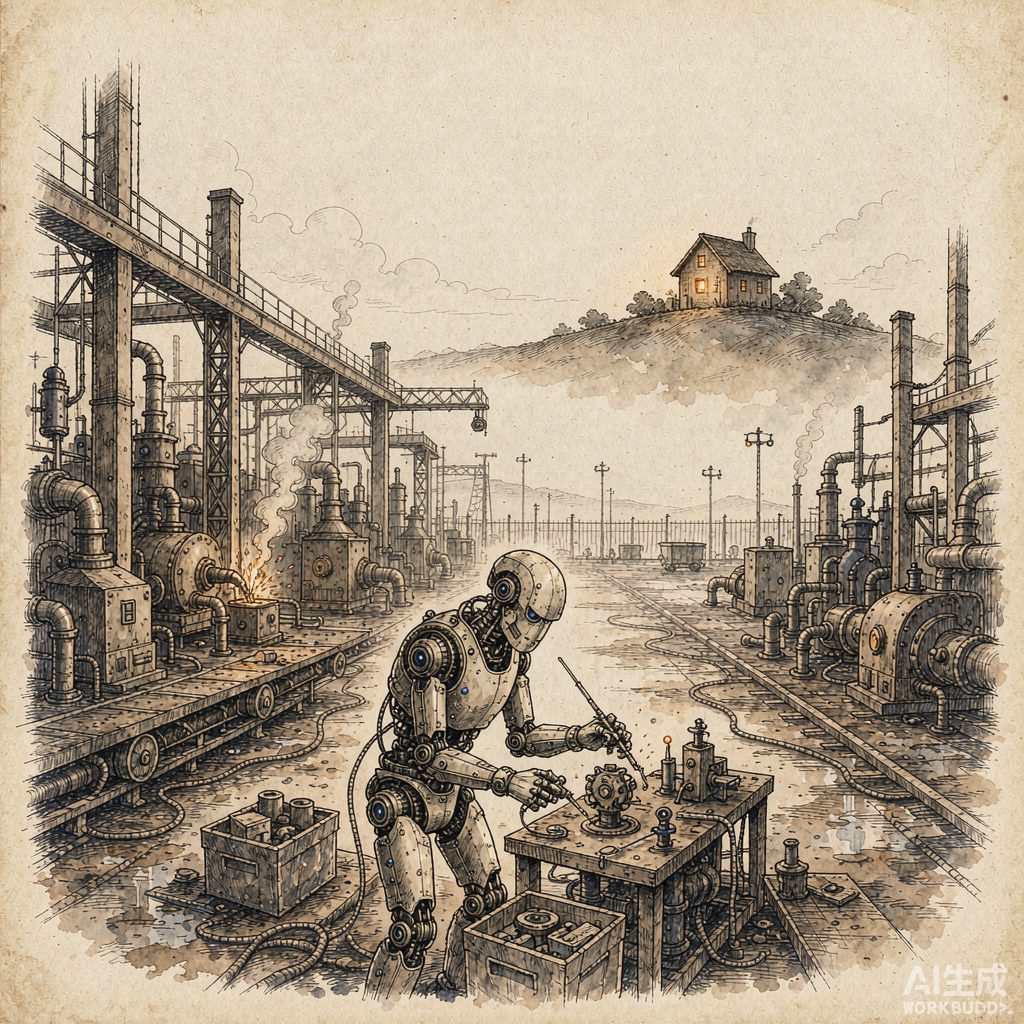
Factories first, homes later; complex tasks in simple settings first, higher-risk intimate interaction later.
In a factory at worst you ruin a part; in a home an accident could hurt someone. He reckons robots entering factories is happening now, but mass entry into homes is still three to five years away—perhaps beginning first through an on-demand subscription model of 'calling a robot to your door.'
We do the full stack not to replace suppliers, but to actually make the scenarios work and get the flywheel turning.
The body, the model, the data, and the scenario form a single whole—collect data in the real world, use the data to iterate the model, let the model push the body forward. Three years after its founding, AgiBot had produced 15,000 units and holds about 39% of the global market; he says revenue going from ¥100 million to ¥100 billion 'is only a by-product.'
The whole industry is still exploring together; no single company can produce the right answer alone. We need to join forces to break through the bottlenecks, and do the right thing at the right time.
In February 2026, at the Ministry of Industry and Information Technology's standardization annual conference, he 'reported his thinking' as a practitioner—there are already more than 140 domestic humanoid-robot makers and 330 products, yet he instead called for jointly building standards and sharing data-governance methods and evaluation systems.
Computer Use is the human-shaped interface of the digital world, and the humanoid robot is the universal interface of the physical world. It may not be the most efficient, but it is certainly the most compatible.
The underlying logic for his insistence on the humanoid route: the entire physical world is designed for the human body—from the height of door handles to the shape of tools. Since the environment is built around people, for AI to maximize generality its terminal form will most likely also have to look like a person.
The industry has moved from lab showboating and demo displays into the second half of engineering- and scenario-based competition. What we'll compare next is whose ability to actually get work done is stronger.
In 2024 everyone was still comparing who walked more naturally; now they can 'scamper up walls and across rooftops.' He judges that body flexibility has reached a practical stage—and we must compete not only domestically but also against leading overseas companies on who can truly land in the 'deployment state.'
The endgame of embodied intelligence is infrastructure, not a single-point product.
The key to scaling physical AI lies in standardizing the data loop, reliability engineering, and operability. 'We must run fast and also run steady.' Breakthroughs in general capability come from the whole industry's migration and the co-building of ecosystems.
Any robot running in a real environment is perceiving, reasoning, deciding, and controlling at every moment, behind which flows a continuous stream of tokens. The task space of embodied intelligence is the sum of the digital world plus the entire physical world.
Starting from Jensen Huang's line that 'tokens are the currency of the AI age,' he reasons: whoever first closes this loop has a chance to define the next-generation productivity platform. This is also the logical origin of AgiBot's shift from 'selling robots' to 'delivering results.'

Our logic must shift from selling robots in the first two years to delivering results. Capital markets are no longer willing to pay for demos.
At the 2026 Partners Conference, he listed three things that together open a breakthrough window: the open-source ecosystem of large models has matured, the body has crossed the 7×24-hour reliability threshold, and the data flywheel is beginning to accelerate—the positive-feedback loop is already spinning.
Many robots in the industry look cool in demos, but there is a very long distance between a demo and mass production.
AgiBot has measured this distance in numbers: from 1,000 to 5,000 units took 11 months, from 5,000 to 10,000 under 4 months, and from 10,000 to 15,000 under 3 months. The hard part of mass production is not building them, but making them reproducible, maintainable, and cost-controllable.
Close to 80% of the tasks that humans do well but traditional automation does poorly are strongly correlated with touch.
He reached this conclusion by visiting factories in person: an assembly-line worker joins two parts by feel, and knows the assembly is right when they hear a 'click.' How to turn that click into a sensor signal is exactly the crux of the dexterous-hand challenge.
Real scenarios are the most effective way to train a system and verify reliability. Robots must run in real scenarios, collecting data and iterating in a loop.
AgiBot's methodology is 'doing complex tasks in simple scenarios': high-degree-of-freedom operations inside structured factories. This is the opposite of autonomous driving's 'simple tasks in complex environments,' yet the endgame is the same—complex tasks in complex environments.
Let scaling be not just a production number, but something that truly converts into industrial value.
At the 10,000-unit roll-off ceremony he stressed this was only a phased milestone: what matters more next is raising reliability, cutting cost, and widening application scenarios. He defines 2026 as the 'first year of the deployment era'—moving from a research state and a creation state toward true deployment.
Everyone says 'the future is already here,' but we are not waiting for the future; we are creating it.
After receiving the China Youth May Fourth Medal, he said it felt more like a reminder: a reminder that the past has been seen, and a reminder to take on more in the future. Technical work is not just personal interest; it can also be linked to the nation's industrial development and to real social needs.
It's more out of passion—making the things I find interesting and worth doing, and sharing them.
From a vlog of controlling an air conditioner with a phone, to a grape-suturing robotic arm and a self-driving bicycle—it is this amateur Zhihuijun that Bilibili's nearly three million followers know. The person who drew and modeled in a rented room has never left.
- Bloomberg Businessweek, 'Person of the Year: I Want to Bring AI into the Physical World through Robots' (2026-08-04)
- Jiazi Guangnian, 'Ms. Jia in Conversation with Peng Zhihui' (2025)
- Autoweek exclusive interview (2026-04-17, AgiBot Partners Conference)
- The Paper, 'A Measure of Character: Given a ¥2 Million Salary, Would You Dare to Quit?' (2026)
- Full text of the HEIS Standardization Annual Conference speech (2026-02-28, The Paper)
- China Youth May Fourth Medal coverage, 'We Do Not Wait for the Future, We Create It' (2026-06-12, Sina Finance)
- Tencent News, 'Huawei's Genius Youth Wants to Send Robots onto the Production Line to “Screw Bolts”' (2026-04-17)
- Global People, 'Giving Up a ¥2 Million Salary, the 32-Year-Old “Genius Youth” Wants to Cash In the “Geek's Romance”' (2025-12-07)
- China Women's News, 'The “Genius Youths” Who Left the Big Tech Firms—What Became of Them?' (2023-09-26)
- The Paper, 'Taking the Baton from Ren Zhengfei, Robin Li Bets on This “Genius Youth”' (2023)
- Guangming Daily / Guangming.net, 'The Romance of the “Geek Boy”' (2025-12-13)
- Cailian Press, 'After One Announcement Ignited Embodied-Intelligence Concept Stocks, AgiBot Held a Robot “Goes to Work in the Factory” Livestream' (2025)
- Eastmoney, 'Only Three Months into the Year, AgiBot Has Built 5,000 Robots, First to Unlock the “10,000 Units” Achievement' (2026-03-30)
- China Industry News, 'AgiBot Proposes the XYZ Development Curve, Pushing Embodied Intelligence toward Productivity Scenarios' (2026-04-18)
- China Securities Journal, 'AgiBot President and CTO Peng Zhihui: Embodied Intelligence Will Be the Biggest Token Consumer' (2026-04-17)
- Sina Finance / Xinhua Finance, 'AgiBot's Peng Zhihui: The “One Body, Three Intelligences” Collaborative Path Is a “Hard but Compound-Interest-Bearing” Choice for AgiBot' (2026-04-18)
- People's Daily Online, Shanghai Channel, '“AI” Shanghai: Three Models Test the “Gold Content” of Shanghai's Intelligent Robots' (2026-04-17)
- China Youth magazine, 'The Grace of the 2026 China Youth May Fourth Medal Recipients: Peng Zhihui' (2026, Issue 6)
- AgiBot official website, APC 2026 Peng Zhihui speech transcript, 'From Perceiving the World to Empowering Industry: AgiBot Drives Embodied Intelligence to Its Productivity Inflection Point' (2026-04-17)
- Baidu Baike entries on 'Peng Zhihui' and 'AgiBot Innovation (Shanghai) Technology Co., Ltd.' (retrieved 2026)
- Kuaidong Baike entry on 'Peng Zhihui' (retrieved 2026)
Wang He
Assistant professor and doctoral supervisor at Peking University, PhD from Stanford University. He entered embodied intelligence through the synthetic data route—first creating endless scenarios in simulation, then transferring them to real robots. Galbot's valuation has reached the ¥20 billion level, and in 2026 it completed a fully autonomous interactive demonstration at the Spring Festival Gala.
01Family and early years: a Bouyei boy from Haidian, Beijing
Wang He, male, of the Bouyei ethnic group, was born in February 1992 in Haidian, Beijing, and grew up in the city as a local boy. He took his bachelor's degree in an electronics-related department at Tsinghua University (several outlets write the Department of Electronic Engineering, while Baidu Baike records the Department of Microelectronics and Nanoelectronics) and graduated in 2014. As a boy he was especially fascinated by physics and semiconductor components, and that curiosity about hardware and how the world works became the ground of his later entry into artificial intelligence and robotics research. The atmosphere of Zhongguancun in Haidian and the engineering training of Tsinghua meant that, before he had ever heard the phrase embodied intelligence, he was already used to taking the real world apart through an engineer's eyes.
In 2014 Wang He went to the United States to Stanford University, taking a master's in electrical engineering and then a doctorate under Professor Leonidas J. Guibas, a member of three American national academies. Guibas is an authority on computer vision and geometric deep learning, and the apprenticeship put Wang He at the front line of research on three-dimensional vision and shape understanding. During his doctorate he moved from semiconductor components to computer vision, and around 2016 fixed on a direction that then had no name—making artificial intelligence understand the world, interact with it and model and simulate it—the field later called embodied intelligence. His doctoral work focused on category-level six-dimensional pose estimation (NOCS), laying the groundwork for robots to understand the spatial position of objects.
The academic base he built during his doctorate was later poured entirely into his company. He has published more than fifty papers at top conferences and journals in computer vision, robotics and artificial intelligence, including the category-level six-dimensional pose estimation work NOCS, a series that won the Young Excellent Paper Award at the 2022 World AI Conference; he also has an ICCV 2023 best paper nomination, an ICRA 2023 best manipulation paper nomination and a Eurographics 2019 best paper nomination. This accumulation let him reach the heart of the problem earlier than most of his contemporaries on what was then a cold research line, embodied perception and interaction.
02The founding impulse: from a Peking University laboratory to Galbot
Wang He's company was not the product of a long-planned departure. After finishing his doctorate in 2021 he chose to return to China at once, joining Peking University's Center on Frontiers of Computing Studies in September as an assistant professor and doctoral supervisor, and founding and leading Peking University's Embodied Perception and InterAction Lab (EPIC Lab). He is one of the earliest scholars in China to push embodied intelligence systematically, and from 2022 he also served as director of the Embodied Intelligence Research Center at the Beijing Academy of Artificial Intelligence, while running the Peking University–Galbot joint laboratory for embodied intelligence. The dual identity of academic and industrial researcher let him see earlier than a pure scholar how far the technology was from a production line.
What really lit the spark was the sudden surge of embodied intelligence under the large-model wave in 2023. Several investors approached the young scholar directly, hoping he would lead a startup. Wang He later recalled that he had gone to the United States only after his bachelor's degree, and that when he finished his doctorate embodied intelligence research in America was hot but lacked a complete hardware ecosystem, with a severe shortage of real-world scenario data and no soil for industrial deployment; China, by contrast, has the world's most complete hardware supply chain and is the chosen land for embodied intelligence startups. In May 2023, in Haidian, Beijing, he joined forces with another co-founder, Yao Tengzhou—who had worked at ABB's Shanghai robot R&D centre and studied under Professor Wang Tianmiao of Beihang University—to found Beijing Galbot Robotics Co., Ltd., serving as founder and chief technology officer.
The slogan Wang He wrote for Galbot is “Galbot sets sail, generality without bounds”. The eight characters are both a wordplay on the company's name and a condensation of his ambition: not to be the best at any one skill but to give the robot general working ability across scenarios and objects. He often calls himself a BAAI scholar, stressing that academic and industrial identities are never mutually exclusive; Peking University taking an equity stake in Galbot gave that relationship an institutional vehicle. For an assistant professor barely past thirty, carrying the twin burdens of a laboratory and a company is itself a high-difficulty experiment in allocating time and energy.
03The hardest gate: the contrarian bet on synthetic data
The first gate was not money but a dispute over route. The industry mainstream, Tesla and Google among them, chose to collect data by human teleoperation to train robots—an intuitive but expensive path, limited by the nature of human demonstration: the fine coordination between fingers simply cannot be collected in full by teleoperation. Wang He bet on an unfashionable route instead: synthetic simulation data as the main body and real-robot data as a supplement, creating endless scenarios in simulation first and then transferring them to real robots (sim-to-real). He chose to sidestep the bottleneck of real-robot collection and make the industry's hard problem of data scarcity his own main battlefield.
It was a gamble against common sense. Sceptics held that however fine the simulation, it could not bridge the noise and friction of the real world, and that a model trained on synthetic data would collapse the moment it reached the site. Greater pressure came from the commercial tempo: a seed round closed just one month after founding, and the capital market expected an immediate product, while Wang He insisted on spending years first building solid data infrastructure. In that period he had to persuade investors, the team and himself at once—while everyone else was showing dancing robots, he was determined to make his robots work. That contrarian certainty is the source of Galbot's later technical label, and also the loneliest gate of the early years.
What was hardest was not outside doubt but managing patience inside. Seed money came in quickly, and investors naturally asked when a product would appear; Wang He insisted on building the synthetic data pipeline, physical rendering and automatic motion synthesis infrastructure first, investment whose demo videos would not show for some time. He has admitted that while the industry generally relied on human teleoperation for data collection, he publicly preached the synthetic data strategy again and again, in essence betting against consensus. What let him hold this gate was his almost religious certainty that data determines the lower bound of capability, and the strategic steadiness of anchoring the company from the start in replicable industrial scenarios rather than a performance show.
04The turnaround: grasping transparent objects and the G1 launch
The key to the turnaround was turning synthetic data from a slogan into a verifiable miracle. Relying on physical rendering, Wang He's team built on its own what it calls the world's largest ten-billion-scale simulated synthetic data infrastructure, AstraSynth, and broke through on grasping challenging materials that are transparent, highly reflective or light-absorbing—for randomly stacked transparent objects it had never seen, the robot's grasp success rate stabilised above 95 per cent for the first time, and it could even pick up randomly scattered fragments of transparent glass. That battle directly cracked a problem that had troubled robotics for decades, and gave the synthetic data route its first hard metric.
The real turning point came on 14 June 2024. Galbot released its first-generation product, the Galbot G1—a humanoid robot with a wheeled chassis, two arms and a folding body—and announced on the same day that it had closed a ¥700 million angel round, with more than a dozen institutions including Meituan, BAIC, SenseTime, Qiming, BlueRun, Matrix Partners China, Source Code Capital and IDG all coming in together. That bout turned Galbot from a scholar's startup into a target on which capital and industry raced to bet, and proved that the synthetic data route was not empty talk. Over the following five months a strategic round added another ¥500 million; in June 2025 a ¥1.1 billion round led by CATL broke the record for the largest single financing in Chinese embodied intelligence.
What supported the G1 was the family of models Galbot released one after another. GraspVLA, built on a vision-language large model, achieved zero-shot grasping planning, letting the robot understand and manipulate objects it had never seen; at the 2025 BAAI Conference Wang He issued the instruction “Galbot, I'm hot and hungry, get me something to eat”, and the robot, with no teleoperation, planned its own path through a 1:1 replica supermarket and identified and grasped biscuits and drinks from the shelf and delivered them. The scene made the loop from synthetic data to real-robot generalisation concrete, and let outsiders see directly for the first time that Galbot's robots are not actors controlled by a pre-recorded script but workers who can understand natural language and work autonomously in an unfamiliar environment.
05Company history (1): founding and the early rhythm of financing
Galbot was founded in May 2023, registered in Haidian District, Beijing, and is an innovative company focused on general-purpose robots with embodied multimodal large models. The logic of its founding was clear: rather than fighting the body-first camp over bipedal walking, it took the route of brain first, body pragmatic—with a wheeled chassis and folding legs it gains mobility stability and a cost advantage in flat-floor environments such as supermarkets and pharmacies, and it leans R&D towards the most central problems of generalised grasping and logical reasoning. This positioning set Galbot apart from the many manufacturers that insist on bipedal walking.
The financing rhythm moved almost in step with product development. One month after founding, the company took seed investment from Matrix Partners China and BlueRun Ventures; on the day the product launched in June 2024, the ¥700 million angel round closed, bringing in strategic backers such as Meituan and BAIC along with leading institutions including Qiming, BlueRun, Matrix Partners China and IDG; in November that year a ¥500 million Series A strategic round came in, adding SAIC, the Hong Kong Investment Corporation (HKIC), Shenzhen Capital Group and the Shanghai Artificial Intelligence Fund, with existing shareholders IDG and Matrix Partners China increasing their stakes substantially. Less than two years after founding, Galbot had raised more than ¥2.4 billion in total, making it one of the fastest-fundraising companies on the embodied intelligence track.
06Company history (2): 2025, from financing star to industrial pacesetter
2025 was the year Galbot moved from financing star to industrial pacesetter. In June the company released TrackVLA, a product-grade end-to-end navigation large model, with pure-vision environment perception, language-instruction driving, autonomous reasoning and zero-shot generalisation; in the same month GroceryVLA, related to retail scenarios, also appeared, achieving zero-shot generalised grasping of goods across the entire retail category. On 23 June the company announced a new round of more than ¥1.1 billion, led by CATL and Puquan Capital with participation from CDB Sci-Tech Innovation, the Beijing Robot Industry Fund and GGV Capital, and Lighthouse Capital as exclusive financial adviser.
Several outlets called this round the largest single financing in Chinese embodied intelligence. At the same time Galbot's deployment scenarios began to move from the laboratory into the street: in March 2025 the company released a smart retail solution for humanoid robots, deployed and running routinely in nearly ten stores in Beijing; on 17 June it formed a joint venture with Boyuan Capital, part of Bosch, to pursue commercialisation and global deployment of embodied intelligence robots in industrial scenarios. By the end of the year the company had rolled out robot deployments in nearly a hundred pharmacies across Beijing, Shanghai, Guangzhou and Shenzhen, dispensing more than a million boxes of medicine in total, with smart retail and unmanned pharmacies the first two scenarios to get working.
07Company history (3): the Series C and a leap in valuation
The Series C of December 2025 was the key node in Galbot's valuation leap. The company announced a new round of more than $300 million (about ¥2.1 billion), led by the China Mobile Chain Leader Fund, with joint investment from CICC Capital, the Chinese Academy of Sciences Fund, Suzhou Venture Capital, the CCTV Media Convergence Fund and Tianqi Co., plus follow-on participation from international institutions in Singapore and the Middle East and from existing shareholders. Total fundraising reached about $800 million, and according to estimates by several outlets and industry figures the valuation climbed to $3 billion, equivalent to more than ¥20 billion, making it the most highly valued unlisted company in humanoid robotics at the time.
In 2026 Galbot's map kept expanding. In March the team achieved fully autonomous robot tennis, maintaining balance throughout, controlling wrist movements precisely and even drawing a human opponent around with tactics; in August, at the second World Humanoid Robot Games (at Beijing's Ice Ribbon arena), Galbot took every gold medal in the three hardest scenario events—home, catering and supermarket—competing in fully autonomous mode, and at the opening ceremony its fully autonomous tennis robot completed the world's first human–machine mixed doubles match with the tennis star Zheng Jie and the actor Li Yunrui, rallying more than a hundred strokes without a break, which the industry called the AstraTennis moment.
08Company history (4) 2026 — today's map: a full-stack layout
By 2026 Galbot had grown from a single-product company into a flagship of embodied intelligence covering the full stack of data, model, body and scenario. On the technical base it built AstraData, described as the world's most comprehensive embodied intelligence data infrastructure—a five-tier pyramid covering internet data, human manipulation data, simulated synthetic data, real-robot teleoperation data and real-robot feedback data, with more than 80,000 hours of autonomous real-robot feedback data, a ten-billion scale of fully physical synthetic data and more than 100,000 hours of human motion data. This data system is the engineering expression of Wang He's belief that data determines the lower bound of capability.
The product matrix expanded in step: alongside the two deployed models, the wheeled G1 (light-load dual arms with dexterous hands) and S1 (heavy-load dual arms able to hold objects weighing fifty kilograms, already working fully autonomously in CATL's battery plant and at BAIC Benz), came the bipedal humanoid Galbot ET1, released at the World Robot Conference in August 2026, carrying AstraBrain-Agent and able to learn new movements through real-time interaction with people without motion capture or video. At the model layer, AstraBrain, the world's first end-to-end embodied large model integrating brain, pons and cerebellum in one model, and WAM (world–action model), praised by Nvidia as the endgame paradigm for robots, have become the company's technical moat. Wang He expects to expand training data from one million hours to ten million hours by 2028 and sprint towards embodied intelligence's ChatGPT moment.
09Leadership style and temperament: a stubborn judge of technology
The outside label for Wang He is scholar-founder, but he is more like a stubborn judge of technology. When the industry generally relied on teleoperation for data, he publicly preached the synthetic data strategy again and again, even though it meant no flashy video in the short term. A person close to the team describes his certainty about the technical route as almost ninety-nine to one—he has stressed repeatedly that 99 per cent of the data embodied intelligence relies on can be produced with high-quality synthetic data, and that only in extreme cases synthetic data cannot handle is there a need to collect a targeted 1 per cent of real data. That steadiness comes from a long-standing faith in the physics of data, not from a passing trend.
The certainty is not arbitrary. He likes to lay out his judgments at academic conferences and public forums, debating the boundaries of VLA and WAM with peers, and he admits plainly that the model is not fully mature, but good enough, and that the truly decisive variable is data. During the Gala backstage shoot with no rehearsal and no retakes he told Jiazi Guangnian that the whole process was done in one continuous take, because the team believed a general model and training paradigm were enough to handle an uncontrollable scenario. Subordinates' assessments of him mostly centre on protecting technology and delegating to engineers—he sets the direction and guards the bottom line, leaving the concrete implementation to the team. Restrained in public, in private he is the technologist who gets excited about a dexterous hand doing more than the scenario requires, and who turns over and over how dynamic contests such as tennis can validate the cerebellum.
Compared with entrepreneurs of his generation, Wang He's sharpest label is brain camp rather than body camp. While many manufacturers pour R&D resources into bipedal balance and joint hardware, he argues for making the brain—generalised grasping and reasoning—strong first, with a pragmatic wheeled folding chassis for the body. He also does not hide his scholarly stubbornness: in public talks he dares to state directly that the first WAM paper was posted to arXiv by us, an assertiveness about owning the definition that contrasts with the traditional scholar's low-key reticence. Subordinates describe him as protecting technology and delegating to engineers—setting direction, guarding the bottom line and leaving implementation to the team, which lets Galbot keep its academic sharpness without falling into the slow rhythm of a professor leading students.
10The method behind the success: seven corroborated threads
Summing up Wang He and Galbot's success yields at least seven threads that can be corroborated. First, steadiness about route: while others chased teleoperation and dancing robots, he bet on synthetic data and sim-to-real and made the data bottleneck his main battlefield. Second, brain first: trading a pragmatic wheeled body for compute and R&D resources, concentrating on generalised grasping and reasoning. Third, data infrastructure first: the ten-billion-scale AstraSynth and the five-tier data pyramid are the ground of his claim to zero-shot generalisation. Fourth, scenario penetration: locking onto replicable drudgery such as unmanned pharmacies and industrial handling rather than staying in performance.
Fifth, a closed loop of academia, industry and research: Peking University took an equity stake, the university and company built a joint laboratory, and academic breakthroughs reach the production line directly. Sixth, use of capital: precisely bringing in industrial players and state funds such as CATL and China Mobile, turning financing into scenario enablement. Seventh, global vision: posting the WAM paper on arXiv early and connecting actively to the international technical community, winning attention from Nvidia and Musk among others. Finally, honesty requires saying that his success comes both from technical judgment and, to a high degree, from the dividends of the age—embodied intelligence being folded into the national science and technology strategy, China's complete hardware supply chain, and capital's hunger for the next ChatGPT had to stack together to produce this three-year-old unicorn. The route can be learned; the luck and the timing cannot be copied. What can be copied is his execution discipline in turning long-termism into data and scenarios.
To be fair, among these seven, steadiness about route and data infrastructure first are the hardest to copy, because they require a founder to be willing to burn money on infrastructure that cannot be monetised in the short term and to endure the loneliness of going against consensus; the others—scenario penetration, the academic-industrial loop, the use of capital—are methodologies later arrivals can study. Wang He's success is a triple stack of technical judgment, the dividends of the age and personal traits: embodied intelligence being folded into the national strategy, China's complete hardware supply chain and capital's hunger for the next ChatGPT together held up this unicorn, founded only three years ago. What can be copied is the discipline; what is hard to copy is the timing and the luck.
11The person, values and life: a pragmatic patriot of technology
Wang He is a young post-90s professor-entrepreneur who rarely discusses his private life in public and more often appears in the dual role of Peking University researcher and chief technology officer. The sharpest item in his values is serving the country through technology—a profile on Beijing's party-member education platform says that after taking his doctorate at Stanford he chose to return and serve his country at the first opportunity. He stresses repeatedly that robotics has passed the stage of showing off and that the real goal is to work in factories and serve every household, ultimately entering the home. This narrative, binding technical achievement to national need, runs through his public remarks.
His view of money is thoroughly pragmatic. Faced with Galbot's price of several hundred thousand yuan, he has given a clear product-market fit logic: the robot's cost is currently far below what a company would pay to employ a person for three years, and as long as it can work for a month without a single failure, it is worth the price. In his interests he is plainly a standard technologist—excited by a dexterous hand spinning a pen or rolling walnuts, skills that exceed what the scenario requires, and treating dynamic contests such as tennis as the touchstone for the cerebellum's general motor control. He also invests in public education for embodied intelligence, building laboratories with leading domestic secondary schools, in the belief that this is an industry that will grow fast for the next twenty to thirty years, with global sales potentially reaching a hundred million units.
External recognition has followed. Wang He was selected for the national overseas high-level talent programme, received the 2024 Peking University–Optics Valley technology transfer award and an Ant InTech award, and was named by MIT Technology Review among its 35 Innovators Under 35 (TR35 China, 2025); in 2025 he also won a World Internet Conference Leading Science and Technology Award. In 2026 he received the 36th Beijing Youth May Fourth Medal, was named to the 2026 Beijing Role Model monthly list and the 2025 Hurun U35 China Entrepreneurship Pioneers, and was elected a member of the 11th National Committee of the China Association for Science and Technology. This string of honours marks the double recognition by academia and officialdom of a young scientist-entrepreneur.
12National and epochal significance: at the front of defining a technological paradigm
Placed on a larger coordinate, Wang He sits at the intersection of China's new quality productive forces narrative and the global race in embodied intelligence. Domestically, embodied intelligence has been upgraded to a national strategy, and the entry of national team players such as the National Artificial Intelligence Fund, China Development Bank and the Beijing Robot Industry Fund both endorses Galbot's technical strength and marks its strategic position in the capital's core industries. That he himself was elected to the 11th National Committee of the China Association for Science and Technology and directs the Beijing Key Laboratory of Embodied Intelligence Large Models is a portrait of that position.
Globally, Galbot races on the same track as America's Physical Intelligence and Skild AI and, at home, Unitree and AgiBot. The WAM route Wang He proposed has been praised by Nvidia as the endgame paradigm for robots, while the Gala's Galbot and the AstraTennis moment let hundreds of millions of viewers touch the technical lead and the human warmth of Chinese embodied intelligence. He predicts that by 2028 embodied intelligence will have its own ChatGPT moment, and that the humanoid robot track has a chance to produce a Chinese company worth a trillion dollars. Whether or not the prediction is borne out on schedule, Wang He and Galbot have already proved that on this long road from the digital world to the physical world, young Chinese scientists can stand at the front of those defining a technological paradigm.
Institutionally, Wang He has also gradually become a participant in the industry's rules: he serves as deputy head of the embodied intelligence group of the Ministry of Industry and Information Technology's technical committee for artificial intelligence standardisation and as a member of the third science and technology innovation advisory committee of the Shanghai Stock Exchange, and directs the Beijing Key Laboratory of Embodied Intelligence Large Models. These roles mean his technical judgments influence more than one company, spilling into the whole track through standards and policy influence. From a laboratory in Haidian to a national standards table, Wang He's trajectory condenses the typical path of a generation of young Chinese AI scientists—established by original academic work, proven by industrial deployment, and then positioned by the coordinates of national strategy.
| Valuation / standing | Within three years of founding it had raised more than ¥6 billion in total (including about $800 million after the Series C at the end of 2025); several media estimates at the end of 2025 put the valuation at $3 billion, about ¥20 billion, making it one of the most highly valued unlisted humanoid robot companies in China at the time; in 2025 the company recorded revenue of more than ¥300 million. |
|---|---|
| Basis and year | The valuation is a media market estimate of December 2025 (not a formal company disclosure); the financing and revenue figures are taken from Xinhua's report of June 2025 and material from Capital Civilization Network in 2026, and the Series C and valuation from several financial media outlets in December 2025. |
Unlike traditional dancing robots, it does not rely on a pre-recorded dance routine and does not need a remote control. The Galbot robot carries our self-developed embodied large model, AstraBrain; it lets our robot understand the environment, understand human instructions and do the work autonomously.
The passage comes from CCTV's coverage of the 2026 Spring Festival Gala, in which Wang He explains Galbot's core difference: other companies' robots rely on pre-recorded movements or a remote control, while Galbot's robot decides autonomously through the end-to-end AstraBrain model it developed itself. He deliberately separates being able to dance from being able to work, stressing that what the Gala showed was not a performance but a productive force that can see, hear and execute. This is consistent with his long-standing judgment that robotics has passed the stage of showing off, and it is a condensed expression of Galbot's choice of a brain-first route.
In the long run, a five-fingered dexterous hand has very good adaptability and generality; the things we are doing today may all become part of a real commercial solution in the future.
Also from CCTV's Gala coverage, Wang He discusses the dexterous hand with more than thirty motors and twenty-two degrees of freedom fitted for the Gala. He admits that difficult skills such as rolling walnuts in the palm or threading sausages far exceed what current application scenarios require, and that in most scenarios two jaws and a suction cup are enough. But he insists that a five-fingered dexterous hand offers better adaptability and generality, and that today's demonstration is a rehearsal for future commerce. This thinking—laying out ahead of the market—explains why Galbot is willing to spend heavily on dexterous-hand neural dynamics (DexNDM), which has no clear return as yet.
The Gala backstage is a crowded, badly lit and highly uncontrollable unstructured environment. Because we were shooting in a busy backstage area, our shooting time was extremely limited; we were the only act in the Gala with no rehearsal and no retakes, and the whole shoot was done in one continuous take.
Wang He's account to Jiazi Guangnian as he reconstructed the shoot reveals where his technical confidence comes from: only because the model has generality and robustness did it dare to go in one continuous take under the extreme conditions of no rehearsal and no retakes. He stresses that the working skills shown on the Gala stage—picking up broken glass, rolling walnuts in the palm, folding clothes—were all completed fully autonomously, with customised training only for the Gala's requirements. This confirms his ranking of values, in which uncontrollable scenarios are where real skill shows, and it is negative proof that a model trained on synthetic data can resist interference on site.
You could say data determines the lower bound of a robot's capability. At this stage synthetic data can solve the zero-to-one problem, data collected by real teleoperation can solve the one-to-a-hundred problem, and the hundred-to-ten-thousand problem is left to video data processing.
This is the most condensed, formulaic expression of Wang He's synthetic-data-ism, from the Sohu interview “Data: 99% + 1%”. He breaks a robot's growing capability into three stages: synthetic data as the base (0 to 1), real teleoperated data for fine-tuning (1 to 100), and massive video data for scaling (100 to 10,000). The point is that the lower bound is set by data, not by model architecture. This also explains why he dares to say the model is good enough: the real shortfall was never the algorithm but the scale and diversity of data.
Of the data embodied intelligence relies on, 99% can be produced with high-quality synthetic data; only where synthetic data cannot cope do you need to collect and use the targeted 1% of real data.
This 99% versus 1% ratio is Wang He's most quoted line in public, most often relayed from occasions such as the World Robot Conference. It directly challenges the mainstream route of Tesla and Google, which depends on human teleoperation, and argues for high-precision physical simulation and physical rendering to generate data that is the most information-dense and, in theory, infinitely expandable. The ratio itself may not be an exact experimental figure—it is more a creed of a route—but in Galbot's data-infrastructure narrative it has become a signature slogan.
Deployment in scenarios that can be replicated at scale will be the make-or-break line for embodied intelligence. Within about three years, those who can find a scenario they can break through will stay at the table; those who cannot will drop out.
Also from the Sohu interview. Wang He states the industry's brutality plainly: embodied intelligence is not a contest of whose skills are flashiest but of who can deploy at scale. He gives a three-year window and says bluntly that only if a thousand to ten thousand units can be delivered in batches in the coming year will the industry's value be verified and the froth stripped away. This pragmatism—delivery is justice—is the clearest shift in thinking since he moved from scholar to entrepreneur, and it determined Galbot's choice to lock onto unmanned pharmacies and industrial handling.
The quality of data matters more than the quantity. If the data is all the same and too homogeneous, its value is very limited. High-quality data means it is diverse, able to represent the manipulation of soft objects, and generalisable across scenarios.
Asked what counts as good data, Wang He gives the judgment that quality beats quantity. He gives an example: if the training data covers a diverse test distribution, the robot can grasp things it has never seen in an unfamiliar environment. The line is in fact a technical footnote to the synthetic data route—the value of a simulator lies not in piling up numbers but in whether it can generate highly diverse, generalisable interaction data at low cost. It also explains why Galbot insists on building its own physical rendering and automatic motion synthesis pipeline.
I would not say it is fully mature, but it is good enough. There has been progress on the model side, but what plays the decisive role is data. When there is not enough data, even a good model becomes a poor student.
Wang He is both modest and certain: the architecture is good enough and the real bottleneck is data. He uses the analogy of teaching a three-year-old to play Go—it is unrealistic to start with high-level technique; first the child has to know what black and white stones are. The passage clarifies Galbot's R&D priorities: rather than chasing innovations in model structure, first make the data infrastructure and the coverage of the distribution thick, and the model will learn well of its own accord. It is also the source of the confidence with which he resists capital's pressure for products and insists on building the data foundation first.
I think when we talk about embodied intelligence today there is one immediate goal, which is that we must push embodied intelligence towards industrialisation. Only if a humanoid robot can serve for 24 hours at an ordinary shelf will that mark the real beginning of embodied intelligence moving into industry, genuinely serving the people and creating productivity.
At the 2025 BAAI Conference Wang He set industrialisation as the single immediate goal of embodied intelligence and gave a verifiable milestone: 24-hour service at an ordinary shelf. He says bluntly that the industry has seen too many flashy skills and must ask whether those skills hold up in a new environment, with new objects and high success-rate requirements. The line also sets the tone for Galbot's choice of unmanned pharmacies and supermarket restocking, compressing an abstract vision into one assessable hard metric. Compared with peers keen on marathons and combat competitions, he cares more about whether a robot can work steadily on a real shelf for a whole day, which is why Galbot put its first deployment scenarios on pharmacies and supermarket restocking.
VLA is still only a starting point. To reach human-level embodied intelligence, new modalities will have to be fused in continuously. The direction VLA is best suited to at present is still movement, grasping and placing.
Wang He affirms the value of VLA (vision–language–action) in outputting actions end-to-end, which avoids the intermediate errors of modular schemes, but warns that it is only a starting point. He points out that humans also have a great deal of sensory input such as smell and taste, and that the most practical landing points for VLA at this stage are movement, grasping and placing—three things that can be executed with vision plus force control at the end effector, and which are in enormous demand in industrial, commercial and service scenarios. It is pragmatic almost to the point of conservatism, yet precisely aimed at the scenarios Galbot got working first.
At present real-world data accounts for only 1% of our training data; the other 99% is synthetic.
The counterpart to the fifth quote, this line quantifies 99% synthetic as the actual state of the training set, and appears on occasions such as the World Robot Conference. Wang He adds that the team feeds its self-developed robot model and a large number of object and material assets into the synthesis pipeline, then runs simulation validation and physical rendering through Nvidia's engine to generate the world's first ten-billion-scale dataset of grasping and soft-object manipulation. Real data is used for the last mile of supplementation and fine-tuning, not as the main body. This ratio of synthetic first, real-robot second is the engineering basis for Galbot's claim of zero-shot generalisation, and it also leaves it far below teleoperation-dependent competitors in data-collection cost.
We expect to reach an annual output of ten thousand humanoid robots within the next two to three years, providing every industry with a highly intelligent humanoid robot productive force.
At the 2025 World Internet Conference Wuzhen Summit, Wang He gave the explicit timetable of ten thousand units a year in two to three years, and used the night pharmacy as an example: in a space of forty square metres a robot can autonomously complete the whole process of navigating, identifying, grasping and packing more than five thousand kinds of medicine and over ten thousand boxes of stock. The line turns productive force from a concept into a plannable capacity target, and echoes his judgment that within three years we will see ten thousand robots working fully autonomously. Writing ten thousand units a year into a public commitment means Galbot has moved from technical validation to scaled delivery, a real test for both its supply chain and its after-sales system.
Beyond serving every industry, our ultimate vision is to bring humanoid robots into the home, serving every household.
Wang He has expressed this vision publicly several times, including in reports by China Youth Net. It is consistent with his brain-first, body-pragmatic route: first use a wheeled body to polish the ability to work in pharmacies, factories and supermarkets, then expand into the home. He also predicts that as foundation-model data keeps expanding and collection costs fall quickly, humanoid robots may genuinely enter the home around 2028, taking on chores such as fetching, tidying and caregiving. From serving every industry to serving every household, the line marks the ultimate destination of Galbot's long-term value and the most imaginative part of its valuation logic.
Our cost is currently far below what a company would pay to employ a person for three years; if the robot can work for a month without a single failure, that is the price it should have.
Faced with Galbot's price of several hundred thousand yuan, Wang He does not talk about parameters but about replacing labour cost: as long as the robot can run for a month without a single failure, its price is reasonable, because it is far below what a company would spend hiring one person for three years. The line anchors the commercial logic of embodied intelligence in productivity replacement rather than a technology toy, and it explains why Galbot locked onto high-repetition, quantifiable drudgery such as unmanned pharmacies and industrial handling rather than flashy demonstrations. This pricing thinking, benchmarked against labour cost, lets both investors and customers work out the payback period with a simple sum, and it is the pragmatic fulcrum of Galbot's push for industrial deployment.
I was born and grew up in Haidian, Beijing... China has the world's most complete hardware supply chain, making it the chosen land for embodied intelligence startups. In 2021 I returned to Peking University and set up the country's earliest laboratory named after embodiment.
In an interview with Caijing Tech, Wang He explains why he gave up opportunities in the United States to come home and start a company: embodied intelligence research was hot in America, but it lacked a complete hardware ecosystem, the supply of real-world data was insufficient, and there was no soil for deployment, whereas China's supply chain is complete and its soil fertile for startups. He returned to Peking University to set up a laboratory in 2021 and founded Galbot in May 2023, growing into an industry leader in a short time—proof that the choice to come home and start a company was right. The passage binds a personal decision firmly to the geography of an industry.
Embodied intelligence is welcoming its own AlphaGo and ChatGPT moments.
In a keynote at the 2026 Beijing BAAI Conference, Wang He used the evolution of digital AI as a mirror: first surpass humans at one complex task (the AlphaGo moment), then move towards generality through scale (the ChatGPT moment). He argues that Galbot already has two breakthroughs on the specialised side—playing tennis fully autonomously and spinning a pen with a dexterous hand (the world's only real-robot implementation of DexNDM)—and on the general side has the end-to-end AstraBrain large model. The line is his overall judgment of the stage the industry has reached.
The first paper titled WAM was posted to arXiv by our team at Galbot. If you search arXiv today for world action model and sort by date, the first result is ours, a 2025 ICCV paper.
Wang He asserts the claim to originality without hesitation: WAM (world–action model) was first proposed by the Galbot team at ICCV 2025, fusing Google's VLA with OpenAI's world-model route, and was praised by Nvidia's Jim Fan as the endgame paradigm for robots. The passage displays academic confidence and reveals his competitive philosophy—in defining a technical paradigm he wants to seize first place rather than follow. For a founder who is both professor and CEO, that assertiveness is rather unusual.
By 2028, with ten times the training data, embodied intelligence's ChatGPT moment will truly arrive. By then many robots now seen as toys will genuinely become productivity tools, so I personally think the valuations of leading companies are reasonable.
Faced with doubts about whether the industry is a bubble, Wang He takes the market-capitalisation swings around Unitree's listing as an example and says capital flowing in and out is normal, that in the long run the value of China's leading companies is far more than two or three hundred billion, or four hundred billion, in market capitalisation, and that the track has a chance to produce a Chinese company worth a trillion dollars. He offers the anchor of a 2028 ChatGPT moment and argues that today's high valuations for leading companies are reasonable, calling on the market to keep faith in the industry. The statement is both a public response to secondary-market doubts and a reflection of his certainty about the long-termism of embodied intelligence: short-term swings do not change the track's upward trend.
- Xinhua, “Galbot closes a new round of ¥1.1 billion in financing,” 2025
- CCTV News, “The robot that ‘acted alongside’ Shen Teng and Ma Li also hides this kind of technical breakthrough,” 2026
- Guangming Online, “Voices from Wuzhen: Peking University's Wang He on making good use of synthetic data to drive humanoid robot deployment,” 2025
- National Business Daily, “Galbot's Wang He: do VLA well and we will witness the first true peak of embodied intelligence,” 2025
- Leiphone, “Galbot's Wang He: embodied intelligence is welcoming its own ‘AlphaGo’ and ‘ChatGPT’ moments,” 2026
- Caijing Tech, “When will humanoid robots enter ordinary homes? An interview with Galbot founder and CTO Wang He,” 2026
- Sohu Tech, “Data: 99% + 1%, achieving ‘from 0 to 10,000’ — Galbot's Wang He,” 2025
- Hithink RoyalFlush, “Galbot raises ¥7 billion in three years at a ¥20 billion valuation; the Big Fund and CATL bet on an IPO hot on Unitree's heels,” 2026
- Tencent News / Guiyang Net, “Galbot founder Wang He gives a keynote at the 2026 China International Big Data Industry Expo,” 2026
- Capital Civilization Network, “Wang He (feature on his record),” 2026
Gao Jiyang
Recommended to Tsinghua without sitting the entrance exam and a PhD from the University of Southern California, he worked at Waymo and Momenta. He founded Galaxea in 2023 and put forward “one brain, many bodies”—a single embodied-intelligence brain that fits different robot bodies. The fundraising has been extremely fast: two rounds totalling ¥3 billion inside 45 days, at a valuation of ¥20 billion.
01Family and early years: a post-90s who won his way into Tsinghua through physics competitions
Gao Jiyang was born in 1992 in Shijiazhuang, Hebei. In high school his outstanding results in physics competitions won him a place at Tsinghua University's Department of Electronic Engineering, beginning a course of study that would stay inseparable from artificial intelligence. At Tsinghua he worked in electronic engineering and then in micro-nano electronics, buried in coursework on circuits, signals and algorithms, and gradually realised how high the bar of traditional hardware design is for a new graduate. What truly lit his enthusiasm for artificial intelligence, he later recalled, was an internship in the second half of his senior year at SenseTime, one of the “four little dragons” of Chinese AI—his first contact with deep learning convinced him that machine learning might make programming as simple as “software 2.0,” and thereby solve the complex problems that rule-based programming could not handle.
In 2015 Gao finished his undergraduate degree at Tsinghua and left for the United States to do a doctorate. At the IRIS Computer Vision Laboratory of the University of Southern California (USC) he studied under Professor Ram Nevatia, an expert in computer vision, focusing on computer vision and autonomous-driving perception. He set himself two goals: to stay in computer vision research, and to finish his degree within four years so as to get to a company sooner. In the event he took only three and a half years to earn the PhD, becoming the fastest graduate in the laboratory's history, and a series of papers he published in that period, including VectorNet and TNT, were later widely adopted by the industry. The experience laid down the methodological undertone he has kept ever since: trust data, trust compute, and do not trust rules designed around human prejudice.
02The founding impulse: from Waymo perception to Momenta mass production, capability banked at a higher dimension
After finishing his doctorate in 2018, Gao did not start a company straight away. Judging that his academic accumulation was not yet enough to support a hard-tech company, he decided to spend time first inside autonomous-driving firms—a sector driven by artificial intelligence, closest in form to robotics, and the bridge to embodied intelligence. From January 2019 to January 2021 he worked at Waymo, Google's self-driving car company, contributing to several important modules in perception, prediction and online mapping, and co-proposing the behaviour-prediction model VectorNet, which expresses maps and moving objects concisely in vector form; the paper was accepted by CVPR and other top conferences and became a classic in autonomous-driving planning and prediction.
In January 2021 Gao returned to China and joined Momenta, a domestic autonomous-driving unicorn, starting in visual perception and gradually extending into localisation, planning and control, parking and NOA products; he ended up as an executive director leading a team of more than a hundred, in charge of algorithm development and mass-production delivery for models including IM Motors, BYD and Geely Lotus. More than four years on the front line gave him solid engineering capability and his own distinctive view of the “scaling law of embodied intelligence.” In 2023 he gave up stock options worth about $10 million and left, teaming up with Zhao Xing, Xu Huazhe and Li Tianwei to enter embodied intelligence as a founder.
On what triggered the company, Gao recalled at the developers' conference that in August 2023 he, Zhao Xing and Li Tianwei visited an investment institution in Shanghai; the firm did not invest in the end, but the photograph of the three of them became “the origin and the beginning of everything.” At the time the term “embodied intelligence” was not yet common and the industry was keener on humanoid robots; the team's mood was “exhilaration and bewilderment braided together.” Yet two things were clear from the outset: first, embodied intelligence would take the form of “one brain, many bodies,” with the bipedal humanoid only one of them; second, the long-term moat lay in a closed loop of physical-world data, and “a complete machine plus intelligence” was the key path to building that loop. Those two convictions became Galaxea's irreplaceable main line of development.
03The hardest gate: giving up $10 million in options and the loneliness of being misunderstood
For Gao the hardest gate of his career was not some hair-raising brush with death but the decision to leave Momenta in 2023. He was then an executive director holding options worth about $10 million, on the rising track of autonomous-driving mass production. To give up that secure post and bet on a sector whose very name was not yet common meant saying goodbye to certain fame and money and shouldering enormous uncertainty across technology, product and business at once. Talking later with Xu Xin of Capital Today, he admitted that the most important lesson of his doctorate was “believe in deep learning, believe in data, believe in compute, and do not believe in rules designed from human prejudice”—and it was that conviction which let him stake everything while others hesitated.
The more practical hardship of the early years came from the “loneliness” of choosing a route. In 2024 the industry stampeded almost unanimously towards bipedal humanoids, and both capital and public opinion kept asking why Galaxea was not building one. Galaxea went the other way, entering through wheeled dual-arm machines and insisting on real-robot data rather than simulation. That misunderstood insistence left the company, for a long stretch, having to prove both that the hardware could be delivered and that the model could evolve, while holding off the charge of being “a body without a brain” or “a brain without a body.” Gao answered with a single top-level strategy of “complete machine plus intelligence”: win the developer ecosystem with reliable hardware and build a data flywheel first, then expand into difficult scenarios. This gate tested not courage but clear-sighted judgment about timing and route.

04The turnaround: the twin breakthroughs in models and ecosystem in 2025
The battle that truly turned Galaxea from “questioned” into “followed” was fought in 2025. That year the company completed five Series A rounds in succession, raising about ¥1.5 billion in total; more consequential still was August, when Galaxea released GOD, the world's first high-quality real-robot dataset for open scenarios, together with G0, its first-generation embodied foundation model. The latter broke the industry SOTA of the day at a stroke and set off a wave of open-sourcing among Chinese embodied large models. The GOD dataset runs to about 500 hours and 10 TB, and within a month of going live it had been downloaded nearly 600,000 times worldwide—almost one copy for every institutional developer on earth—making Galaxea the pioneer and leader of the wheeled-arm track.
The product-side turnaround was just as crisp. In October 2024 the first batch of R1 units was delivered to Fei-Fei Li's team at Stanford University; iterating quickly on customer feedback, the company launched its two flagship wheeled-arm products, R1 Pro and R1 Lite, in the first quarter of 2025, reaching more than 90% of the world's top developers and becoming the core development platform for leading laboratories including Fei-Fei Li's team at Stanford, Physical Intelligence and Nvidia. By February 2026 Galaxea had closed a ¥1 billion Series B at a valuation above ¥10 billion, making it the fourth domestic embodied-intelligence ten-billion-yuan unicorn after Unitree, AgiBot and Galbot. The sequence proved that beyond the clamour over humanoids, a pragmatic route built on models and data can also run the full loop from R&D to delivery.
05Company history (1): founding and early survival, 2023–2024
Galaxea began on September 5, 2023 as Galaxea (Suzhou) Artificial Intelligence Technology Co., Ltd., registered in Suzhou—Gao valued the city's existing manufacturing base and its growing AI ecosystem, which gave access to both the “soft” and the “hard” at once. In its first month the company settled on its core idea of “one brain, many bodies and a closed loop of physical-world data,” and in October 2023 it took its first money, an angel round led by IDG Capital and Baidu Ventures. The R&D route then landed quickly: skipping the industry's mainstream crush into bipeds, the company was first into the wheeled dual-arm complete-machine track, shipping products built on its own hardware and winning early validation from a benchmark customer, Fei-Fei Li's laboratory at Stanford.
2024 was Galaxea's first year of R&D. In February the company began full-stack in-house development of the wheeled dual-arm R1, establishing the logic that intelligence defines the body—designing hardware around the needs of intelligence rather than following the crowd into humanoids. On the capital side it closed a second angel tranche of tens of millions of dollars in January (led by IDG, with Baidu Ventures, SEE Fund, GSR Ventures and Qixi Investment participating), took an additional angel round from the Beijing Robotics Industry Development Investment Fund in July, and in August completed a Pre-A round of more than ¥200 million led by Hillhouse Venture Capital and Ant Group, with miHoYo, Wuxi Venture Capital, Tongge Venture Capital and Funplus participating. On the technical side it developed the vector-controlled chassis X1 and the ultra-light quasi-direct-drive robotic arm A1, and proposed the world's first Real2Sim2Real spatial-intelligence engine paradigm for robots.
06Company history (2): the 2025 Series A rounds and the G0 model
2025 was the year Galaxea's fundraising and its models both detonated. In the first half the company closed five consecutive Series A rounds worth about ¥1.5 billion in total: a ¥300 million A1 round led solely by Ant Group; A2 and A3 together worth more than ¥300 million, led by Cathay Capital with industrial investors including Lenovo Capital and Haier Capital participating; an A4 round co-led by Capital Today and Meituan Longzhu, with the CICC Porsche Fund, Xiang He Capital and existing shareholders joining; and an A5 round co-led by Meituan Longzhu and Meituan Strategic Investment, with the Beijing Robotics Industry Fund oversubscribing and Yizhuang Guotou joining. Ant, Capital Today, Meituan, Hillhouse, Cathay and Yizhuang Guotou all became shareholders in turn, and the proportion and frequency with which existing shareholders kept adding is rare in the industry.
The breakthrough on the intelligence side mattered more. In August 2025 Galaxea released the GOD dataset and the first-generation G0 foundation model; G0 uses a “slow thinking, fast execution” fast-and-slow dual-system architecture, combined with 500 hours of highly consistent whole-body motion data and a three-stage learning and training strategy, to execute long-horizon tasks all the way from visual and language instructions to 23-degree-of-freedom whole-body control, with evaluation figures beating the industry benchmark of the time. Helped by customer feedback, the company shipped several thousand units that year, to customers spanning university laboratories, big-tech research institutes and leading industrial groups, Huawei and BYD among them; the R1 platform reached more than 90% of the world's top developers, making it one of the most influential development foundations in embodied intelligence.
07Company history (3): the shareholding reform and the B and B+ rounds in the first half of 2026
In the first half of 2026 Galaxea rose on both the capital and the governance fronts. Early in the year the company completed its conversion to a joint-stock company, changing from a limited liability company into a “joint-stock company (foreign-invested, unlisted)” and renaming itself Galaxea (Beijing) Artificial Intelligence Technology Co., Ltd., the first embodied-intelligence company that year to finish the conversion and clear the obstacle of legal status for approaching the capital markets. On February 11 it announced a ¥1 billion Series B led by Jinding Capital, BAIC Industrial Investment, Bihong Investment (Geely), Zhengxin Valley Capital, Qianhai Ark and Yifeng Capital, with existing shareholders including Cathay, Meituan Longzhu, Capital Today, Xiang He and Hillhouse Venture Capital oversubscribing; cumulative fundraising reached nearly ¥3 billion and the valuation passed ¥10 billion.
Just 51 days later, on April 2, 2026, Galaxea closed a further Series B+ of nearly ¥2 billion, pushing its valuation past ¥20 billion and making it the most highly valued embodied-intelligence company in the primary market, with cumulative fundraising approaching ¥5 billion. The investor list spanned industrial capital, internet giants, top-tier private equity and state funds: Huadeng Technology, Lens Technology and the Aero Engine Fund; Ant, Meituan and the Baidu group; CICC Capital, Puhua Capital and Hongtai Fund; and Financial Street Capital, Beijing Sci-Tech Innovation and Yizhuang Guotou. Two rounds worth about ¥3 billion in total and a valuation that nearly doubled within two months made Galaxea the fastest-rising embodied-intelligence company after the Spring Festival, and put it at the sharp end of the sector's fundraising race.
08Company history (4) 2026 — today's map
On June 16, 2026 Galaxea held the first Global Embodied Intelligence Developers Conference (Galaxea WDC 2026) in Yizhuang, Beijing, under the theme Build with Galaxea, laying out its strategy in full. At the event the company open-sourced its new-generation VLA foundation model G0.5, which crosses from task post-training to zero-shot generalisation and took first place on six authoritative global leaderboards, holding a place in the international first tier; it also unveiled the world model Fast-WAM, whose single-step inference latency is compressed to 190 milliseconds, more than four times faster than conventional architectures, and a whole-body control foundation model, and gave its self-developed bipedal humanoid robot Kengo its debut. With Kengo's release Galaxea became the only Chinese embodied-intelligence company to own both a top-tier model and a top-tier body, formally closing the loop on its “complete machine plus intelligence” strategy.
From August 19 to 23 Galaxea appeared at the 2026 World Robot Conference (WRC), taking the largest stand on the floor, 500 square metres, and building a “productivity test ground” on site. CEO Gao Jiyang launched new hardware including Lemo (a dual-arm desktop operating platform) and Nexo (the flagship wheeled-arm humanoid, with 30 degrees of freedom across the body); a front-warehouse demonstration system built with JD.com completed more than a hundred real orders before the show opened, with a 99% order execution success rate, precision assembly tolerance of one millimetre, and 99.9% accuracy in gift-box packing. By 2026 Galaxea had served about 200 customers worldwide, spanning universities, big-tech research institutes and leading industrial groups; the company has set a 2026 target of 10,000 units shipped, and has launched the Yishu Intelligence million-hour real-robot data programme—heading for ten million hours within three years—and, with Cathay Capital, the Xingtu programme to incubate an ecosystem.
09Leadership style and temperament: a cool, pragmatic engineer's cast of mind
Gao's leadership style carries a clear engineer's cast: respect for facts, faith in scale, resistance to short-term noise. The line he is quoted for most often is “robots get smarter the more they learn, not cheaper the more you build”—at once a summary of the company's positioning and a portrait of his management philosophy. He defines himself as the helmsman of an artificial-intelligence company rather than a traditional robot manufacturer, convinced that the scale effects of data and compute will rebuild the rules of competition. On route he is almost coldly pragmatic: when the whole industry chased bipedal humanoids he stuck with wheeled arms; when the industry leaned on simulated data he insisted on 100% real-robot data, holding that “simulation can model the laws of physics, but it cannot simulate the randomness and accidents of the real world.”
His manner with people is low-key and restrained. When the first R1 units went to Fei-Fei Li's laboratory the product was still incomplete, and rather than gloss over the flaws he iterated alongside the customer; he stresses repeatedly that “being customer-centric is not about obeying the customer but about cultivating the needs they have not yet voiced.” Towards capital he keeps a clear ledger logic: “the fundraising path and the spending path are two different things.” He expects embodied intelligence to follow the AI scaling law with the leaders concentrating further, and therefore argues for keeping reserve funds. In public he is not a performer in the way some founders are, putting his energy into product, models and team; in conversation with Xu Xin he admitted that the most important thing he learned in his doctorate was to “trust data, trust compute, and not trust rules designed from human prejudice”—a rationality that runs through every decision Galaxea makes.
10The method behind the success: seven replicable threads
Taking Gao's rise apart, the first thread is the strategic steadiness of “one brain, many bodies.” From his first day as a founder he judged that the bipedal humanoid was only one form of embodied intelligence and that the long-term moat lay in a closed loop of physical-world data, so he chose the integrated route of “complete machine plus intelligence,” fitting the same intelligence system to the wheeled-arm R1 and the bipedal Kengo and breaking the convention that one form requires one control system. That steadiness let Galaxea avoid homogeneous competition amid the industry's noise and take a differentiated path of software and hardware combined—and let it hold its tempo, never dragged off course by the prevailing wind, when capital and opinion kept asking why it was not building a humanoid.
The second is a technical faith in real-robot data first. He insists that pretraining use real data entirely and almost no simulation, treating it as the solid foundation of model capability even though real-robot data costs ¥100–150 per hour and a million hours would cost roughly ¥100–200 million. The third is the R&D logic that intelligence defines the body: define hardware specifications that are friendly to the brain first and grow the body afterwards, with 80% of the power units already developed in-house or jointly with supply-chain partners, avoiding the rework of building a body and patching in a brain later. The fourth is putting the developer ecosystem first—capturing 90% of the world's top developers with reliable hardware and building a data flywheel.
The fifth is the model innovation of a “fast-and-slow dual system”: in the G0 series a slow-thinking VLM handles language understanding and planning while a fast-executing VLA handles high-frequency motion, running asynchronously to combine intelligence with responsiveness, and G0.5 topped six global leaderboards. The sixth is efficiency in handling capital: a valuation that grew more than a hundredfold in 28 months, on the back of existing shareholders repeatedly oversubscribing and a clear narrative of the product-and-data loop. The seventh is the team combination of “Tsinghua post-90s plus an autonomous-driving all-star cast transferred down a dimension”: Gao runs strategy and fundraising, Zhao Xing runs technology and models, Li Tianwei runs hardware and bodies, with a clear division of labour and fast execution. Taken together, his success is the product of personal method, timing judgment and ascetic effort, and it also depends heavily on China's complete supply chain and rich real-world scenarios—the route is replicable, the window of the era is not.
11The person, values and life: a clear-eyed view of money, a low-key cast
On money and life Gao is unusually clear-eyed. He gave up about $10 million in Momenta options to start a company, which says enough about how he weighs a road worth walking; facing the high valuations the capital markets offer, he coolly reminds people that “in the early years of almost every technology industry, the valuations the capital markets give out cannot simply be carried over from the logic of traditional industries.” He argues for holding reserve funds against exponentially climbing R&D spending and for separating the “fundraising path” sharply from the “spending path.” That restraint runs in the same channel as his artificial-intelligence thinking—trust scale, trust data: do not chase quick money, but press resources onto the long-term variable, the foundation model.
He exposes his private life very little, hardly ever volunteers anything about family or hobbies, and keeps most of his energy for products, models and team. In public he looks more like a cool-headed algorithm scientist than a showman; he says of himself that “we are not a company that develops and manufactures robots, we are an artificial-intelligence company,” and positions himself as a long-distance runner in foundation-model pretraining. Curiously, he stays humble and open towards the industry: at the close of the developers' conference he invited the whole room with “Build with Galaxea—let the new world arrive a little sooner,” stressing that no single company can define embodied intelligence alone and that only developers and industry partners worldwide, joining hands, can create the future.
12National and epochal significance: a specimen of the large-model-native generation of embodied intelligence
Placed on a larger grid, Gao stands for a representative specimen of China's “large-model-native” generation of embodied-intelligence founders. Unlike robot companies that started in hardware, Galaxea was built around embodied foundation models from birth, transferring the perception, planning-and-control and mass-production experience accumulated in the autonomous-driving era “down a dimension” into robotics, and putting forward the “one brain, many bodies” idea together with a three-stage framework of “instinctive intelligence, operational intelligence and evolutionary intelligence.” In Gao's view China has the world's richest manufacturing scenarios, its densest supply-chain network and the most convenient conditions for data collection, and within two to three years domestic embodied foundation models can be expected to lead the world.
In the industry's line-up Galaxea is named alongside Unitree, AgiBot and Galbot as a domestic leader in embodied intelligence, yet it has taken a distinctive path in which a robot company builds its own brain—making both bodies and models, supplying R1 and Kengo hardware while also outputting G0 and Fast-WAM algorithms. In August 2025 Gao was named to Fortune China's list of the 40 most promising business figures under 40; in March 2026 he appeared on CCTV Finance's Dialogue programme, discussing with Dong Mingzhu, chairwoman of GREE, how embodied intelligence can empower manufacturing. In two years and nine months he turned Galaxea into a leader valued in the tens of billions of yuan with about ¥5 billion raised, proving that when engineering capability, real scenarios and the window of the era stack up, a “Tsinghua post-90s” can also make a concrete and solid contribution to extending the boundaries of human capability.
| Valuation / standing | According to public reports following the Series B+ of nearly ¥2 billion completed in early April 2026, Galaxea's post-money valuation passed ¥20 billion, making it the most highly valued embodied-intelligence company in the primary market and the fourth domestic ten-billion-yuan embodied-intelligence unicorn after Unitree Robotics, AgiBot and Galbot. As of the B+ round the company's cumulative fundraising approached ¥5 billion. |
|---|---|
| Basis and year | The ¥20 billion figure is on the post-Series B+ basis of April 2026 (per 21st Century Business Herald, PEdaily and other outlets); the ten-billion-yuan valuation is on the post-Series B basis of February 2026; cumulative fundraising of nearly ¥5 billion is an aggregate estimate after the B+ round. Figures such as several thousand units shipped in 2025 and a 2026 target of 10,000 units are all on the basis of public reports. |
Data matters enormously. We have always insisted on real data, and we use very little simulated data.
At a small-group media interview during the 2026 World Robot Conference, Gao Jiyang pinned the clearest technical label on Galaxea. He argues that the cost of collecting data cannot be counted on its own: what is needed is a total “intelligence ledger” in which data, compute and the research team are all entered. In his view compute is the most expensive item and talent the scarcest, while data is precisely the kind of problem engineering can solve step by step rather than an insurmountable obstacle. That judgment also explains why Galaxea would rather bear the high cost of real-robot data and hold to the real-data route.
Compute is still the most expensive thing, talent is the scarcest, and data is an engineering problem that can be solved—not a problem that cannot be solved.
The line follows directly from his view of data and points to where the real bottleneck in embodied intelligence lies. Gao does not deny that real-robot data is expensive, but stresses that beside compute and talent the cost of data is in fact manageable; high-end compute spending and top research talent are the genuinely scarce resources over the long run. It also explains why Galaxea puts 80% of its R&D money into brain models and woos developers worldwide with an open-source ecosystem and high salaries. In his eyes, only whoever can keep investing in compute and keep hold of talent has the right to finish the long race of foundation models.
The embodied-intelligence industry may simply not have a “ChatGPT moment.”
Asked when embodied intelligence would have its ChatGPT moment, Gao gave a cool and singular answer. A ChatGPT moment, he notes, is a technical breakthrough perceived by the public all at once; but embodied intelligence lands first in factories and warehouses, places the public seldom gets to touch. The technical inflection point will arrive, yet public awareness will seep in gradually—working its way in quietly—until years later people suddenly realise robots are everywhere. He reminds the industry that there is no need to fixate on finding that one explosive instant.
What customers buy is not the robot itself but the production work a robot can do; what customers pay for is labour output.
In a group interview at the 2026 World Robot Conference, Gao went straight at the nature of the business. He expects the embodied-intelligence business model to pass through three stages: first selling complete machines, then selling solution subscriptions, and finally pricing by the “physical-world token”—the amount of labour a robot actually performs. That projection moved Galaxea from selling hardware to selling productivity, and explains why it does not chase unit sales blindly but puts its weight on foundation models and closed loops in real settings. Customers, he holds, have never been buying ironware; they are buying usable labour output.
Robots get smarter the more they learn, not cheaper the more you build.
This is one of the ideas by which Gao defines Galaxea. He draws a sharp line between two kinds of scale effect: traditional manufacturing cuts cost by expanding capacity—the more you build, the cheaper it gets—while artificial-intelligence companies are driven by data and algorithms, so the more they learn the smarter they become. For that reason he positions the company as an artificial-intelligence company rather than a robot manufacturer, and treats pretraining as the core of building that advantage instead of simply expanding the production line. This generation of embodied-intelligence founders and the robot companies of the past, he argues, are two different species at bottom, and the rules of competition change with them.
Models, bodies and data are the three papers any embodied-intelligence company has to hand in well.
At the developers' conference in June 2026, Gao used this image to sum up the triangle of industry success. The outside world, he admits, has called them a hardware company and then a data company, but everything Galaxea does circles around embodied foundation models: the model sets the boundary of intelligence, the body carries physical interaction, and data is the fuel that trains the model—none of the three can be missing. He adds that what actually separates companies is usually not the model architecture itself but the quality and scale of the training data. The judgment echoes his insistence on the real-data route.
In the next two years, China's embodied foundation models will certainly be the best in the world.
In the same talk, Gao gave an optimistic verdict on Chinese embodied intelligence. His reasoning: China has the world's richest manufacturing scenarios, its densest supply-chain network, and convenient conditions for organising data collection. If the focus of competition shifts from who builds a better motor to whose data flywheel starts turning earlier and more steadily, then the leaders in data infrastructure will gain a lasting edge in model capability. On that basis he predicts that within two to three years China's embodied foundation models can lead the world, and treats a data supply chain as an advantage as important as the hardware supply chain.
Pretraining is entirely real data; we barely use simulation at all.
In conversation with Xu Xin of Capital Today, Gao was emphatic. Simulation is tempting—cheap, abundant, fast—but it cannot reproduce the randomness and accidents of the real world, and those unpredictable problems in real environments are exactly what a robot ultimately has to solve. The insistence made Galaxea the earliest and most committed domestic bettor on the real-robot data route, and it went on to launch a million-hour real-robot data programme. One high-quality piece of real data, he holds, may improve a model more than ten or even a hundred low-quality simulated samples.
We are not a company that develops and manufactures robots; we are an artificial-intelligence company.
The line reveals Gao's fundamental positioning of Galaxea. Though the company builds both bodies and models, he still holds to the underlying logic of an artificial-intelligence company: solve problems with scale rather than with rules. This generation of embodied-intelligence people, he argues, are artificial-intelligence companies at bottom, solving problems through the scale of data and compute rather than through the stack of rule-based edge cases of the robotics era—a clear generational dividing line. Hence his repeated emphasis that Galaxea's core is foundation-model pretraining, and that hardware is only the carrier that bears and validates the model.
In the past humans defined robots; next it will be AI that defines robots.
In his developers' conference talk, Gao set out a three-stage framework of “instinctive intelligence, operational intelligence and evolutionary intelligence.” Today's robot bodies are still designed by human engineers, he judges, but in future artificial intelligence will define and design a robot's own body around application scenarios and specific tasks, moving robots from a single product to a replicable, iterable productivity system. The line marks out the end state of embodied intelligence: once models, data and task requirements together decide what kind of robot is best at creating productivity, human engineers will step backstage.
Embodied intelligence will be “one brain, many bodies,” and the bipedal humanoid will be only one of those forms.
This is a conviction Gao has held since the first day of the company. On its basis he avoided the industry's stampede into bipedal humanoids, entering first with wheeled dual-arm machines and then fitting the same intelligence system to both the wheeled-arm R1 and the bipedal Kengo, breaking the convention that one form requires its own control system. In his view a generalised model plus an adapted body is the core feature that sets embodied intelligence apart from traditional industrial robots. A factory floor needs the efficient travel of a wheeled chassis, a narrow passage needs the agility of legs, precision work needs the fine grip of dexterous hands—and the same brain is enough to command different bodies.
Being customer-centric is not about obeying the customer; it is about cultivating the needs they have not yet voiced.
Gao has his own reading of “customer-centric.” True customer orientation, he argues, is not being led around by what customers ask for today but seeing the deeper needs they have not yet put into words and meeting them with technology. It shows in Galaxea's product cadence: no rush to pile up flashy demonstrations, but solid reliable hardware and a data flywheel first, then harder scenarios. Cultivating latent demand rather than obeying surface requests is what lets the company keep its strategy coherent and steady when capital and customers expect quick results.
The fundraising path and the spending path are two different things.
Facing cumulative fundraising of ¥5 billion, Gao stays cool. He reminds the team to separate sharply how much can be raised from where it should be spent—the fundraising path and the spending path are in essence two different matters. He expects embodied intelligence to follow the scale laws of artificial intelligence, with R&D spending climbing exponentially, and therefore argues for keeping reserve funds in hand instead of firing all the ammunition at once. That clear-eyed ledger logic let Galaxea keep advancing models, data and bodies at its own pace amid fundraising fever, rather than being taken hostage by the rhythm of capital.
In the end there may be only three to five leading embodied-intelligence companies left.
In several public statements Gao has given a clear prediction on industry concentration. Embodied intelligence, he believes, will follow the competitive pattern of large models, with the players at the top concentrating further and only a handful that have raised billions able to keep training their own foundation models. That is the root reason Galaxea works so hard to build a triple barrier of valuation, ecosystem and data and to capture a global developer ecosystem. He says plainly that in the end the industry may keep only three to five leaders, while the rest are naturally eliminated at the twin thresholds of technology and money.
No single company can define embodied intelligence on its own. Together, let us make the future arrive a little sooner.
At the close of the 2026 developers' conference, Gao issued this invitation to developers worldwide, under the English theme Build with Galaxea. The embodied-intelligence chain, he stresses, is extremely long, linking artificial intelligence, robotics, sensors, data, manufacturing and application scenarios, and can never be completed by a single point of technology. Galaxea's choice to open-source models and datasets and to launch the Xingtu programme to incubate early-stage teams is precisely aimed at an open, co-built ecosystem. He believes no single company can define embodied intelligence alone; only developers and industry partners worldwide working together can hasten that new world.
Many of the world's fundamental problems are physical problems at bottom.
Speaking at the Yizhuang ecosystem conference in May 2026, Gao discussed where the training data for foundation models comes from and what form it takes. He makes no bid for so-called “clean” data: what matters is the authenticity of the scenario and the task, which is why the robots were driven into complex environments such as hotels and shopping malls to collect “real scenarios, real tasks, real data.” The mess and imperfection of the physical world, he argues, are precisely the fuel that drives a model's evolution. Many of the world's fundamental problems are physical at bottom, and to talk about intelligence while avoiding real physical interaction is to build castles in the air.
This system did not memorise all the answers; it learned how to handle change.
At the 2026 World Robot Conference, Gao used an analogy to explain the real nature of Galaxea's front-warehouse demonstration system. Facing an open scenario with goods placed at random and packaging of every kind, conventional automation runs on preset programmes and must be reprogrammed for every new item; Galaxea lets the robot “look for itself,” relying on the foundation model to recognise and correct autonomously, moving from reciting answers to thinking. The real value of the system, he says, lies not in remembering every standard answer but in learning how to handle the chaos and accidents of a real world that is always changing.
We do not chase flashy performances on single tasks; we give robots the ability to understand goals, adapt to change and decide for themselves.
In the keynote at the same World Robot Conference, Gao set out Galaxea's sense of value. The goal is large, he admits, but every live demonstration on the stand is a footprint towards it—more than a hundred real orders fulfilled at the front warehouse, screws inserted into holes to the millimetre, 99.9% accuracy in gift-box packing—all answering, with verifiable productivity, the ultimate question of whether robots can really do the work. The company does not chase virtuoso performances on single tasks, he stresses, but gives robots the ability to understand goals, adapt to change and decide for themselves; that is the proper road to bringing embodied intelligence to scale.
- 21st Century Business Herald, “In conversation with Galaxea founder Gao Jiyang: embodied intelligence has no instantaneous inflection point, and we insist on real data,” 2026
- PEdaily (36Kr), “A post-90s Tsinghua founder raises another ¥1 billion,” 2026
- Beijing Daily app / Tencent News, “Galaxea closes a ¥1 billion round, adding another ten-billion-yuan unicorn to embodied intelligence,” 2026
- China Daily / CNR, “Galaxea founder Gao Jiyang: embodied-intelligence companies must hand in three papers on models, bodies and data,” 2026
- NetEase Tech / Robot Qianzhan, “Galaxea drops the full embodied-intelligence set: bipedal humanoid, VLA model and world model all unveiled,” 2026
- Institute for Interdisciplinary Information Sciences, Tsinghua University, “An Industrial Perspective on Real-World Embodied AI,” talk abstract by Gao Jiyang, 2024
- Baidu Baike, “Gao Jiyang,” 2026
- NE Times, “Galaxea raises another ¥2 billion, valuation passes ¥20 billion,” 2026
- Caijingjie / Time Weekly, “The youngest embodied-intelligence unicorn: ¥10 billion valuation in two and a half years,” 2026
- ZOL (Zhongguancun Online), “Galaxea CEO Gao Jiyang: embodied intelligence rebuilds scale effects around learning more and getting smarter,” 2026
- Tech Corner / x-techcon, “Xu Xin, queen of VC, in a new conversation with Gao Jiyang: he gave up nearly $10 million in options,” 2026
- Yueqian Alliance, “Embodied Era · Hundred Innovators Ecosystem Conference,” transcript of Gao Jiyang's talk, 2026
- Beijing Daily / Tencent News, “Galaxea closes a ¥1 billion round, adding another ten-billion-yuan unicorn to embodied intelligence,” 2026
- NetEase Tech, “Galaxea drops the full embodied-intelligence set: bipedal humanoid, VLA model and world model all unveiled,” 2026
- Caijingjie (cited from Time Weekly), “The youngest embodied-intelligence unicorn: ¥10 billion valuation in two and a half years,” 2026
- Robot Qianzhan / NetEase, “Gao Jiyang hits the accelerator: Galaxea's ambition can no longer be hidden,” 2026
Jiang Zheyuan
Born in 1998, he dropped out of a doctorate at Tsinghua University to start a company. He founded NOETIX in 2023 and used extreme cost control to push the price of a full-size humanoid robot down to the ¥39,900 level. Runner-up in the first humanoid robot marathon, and on the Spring Festival Gala in 2026.
01Family and early years: the “other family's child” who grew up inside the Tsinghua campus
Jiang Zheyuan was born in Beijing in 1998; his family home is Longkou in Shandong. His father, Jiang Kaili, is a professor in Tsinghua University's physics department, a former Changjiang Scholar and a member of the second cohort of the Ten Thousand Talents Programme's leading talent list, who published as first author in Nature in 2002 while still working on his doctorate; his mother teaches at Peking University. In his own words, his mother is from Peking University and his father from Tsinghua: “my father did his bachelor's, master's and doctorate and his teaching post all at Tsinghua.” From kindergarten through primary school, middle school, high school, undergraduate study and on to a doctorate he barely left the Tsinghua campus—and in this family he was “the one with the least education.”
A childhood on the Tsinghua campus gave him two things. The first was an instinctive hunger to define a product from zero—in primary school he read “The Secret Diary of Steve Jobs” and felt for the first time that turning an idea into a product and selling it to the world “was a particularly interesting thing to do.” The second was a feel for combining software and hardware: from middle school he knew the open-source hardware platform Arduino inside out, and he took classmates out to fly near-space balloon rockets and photograph the view from near space; his contemporaries, he later recalled, were all playing video games. By high school he had already thought about starting a company, but his father pressed him down—“at least finish your undergraduate degree first.” In the 2017 national college entrance examination he entered Tsinghua's Department of Electronic Engineering ranked 28th in Beijing; the choice was no accident, because the department's curriculum “requires you to do both algorithms and hardware,” exactly matching his software-and-hardware appetite.
In September 2021 Jiang entered the Institute for Interdisciplinary Information Sciences at Tsinghua to do a doctorate, studying the application of deep reinforcement learning to legged-robot motion control. The institute, led by Turing Award winner Andrew Yao, later became one of the densest cradles of embodied-intelligence founders in China; Chen Jianyu, founder of Robot Era, was his doctoral supervisor, and Jiang took part in Robot Era's early work. Soon after he enrolled, the laboratory unboxed a Unitree robot dog, and he saw a four-legged machine running forward for the first time—“genuinely quite striking”—having previously known only wheeled platforms and self-balancing scooters. His father gave him two pieces of advice: “Do research with real depth, and you need publish only two kinds of paper—the first paper in a field and the last paper in a field.” The line became his ruler for judging a track: quadrupeds were already occupied by Unitree, so he would go and build the force-controlled humanoid robot hardware that nobody in China was making at the time.
02The founding impulse: ¥1 million, six people and 43 days
With his supervisor's support Jiang put a team together and built a humanoid robot during his doctorate, applying for a patent on it—an application filed in September 2022 and jointly signed with Chen Jianyu, for “a leg structure for a humanoid robot and a humanoid robot having the same,” is the earliest public record of this thread. What actually made up his mind was a sense of timing. He has said repeatedly that he “dropped out too late”: “I think this wave of opportunity started in 2022. If I had founded a company in 2022, I think today's landscape would look very different.” Among “the right time, the right place and the right people,” the right time matters most; coming out at the right moment may matter more than coming out once you are ready. He once reached for an imperfect analogy: it is a bit like buying property in those years—many people feel they should save up enough money first, and by then it is already too late.
In 2023, in the third year of his doctorate, Jiang decided to drop out. His parents objected—or rather, they were mostly worried—and arranged a dinner with several entrepreneur friends, ostensibly so that “uncles and aunts could give some guidance,” in reality to have their elders talk him out of it. He turned the dissuasion dinner into a pitch: once he had explained what he meant to build and what the team looked like, the other side called the next day to say they wanted to invest. He was “especially happy, thinking I had turned my father's friend to my side,” and only learned the truth in 2025, in a hotel, while driving his parents to Zhangjiakou—his parents had long since set aside money and meant to invest it in his name through a friend, afraid that giving it to him directly would distort his decisions. In the end the money was never used, because the hardware was built quickly and Tsinghua-affiliated funds and market investors came to him of their own accord. On September 15, 2023, NOETIX (Beijing) Technology Co., Ltd. was registered in Beijing, with about ¥1 million in seed capital, a team of six, and an office in a rented house.
The first thing this “student army” produced was speed. Only 43 days after the company was founded, the first-generation humanoid prototype N1 had gone from concept design to machining, assembly and testing, completed stability tests on bipedal walking, and passed staged tests on terrain including grass, snow, asphalt road, slopes, steps and piles of clutter. On the strength of that machine the company raised a ¥7.6 million seed round; once the walking demo was working, a second round followed, and more than ¥30 million in total poured into a team whose average age was under 30. NOETIX at the time resembled a research group more than a company: old hands leading newcomers, with one person each holding down algorithms, structural design, multimodality and face design, and circuit design; most of the early members were “internet friends” Jiang had met online—in his words, a bunch of people pointed at the same goal.
03The hardest gate: a few thousand yuan left in the account and “multiple organ failure”
Money arrived faster than capability, and trouble arrived just as fast. In early 2024 NOETIX fell into the most dangerous stretch since its founding: the team had swollen rapidly, spending was out of control, and no new demonstration prototype was forthcoming; worse, the original technical route had been shown not to work. Jiang described the company's condition at the time as “multiple organ failure.” He later laid the biggest problem at his own door—“young, and without experience.” He recalls that in October 2023 there was still about ¥30 million in cash on the books, and that “I had never seen that much money; when the money you can dispose of freely increases, a person goes a little mad,” so he hired furiously and spent without restraint, “even our shareholders sent me WeChat messages saying you have to economise when you run a company.” Other reporting says only ¥300,000 was left before the Spring Festival of 2024, and that the first prototype broke down frequently.
“At our poorest, there were only a few thousand yuan left in the account.” It is a line he has come back to repeatedly. To bring the money back he shut himself in a meeting room and spent months on the phone every day, telling the same story over and over. In the image he used on CCTV's “Face to Face”: the card table is round, and he had “one fingernail hooked over the edge of it,” so that a small gust of wind could blow him off. In the middle of the crisis he made two decisions. The first was to tear up the technical route and start again, rebuilding from zero a team working on deep reinforcement learning. The second was to change his hiring standard: if he could not recruit top performers with built-in halos, he would cultivate high-potential, fast-growing people himself. He wrote an extremely hard written test himself—handing candidates a piece of open-source code and asking them to convert four-legged walking into two-legged standing, which involved changing parameters, rewriting description files and filling in a complete algorithm.
His logic was blunt: anyone willing to spend money on compute and time on that problem must love the industry, and anyone who can solve it must have good aptitude and good code. With that test he fished out the algorithm engineer later nicknamed “Chubby”—whose academic background would not have cleared the résumé screen at any big company, and who now trains most of NOETIX's high-dynamics flips and running motions. The test later became the standard assessment in NOETIX's induction training. Part of the turnaround came from the product: at the end of March 2024 the team's bionic-face robot won over the Beijing Robotics Industry Development Investment Fund, and NOETIX became one of the fund's first key investments, with existing shareholders following in, and only then did the company catch its breath. Another part came from luck: in the second half of 2024 a customer who came to look at the robots talked with him in the office until midnight and ended up leading that funding round, remaining one of the company's staunchest supporters in the years after.

04The turnaround: the Yizhuang half-marathon and that red headband
The turnaround was foreshadowed in a single robot. On March 14, 2025 NOETIX released the N2: about 1.2 metres tall, about 30 kilograms, 18 degrees of freedom across the body, a maximum knee torque of 150 newton-metres and a measured top running speed of 3.5 metres per second, capable of consecutive backflips, cartwheels, one- and two-footed jumps and dance—the world's first robot to achieve consecutive flips across multiple scenarios, with a flip success rate above 90%. In August the N2 served as flag bearer at the World Humanoid Robot Games, which opened at the National Speed Skating Oval, the “Ice Ribbon,” and took first place in floor gymnastics and second in solo dance; in October the N2 appeared in TIME. What shook the industry more was the price: from ¥39,900, nearly 60% below the ¥99,000 of Unitree's basic G1.
On April 19, 2025 the world's first humanoid robot half-marathon set off in Yizhuang, Beijing. NOETIX entered two N2s, named “Little Rascal” and “Whirlwind Kid.” Track temperatures were high that day and joints on robots running continuously under heavy load reached above 80 degrees, causing several teams' machines to trip their automatic protection and go on strike while engineers ran alongside spraying coolant. “Little Rascal” finished in a total time of 3 hours 37 minutes 50 seconds to take second place; “Whirlwind Kid” came fourth—the same model of robot holding two of the front positions in a single race. Before the race Jiang had added three locating pins to the joint between the ankle motor and the linkage, because it had snapped at the 15-kilometre mark in the first test run. At the finish he wore a red “certain victory” headband, waved his arms and shouted for his robots, and did a spot of live selling on the spot: “A ¥5,000 deposit locks in your order—¥39,900 and the N2 is yours.”
That campaign changed the company's coordinates. Within a month of the race NOETIX had received interest for more than 2,000 units and over ¥100 million in contract value, and the team grew from sixty or seventy people to 280. On May 11, 2025 the company held an ecosystem strategy launch, signing more than ¥50 million of orders on the spot, selling over a thousand humanoid robots and more than twenty bionic robots, with confirmed orders for the N2 passing 1,000 units. Capital reacted more directly still: the valuation rose from ¥500 million before the race to about ¥2 billion, and investors arrived in a stream. Jiang kept a curious clear-headedness about it, later admitting that “I think we handled it badly”—not the placing, but the fact that when the wave of attention came the company did not even have a production line, so it could take orders but not deliver them, letting a chance to double slip away. At the same time, Zhu Xiaohu's exit was being raised again and again; his answer was that he had never met Zhu Xiaohu, that it was Zhu's partner who invested when the company's valuation was at its lowest, and that “our valuation is now ¥2 billion—Mr Zhu sold at the low point.”
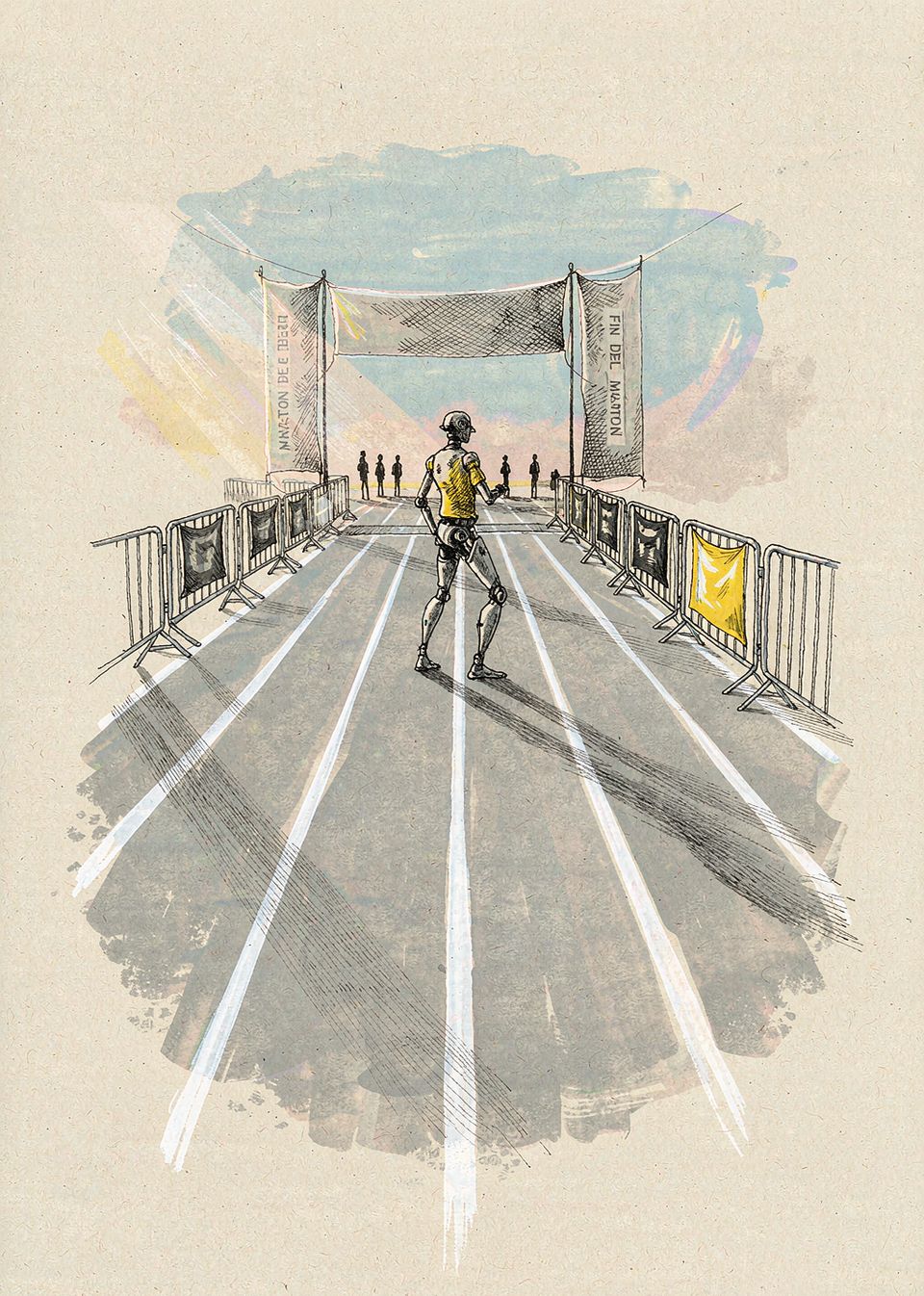
05Company history (1): from N1 to N2, a product line built from nothing
NOETIX's product chronology can be dated from October 2023. After the N1 prototype was built in 43 days, the team completed bipedal walking and multi-terrain tests on the N1 that November, and at the end of the year launched the bionic robot head Hobbs—China's first high-degree-of-freedom, immersively interactive bionic robot head, carrying a self-developed multimodal large model, capable of ultra-low-latency human-machine conversation and fitting 29 degrees of freedom into a standard human head measurement. 2024 was the year the product line spread out: the general-purpose humanoid robot Dora appeared, achieving gaits including straight-leg walking and equipped with multi-degree-of-freedom bionic arms; the N1 achieved autonomous navigation and obstacle avoidance in September. In December 2024 Virtual Dynamic Point, a unit of Leyard, and NOETIX set up a “Joint Laboratory for Embodied Intelligent Robots,” bringing optical motion-capture technology into the training of bionic robots' expressions and movements.
The real explosion was the N2. On March 14, 2025 NOETIX released the bipedal humanoid NOETIX N2 and reached a project agreement with the Tianning Economic Development Zone in Changzhou, Jiangsu, to industrialise humanoid robots in an auto-parts industrial park, originally planning mass production that June. The N2 came in three colours—deep space grey, bright moon white and flowing light purple—and pre-orders opened on launch. Jiang explained the price not as a “price war” but as a “price band”: if someone else sells for ¥200,000 and you sell for ¥199,000 that is meaningless involution, but if someone else sells for ¥200,000 and you sell for ¥30,000 it is no longer involution—you have found a “blue-ocean price band.” He also disclosed that the N2's ¥39,900 price was meant to sidestep competition along the price dimension, and that it was still profitable with a gross margin of about 15%; as for why other companies had not followed with low prices, that “may have to do with each company's competitive strategy.”
The other leg was the E1. A home and general-purpose platform standing about 1.36 to 1.4 metres tall with 23 to 29 degrees of freedom across the body, Jiang called it the industry's first “one-kilowatt-hour” humanoid robot—a battery capacity of 1,000 watt-hours, giving a range of three to four hours, about 20 kilometres, among the very best of humanoid robots at the time; the N2's endurance was around an hour and thirty to forty minutes. On delivery, the company did not have its first respectable mass-production month until July 2025: 105 humanoid robots delivered that month, 92 of them N2s and 13 E1s, a month-on-month rise of 176% in total deliveries and a record since the company was founded. For a company that had only moved into a factory building two months earlier, this was both a milestone and proof of its lopsidedness—motion-control algorithms a clear strength, while production, delivery, sales and corporate governance lagged plainly behind.
06Company history (2): the sub-¥10,000 Bumi and R&D reverse-engineered from price
On October 22, 2025 NOETIX announced that it would release the industry's first bipedal humanoid robot under ¥10,000; at 8pm on October 23, “Bumi” opened for pre-order at ¥9,998. It stands about 94 centimetres tall, weighs about 12 kilograms and has no fewer than 21 degrees of freedom across the body—six in each leg, four in each arm and one at the waist—supports getting up from the ground, walking, running and dancing, and can be further developed by users through graphical programming; it is pitched at emotional companionship at home and early education. Pre-orders passed 200 units in three hours, orders broke 100 in the first hour, and the first 500 units sold out within two days. Jiang's explanation: “we worked backwards from the price to the R&D schedule, and everyone took a share of the cost away with them.” The cost rests on heavy use of composite materials, self-developed domain controllers and core boards, domestic chips, and a circuits lead who stockpiled memory chips in advance to avoid price rises.
The low price is not losing money for the sake of a fuss but a sum that has been done. He has made his gross-margin figures public: the ¥39,900 N2 is still profitable at a gross margin of about 15%, with another report putting the margin at about 20%; the point of squeezing the margin is to win recognition with a price that carries a talking point, and in the end trading price for volume “traded out ¥100 million”—at ¥100,000 or more, that scale of revenue could not have been reached. His reading of the market also differs from his peers': most companies focus on the B2B route into factories, while he believes the industry's real core opportunity lies with consumers. Constrained by the generalisation ability of models, robots cannot yet pour tea or fetch water, but they can offer emotional value first, and a child getting a robot to talk and dance through programming is just as much a real need. He even draws an analogy with educational tablets: a device that teaches maths, Chinese and English can sell for five figures, so a new category that combines companionship with programming education will certainly sell too.
On application scenarios NOETIX spread across four lines at once: education, research, culture and tourism, and commercial performances. In education it signed a targeted order for a thousand Bumi units with Codemao and is co-building a humanoid-robot programming education laboratory, and it works with schools including Tsinghua University High School and Beijing No. 101 Middle School; in culture and tourism it is co-building scenario solutions with Fengyuzhu; with government and enterprise customers it works with Maxvision Technology and Shouchang Holdings, putting robots into port inspection and the car park building at Capital Airport. On channels, Jiang said in 2025 that there were several dozen distributors, concentrated in Jiangsu, Zhejiang and Shanghai, the Greater Bay Area and Henan, with a target of over a hundred that year. Overseas it began with CES in early 2026, planning to deliver a first batch of a thousand units abroad in the second quarter, covering North America, Europe, the Middle East, Southeast Asia and Japan and South Korea. The bionic-face line he defines as a “functional spectacle”—it can guide, converse and greet, and is itself a magnet that draws footfall.
07Company history (3): nine funding rounds, the shareholding reform and two product lines
The road through capital was more winding than the road through products. After the ¥7.6 million seed round at the end of 2023, NOETIX completed four consecutive rounds across 2024 and 2025, and became the first company backed by the Beijing Robotics Industry Development Investment Fund. 2025 was the densest year for fundraising: five rounds within twelve months, including an A++ round of several hundred million yuan in August that brought the cumulative total to six rounds; a Pre-B round of nearly ¥300 million in October led by Fangguang Capital; and a Pre-B+ round of nearly ¥200 million in November led by CICC Capital—the two barely a month apart. By October 2025 the figures Jiang gave in a Phoenix interview were seven rounds and roughly ¥600–700 million, with 46 shareholders, only four seats short of the fifty-shareholder ceiling for a limited liability company. His attitude to fundraising is candid: raising many rounds does not mean a company is doing well, it means the company needs money.
On February 6, 2026 NOETIX announced the completion of its conversion to a joint-stock company, the entity changing its name from NOETIX (Beijing) Technology Co., Ltd. to Beijing NOETIX Technology Group Co., Ltd., paving the way for later capitalisation. On March 2 the company announced a Series B bringing the cumulative total to nearly ¥1 billion, led by Chendao Capital, the industrial investment platform of the CATL group, with Guoke Investment, Jingguosheng Fund and Jiuhe Venture Capital participating. NOETIX had by then completed nine rounds in only two and a half years, with about ¥1.5 billion disclosed and a valuation of about ¥2 billion (a second account puts it at ¥2–3.5 billion, marked here as an estimate). Chendao Capital's entry has been read as industrial logic: humanoid robots are one of the earliest high-value commercial applications of solid-state batteries, and battery makers are using capital to lock in future early users ahead of time.
The company's account of what the money is for: to bring together industrial capital, market money and state capital, to dig deeper into home-consumer scenarios, to accelerate the industrialisation of its technology—and it says the round marks the humanoid robot industry's formal move from the technology-validation stage into a commercial closed loop at the consumer end. On governance, NOETIX's management and technical teams are dominated by post-95s, and Jiang is the legal representative and the person in actual control; the company registry shows registered capital of about ¥4.596 million, of which about ¥3.246 million is paid up, with about 201 people enrolled in social insurance in 2025 and more than 400 expected in 2026. As of March 2026 the company had not formally begun IPO coaching or disclosed a clear timetable, but the shareholding conversion is widely seen as preparatory work for capitalisation. On the financial side, the company's own account for 2025 is revenue above ¥100 million and continuing losses, with positive cash flow planned for the fourth quarter of 2026.
08Company history (4) 2026 — today's map
On the evening of February 16, 2026, on China Media Group's Spring Festival Gala, Cai Ming and Wang Tianfang appeared with several robots in the sketch “Grandma's Favourite.” NOETIX's N2, E1 and Bumi, along with a custom bionic humanoid, all took the stage—the first time in the Gala's history that humanoid robots had entered a comedy sketch, and a case of “Cai Ming unveiling Cai Ming”: the bionic robot head replicating Cai Ming's face one to one has 40 degrees of freedom in the head, with 32 drive motors implanted in the face and 12 in the mouth alone, using the self-developed D2P technology to map the mouth shapes of a digital human in the virtual world onto the motor angles of a real robot. In a CCTV behind-the-scenes programme Jiang explained to a reporter: “In our bionic robots we used our newly developed D2P technology, which can map the digital human in the virtual world onto the motor angles of a real robot, simulate any human mouth shape, and achieve one-to-one synchronisation of voice and lip movement.”
The appearance was not cheap. Jiang likens it to “air force bombing”: blanket the country with prime-time exposure first so that the “ground troops”—product, capacity and sales—can advance more easily, and therefore “the Gala cannot be assessed by simple ROI.” The company put more than 40 people into it, which for a business of just over 200 people meant slowing part of its R&D; within a month the team completed 21 rounds of dance-motion training for Bumi, prepared more than 300 algorithm strategies and 21 versions of the dance, and bought the Gala props back to the office to rehearse on a one-to-one replica of the stage. The returns were equally direct: within two hours of broadcast, searches for robots on JD.com rose more than 300% month on month and orders rose 150%; the ¥9,998 Bumi broke 100 orders in its first hour of release and sold out its first 500 units in two days, accumulating several thousand orders after the Gala, about 95% of them from individual consumers, with orders from county-level markets at one point reaching 30%.
On April 19, 2026 the second humanoid robot half-marathon set off in Yizhuang, Beijing, with more than a hundred teams and over 300 robots competing. This time NOETIX did not send out a small one but brought a full-size robot; the N2 “Little Rascal” competed in fully autonomous navigation mode. Jiang's reaction was calm: everyone had assumed NOETIX could only make small robots, and this time it fielded a full-size robot of very strong performance; nor does he cling to placings—“our attitude is good, I am not chasing placings. I think this year's marathon was more a stage on which we prove something to ourselves.” In August the company exhibited its full matrix of humanoid and bionic product lines at the World Robot Conference, launching four newly styled bionic robots and an upgraded Bumi OTA; during JD.com's “618” shopping festival Bumi took several first places in the humanoid robot category. The full-year target was set at “10,000 units delivered,” with a first batch of a thousand units to be delivered overseas.
09Leadership style and temperament: a guerrilla band, “slope over intercept” and that whiteboard
On the wall just inside the door of NOETIX's office are five values Jiang wrote himself: customers matter more than the boss, results more than process, the collective more than the individual, execution more than ideas, and slope more than intercept. He says he prizes the last most: “that is really just growth—the speed of growth matters more than how good I am right now.” Alongside it goes an extremely spare management style: a whiteboard always stands in his office, and engineers can push the door open and come in to discuss any problem that arises as a project advances; he personally interviews candidates once for core technical and R&D roles; and since the company moved to Changping he goes to the factory two or three times a day to check on assembly and delivery progress. The other side of that hands-on management is his description of the company as a “guerrilla band” of more than 300 people—a few people sitting down together, deciding, and getting on with it, with a decision chain as short as it can be—which he takes to be exactly where the big companies cannot reach, at least in the short run.
In hiring he looks at passion rather than credentials. “We pay only for ability, not for credentials.” The line caused a considerable stir in Tsinghua circles. He has explained his preference: he has met entrepreneurs with dazzling résumés, and “their sights are set too high; it is hard for them to get down to work on the ground.” Almost none of NOETIX's department heads was hired from outside; they are essentially engineers who worked their way up on the front line. “We are not looking for people to sit up there and command; we are looking for people who can work close to the ground.” Nor does he mind the company being used as a springboard: “NOETIX is a bit like Yangcheng Lake—staff who come here to pass through the water leave with salaries several times higher.” In his system for judging talent, passion comes first and personal commercial ability second—resources run out, and the ability to keep monetising is the difference between being given a fish and being taught to fish.
Outwardly he carries none of the baggage of a chief-executive image: shouting slogans in a red headband at the marathon finish line, doing live selling in front of a streaming camera, setting the company the annual goal of becoming number one in the consumer robot market after the Gala. Inwardly he shows another face. When the valuation rose from ¥500 million to ¥2 billion he warned the team to watch out, amid the heat, for whether the company had the technical strength to support a high valuation; of the company's achievements he says, “we are really still far from success, it has only been two or three years… starting a company is absolutely a marathon, and I think it is far too early to talk about success.” He will also admit his own fragility plainly: in the hardest days of 2024 he would shut himself in a meeting room and make calls as soon as he got to work, for months on end—“I was genuinely extremely anxious then.” That contrast between outward exuberance and inward clear-headedness is the most distinctive thing about him among founders of his generation.
10The method behind the success: what can be replicated and what cannot
Reviewing NOETIX's three years, a few well-evidenced key moves can be identified. First, choosing a narrow gate that nobody was working: during his doctorate he saw that quadrupeds were already occupied by Unitree and that nobody in China was making force-controlled humanoid robot hardware, so he moved the logic of “quadrupeds plus reinforcement learning” onto humanoids, building a robot and filing a leg-structure patent while still a doctoral student. Second, treating pricing as product strategy rather than sales strategy: the ¥39,900 N2 was meant to “make our robot a social topic in the small circle,” while Bumi at ¥9,998 aimed below ¥10,000 from the very beginning of its design, working backwards from the price to the R&D schedule. Third, trading competitions and stages for brand: the Yizhuang half-marathon and the CCTV Spring Festival Gala, two big examinations, gave a company with no marketing team nationwide exposure. Fourth, a younger organisation: the core team's average age is about 25, and a single written test screens out the people who can genuinely be used.
Fifth, a sense of capital rhythm. From the angel round with Tsinghua-affiliated funds, to the Beijing Robotics Industry Development Investment Fund, to the A++, Pre-B and Pre-B+ rounds and the Series B led by CATL's Chendao Capital, he has always managed to get “the right money” at the key moments; when Zhu Xiaohu exited he did not get entangled, saying only that “Mr Zhu sold at the low point.” Sixth, tolerance of failure. “Celebrate failure” is a piece of corporate culture he has put on the wall, and his reasoning is simple: any technology company should live by that culture, because tolerating failure is in essence encouraging innovation. Of these six, the route judgment, the pricing strategy and the capital rhythm are to some degree replicable; but a starting point that ran from kindergarten to doctorate on the Tsinghua campus, with a father who is a Tsinghua physics professor and a supervisor who founded Robot Era in Chen Jianyu, together with the time window opened when ChatGPT ignited the embodied-intelligence boom in 2023, are gifts of era and luck. He admits as much himself: the college entrance examination was probably the best he ever performed in his life, and “mainly it was good fortune.”
More worth recording is his resistance to the word success. On CCTV's “Face to Face” he compared the global embodied-intelligence industry to a marathon that has run ten metres; in an interview with Jiemian News he called his team a “guerrilla band,” arguing that what big companies cannot reach in the short term is not capital but speed. That self-positioning determines his view of replication: the methodology can be learned, and the speed of building a prototype in 43 days can be caught up with, but the combination of being born in 1998, dropping out in 2023 and running into a half-marathon and a Spring Festival Gala in 2025 is unlikely to come round a second time. The two demands he sets himself also show his measure of time: in ten years, to build a company like Apple or Google; in the short term, to make NOETIX a commercially healthy company that turns cash flow positive quickly and can sustain itself.
11The person, values and life: five values and a Spring Festival not spent at home
Jiang's attitude to money comes half from a lesson and half from his family. The lesson was the runaway expansion of 2024—at 25 he suddenly held about ¥30 million in cash: “I had never seen that much money… before I started the company, the most I ever had on hand was a ¥2,000 monthly living allowance,” so he hired furiously and spent without restraint, until a shareholder sent him a WeChat message reminding him that a startup has to economise. He later adopted a frugal style, and according to reporting from February 2026 even expenses above ¥500 require his approval. The family half is warmer: his parents twice wanted to invest and were twice refused, once in the early days of the company—his mother later lamented that “we could have sold the house and invested in you then; if we had, I would be a multimillionaire now”—and once in 2024, when fundraising was difficult and he was afraid of losing their money. To this day his parents have not made a single yuan from his company and are substantially out of pocket. He also says plainly that his parents were in fact worried, but that if he truly made up his mind, they supported him.
Little is public about his life, but a few details are enough to sketch the outline. What he loved most as a child was in fact cars, and he only turned to robots during his doctorate; he played with Arduino from middle school into university and is used to deploying code onto a machine and driving it with a remote control, “the same as playing with robots normally.” He does not consider himself a geek and prefers to define himself as “a product manager who understands technology”—to make up for what he lacked on the product side he went in late 2024 to hear a sharing session by Wang Ning, founder of Pop Mart, and he keeps Duan Yongping's phrase “dare to come after” in mind. At the Spring Festival of 2026 he did not go home for the holiday, too busy preparing for the Gala and with company affairs. In public the line he stresses again and again is that “the speed of growth matters more than how good I am right now”; in private he admits that starting a company is a process of forgetting all your halos, lowering yourself into the dust and standing back up.
His attitude to his home province is equally clear. A native of Longkou in Shandong, he has said repeatedly that the province has both a coastal advantage and a dense pool of talent, and that as a Shandong man he hopes to give something back—setting up an R&D centre, for instance, and doing production and data collection there. It is not an empty promise: NOETIX has established substantive industry-academia-research cooperation with Shandong University, and an obstacle-crossing algorithm the two developed jointly was successfully used in the 100-metre obstacle race at the 2025 World Humanoid Robot Games, making Shandong University the only university team to complete the entire course. On the public-interest and science-outreach side the company works with Tsinghua University High School to have robots serve as pace-setters and exercise leaders on campus; in the September 2025 school term NOETIX's robots visited eight primary and secondary schools including Tsinghua University High School, showing the possibilities for humanoid robots in K-12 education.
12National and epochal significance: pulling robots down off the altar
The significance of Jiang and NOETIX has to be read first against the coordinates of China's humanoid robot industry. In 2023, when he started the company, a humanoid robot was still an expensive toy in a laboratory; by 2026, when he appeared on the Spring Festival Gala, the industry already had IPO coaching, ten-billion-yuan valuations and slogans about delivering ten thousand units. NOETIX chose a peculiar position: not the flashiest full-size flagship, nor the fattest-margin industrial scenario, but the cheap, mass-producible, sellable consumer and education market. Jiang has put it bluntly: whichever direction you enter from, you will certainly meet somewhere in the end—companies that make bodies will go and make brains, and every body-making company will eventually become an embodied-intelligence company; and before that day arrives, whoever can get scale and data running first will have earned the right to stay at the card table.
The ground colour of that route is the domestic supply chain. More than 80% of NOETIX's core components are made in China, the main control chip is from the domestic Rockchip series, and its suppliers—structural parts, standard parts, circuit boards, joints—are almost all domestic; the company does no machining itself and outsources everything. This system dragged the price of a bipedal humanoid robot down from the hundreds of thousands of yuan to under ten thousand, and turned “selling humanoid robots by the catty” from a joke into a calculable engineering proposition. Jiang quotes Musk's “Idiot Index” directly to explain the logic: add up aluminium, iron, copper, chips and magnetic steel by gross weight and at futures prices, and whatever exceeds that line is exactly where design, processes and scale still have room to improve. In his view a humanoid robot ought not to be expensive, and the expensive part is precisely the part engineers have not yet got right.
More telling of the times is the age structure of the team. NOETIX's management and technical teams are dominated by post-95s with an average age under 30, and Jiang himself was 27 when he led more than 200 people through the hard battle of a Spring Festival Gala. In his view China has ranked first in the world for years in humanoid robot patent applications, and there is not much difference from abroad at the level of motion control; the real gap is in embodied large models, and the variable that will ultimately separate the field is data—“data has to be produced, and no one in the world understands production better than the Chinese.” From the Tsinghua campus to a race track in Yizhuang and on to the Spring Festival Gala stage, this young man born in 1998 proved in under three years that pulling technology down off its altar and making it cheap enough for ordinary people to afford is itself an extremely difficult technical capability.
| Valuation / standing | In May 2025 Jiang told Caijing Tianxia that the company's valuation had risen from about ¥500 million before the Yizhuang half-marathon to about ¥2 billion; in October 2025 he confirmed in a Phoenix interview that “the post-money valuation of the latest round is about ¥2 billion.” After the Series B of March 2, 2026 (bringing the cumulative total to nearly ¥1 billion, led by CATL's Chendao Capital), the company had completed nine rounds with about ¥1.5 billion disclosed; a second account puts the post-Series B valuation at ¥2–3.5 billion, a figure not authoritatively disclosed and marked here as an estimate. In the industry's line-up NOETIX is listed as the representative company focusing on the consumer route within China's first tier of humanoid robots. |
|---|---|
| Basis and year | All valuation figures are post-money (renminbi). The move from ¥500 million to ¥2 billion took place between April and May 2025 and comes from Caijing Tianxia's interview of May 2025; the ¥2 billion figure is the company's own account from October 2025. The Series B was announced by the company on March 2, 2026, and the cumulative number of rounds and the disclosed amount follow the company's announcements and CNR's reporting. No authoritative disclosure of the latest valuation after March 2026 exists, so it is marked as an estimate. Financially, the company had revenue above ¥100 million in 2025 and remained loss-making, with cash flow planned to turn positive in the fourth quarter of 2026—a target the company states rather than a fact already achieved. |
I think among “the right time, the right place and the right people,” the right time matters most—coming out at the right moment may matter more than coming out once you are ready.
This is Jiang's own account, given in the “Opening Up the Thinking” interview on Phoenix, of the timing of his company. He considers that he dropped out late, puts the right time first among “time, place and people,” and reaches for an analogy from the property market: many people think they should save up enough money before buying, by which point it is already too late. That judgment shaped the way NOETIX behaves—come out first and fill in the gaps, rather than perfecting the technology in the laboratory first. It also explains every one of his later sprints: a prototype in 43 days, using price to force the supply chain, and spending without counting the cost at two milestones, the half-marathon and the Spring Festival Gala. In his view there are a few benchmark schools in this field, and whoever signs them up first will afterwards have the strongest brand; time itself is a moat.
In our bionic robots we used our newly developed D2P technology, which can map the digital human in the virtual world onto the motor angles of a real robot, simulate any human mouth shape, and achieve one-to-one synchronisation of voice and lip movement.
After the 2026 CCTV Spring Festival Gala sketch “Grandma's Favourite” aired, Jiang explained the core algorithm of this “fake grandmother” to a China Media Group reporter in a CCTV behind-the-scenes programme. The value of D2P lies in mapping the mouth-shape data of a digital human in the virtual world onto the rotation angle of every motor in a real robot, so that voice and lip shape stay synchronised one to one—precisely the hardest gate in a bionic face, where the structure must fit 32 drive motors into a very small space and the algorithm must then coordinate those motors into natural expressions. For a few minutes on stage the team prepared more than 300 algorithm strategies and 21 versions of the dance, and compressed a real human head measurement by 30%. The technical explanation was a public demonstration of NOETIX translating showmanship into a deliverable product.
We needed a price with talking-point value, so that our robot would at least become a social topic in the little circle of robotics.
The line comes from a Phoenix interview in October 2025. Jiang drew a clear line between a marketing strategy and a sales strategy: the ¥39,900 price was not meant to sell in volume but to make the product a talking point in the small circle of people who work with robots. Before that price was announced, he admits, the company had almost no brand equity at all—no social media accounts, no videos or articles ever posted. Manufacturing a talking point with a startling price and then trading the talking point for exposure and orders was the most economical way out for NOETIX at a stage when it had no marketing team and no budget. Events proved the logic sound: after the N2 appeared, prices for domestic humanoid robots were dragged steadily down and competitors were forced to follow.
If someone else sells for ¥200,000 and I sell for ¥199,000, that is meaningless involution. If someone else sells for ¥200,000 and I sell for ¥30,000, that is not involution any more—you have actually found a “blue-ocean price band.”
Jiang said this in a CCTV News interview after the half-marathon in April 2025. Until then there had been loud argument inside and outside the company over whether it was waging a price war, and he turned the question into a matter of positioning with a piece of arithmetic: going from ¥200,000 to ¥199,000 is killing your own kind, while going from ¥200,000 to ¥30,000 is setting up a different table. The point is not the price itself but his belief that an unoccupied “blue-ocean price band” exists—one that makes customers feel the offer is too cheap to refuse while still leaving the company a gross margin. The outcome was that he was not accused of cut-throat competition; instead the ten-thousand-yuan level became a new psychological anchor for the humanoid robot industry, forcing competitors to reprice.
A humanoid robot is essentially aluminium, iron and steel, plus chips, magnetic steel and copper wire. Counted by the gram, the cost is very low.
This is a judgment that recurs across Jiang's remarks in Star Market Daily and in reporting by the Beijing Municipal Science and Technology Commission. He strips a humanoid robot's bill of materials down to the bone: aluminium, iron and steel, plus chips, magnetic steel and copper wire, priced by the gram—the cost is in fact very low. The real cost is not in the materials but in the processes: at small production volumes you can only machine parts on CNC equipment, and once the processes are optimised the total cost falls markedly. This habit of looking at hardware as so much metal is the source of his confidence in pushing the N2 down to ¥39,900 and openly promising later products in the thousands of yuan, and it is how he understands the whole supply chain: cutting cost is not haggling, it is redesigning.
Work it out: it is really just some aluminium, some iron, some copper, some chips and maybe a few magnets—that is all. Add up the gross weight of those things and sell it by the catty; anything above that line means you have not designed it well enough, or your volume is not big enough, or your processes are not optimised enough.
This passage comes from the Phoenix interview of October 2025, in which Jiang set out where “selling by the catty” comes from—he is borrowing Musk's “Idiot Index” at SpaceX: price the raw materials at futures prices by weight, compare that with the actual cost, and the wider the gap the more waste there is in engineering and processes. He applies the same ruler to humanoid robots: aluminium, iron, copper, chips and magnets, with the gross weight adding up to a theoretical floor price, and everything above that line represents room left for better design, greater scale and more refined processes. It is both a cost methodology and his most direct criticism of competitors' high pricing.
The N2 is priced at ¥39,900, intended to sidestep competition along the price dimension, and it is still profitable, with a gross margin of about 15%.
This is the pricing logic Jiang disclosed in Star Market Daily and in the Beijing science commission's reporting. He stresses that ¥39,900 is not losing money for the sake of a fuss but a deliberate choice to sidestep competition along the price dimension, and that it still leaves a gross margin of about 15%; asked why other manufacturers have not followed with low prices, he explains that it “probably has to do with each company's competitive strategy.” A second account, in Caijing Tianxia, puts the N2's gross margin at about 20%. The disclosure strips the “price butcher” label of sentiment and reduces it to a worked financial problem: the point of a low price is not that it cannot make money, but at which stage to make it, how much, and what to trade it for in scale.
We found that in the end trading price for volume traded out ¥100 million; if we had sold at ¥100,000 or more, we could not have traded out that scale of revenue.
This too is from a Caijing Tianxia interview, in May 2025. Pressed on whether a low price hurts the company, Jiang answered with a results-driven argument: squeezing the gross margin buys a much larger revenue base—if you insist on selling at ¥100,000 or more, you simply cannot trade out a contract value in the hundreds of millions. It also explains NOETIX's choices in 2025: the more than ¥50 million of orders signed on the spot at the May ecosystem conference and a contract value above ¥100 million for the year were both piled up out of volume at low margin. He later extended the logic to Bumi: the real value of trading price for volume is not the unit price but whether it can push humanoid robots into an entirely new market.
At our poorest, there were only a few thousand yuan left in the account.
The remark appears in Tencent News's “A Survey of China's Embodied-Intelligence Academic Lineage.” It refers to the genuinely desperate stretch in early 2024: the team had ballooned, costs were out of control and the technical route had been shown not to work, leaving only a few thousand yuan in the account at one point—not even enough to pay wages. Other reporting says only ¥300,000 was left before the Spring Festival of 2024; the two figures are accounts of different moments. Jiang later shut himself in a meeting room and spent months on the phone begging for investment, describing himself as having only one fingernail hooked over the edge of the table. The experience directly rewrote his hiring standards and his way of managing—he rebuilt the algorithm team, laid down the rule of not paying a premium for credentials, and made survival a goal that outranks technical benchmarks.
Delivery is a gate of hell.
This is how Jiang described the mass-production gate in a CCTV News interview. The hardest part of making humanoid robots, he stresses repeatedly, is productisation: getting stability and mass production right is far harder than producing a prototype that can do a backflip. Delivery feels like a gate of hell because when capacity cannot keep up customers chase you and the cost of communication becomes enormous; and even if output hits the target, poor reliability after delivery—breakdowns and repairs at scale—is more than a startup can bear. To meet it he gathered the company's entire hardware and production teams for a “hundred-day oath-taking rally,” and made doing everything possible on delivery the single most important task of 2025.
Every moat is a system that cannot be overtaken. Once mass production, sales and delivery are all running smoothly, they form a positive cycle as a whole.
Jiang said this in August 2025, in an interview with The Beijing News's Shell Finance programme “Ji Zhi Tan.” His judgment is that no single point is enough to constitute a moat—technology is fairly transparent today, and everyone in the industry knows which approach each company is taking. What really forms a moat is the positive cycle that appears once mass production, sales and delivery are all running; he calls the process a flywheel: the more you sell, the more videos are made and circulated, the stronger the brand, and so the better you sell. The formulation explains why in 2025 he shifted the centre of gravity from R&D to capacity and channels, and why he chose to compete on who could put a robot in a customer's hands rather than on who had better specifications.
I have been reading a book by Duan Yongping recently, and I think the idea of “daring to come after” is rather good; sometimes the first person to eat the crab does not do well.
In the “Ji Zhi Tan” interview with The Beijing News, asked why he was not pouring money into an embodied large model, Jiang quoted Duan Yongping. His thinking: do not throw large sums at large-scale R&D in embodied intelligence; watch first, decide, then act, because the industry has not even worked out how data should be collected or how much of it is needed, and betting too early is extremely risky. That contrasts sharply with his aggression on hardware—he is happy to be first to push the price down, but would rather be a late mover on technical route. He uses the same logic to explain not building quadrupeds: Unitree already does it well enough, so there is no point in founding another robot-dog company. That sense of tempo, striking after others have moved, is the survival choice of a NOETIX with limited resources.
I have never met Zhu Xiaohu. It was not he who invested in us; it was Mr Zhu's partner at the time.
In March 2025 Zhu Xiaohu, founder of GSR Ventures, pronounced the “humanoid robot bubble” thesis and announced that he had sold the firm's stakes in companies including NOETIX, sending the A-share robotics sector down across the board; a month later NOETIX took second place in the half-marathon and became famous overnight. Interviewed again by Caijing Tianxia in May, Jiang gave his version: the money invested in NOETIX had come from Zhang Yutong, Zhu's partner at the time, and it went in when the company's valuation was at its lowest (about ¥200 million), while Zhu sold existing shares at a valuation of about ¥300 million at the end of 2024. His response carried no emotional accusation; he simply put the facts and the prices side by side, which in the end turned the public-relations crisis into part of the company's valuation story.
The monkeys on both banks keep calling, but my light boat has already passed ten thousand mountains.
After Zhu Xiaohu's exit, NOETIX responded in a promotional video with “fear no noise, keep moving forward,” and when Jiang reposted it on WeChat Moments he added this line from Li Bai's “Setting Off from Baidi City at Dawn.” It appeared at a moment when the company's valuation was being questioned from outside, serving both as a debonair farewell to the person leaving the table and as reassurance for the team—only those who truly stay at the table earn the right to see a more distant future. In the event the line was no empty boast: in May the company lifted its valuation to about ¥2 billion and investors arrived in a stream, while the old shares sold at the low point became the most frequently cited footnote to the whole story.
At that point I felt the card table was round, and I had one fingernail hooked over the edge of it—just that fingernail holding me on, and a small gust of wind could have blown me off.
From a CCTV “Face to Face” interview with Jiang in April 2026. Describing the fundraising predicament of 2024, he said that without expanding, the money would have lasted more than ten months, but what he feared was not running out of cash but being pushed off the card table—the robotics industry moves too fast, and if a competitor raises money and pushes its valuation up while you stand still, you are finished. So he shut himself in a meeting room and spent months on the phone, using the image of one fingernail hooked over the edge of the table to describe a position from which any gust could blow him away. The metaphor captures his understanding of competition precisely: at this stage staying in the game outranks everything, including dignity and valuation.
I constantly remind myself that starting a company is a process of forgetting all your former halos, lowering yourself into the dust, and then standing back up.
Also from the CCTV “Face to Face” interview. Jiang uses this line to sum up how he pulled himself out of the trough of 2024: starting a company demands that you first put down all your former halos, lower yourself into the dust, and then stand back up bit by bit. In the same interview he said that in that funding round he would have accepted whatever the investor asked, so long as they would wire the money. That almost brutal pragmatism contrasts sharply with his public exuberance—the man shouting in a headband at the marathon finish line and the man shut in a meeting room phoning for help are the same 27-year-old founder.
We pay only for ability, not for credentials.
The line appears in Tencent News's “A Survey of China's Embodied-Intelligence Academic Lineage” and in Chongqing Daily and elsewhere, and it is the rule Jiang laid down when rebuilding the team. It answers a reality of the early days: a poor employer brand, top technical people turning up their noses, experienced hands snapped up by star companies and new graduates bid up to absurd salaries. So he took a different road: he wrote a hard written test himself to screen people, hiring on passion and aptitude rather than credentials. The standout example was an algorithm engineer whose academic background would not have cleared the résumé screen at any big company, and who now trains most of the company's high-dynamics motions. In a venture world thick with credential worship, that view of hiring became NOETIX's invisible competitive edge in rapid trial and error.
Slope matters more than intercept; that is really just growth—the speed of growth matters more than how good I am right now.
This is one of five values Jiang wrote on the office wall, and the one he admits he prizes most. The full five are: customers matter more than the boss, results more than process, the collective more than the individual, execution more than ideas, and slope more than intercept. He explained it plainly on CCTV's “Face to Face”: slope over intercept simply means the speed of growth matters more than how good things are right now. The value system explains why NOETIX dares to send a cohort of post-95s and post-2000s to chew through the hard bones of hardware and motion control, and why it does not mind being used as a springboard—Jiang says NOETIX is a bit like Yangcheng Lake, where crabs from elsewhere are briefly soaked to earn the name, and staff who come here to “pass through the water” leave with salaries several times higher.
- TMTPost AGI, “In conversation with Jiang Zheyuan: ¥39,900 will be the inevitable trend of the robot industry,” 2025
- Phoenix Finance, “In conversation with NOETIX: after being sold by Zhu Xiaohu, the valuation rose sixfold,” 2025
- Phoenix, “In conversation with NOETIX's Jiang Zheyuan: domestic humanoid robots under ¥10,000—will they really be sold by the catty?,” 2025
- The Beijing News / Shell Finance, “Ji Zhi Tan: NOETIX's Jiang Zheyuan, from dropping out of Tsinghua to six funding rounds—this year will be decided by mass production,” 2025
- Office of the Capital Steering Committee for the Construction of Spiritual Civilisation, “Jiang Zheyuan: let China's humanoid robots lead the world, and define Chinese speed through unremitting self-improvement,” 2026
- CCTV News, “When robots meet a sketch star: behind the Spring Festival Gala, how technology and family feeling connect,” 2026
- CCTV News, “Face to Face: Run, robot! An interview with NOETIX founder Jiang Zheyuan,” 2026
- Yicai, “The 2026 CMG Spring Festival Gala had the highest robot density,” 2026
- China Entrepreneur, “An interview with NOETIX's Jiang Zheyuan: the Huaihai Campaign of getting onto the Spring Festival Gala,” 2026
- Star Market Daily, “Founder is a Tsinghua PhD: NOETIX's N2 priced at ¥39,900,” 2025
- Beijing Municipal Science and Technology Commission, “Future Science City's robot ‘kid’ is on fire yet again!,” 2025
- Red Star Capital Bureau, “How did the fake Cai Ming share the stage? NOETIX at the 2026 Spring Festival Gala,” 2026
- Sohu, “The humanoid robot Zhu Xiaohu exited ran a marathon,” 2025
- Tencent News, “A survey of China's embodied-intelligence academic lineage: Andrew Yao's Tsinghua institute and the Yao class cohort,” 2026
- Chongqing Daily, “Jiang Zheyuan, 27-year-old founder of NOETIX: I want to be number one in consumer robots,” 2026
- Jiemian News, “NOETIX founder Jiang Zheyuan: breaking out through guerrilla war, and putting a robot in ten million homes,” 2026
- Xueqiu, “NOETIX: is embodied intelligence an opportunity or a bubble?,” 2025
- Toutiao, “Eight post-90s and two post-2000s founders hold up half of China's robotics,” 2025
- Caijing Tianxia, “In conversation with NOETIX: after being sold by Zhu Xiaohu, the valuation rose sixfold,” 2025
- CCTV News, “The father of Little Rascal: Jiang Zheyuan,” interview (reprinted by Future Science City), 2025
- CNR, “Fresh from the Spring Festival Gala, NOETIX announces a Series B of nearly ¥1 billion,” 2026
- Yicai, “Head of the ‘robot Cai Ming’ company: Cai Ming's face is small, so the robot's dimensions were compressed by 30%,” 2026
- Red Star Capital Bureau, “‘Fake Cai Ming’ shares the stage: NOETIX at the 2026 Spring Festival Gala,” 2026
- China Youth Daily, “Behind the Spring Festival Gala's ‘robot Cai Ming’: how this young team injected a soul,” 2026
- Dazhong Daily, “The Spring Festival Gala's ‘real and fake Cai Ming’ robots go viral, and the post-95s founder behind them is from Longkou, Yantai,” 2026
- People's Daily Online / Securities Daily, “Beijing's embodied-intelligence industry sprints ahead, with whole-chain coordination resonating with manufacturing,” 2025
- TMTPost, “The survival logic of a young robot company,” 2026
- People's Government of Tianning District, Changzhou, “The robot that can do consecutive flips settles in Tianning!,” 2025
Chen Jianyu
Assistant professor at Tsinghua University's Institute for Interdisciplinary Information Sciences and a PhD from UC Berkeley. He founded Robot Era in 2023 to work on general manipulation and locomotion in embodied AI; it is the only embodied-AI company in which Tsinghua University holds equity.
01Family and early years: a Leshan boy, from physics competition to Tsinghua's precision instruments
Chen Jianyu was born in April 1992 in Leshan, Sichuan, and there is nothing dramatic about his family background. He describes an ordinary middle-class household—not well-off, though under no financial pressure either, and he was never spoiled. His parents favoured encouragement and rarely criticised him; his school record was consistently good, and the steady flow of positive feedback gradually bred a self-drive that needed no external prodding. His mother worked at a university and often took him as a small boy to wander through physics laboratories; those scattered fragments of memory, together with science fiction such as Iron Man and The Three-Body Problem, made “building a very advanced, very intelligent robot” a vague sense of direction in his boyhood. Looking back, he says he was plainly never drawn to literature or the arts—the films and books he consumed were almost all science fiction and technology—and that he simply liked these things by nature.
In secondary school he started working at subject competitions on his own initiative from junior high—a textbook “good student” trajectory: coming first and winning prizes in competitions made him feel rather impressive, and he always wanted to defend that edge. He admits that at the time it was competitiveness and the desire to win that drove him, but it also produced a lesson that served him well later: many people separate passion from aptitude, yet the two are very hard to draw apart—once you do something well and keep being recognised for it, you gradually come to genuinely like it. Physics interested him most and he competed in physics all the way, but what he really wanted was not pure physical theory; it was to use physical principles to build impressive devices and products, which in fact fits robotics closely. There was almost no extracurricular activity in technology where he lived, so physics competition was the closest thing to robots available to him.
In 2011 he was admitted to Tsinghua University's Department of Precision Instruments without sitting the entrance examination, on the strength of his competition record. Computer science was popular even then, but the most sought-after fields were architecture and finance; he had studied physics throughout secondary school and preferred things he could see and touch, wanted a direction with a hardware character that was not merely mechanical manufacturing, and wanted to combine it with intelligent technology. Tsinghua's department of precision instruments and mechanics was large, covering sensors, aerospace equipment, machinery and robotics, and many of the university's robot teams, its robot football squad and its bipedal-robot core laboratories were based there, so he chose it. He graduated in 2015; his final-year project was on bipedal robot gait planning, and he took honours including Beijing Outstanding Graduate. As an undergraduate he wrote his thesis in the group of Fu Chenglong in the department—Fu was rigorous in scholarship and good at starting research from the phenomena of daily life, watching his own newborn child walk while studying how robots walk. Tsinghua's precision instruments department was one of the earliest units in China to work on bipedal humanoid robots, and that experience, he says, “quietly planted the seed for the bipedal humanoid robots I work on now.”
02The founding impulse: six years at Berkeley, and a board game rewritten by AlphaGo
After his undergraduate degree Chen Jianyu went straight into a PhD at UC Berkeley, studying under Professor Masayoshi Tomizuka, a member of the US National Academy of Engineering and a pioneer of the electromechanical control discipline. Tomizuka is one of the founders of model predictive control (MPC) theory, and Chen has often said since that today's robot systems can be understood as an extension of electromechanical control systems. In his early doctoral years he was not yet using AI techniques but computational modelling and numerical optimisation, still at the stage of hand-written rules: build an accurate model of the robot, then write code to solve for the control inputs step by step, with no neural network anywhere in the loop. A real-time trajectory optimisation algorithm he proposed for nonlinear systems under non-convex constraints was successfully applied to a real autonomous vehicle. Sitting in a car driven by his own algorithm, adjusting it and hunting for the cause while the car lurched about, he describes as “extremely thrilling.”
AlphaGo's arrival in 2016 was a turning point. The deep reinforcement learning behind it could solve high-dimensional complex decision problems, and robots precisely need to process large numbers of high-dimensional, complex instructions in real time and make dynamic decisions, so the technique was quickly brought into robotics. Quite a few Berkeley scholars spotted the trend at the time, and Chen was studying there—he can be counted among the earliest people to touch this class of technology. The R&D paradigm thus shifted from hand-written rules to data-driven methods: training neural networks to solve the various problems robots face. During his doctorate he also interned at the autonomous-driving companies Waymo and Nutonomy, with research spanning robot control, reinforcement learning and self-driving cars, and he took his PhD in 2020.
On graduating he had generous offers, including from Google's self-driving car unit, but he chose to return to China, and the decisive figure was the Turing laureate Andrew Yao—Yao intervened personally, bringing him to teach at the Institute for Interdisciplinary Information Sciences at Tsinghua University. That year he was twenty-eight, becoming an assistant professor and doctoral supervisor there, one of Tsinghua's youngest doctoral supervisors at the time, and he founded its Intelligent Systems and Robotics Laboratory and became its director; from July 2021 he was also a PI at the Shanghai Qi Zhi Institute, and that year he was named to the Forbes China 30 Under 30 list (science). Looking back later, he considered that he “caught both waves”: the first when deep reinforcement learning entered robotics during his doctorate, the second when large models after ChatGPT made general embodied models possible.
The idea of starting a company came from pressure on two sides. One was the limits of reality: universities struggle to support capital-intensive R&D, and he wanted robots to be genuinely deployed and to create real value. The other was the spur of peers: in 2022, seeing Tesla bring out a robot product, he felt a strong sense of urgency. As early as the spring of that year the robot “Xiaoxing” had begun to be studied in his laboratory. In the second half of 2022 he resolved to start a company; on 4 August 2023 Beijing Robot Era Technology Co., Ltd. was formally registered, incubated by Tsinghua University's Institute for Interdisciplinary Information Sciences and the Shanghai Qi Zhi Institute. He sets out the timeline precisely in interviews: “The formal founding was August 2023, but in fact we started working on it in 2022.”
03The hardest gate: from snowfield to warehouse, a company mistaken for a maker of dexterous hands
Robot Era's technical starting point was not a smooth one. In June 2023 the team brought out a second-generation humanoid body with walking capability: “The hardware had just been assembled, and we had it walking after a day of tuning.” At the end of 2023 the fourth-generation humanoid “Xiaoxing” became the first humanoid robot anywhere to walk in snow in the field using end-to-end reinforcement learning, including up and down snow slopes and stairs; the whole process relied on no pre-programmed walking patterns and was learned entirely by the AI itself, allowing the robot to adapt on its own to different ground conditions. The paper was nominated for the Outstanding Paper Award Finalists at RSS 2024, robotics' leading conference, with only three papers selected worldwide—the first time a Chinese team had won the honour in the conference's history.
But technical leadership did not immediately buy financial ease. Recalling those days, he says early fundraising was far harder: “In the first two or three rounds we raised little and the pace was slow; the pressure in that period really was considerable.” At the time he also had to explain the industry's ideas to investors again and again, and many understood the field only shallowly and had many reservations, so decisions were always hesitant. In October 2023 the seed round brought in only several tens of millions of yuan from Century Jinyuan and Turing Ventures; three months later the angel round, led by Lenovo Capital with more than ¥100 million, was the first real foothold. The company had also approached Sequoia in 2023, but it was far too early and the firm had not thought through how to position itself on this track, so nothing came of it.
Another difficulty came from being misread. The dexterous hand was the first product the team brought to market and the first to be genuinely commercialised; the company did not push it hard, but market feedback was good and sales were solid. As a result, “for a long time outsiders thought we were a company that makes dexterous hands,” and in the first half of 2024 quite a few investors even valued them on the logic of a hand-maker. In his view the hand was only one part of the business—the robot body and the intelligent brain were the more core technologies—and only once the whole robot system formed a complete loop did those core strengths gradually become visible to the outside. The supply chain was another blank: humanoid robots lacked standard core components designed for them and the industrial chain was extremely immature, so the company had to develop everything itself, from joint modules, motors and reducers through to controllers. A firm that put the hardest parts first had to endure a stretch with no applause and little respect.

04The turnaround: ERA-42 and real work in the logistics warehouse
The real turning point came on 23 December 2024. Robot Era released ERA-42, China's first end-to-end natively trained robot foundation model paired with a five-fingered dexterous hand; combined with its in-house XHAND1 hand, it learned to use different tools to complete more than a hundred complex dexterous manipulation tasks—picking up a screwdriver placed at random on a table and driving a screw, striking a nail with a hammer, righting an overturned cup and pouring water into it. None of these operations required any pre-programmed skill; they relied entirely on the model's generalisation and self-adaptation, and it could learn a new task from a small amount of collected data in under two hours, continuing to acquire new skills within the same model. It was the first time the industry had seen one embodied foundation model let a five-fingered dexterous hand use tools of widely different shapes to complete over a hundred tasks as a human hand would—and the first genuine five-fingered dexterous-hand embodied foundation model in the world.
ERA-42's key design decision was not to imitate what people do in videos but to learn what results an action produces. That strategy freed learning from the limits of data quality and sharply reduced the cost of data collection, solving the industry's problem of heavy data consumption and high dependence on high-quality data. The team also built a world model into the model, so that it can not only act but also understand the physical world and predict future trajectories, responding quickly to external disturbance and continuously self-adapting its behaviour as it executes. The results also showed an early “scaling effect”: as model size grew, task success rates rose markedly, a positive correlation similar to that seen in large language model training.
Beyond the technology, the turnaround landed in the warehouse. The company directed its main resources into logistics, working closely with the SF Group and China Post, and moved robots in batches into more than ten logistics centres in north, east and south China; in May 2026 CCTV recorded a Robot Era M7 going on duty at China Post's Guangzhou mail-processing centre, identifying parcel positions on its own, grasping accurately and flipping parcels smoothly so that the label faces up, feeding up to 1,200 items an hour at more than 85% of human efficiency, and reaching 2,000 an hour in internal stress tests. In some harsh environments, extreme heat and humidity among them, its performance already approaches human level, and it can run stably around the clock. His judgment on this inflection point is blunt: “Much of the time it is not us pushing robots at customers—it is customers chasing us for delivery.”
05Company history (1): 2023–2024, six generations of body and the first money
Pull the lens back into chronology. In the spring of 2022 “Xiaoxing” began incubating in a Tsinghua laboratory; on 4 August 2023 Beijing Robot Era Technology Co., Ltd. was registered, incubated by the Institute for Interdisciplinary Information Sciences and the Shanghai Qi Zhi Institute. Soon after founding, building on research results from the institute, the company brought out its first humanoid robot, Xiaoxing (XBot-S): 1.2 metres tall, 28 kilograms, with 34 degrees of freedom across the body, able to run, jump and carry loads indoors and out, with a 10-kilogram payload in the upper limbs and 100 kilograms for the whole body. Hardware iteration was the company's first body of work: the second generation could walk by June 2023, and at the end of that year the fourth-generation “Xiaoxing” completed end-to-end reinforcement-learned walking in snow in the field, with no prior modelling or programming of any kind.
The first money arrived even before the company did. Co-founder Xi Yue, a fellow Tsinghua alumnus, recalls: “Before the company even existed, investors were fighting to put money in.” In October 2023 the seed round brought several tens of millions of yuan from Century Jinyuan and Turing Ventures; in January 2024 the angel round was led by Lenovo Capital with more than ¥100 million. 2024 was a year of dense product milestones: in May the full-size Xiaoxing XBot-L became the first humanoid robot to climb the Great Wall—1.65 metres tall and 57 kilograms, equipped with dexterous hands, able to walk stably over complex terrain, climb stairs, lift weights and jump, and using perceptual reinforcement learning to move autonomously without pre-programming; in June the company open-sourced Humanoid-Gym, a reinforcement-learning training framework for humanoid robots, combined with NVIDIA Isaac Gym to improve the efficiency of transferring from simulation to the real environment.
On 19 August 2024 the company released its first product-grade humanoid robot, the sixth-generation Robot Era STAR1. Degrees of freedom rose to 55 (twelve in the legs, fourteen in the arms, three at the waist and two at the neck, plus fully actuated dexterous hands with twelve active degrees of freedom each); joint torque reached 400 newton-metres at 25 radians per second; maximum running speed exceeded 6 metres per second and 3.6 metres per second in real outdoor settings; maximum payload was 160 kilograms; and it stood 171 centimetres and weighed 65 kilograms. In October STAR1, wearing trainers, took part in a race on the Danxia landforms of the Hexi Corridor, the first time a humanoid robot had joined an outdoor running event. In December the company released the fully direct-drive five-fingered dexterous hand XHAND1, with twelve active degrees of freedom, a maximum grip force of 80 newtons and a payload of up to 25 kilograms per hand, and fingertip tactile sensors accurate to 0.1 newtons.
06Company history (2): 2024–2025, Alibaba comes in and the Series A money
In October 2024 the company closed a Pre-A round of nearly ¥300 million, co-led by Tsingliu Capital, Yuanjing Capital and Alibaba, with Ceyuan Ventures participating, and existing shareholders Lenovo Capital, Century Jinyuan, Jinding Capital, Zeyu Capital and Qingkong Tiancheng following on—the third round since Robot Era's founding, and the first time Alibaba entered the shareholder register of this Tsinghua-affiliated robotics company. In January 2025 the company completed a further capital increase, with new shareholders including Alibaba; registered capital rose from about ¥8.748 million to ¥10.959 million. After the registration change Tsinghua's stake was diluted, but it remained a significant shareholder.
2025 accelerated further. In June the company launched the wheeled service robot Robot Era Q5, extending its platform idea of “a general brain plus different form factors” into commercial service settings; that month Vision Plus Capital invested in Robot Era's Series A, and its founding managing partner Ji Wei's assessment was that Robot Era is a globally scarce team with “both architecture-level innovation capability in brain algorithms and underlying hardware R&D strength.” In July the company announced a Series A of nearly ¥500 million, co-led by CDH VGC and Haier Capital, with Houxue Capital, Vision Plus Capital, Xianghe Capital and Fengli Intelligent participating, and existing shareholders Tsingliu Capital and Qingkong Fund adding further investment. On 22 July the full-size bipedal humanoid Robot Era L7 was released, carrying ERA-42 and XHAND1, and became the company's main model for industry and logistics.
That year Robot Era's recognisability in the industry rose fast. In January 2025 Nvidia founder Jensen Huang named Robot Era one of the “top 14 robotics companies in the world”; in August Robot Era L7 set a world record of 95.641 centimetres in the standing high jump at the World Humanoid Robot Games athletics competition; in November the company was recognised as the world's first provider of an end-to-end VLA warehouse logistics solution. Technically the company also turned world models into its signature: PAD in November 2024, VPP in December—the world's first world model in the embodied field—and UP-VLA in January 2025, which brought language reasoning and visual prediction into decision-making at the same time.
07Company history (3): 2025–2026, industrial capital and state funds in relay
On 20 November 2025 Robot Era announced a Series A+ of nearly ¥1 billion, led by Li Shufu's Geely Capital, with strategic investment from BAIC Industrial Investment and joint funding from the Beijing Artificial Intelligence Industry Investment Fund and the Beijing Robotics Industry Development Investment Fund under Shoucheng Holdings, alongside several international industrial giants. The round set a record for the largest single investment by automotive capital in an embodied-AI company; before Robot Era, Geely had invested in only one robotics company, Unitree Robotics. As of 2025 the company's cumulative order book had passed ¥500 million, of which the largest single logistics order was close to ¥50 million, with overseas business at around half.
2026 was the densest year for fundraising. On 5 March the company closed a ¥1 billion strategic round that pushed its valuation past ¥10 billion: new institutions including Samsung, Gaocheng Investment and Singtel invested jointly, and existing shareholders such as CDH VGC and Qingkong Tiancheng increased their stakes beyond their pro-rata; by then it had attracted sixteen industrial investors at home and abroad, spanning technology, automotive, logistics, consumer electronics, semiconductors, new energy, new materials and telecommunications. On 27 April it raised more than $200 million (about ¥1.4 billion), led by the SF Group with Sequoia China, IDG Capital, CICC Capital, Jingming Capital, Chaoxi Capital and Luxin Venture Capital joining in, industrial players including Kengic Intelligent, Dongfeng Industrial Investment, ICBC Capital and a China Unicom fund taking part, and existing shareholders Qingkong Tiancheng and Hongruida adding further; investor interest far exceeded the original target.
On 6 July the company announced a further ¥1 billion round, led by the Chengtong Fund, a state capital operating company under the State Council's SASAC, with several large state investors taking part—Jiangxi Guokong, Guoyuan Equity, the Yufu Zhongxin Fund and Hangzhou Capital among them—financial institutions including CICC-Renault, Jiukun Ventures and Hony Capital following, and existing shareholders Houxue Capital, Qingkong Tiancheng and Qianshan Capital adding. Within two months the company had thus raised close to ¥2.5 billion in total, assembling a threefold capital matrix of “national-level capital in the lead, top-tier financial capital enabling, and industrial ecosystem in coordination.” Chen's explanation for the tempo: “Financing is not only about money; it is also about resources. A very good strategic partner can be tied into a camp through a round, so that in future competition we hold a better ecological niche. That matters a great deal.”
08Company history (4) 2026 — today's map
By 2026 Robot Era's product matrix was clear: the full-size bipedal humanoid Robot Era L7, the wheeled service robot Robot Era Q5, the new-generation full-size half-body humanoid Robot Era M7, and the Robot Era XHAND 1 / 1 Lite / 1 PRO series of fully direct-drive five-fingered dexterous hands. More than 95% of hardware is developed in-house, covering joint modules, motors, reducers, controllers and the complete machine; the company says it has full-stack in-house capability across the brain, motion control, the body, joint modules and dexterous hands. The dexterous hand is regarded as the component that sets the ceiling on manipulation, and the XHAND series has been chosen as research equipment by leading institutions including Stanford, Carnegie Mellon and Columbia and by manufacturers such as Skild AI and Rainbow Robotics.
Models are the part of this company it most wants to be seen. In January 2026, with Stanford's Chelsea Finn and her team, it released VLAW, making a world model not only look right but be physically right; back in October 2025 it had already worked with the same team on Ctrl-World, which uses a world model as a data simulator. In February, on WorldArena, the authoritative world-model benchmark, Robot Era took first place worldwide on embodied tasks and second overall on world models; in April, at the real-robot competition Benjie's Olympics, it swept first place worldwide in three events—peeling an orange, unlocking a lock and folding a sock—breaking the world record held by Physical Intelligence, the only Chinese embodied-AI company on the list. On 20 August he gave a speech at the World Robot Conference titled “The co-evolution of brain, body and scenario,” proposing that a World Action Model (WAM) may be not merely an enhancement module for VLA but the core paradigm of the next generation of embodied intelligence.
The numbers on commercialization and capital climbed in step. In the second quarter of 2026 the company began batch delivery at the thousand-unit level, growing 300%; working with China Post and the SF Group, it has moved robots in batches into more than ten logistics centres, where in some the robots already exceed 85% of human efficiency and can run stably 24 hours a day; nine of the world's ten most valuable technology companies are its customers. In March its valuation passed ¥10 billion, and the “2026 Global Unicorn List” published by the Hurun Research Institute in June ranked it 875th on a valuation of ¥10 billion. On 17 August Bloomberg, citing people familiar with the matter, reported that the company was planning a Hong Kong IPO to raise $800 million to $1 billion; a company representative replied orally to reporters that the report was “untrue,” and the company has not commented publicly on the matter since.
09Leadership style and temperament: pragmatism, code at four in the morning and an electric scooter
The word investors who have dealt with him use most is pragmatic; some even say he is too pragmatic, not the kind of CEO who is good at speeches and good at promoting himself. The impression of talking to him is one of no drama, little display of emotion and a speaking cadence so steady it is almost monotonous. He attributes this to his origins: “Pragmatism is simply the underlying colour of Tsinghua people. I studied at Tsinghua as an undergraduate and I still teach there, so I have been in this environment a long time and the style has kept being reinforced.” At the same time he stresses that pragmatism does not mean doing no marketing: “In my view marketing is not exaggeration, boasting or manufacturing gimmicks; its core is to convey a product's real value.”
His attitude to money says most about the character. In July 2025, looking for new offices for the team, he picked premises vacated by an online education company on the grounds that “the fit-out looks decent, the desks and chairs can still be used, and we can save a sum.” He rides an electric scooter to work every day, and his home is not big enough for a humanoid robot to stretch out in. That thrift contrasts sharply with his willingness to stake heavy bets on technology: the company pursues several research branches of VLA and world models at once and invests in full-stack in-house development of legs, dexterous hands and core components. His explanation is that this is the greater pragmatism—“do the hardest parts, the ones that fit the widest range of uses, first, and the commercial possibilities multiply.”
In his students' eyes he is a different figure: “refined and genial, always encouraging,” a teacher who “edits his students' code at four in the morning.” He founded the Intelligent Systems and Robotics Laboratory and serves as its director, leading a team that has published more than seventy papers in top international conferences and journals, with repeated nominations for best-paper awards at meetings including RSS, L4DC, IEEE IV and IFAC MECC. His own assessment: his strengths are being steady and rational, thinking problems through more deeply, habitually analysing systematically and not being easily swayed by emotion; his weaknesses are the reverse side of those strengths—sometimes he overthinks and is not decisive enough. After founding the company, a mass of affairs and hard deadlines forced decisiveness on him, and that capacity to stake bets under uncertainty is, he believes, the biggest change that starting a company has brought him.
10The method behind the success: six identifiable rules and one window that cannot be replicated
The first is full-stack in-house development, decided on day one. From the outset Robot Era has insisted on hardware and software as one and on being AI-native in both its embodied brain and its humanoid body, with more than 95% of hardware developed in-house, doing everything itself from components (core motors, drivers, reducers) to assemblies to the complete machine. His reasoning is direct: a robot without a brain is a pile of scrap metal, and a brain without a body cannot be called a robot; “a smart brain, a good body and dexterous hands—you cannot leave out any one of them.” The second is a first-principles choice on the technology route—from traditional modular control, to a bet on end-to-end VLA from 2023, to being first to work on world models for robots from 2024, each step half a pace ahead of peers.
The third is the mutual corroboration of original results and public leaderboards. From PAD in November 2024 and VPP in December—the world's first world model in the embodied field—to UP-VLA in January 2025, Ctrl-World in October and VLAW in January 2026, the company has kept turning world models into papers and releases and then testing them on public leaderboards such as WorldArena and Benjie's Olympics. The fourth is “laying eggs along the way”: turning every usable component into a standalone product and selling it first—dexterous hands, wheeled chassis, joint modules—which both recovers cost and eases funding pressure, and collects data in real scenarios to feed back into research. That is exactly how the dexterous hand became the company's earliest commercial product, and for a while it made outsiders mistake them for a hand-maker.
The fifth is turning industrial capital into scenarios and orders. Industrial partners—SF Express, Alibaba, Geely, BAIC, Dongfeng, Samsung, Lenovo, Haier, Century Jinyuan, Singtel, South Korea's Woori Finance and a China Unicom fund among them—are not merely financial investors; each brings real scenarios and procurement needs, letting the company validate and replicate quickly in logistics, car manufacturing and consumer electronics. The sixth is Tsinghua's incubation and endorsement: the company was incubated by Tsinghua University's Institute for Interdisciplinary Information Sciences and the Shanghai Qi Zhi Institute, and is the only embodied-AI company in which Tsinghua University holds a direct stake (through Huakong Technology Transfer Co., with the percentage varying over time), an identity that is scarce in talent, trust and government-enterprise resources.
How much of this is replicable? Route judgement, full-stack in-house development, laying eggs along the way and binding industrial capital can all be learned. The other half cannot: he happened to catch two waves—deep reinforcement learning entering robotics during his doctorate, and large models making general embodied models possible after he founded the company; he himself happens to have the scarce hybrid background of having worked on both hardware and artificial intelligence; and on top of that come Beijing's policy support for the robotics industry, the density of China's manufacturing supply chain, and the capital window in which embodied AI suddenly became the hottest primary-market track in 2025–2026. He is clear-eyed about his own position: “It is not the case that being furthest ahead in some piece of technology wins you the most attention and a higher valuation.”
11The person, values and life: a middle-class family, encouragement-based education and “becoming yourself”
There is almost no material in Chen Jianyu's family and upbringing for dramatic embellishment. He was born into an ordinary middle-class family, not well-off and under no financial pressure, and was never spoiled; his parents favoured encouragement and rarely criticised him. The result of that upbringing is a “good student” with a strong self-drive and a sensitivity to positive feedback: his school record was always good, he never needed prodding to study, and from junior high he worked at competitions on his own initiative. He does not conceal that competitiveness and the desire to win were part of it, but he also draws from it a lesson that works for him—aptitude and passion tend to shape each other: “once you do something well and keep being recognised for it, you gradually come to genuinely like it.”
In daily life he presents as a founder who does not much resemble a founder: he rides an electric scooter to work, picks offices others have vacated in order to save money, speaks at a cadence so steady it is monotonous, and prefers the sober, restrained dark end of the palette in his clothing. His interests are concentrated too—science fiction and technology. Works such as Iron Man were the nourishment of his boyhood, and the films and books he consumes lean almost entirely to science fiction and technology, something he considers himself “born to like.” As for why computer science was not his choice, his explanation is specific: at the time computing was essentially software alone, with very little connection to hardware, and he preferred a direction with a hardware character that was not merely mechanical manufacturing.
The clearest of his values is “becoming yourself.” He has said in interviews: “I think the most important thing for anyone is to become themselves, and to make the most of their own underlying colour. No underlying colour is better, and none is worse; what matters is to bring out the strength that comes most easily to you, build a way of behaving or a system that suits you better, and reach the goal you want to reach.” Another is a belief in openness: the company has open-sourced the humanoid reinforcement-learning framework Humanoid-Gym and the generative model VPP, and he argues that “the rapid progress of AI is inseparable from open source… others improve our work and open-source it again, and in the end we benefit too.” In 2025, asked whether the ambition he set four years earlier—“to produce world-class results”—had been realised, his answer was a single sentence: “By my standard, not yet.”
12National and epochal significance: a “Tsinghua specimen” of Chinese embodied AI, and the World Cup
In the landscape of Chinese embodied AI, Robot Era occupies a rather particular position: it is the only embodied-AI company in which Tsinghua University holds a direct stake, incubated by the Institute for Interdisciplinary Information Sciences and the Shanghai Qi Zhi Institute, and its founder is an assistant professor and doctoral supervisor at Tsinghua. That identity had it labelled “Tsinghua-affiliated” from the start and gave it early access to university research results, talent and policy resources; more than 80% of the team comes from Tsinghua University, Peking University, UC Berkeley, the National University of Singapore and well-known companies. At the same time it has had to endure persistent scepticism about whether a university-incubated company can do business—and its answer has been thousand-unit delivery in a logistics warehouse.
Policy and geopolitics are variables that cannot be avoided. Beijing has issued an action plan and a set of measures for the innovative development of the robotics industry, explicitly calling for faster positioning in humanoid robots; the Beijing Artificial Intelligence Industry Investment Fund and the Beijing Robotics Industry Development Investment Fund have put money in across several rounds, and the Chengtong Fund under the State Council's SASAC led the final round of 2026. In person, at the Boao Forum for Asia's 2026 annual conference, he said that China and the United States now stand in the same generation in humanoid robots and that China has very strong advantages in developing the industry. That remark is not mere courtesy: the density of China's manufacturing supply chain, the scale of its engineering workforce and the richness of its scenarios are indeed the most solid cards in this round of embodied-AI competition.
But the real shortcomings are equally clear. The mean time between failures of high-degree-of-freedom dexterous hands under continuous industrial conditions remains far below the benchmark for traditional industrial robots; the flexspline material for harmonic reducers and the automated winding equipment for miniature frameless motors are still controlled by others; and “works in the showroom, fails on the line” is a common industry bottleneck. The Beijing Academy of Artificial Intelligence's 2025 industry assessment placed Robot Era in the second tier of humanoid robots rather than the first. For the industry, Robot Era's significance may lie precisely in having chosen a harder road: making the body and the dexterous hand as well as the embodied foundation model and the world model, and trying to lock the three together with a “brain–body–scenario” flywheel. Whether his claim that “general-purpose robots will certainly be a trillion-yuan track” is a judgement or a wish can only be answered by the delivery numbers, repeat orders and failure rates of the next few years.
| Valuation / standing | After Robot Era (Beijing Robot Era Technology Co., Ltd.) closed a ¥1 billion strategic round in March 2026, its valuation passed ¥10 billion; the Hurun Research Institute's “2026 Global Unicorn List,” published in June 2026, ranked it 875th on a valuation of ¥10 billion. The company describes itself, and has been widely reported, as the only embodied-AI company in which Tsinghua University holds a direct stake, with more than 95% of hardware developed in-house. It began batch delivery at the thousand-unit level in the second quarter of 2026; as of 2025 its cumulative order book had passed ¥500 million, with overseas business at around half. Chen Jianyu himself puts the rough definition of the industry's first tier at a valuation range of $2–3 billion. |
|---|---|
| Basis and year | The ¥10 billion valuation is the figure disclosed with the March 2026 round; media mostly report it as “past ¥10 billion” rather than as an exact number, and the Hurun unicorn list was published in June 2026. The 2026 rounds came in rapid succession (¥1 billion in March, more than $200 million in April, ¥1 billion in July), and media have two ways of calculating “cumulative financing since 2026”—close to ¥5 billion and just over ¥3 billion; this profile lists only the verifiable amounts round by round and does not adopt an annual total. The August 2026 report of a Hong Kong listing came from Bloomberg citing people familiar with the matter; the company replied orally that it was “untrue,” and it remains an unverified report. |
Financing is not only about money; it is also about resources. A very good strategic partner can be tied into a camp through a round, so that in future competition we hold a better ecological niche. That matters a great deal.
In November 2025 and again in March 2026, Robot Era closed two rounds of ¥1 billion within a little over three months, and in April it completed another round of more than $200 million. His explanation for that tempo was not a shortage of money but the binding of resources: industrial investors each bring real scenarios and procurement demand, Samsung is both lead investor and customer, and the strategy at the time was “one investor in China, one in the US, one in Korea.” By April 2026 the company had drawn in sixteen industrial investors at home and abroad, among them SF Express, Alibaba, Geely, BAIC, Dongfeng, Samsung, Lenovo, Haier and Singtel—a concrete footnote to what he meant.
Everyone's valuation is climbing fast right now. If we want to become a giant, we need a trillion-yuan market cap.
After closing the ¥1 billion round in November 2025 he stated the goal directly in terms of market capitalisation. That figure was two orders of magnitude above the roughly ¥10 billion primary-market valuation of the time, and it explains why he was betting heavily on three lines at once: models, the robot body and dexterous hands. Over the following three months more than twenty companies in embodied AI raised over ¥20 billion; in interviews he judged that this race was not about any single round's valuation but about who could first build a genuinely high-value product with the capacity to scale. Half a year later his rough definition of the first tier was a valuation range of $2–3 billion.
Internet industries carry the risk of a burst bubble, because if the demand turns out to be fake, the industry ceases to exist. Hard tech is not like that. The demand is real, because behind it is a rise in productivity.
Pressed on whether embodied AI was a bubble, he answered by separating hard tech from the internet: if the internet's demand is shown to be fake, the industry ceases to exist; hard tech's demand is real because productivity gains lie behind it. He accepts that the market's estimate of how fast the technology will advance can run too high or too low, and that this produces volatility, but the long-run trend is a steady climb. He also notes that peers had been worrying since 2024 about whether the sector would slump—and financing only became more extravagant. The passage offers one framework for explaining the capital frenzy of 2025–2026.
In some real industrial settings, intelligent robots have already reached 70% of human efficiency, and next year they can reach around 90%. Given time, I believe robots will reach the same level as humans.
His progress assessment, given in a media interview during the World Robot Conference in August 2025. He argues that an end-to-end architecture can deliver real-time feedback and control, unlike traditional methods that identify, plan and execute in separate stages—the key to the leap in efficiency. By May 2026 CCTV cameras recorded a Robot Era M7 on the job at China Post's Guangzhou mail-processing centre, feeding up to 1,200 items an hour at more than 85% of human efficiency; the company says that in some logistics centres its robots already exceed 85% of human performance and can run stably around the clock.
Above data sits the model. If you can only watch one thing, watch the model.
His answer during the World Robot Conference in August 2025 when asked whether the industry should focus more on data or on models. Unitree Robotics founder Wang Xingxing had publicly urged the industry to pay more attention to model frameworks and less to data; Chen went a step further: the model sits above the data, and if it is a choice of one, watch the model. He has repeatedly stressed that “the model determines the data”—the model decides how data can be used efficiently, including how many types, sources, volumes and levels of quality it can absorb. His data thresholds: 1,000 hours trains something reasonable, 10,000 hours trains a decent model, and only above 100,000 hours does a scaling effect become visible.
Model architecture matters most. It directly sets the ceiling of the model.
A judgment he put forward in an interview with Lanjinger News in August 2025. He breaks the core of a humanoid robot into three layers—model architecture, data strategy and body design—and places model architecture first, on the grounds that it directly determines the model's ceiling. What matters about data is diversity, richness of sources and quality, not sheer volume; the capability of the body determines the boundary of the task—whether there are legs decides whether it can climb stairs, whether there are hands decides whether it can handle complex tools. This ordering is the theoretical basis for his insistence on developing the brain, the bipedal body and the dexterous hands in-house at the same time.
A human being is a standard, general-purpose VLA model. A human being is an AGI.
From Zhang Xiaojun's business interview series. He uses the line to argue for VLA (vision–language–action) as the foundation of embodied intelligence: a human is itself a standard, general-purpose VLA system, perceiving the world visually, understanding and communicating through language, and producing output and manipulation through action. In his view VLA is not a narrow model architecture but a complete loop covering perception, understanding and action; any robot that uses visual perception, language and motor behaviour can be classed as VLA. Robot Era has bet on that path since 2023, which he calls a first-principles choice.
The world model may not merely be an enhancement module for VLA—it may become the core paradigm of the next generation of embodied intelligence.
The central judgment of his speech “The co-evolution of brain, body and scenario” at the World Robot Conference on 20 August 2026. He argues that the limits of VLA lie not in end-to-end training itself but in the mode of learning—VLA relies almost entirely on imitation and struggles to generalise to unseen tasks, whereas a world model must build a common-sense understanding of the physical world and so generalises better by nature. The company began laying that groundwork in 2024, released PAD, VPP, UP-VLA, Ctrl-World and VLAW in succession, and in 2026 proposed the concept of a World Action Model (WAM), arguing that a model processing raw video is better suited to physical-world manipulation than a language backbone.
The humanoid robot is the ultimate form of embodied intelligence.
A line he has repeated on many occasions, including the 2026 World Robot Conference. The reasoning has two layers: first, data acquisition—a humanoid can learn more naturally and directly from human behaviour, and humans are themselves a general-purpose source of data; second, the boundary of capability—efficient bipedal locomotion and two-handed manipulation substantially widen the range of applications. Hence his choice of the full-size “legs carrying hands” route rather than wheeled or half-body configurations alone. The product line still kept the wheeled service robot Q5 into 2026, but he insists that bipedal legs and dexterous hands are the trunk road to generality.
The eventual killer application for humanoid robots, I believe, is certainly in the home.
A judgment from a group interview at the World Robot Conference in August 2025, and one he has set out repeatedly as a two-step path: in the short term the work is certainly in B2B industrial scenarios, providing solutions for enterprises while accumulating technology and data to turn the industrial flywheel; in the long run, however, the killer app is certainly in the home. He predicts that within five years relatively simple domestic robots will appear, and that some high-net-worth households may be the first to try more general-purpose models; he also warns that the home demands a far higher intelligence ceiling than logistics or manufacturing, and the current VLA path cannot support it.
Much of the time it is not us pushing robots at customers—it is customers chasing us for delivery.
His description of the commercialization turning point around the 2026 World Artificial Intelligence Conference. The numbers behind the line: working with China Post and the SF Group, the company has moved robots in batches into more than ten logistics centres across north, east and south China; in the second quarter of 2026 it began batch delivery at the thousand-unit level, growing 300%, with cumulative orders above ¥500 million and overseas business around half. He calls this the embodied-AI industry's first product-market fit, and believes the sector is moving from “dancing” to “working,” with 2026 and 2027 the decisive two years.
A smart brain, a good body and dexterous hands—you cannot leave out any one of them.
From coverage around the 2026 World Artificial Intelligence Conference, and the most succinct statement of his full-stack approach. In an interview with 36Kr he said almost the same thing: a robot without a brain is a pile of scrap metal, and a brain without a body cannot be called a robot. For that reason Robot Era has built the embodied brain and the humanoid body simultaneously from day one, with more than 95% of hardware developed in-house, covering core motors, drivers, reducers and controllers through to the complete machine. He concedes the path is harder but argues the ceiling is higher and the commercial possibilities more numerous.
Overall, the endgame for the industry is “software-defined hardware.”
A judgment he gave in interviews with 21st Century Business Herald and other outlets in August 2025. He argues that the demands of AI models and algorithms will in the end determine the direction of hardware design; one reason Robot Era's dexterous hand uses a fully direct-drive scheme is largely to suit AI—direct drive responds fast, captures higher-quality data and is better suited to reinforcement-learning training. But he also stresses that at this stage hardware and software are deeply coupled, the supply chain is immature and there are no standard core components designed for humanoid robots, so vertical integration of “software and hardware as one” remains an unavoidable phase.
Many people call us a “hexagonal warrior”—unlike some brands that lean towards showing off, or others that focus purely on working, we can both show off and work.
A self-deprecating positioning from an interview with the STAR Market Daily in November 2025. The context: the industry has two kinds of company, one drawing attention through commercial performances and demonstrations, the other heads-down working on production lines. His point is that Robot Era does both—it can set a world record of 95.641 centimetres in the standing high jump at the World Humanoid Robot Games and release a robot fencing demonstration, and it can also feed 1,200 items an hour at a logistics centre. That double narrative—technological spectacle and real deployment—has become the company's most distinctive public label.
Pragmatism is simply the underlying colour of Tsinghua people. I genuinely dislike ostentation and empty talk—but that does not mean we do no marketing.
From a conversation in Yunxiu Capital's “Blue hour” series. He traces his pragmatism to the Tsinghua environment—he studied there as an undergraduate and came back to teach as a postdoctoral researcher, and long immersion has reinforced the style. He accepts that pragmatism cuts both ways: on one side solid execution, on the other a certain clumsiness at promoting himself and the company, which cost him in early fundraising. But he refuses to equate pragmatism with doing no marketing, stressing that the core of marketing is to convey a product's real value; in the early period the company put polishing the product and consolidating core capability first, and most of its energy went there.
I chose to start a company because I wanted to build a product that is genuinely valuable and can actually be deployed.
From the conversation in Yunxiu Capital's “Blue hour” series. He stresses that he did not first decide to be a founder and then look for a subject; the drive came from a concrete goal—to build a genuinely valuable, deployable general-purpose humanoid robot. The contrast he draws: universities struggle to support capital-intensive R&D, and a robot struggles to leave the laboratory; in 2022, after seeing Tesla bring out a robot product, he felt a sense of urgency, decided in the second half of 2022 to start a company, and formally incorporated it in August 2023. He also admits that founding a company has forced him to stake bets amid uncertainty, which is the biggest thing he has gained from it.
My strengths are that I am steady and rational, that I think problems through more deeply, that I analyse systematically, and that I am not easily swayed by emotion. Weaknesses are generally the reverse side of strengths. Sometimes I overthink and am not decisive enough.
From the Yunxiu Capital “Blue hour” conversation, a rare piece of self-analysis. He counts as strengths being steady and rational, seeing problems more deeply, analysing systematically and not being easily swayed by emotion; his weaknesses are the reverse side—overthinking and insufficient decisiveness. He holds that the biggest difference between starting a company and doing academic work is confronting a mass of uncertainty, and that systematic, deep thinking helps him find a direction within it; as for commercial scenarios, he was not familiar with them at first, then concluded that the core was to get a commercial loop working, and a year ago resolved to direct the bulk of the company's resources into logistics.
I think the most important thing for anyone is to become themselves, and to make the most of their own underlying colour. No underlying colour is better, and none is worse.
From the Yunxiu Capital “Blue hour” conversation, the passage most often quoted. He separates personality into two things: the underlying colour and how it is expressed. The colour is mostly heaven-sent, and no kind is better or worse; what really matters is making the best of your strengths and building a way of behaving and a system that suits you. The argument explains why he does not imitate the high-profile founder image but presents himself as a pragmatic technologist. It also answers whether he is a suitable founder—he did not set out to become a founder, but to do this thing for a goal.
- LatePost, “A conversation with Robot Era's Chen Jianyu: a Tsinghua doctoral supervisor at 28, aiming for a trillion-yuan embodied-AI company,” 2026
- Tsinghua Alumni Association, “Tsinghua innovators: Robot Era's Chen Jianyu—defining a new paradigm of natively general intelligence for humanoid robots,” 2025
- Yunxiu Capital, “Blue hour: an interview with Robot Era founder Chen Jianyu,” 2026
- 36Kr Smart Emergence, “Robot Era closes a ¥1 billion Series A+ led by Geely Capital,” 2025
- STAR Market Daily, “The largest embodied-AI investment by automotive capital yet: Robot Era closes a ¥1 billion round,” 2025
- Lanjinger News, “Robot Era founder Chen Jianyu: model architecture sets the ceiling of intelligence,” 2025
- 21st Century Business Herald, “Robot Era's Chen Jianyu: robots may reach 70% of human efficiency in the second half,” 2025
- China Securities Journal, “Embodied-AI company Robot Era closes a ¥1 billion strategic round,” 2026
- Shanghai Securities News, “SF Express, Sequoia and IDG join forces as Robot Era raises more than $200 million,” 2026
- The Beijing News Shell Finance, “Robot Era releases ERA-42, an end-to-end natively trained robot foundation model,” 2024
- Global People, “Robot Era founder Chen Jianyu: the open road and the long march of humanoid robots,” 2025
- Tencent News, “Tsinghua University is about to reap an embodied-AI IPO,” 2026
- Zhang Xiaojun Business Interviews, “A paper-by-paper walkthrough of robot foundation models and VLA architectures,” 2025
- Baidu Baike, “Chen Jianyu” and “Beijing Robot Era Technology Co., Ltd.,” 2026
- BAAI Hub, “Tsinghua's Chen Jianyu: when humanoid robots become human stand-ins, what kind of revolution is that?,” 2024
- Tsingliu Capital · Jiemian News, “The other side of the coin: a conversation with Robot Era's Chen Jianyu on defining a general embodied agent,” 2025
- 36Kr Smart Emergence / KrASIA, “More than a hardware play: Robot Era's founder sets the record straight,” 2025
- 21st Century Business Herald / Sina Finance, “Robot Era's Chen Jianyu: robots may reach 70% of human efficiency in the second half,” 2025
- China Securities Journal · China Securities Taurus, “Embodied-AI company Robot Era closes a ¥1 billion strategic round,” 2026
- Shanghai Securities News · China Securities Network, “SF Express, Sequoia and IDG join forces as Robot Era raises more than $200 million,” 2026
- Tencent News “IPO Express,” “Humanoid robot listings heat up as LimX Dynamics and Robot Era are reported to be racing towards Hong Kong,” 2026
- Baidu Baike, “Chen Jianyu,” “Beijing Robot Era Technology Co., Ltd.” and “ERA-42,” 2025–2026
Liu Songming
Born in 2000, ranked first in his year in Tsinghua University's computer science department and a student of Professor Zhu Jun. He founded LiberAI in 2024 and developed the embodied foundation model RDT-1B, released three weeks before π0. Within half a year he had raised close to ¥500 million, among the largest sums raised by any founder of his generation.
01Family and early years: from chemistry competitor to first in his year in computer science
Liu Songming was born in 2000. Most public reports give his year of birth as 2000, though one or two outlets write 2001, a difference of a single year; this book adopts “2000,” which is more consistent with his own CV and with Tsinghua alumni materials. He is not the type who was called a child prodigy from an early age. After winning Tsinghua's Distinguished Scholarship in 2022, he described himself in a piece written for secondary school students as an ordinary high schooler from a second-tier city, without outstanding talent—at least none visible at the time—and with unremarkable grades. What carried him to a top university was a less common path. He did not sit the national college entrance examination; he became a chemistry competition student. After many days and nights of work he won a national gold medal in his final year of high school. The gold medal in the Chinese Chemistry Olympiad gave him his first close look at the country's best university, something he had never even imagined.
Choosing a university, he hesitated between Peking University and Tsinghua. He sets out his reasons plainly: he wanted Peking University because it is said to stand for “free thought and an independent spirit” and to have its share of romantic love stories; he wanted Tsinghua because of its ethos of “actions over words, rigour and truth-seeking,” its world-class disciplinary system and research strength, and its rich offerings in the arts and sport. What settled it was a senior student in the computer science department, who described Tsinghua life to him vividly—hardcore but extremely cool major courses, writing an operating system and building a computer with your own hands; interesting electives such as shooting, diving and pop dance; and thrilling science and innovation projects. He chose Tsinghua without hesitation and entered the chemical engineering department as a gold-medal chemistry competition recruit admitted without examination. But at the end of his first year he made a decision that surprised everyone: he switched departments, to computer science. Asked years later, his explanation was not the stuff of legend—rather than repeating known reactions in front of a test tube, he wanted to understand how intelligence itself comes about.
In the three years after the switch he became one of the most conspicuous students in Tsinghua's computer science department. He was in class 91, with Professor Zhu Jun as his adviser and Zheng Ninghan as his head teacher. From his first to his third year he stayed first in his year; graduating in 2023 he ranked first among all 215 students in the department, with a GPA of 3.99 out of 4.00 and A+ grades in more than a third of his courses. His competition record was just as dense: special prize in the national final of the fifth “Loongson Cup,” a Finalist award (special prize nomination) in the 2021 Mathematical Contest in Modeling, third prize in the sixth “Internet Plus” entrepreneurship competition, and first prize in the 36th National Physics Competition for university students.
In December 2022 Tsinghua University announced the year's Distinguished Scholarship results, and he won alongside the graduate student Zhou Xuanhe—an honour established in 1989 that rewards only ten undergraduates and ten graduate students each year, the highest award Tsinghua gives to enrolled students. Beyond his coursework he was head of the tutoring workshop at Tsinghua's Learning and Development Centre: as an undergraduate he personally answered nearly 600 queries, spending about 800 hours on tutoring, and logged 871 hours of volunteer work, being rated a Redbud five-star volunteer and a Beijing three-star volunteer. On graduating in 2023 he also took two honours, Tsinghua University Outstanding Graduate and Outstanding Graduation Thesis.
02The founding impulse: a paper on solving PDEs, and the moment GPT-3.5 appeared
Before he became the founder of a robotics company, Liu Songming's academic starting point was AI for Physics. As an undergraduate he worked deeply on AI for Science, and his first paper studied how to use artificial intelligence to solve partial differential equations. He later explained in an interview what that line meant: in essence it was using AI to replace computational physics simulation, which has something in common with the philosophy of building world models. His 2023 undergraduate thesis continued the same theme. In the computer science department his adviser Zhu Jun is vice dean of Tsinghua University's Institute for Artificial Intelligence, a leading scholar in machine learning and founder and chief scientist of the video large-model company Shengshu Technology; another of his doctoral advisers was Su Hang. This two-track training in physical modelling and machine learning later became the underlying tool with which he judges technology routes.
The real turning point was GPT-3.5. He says he took part in many entrepreneurial activities as an undergraduate but never settled on a direction until GPT-3.5 appeared. Faced with several possible directions, he ran a cold process of elimination: AI for Physics had too little data and the GPT moment was too far off; image and video had enormously rich data, which meant the GPT moment would come too soon, and that was not his track; embodied AI had little data but the potential to expand quickly. There was also a more personal signal—he has a grounding in physics and mechanics and found himself full of ideas when he began reading embodied-AI papers. He attaches great weight to this, calling it “a very important signal,” and admits frankly that, honestly examined, embodied AI looks more like his calling. Looking back at the choice, his summary is that life choices are usually a matter of finding the intersection between aptitude, passion and the prospects of an industry.
Before actually going out to start a company he set himself two preconditions. The first was to put in hard work, stay in the laboratory and personally run a representative technology route from end to end. The second was to accumulate recognition in the field—in his words, to make citations and friends plentiful. He did carry both out: during his doctorate he published twelve papers with more than 1,300 citations; the RDT series accumulated more than 1,600 stars on GitHub; and in January 2026 he won the first Tencent Qingyun Scholarship, which selects doctoral students in fundamental computer science research from the world's leading universities, choosing only fifteen worldwide at ¥500,000 each. In interviews he has explained why academic credit had to be built up first: to be the CEO of this field you must genuinely feel a surging technical faith, and know what exactly the company is betting on and where the odds lie.
03The hardest gate: two papers in two years, and the silent period for dexterous hands that no one could see
What the outside world saw was his getting ahead of Silicon Valley twice; what it could not see was how hard the year in between was. After RDT-1B succeeded he chose to do RDT-2. The problem the whole industry faced then was the absence of data; most teams used teleoperation data, and the trouble with teleoperation is that it is expensive. His solution was to scale up body-agnostic UMI gripper data—no robot needed, a human could simply put on a gripper and go anywhere to collect data, which naturally raised efficiency. The idea is very simple and direct; the real difficulty is that it is troublesome and dirty, and a great deal of engineering is needed to turn the idea into reality. Work began at the end of 2024 and it was released in 2025, a full year in total. He has done the arithmetic: an ordinarily strong student can produce a paper in a few months, while he produced only two papers in two years, which from a return-on-investment standpoint is not a particularly good trade. The cost of that campaign was concrete—the team built a hundred UMI devices, collected more than 10,000 hours of human manipulation data in over a hundred real households, and finally trained a seven-billion-parameter model capable of zero-shot cross-embodiment deployment and even end-to-end table tennis.
After founding the company, the gate he faced was harder than during his doctorate. The moment LiberAI was founded he abandoned the UMI gripper route he had just validated and turned to human data gloves and a twenty-degree-of-freedom five-fingered dexterous hand. The pivot amounted to overturning his own best-known work with his own hands. A gripper is essentially a simplified grasp: it opens and closes, picks up and puts down, and 100 or 1,000 hours of early data already produces a decent demo in which every step is usable. The dexterous hand is another matter: each additional degree of freedom expands the control space exponentially, and the difficulty of sampling, the difficulty of perception and the difficulty of decision-making pile on top of one another. He states the risk without mercy: before human intelligence is reproduced, this route will pass through a silent period; the model may go a long time without a demo worth showing, capital sees no progress and peers begin to doubt. If a founder talks only about upside, smart money starts to ask questions; his willingness to say the words “silent period” out loud means he knows how hard it is—and, having done the sums, still chose the hard road.
The external conditions were harsh in equally real ways. By the middle of 2026 LiberAI still had zero revenue and no publicly announced orders, while comparators on the same track had already reached thousand-unit scale—Galbot took a thousand-unit order from CATL, and AgiBot had rolled out 10,000 units in total. The company's valuation has never been disclosed, and the market cannot price it. There was plenty of cold water from inside the industry too: Fei-Fei Li called the world model the most important concept of the moment and the most abused, Yann LeCun has been warning of a concept bubble, and Bai Zongyi of Yaotu Capital observed that fundraising is now hard without talking about world models, yet the moment you do, valuations start in the hundreds of millions of dollars. The larger structural pressure is that the capital cycle is far shorter than the industry cycle: the faster the rhythm of five rounds in eight months, the sooner the exit pressure arrives. Liu Songming's response to all of it is route confidence plus a time budget: he sees the dexterous hand as a high-risk, high-upside bet, and once he climbs up it he can connect to all human data and internet video.

04The turnaround: a dexterous-hand demo in four months and five funding rounds in eight months
In April 2026, only four months after being founded, LiberAI released its first technical demo, claiming it as the world's first embodied foundation model for high-degree-of-freedom dexterous manipulation. In the demonstration a robot fitted with five-fingered dexterous hands completed fine manipulation and long-horizon sequential tasks: peeling a banana with two hands, twisting off a bottle cap with two hands and tossing a pan one-handed. These actions are unremarkable for humans but approach hellish difficulty for robots: twisting off a cap requires coordinating finger curvature, force, contact point and timing at once, while tossing a pan is a continuous test of force control and dynamic prediction. The significance of the demo lay not in how good the motion looked but in the first public proof that the route of “human data gloves plus a physical world model” runs on real hardware. By the middle of 2026 the company had made the entire chain work, from model training to deployment, on high-degree-of-freedom dexterous hands; its in-house human data glove entered mass production, and its in-house humanoid body also began mass production.
Capital reacted earlier and more intensively than the technology progressed. On 8 December 2025 Beijing Jiangxian Technology Co., Ltd. was registered, and in the same month it took a seed round invested solely by ZhenFund. In February and March 2026 Sequoia China came into the angel round. On 15 May the company announced that it had completed seed, angel and angel-plus rounds in succession, with a cumulative total close to ¥500 million, from investors including ZhenFund, Sequoia China, Meituan Longzhu and Shunwei Capital. On 11 June a Pre-A round of several hundred million yuan landed, led by Shunwei Capital with Cathay Capital, Oriza Seed and Muhua Kechuang following, and existing shareholders Sequoia China and ZhenFund adding further. On 31 July a Pre-A-plus round of several hundred million yuan closed, widening the investor base to 360 Strategic Investment, China Development Bank Capital, Sinovation Ventures, CMC Capital and Binfu Capital. From founding to that point was a full eight months, in which the company completed five rounds and raised close to ¥1 billion in total; Sequoia China followed on four times from the angel round, and ZhenFund invested all the way through as well.
The substance of the turnaround was an upgrade in the capital structure. Shunwei Capital sits behind Lei Jun and Meituan Longzhu behind Wang Xing; the two betting together on the same project is a rare combination in the primary market, and Xiaomi's positioning in smart manufacturing and robotics and Meituan's need for robots able to operate autonomously in the physical world make the industrial logic of the investment plainly legible. The Pre-A-plus round brought in national-team money such as China Development Bank Capital along with industrial and long-established funds such as 360 and Sinovation Ventures, widening the investor base from purely financial investors to industrial capital and state-level money. In the same period Cathay Capital appeared both in LiberAI's Pre-A round and in the seed round of Yann LeCun's AMI Labs—one Chinese fund staking a bet on both walls of world models, East and West. There is a concrete technical footnote too: the head of force control who joined in March 2026 raised the standardised success rate for banana peeling from 62% to 75%—still a laboratory-condition figure, but evidence that people who industrialise things have genuinely arrived.

05Company history (1): December 2025, Jiangxian Technology registered in Haidian
The company's legal entity is Beijing Jiangxian Technology Co., Ltd., registered on 8 December 2025, with Liu Songming as legal representative and the corporate type of limited liability company (investment from Hong Kong, Macao and Taiwan; not solely foreign-owned), unified social credit code 91110108MAK1YGEX22, registered in Haidian, Beijing, and a business scope covering the research, development and sale of intelligent robots, the development of artificial intelligence theory and algorithm software, artificial intelligence application software and artificial intelligence foundation software, and data processing and storage support services. The capital has been increased several times: early public information shows two figures, ¥1,178,100 and ¥1,543,100, rising to ¥1,613,520 by August 2026. In governance, Liu Songming is chairman, manager and head of finance, with Zhang Han and Deng Peiqiong as directors, and he is also the company's actual controller. The company wholly owns two subsidiaries, Beijing Jiangxian Bangrui Technology Co., Ltd. and Suzhou Mingqisenrong Technology Co., Ltd. From 25 March 2026 it filed trademark applications in quick succession for “LIBER” and “LIBERAI,” reaching ten trademark records by August 2026.
The opening hand was a team grown in a Tsinghua laboratory. The company's technical foundation comes from RDT-series model development in Tsinghua University's TSAIL laboratory, and most core members come from the RDT core team, full-stack in software and hardware and spanning Tsinghua's top laboratories and the hardware teams of leading companies. Co-founder Lin Fanqi also comes from Tsinghua, where he studied under Gao Yang, an assistant professor at Tsinghua's Institute for Interdisciplinary Information Sciences—Gao Yang is also chief scientist of Qianxun Intelligent, by then one of the leading companies in embodied AI. Lin Fanqi's first-author paper “Data Scaling Laws in Imitation Learning for Robotic Manipulation” was the first in embodied AI to reveal the rule that a model's generalisation improves markedly with data diversity, and it took honours including an ICLR Oral and the CoRL X-Embodiment Workshop Best Paper. The company's vision is plainly stated: build a physical world model, drive agents that genuinely understand the physical world, and achieve physical AGI; the culture it advocates internally comes down to two words—Simple, and seeking truth from facts.
06Company history (2): eight months, five rounds and four follow-ons from Sequoia China
Lay out LiberAI's funding timeline and it is a curve rarely seen in early-stage venture capital. December 2025, seed round, invested solely by ZhenFund, in the hundreds of millions of yuan. March 2026, angel round, with Sequoia China entering for the first time. On 15 May the company announced the successive completion of seed, angel and angel-plus rounds, with press reports putting the cumulative total near ¥500 million, from ZhenFund, Sequoia China, Shunwei Capital and Meituan Longzhu. On 11 June, a Pre-A round of several hundred million yuan led by Shunwei Capital, with Cathay Capital, Oriza Seed and Muhua Kechuang following and Sequoia China and ZhenFund adding further. On 31 July, a Pre-A-plus round of several hundred million yuan with 360 Strategic Investment, China Development Bank Capital, Sinovation Ventures, CMC Capital and Binfu Capital joining together, and Sequoia China following on four times from the angel round. Throughout, Duowei Capital acted as sole financial adviser for several rounds. On the use of funds the company is consistent: technology iteration, team expansion, compute upgrades and commercialization, pointing specifically to building a full-stack system of model, data and hardware, raising the slope of the scaling curve and lowering the marginal cost of collecting high-quality data.
The valuation is the blurriest part of the story and needs to be flagged as an estimate. The only figure available in public sources is that “the valuation rose fivefold in under half a year,” on which basis some outlets place it in the ¥1 billion to ¥2 billion range, but the absolute number has never been disclosed by the company or its investors, and this book will not invent one on its behalf. On equity, corporate registration records show Liu Songming holding 28.3736% directly, making him the largest shareholder; another source records direct holdings of about 26.85% and ultimate beneficial shares of about 35.51%. Such differences are common because the registration dates differ between capital increases—readers need only take the trend, which is that the founder remains the largest shareholder and the actual controller throughout. Worth noting is the marked migration in the type of investor over those eight months: from purely financial VCs to industrial capital such as Lei Jun's Shunwei and Wang Xing's Meituan Longzhu, and then to state-level money such as China Development Bank Capital. The migration is itself a signal: world models have gone from a paper topic to a track that is being taken seriously.
07Company history (3): building infrastructure for human data rather than the whole machine
LiberAI made a clear trade-off on technology route: it does not build a vision–language–action model but a physical world model. Liu Songming defines the world model on two levels. In the narrow sense it is a model of how the state of the world transitions under the influence of an action; in the company's framework it is more than that—a systematic methodology including large-scale data collection, model architecture, training strategy and even the design of the hardware body, every part tightly linked to the others. The outcome metric is what he describes: taking physical intelligence as the vertical axis, building the world model with the lowest marginal cost and the fastest scaling. At the model level there are two core differences. One is modality alignment: aligning the physical modality (force, contact) with the video modality (motion state) at the causal level, using video's strong generalisation to lever scarce physical data. The other is inductive bias: injecting physical laws into the model as a human prior, shrinking the search space, accelerating convergence and at the same time avoiding results that violate physical law. What supports this judgment is his diagnosis of the industry's current bottleneck—the core reason embodied models generalise poorly is the absence of causal modelling, leaving the model unable to understand that “force is the cause and motion state is the effect.”
On the data side the company proposes a “data pyramid.” The base is human video from the internet, one to two orders of magnitude larger than glove data; the middle layer is human manipulation data captured by its in-house human data glove; and only the apex is real-robot data, the scarcest and most expensive of all. The logic of the ordering is cost: video and glove data scale most easily, whereas real-robot teleoperation is both expensive and scarce. To that end the company has done a good deal of dirty work on hardware. Its in-house human data glove claims to have overcome the problems of precision, wearing comfort, resistance to electromagnetic interference and resistance to occlusion, and to have entered mass production and large-scale collection in the field;
The automation rate of the data pipeline exceeds ninety per cent, and the company goes further by handing the pipeline to an agent to monitor—on finding that performance is strong on tasks such as folding clothes and weak on collecting rubbish, it automatically issues tasks to collect the corresponding data, summarises for itself the problems it cannot cover and iterates the model, something Liu Songming calls “an AI-for-AI self-improving system.” As for the end effector, the company chose a twenty-degree-of-freedom five-fingered dexterous hand rather than a gripper, on the grounds that human manipulation is performed with five fingers to begin with, and the closer the form the smaller the transfer loss. He is equally clear in interviews: systems thinking is not the same as full-stack in-house development; the company's core is product definition—defining, as Apple does, the way data is collected in the age of world models, the form of the robot body, and most importantly the evaluation standard.
08Company history (4) 2026 — today's map
By the middle of 2026 LiberAI's team fluctuated between thirty and fifty people, with different reports giving different figures, one of them—about half a year after founding—putting the team at under thirty. Tsinghua-affiliated members make up more than seventy per cent, and the company has also taken on former engineers from UBTECH, DJI and Tesla's Optimus programme to strengthen its hardware deployment capability. In January 2026 Liu Songming himself won the first Tencent Qingyun Scholarship. On 2 June the company was named to the “2026 China world-model technology breakthrough TOP 20”; on 6 June to the “2026 China humanoid robot company vitality list TOP 100” and the “2026 China physical AI innovation top ten.” Such lists are not financial proof, but they reflect how much attention the route attracted in the first half of 2026. Note that the 2025 corporate annual report shows zero employees declared in the year of registration—a registration artefact of the founding timeline that should not be read as the company having no team.
The company's public plans for the second half of 2026 focus on two things. First, to get human data working end to end and derive a pretraining scaling law for human data, achieving emergence in generalisation so that it no longer depends on simulation and real-robot data, and human data becomes the central pillar. Second, on model architecture, to build a world model with reasoning-agent capability—no longer a single-task model but one that can reason and can plan, execute and correct tasks in the real world, which Liu Songming likens to “a physical version of Claude.” On commercialization the company plans to run scenario-based joint validation with leading robotics and autonomous-driving companies over the coming year, exploring what a physical world model can actually do in complex manipulation, path planning and environment prediction. That also means that, so far, its commercialization has not truly begun.
Look at the map from further off and this company sits in a particular place. In scale it is far smaller than its peers; in fundraising speed it is at the front of the primary market; in technology route it is one of the few teams in China to have closed the full loop from UMI hardware to data collection to large-model training, and to have kept grinding away at dexterous hands. Liu Songming has a fairly unsparing line about the early movers: the main task of a group of first movers may now be more about sprinting towards a listing, and their goals from a first-principles standpoint do not align with ours. The implication is that some are racing for a listing window while he races for a technical paradigm. He also concedes that larger companies tend to run several routes at once and find it hard to bet on any one, whereas he has put all his chips on a route widely judged the harder. It is a classic early-stage bet: if human data really is the oil of embodied intelligence, then today's thirty to fifty people are the entire cost of that judgment.
09Leadership style and temperament: putting the choice of route before hard work
The most striking management trait in Liu Songming is an almost obsessive emphasis on “choosing the route.” He has set it out concretely: this is not a field where you can change things as you go; a technology route is an entire system, with hardware, data collection and models joined as tightly as flesh and blood, and once a change is needed, design, production, supply chain and operations all have to be rebuilt from scratch. The switching cost is enormous. Because he cannot afford to change it, he has to choose accurately. He compares it to marriage—you have to spend time seeing clearly which person is worth entrusting your life to before you can go and register the marriage. The logic explains why he insisted on running a representative route himself during his doctorate, and why he dared to overturn the UMI gripper route he had just validated after founding the company: in his view that was not a tactical adjustment but a realignment with the first-principles goal.
On organisation and management he has summed up a set of “three points” for himself. On interests, think in concentric circles and distribute fairly; on information, write memos, because writing is more profound than speaking; on values, drop your ego, oppose factional culture and do not deliberately screen out people without glossy CVs—look at direct evidence. The company has no clock-in; the team spent a great deal of effort tearing down departmental walls so that everyone could define the scaling paradigm together. Discussions are sometimes heated, but everyone knows they have gathered that day for the same thing, so colleague relationships stay simple and people argue from facts. In hiring he is very open about provenance, having taken on engineers from other disciplines and industries, and he believes such people grow quickly once inside; at the level of belief he asks only one thing—agreement with the route, and seeking truth from facts. The talent profile he likes is creative, or very talented, or possessed of taste. His own summary runs to a single line: facts beat cheap talk every time.
On temperament, the most counter-intuitive thing is that he meditates over the long term. He says the habit has lasted more than ten years, and after founding the company he still sets aside time almost every day. He explains that meditation reduces his own noise: when the company wants to make the scaling slope as steep as possible, the first thing he has to do is eliminate the factor of “the CEO getting the route wrong,” and only then can he judge whether the problem lies in the hardware, the model or the data. He describes that state as “keeping calm when great matters arise,” and admits that staying clear-headed is hard and that persisting in doing what is right in the long term is hard too. He does not avoid risk; he is willing to put the sharpest self-criticism on the table—volunteering that dexterous hands will pass through a silent period, and conceding that two papers in two years is not a good trade on a return-on-investment view. He also says he is not good at writing elegant papers for prizes, and that what he does is the main line of embodied work, exploring and pushing the scaling law forward. In the primary market that frankness has become a form of credit.
10The method behind the success: seven verifiable lessons and one piece of luck that cannot be replicated
The first is to put the choice of subject before hard work. After GPT-3.5 appeared he ruled out both AI for Physics and image and video, on the grounds respectively that “the GPT moment is too far off” and “the GPT moment comes too soon,” and chose embodied AI, with little data but great potential to expand. The second is to front-load academic credit. Twelve papers during his doctorate, more than 1,300 citations, over 1,600 GitHub stars for the RDT series, Tsinghua's Distinguished Scholarship in 2022 and the first Tencent Qingyun Scholarship in 2026—these are not decoration but the only verifiable assets he had when raising his first money. The third is the nerve to overturn himself. RDT-2 is his best-known work, and its foundation was UMI gripper data; after founding the company he turned instead to human data gloves and a twenty-degree-of-freedom dexterous hand, giving up with his own hands an approach he had just validated. At the time the decision looked like self-negation; in hindsight it put the company on the same starting line as the most advanced teams in the world.
The fourth is the time gap. In October 2024 the RDT-1B he led was released—the world's first robot manipulation foundation model using the paradigm of large-scale pretraining plus a diffusion transformer; Physical Intelligence's π0, in San Francisco, appeared only at the end of that month. On the submission date of arXiv 2410.07864 the two were about three weeks apart, a gap Chinese media generally summarised as “a month ahead.” In 2025 he released RDT-2, the first embodied model pretrained on large-scale UMI human data, while Generalist AI's GEN-0 in the United States was released on 4 November 2025, again a gap of about a month. Twice ahead: on the Silicon Valley side stood a full-fledged team of stars with hundreds of millions of dollars in funding, and on the Tsinghua side a young man still doing his doctorate with a student army. The fifth is to design the organisation as part of the route—software and hardware working in concert, models and data collection iterating in step, so that every link serves the same scaling curve.
The sixth is managing the rhythm of capital. Five rounds in eight months, four consecutive follow-ons from Sequoia China, ZhenFund investing all the way from the seed round, Shunwei going from leading its first check in the angel-plus round to leading the Pre-A outright—that density usually appears only in two kinds of company: those with too good a story, or those whose progress is genuinely too hard to ignore. The seventh is long-termism and noise reduction. Meditating for more than ten years, writing memos and insisting on eliminating “the CEO getting it wrong” first are all, in essence, about preserving judgment for a very long bet. Finally the non-replicable part must be stated clearly: he caught the window from 2024 to 2026 in which Chinese embodied-AI fundraising was at its densest, the moment when world models became a direction on which OpenAI, Nvidia and Figure all placed bets, and the primary market's marked preference for the narrative of the “post-2000s Tsinghua prodigy.” The seven lessons can be learned; that layer of timing cannot.
11The person, values and life: a man who wrote freedom into his company's name
To understand Liu Songming you cannot avoid the word “freedom.” The company name LiberAI comes from Liberty, and he sets out the reasoning fully in interviews: every life ends the same way, so the process matters enormously, and within the process the right to choose for yourself becomes the essence. So what obstructs free choice? His answer is that beyond money there are too many trivial things to do. But the real world has objective laws: the world's labour does not vanish into thin air, and someone must always take on the dirty and heavy work nobody wants; from the standpoint of society as a whole, if some people are to be free and idle and live as they please, it necessarily follows that others are bound by trivialities. Pushing forward from first principles he arrives at essentially one conclusion: create a new kind of carrier to take this complicated work off human hands. That thing is the robot. Asked whether robots will replace jobs, he offers the analogy of the rickshaw puller—after cars became widespread the profession slowly disappeared, yet overall employment did not shrink as a result, and the advance of productivity will always generate new jobs without end.
In his daily life he retains details that do not fit the stereotype of a founder. He loves chemistry and physics and has an integrated understanding of the natural sciences; he meditates almost every day, a habit carried over from his teens; he likes to organise his thinking by writing, holds that writing is more profound than speaking, and wrote that into the company's principles for information. The company logo is an L-shaped beach lounger, inspired by his experience at ICML in Hawaii in 2023—he lay on a beach chair every day watching jade-green waves until sunset and found himself full of research ideas, so he made the beach chair a symbol of freedom, pleasure and creativity. He had wanted to add a sun umbrella, then decided that would make it look like a travel company and dropped the idea. Over his four undergraduate years he answered nearly 600 queries and gave 871 hours of volunteer service. Asked what he most likes doing outside of running the company, his answer is meditation; asked to sum himself up in one sentence, his answer is “sincerity is the killer move.”
12National and epochal significance: China's post-2000s generation on the world-model track
Put Liu Songming back on the industry coordinate system and he sits at three intersections. The first is generational: in the first half of 2026 several new companies emerged at once in China's embodied-AI and world-model tracks, including teams founded by veteran scientists such as Jijia Vision, Manifold Space and Zhizai Wujie, and teams of “little prodigies” led by post-2000s founders such as LiberAI and Inverse Matrix Technology; Lin Junyang, formerly head of Alibaba's Qwen large model, also entered world models. LiberAI is the fastest-funded and most sought-after of that group. The second is a crossing of routes: most domestic companies choose the easier gripper plus vision–language–action route, while LiberAI chose the harder physical world model plus a twenty-degree-of-freedom dexterous hand, which places it in the same technical discussion as Physical Intelligence, Generalist AI, Figure and Google DeepMind in the United States. The third is a crossing of capital: from ZhenFund, Sequoia, Shunwei and Meituan Longzhu to China Development Bank Capital and 360, financial capital, industrial capital and the national team have completed a relay on the same company.
The significance for the era has to be seen in a colder frame. World models are becoming the next main battlefield of global AI, with OpenAI, Nvidia, Figure and Musk's Optimus all placing collective bets, and the watchword of this round of competition has shifted from compute to data—above all the real physical data closest to human manipulation. Liu Songming sums it up as “human data is the oil of embodied intelligence,” and has staked the company's entire position on that judgment. The judgment has been corroborated on the other side of the Pacific: GEN-1, released by Generalist AI in the United States in April 2026, used more than 500,000 hours of real-world data and likewise relies on data gloves for collection and pursues dexterous manipulation.
At the same time the risk of a bubble is real: the company has zero revenue and no public orders, the success rate and endurance of dexterous hands in real homes and in the industrial long tail are far from the commercial line, and world-model architectures have yet to converge. Even Yann LeCun is warning of a concept bubble. For China, the value of this track is that it pulls on artificial intelligence and physical manufacturing at once—physical AI connects software with hardware and algorithms with production lines, and its market space is wider than that of pure-software large models. For Liu Songming personally, what he holds is a ticket to the starting line of a long race, not to its end. At twenty-five he has already written “freedom” into his company's name; the question left to answer is how long this silent period will last.
| Valuation / standing | The company has completed five funding rounds since it was founded, with public reports putting the cumulative total close to ¥1 billion; media reports say its valuation rose fivefold in under half a year, and one source says it has entered the ¥1 billion to ¥2 billion range. These are media estimates: neither the company nor its investors has ever disclosed an absolute valuation figure, and this book does not price it on their behalf. The Pre-A-plus round on 31 July 2026 was several hundred million yuan, with investors including 360 Strategic Investment, China Development Bank Capital, Sinovation Ventures, CMC Capital and Binfu Capital, and Sequoia China following on four times from the angel round. |
|---|---|
| Basis and year | Funding data is as of 31 July 2026 (the completion date of the Pre-A-plus round); the “fivefold” valuation and the “¥1 billion to ¥2 billion range” are media figures from May to August 2026, estimates rather than company disclosure. There are two sources for the equity figures: corporate registration records show Liu Songming holding 28.3736% directly, while another source records about 26.85% and ultimate beneficial shares of about 35.51%, the difference arising from different registration dates after each capital increase. |
The endgame of the world model is to let humanity enter the easy mode of Earth Online. A physical AI that cannot make breakfast, cannot do housework and cannot live alongside people over the long term does not belong to the future.
The line translates a technical goal into a domestic scene. He does not reach for grand terms such as “general artificial intelligence” but defines useful physical intelligence through three acts: breakfast, housework and long-term coexistence. The bar is in fact severe—it must get into the kitchen, tolerate repetitive labour, and share a space with people for long periods without mishap. In the dexterous-hand demo LiberAI released in April 2026, two hands peel a banana, twist a bottle cap and toss a pan—the technical version of that sentence. He applies a single acceptance criterion to the goal, which he calls error-correction capability: real intelligence knows it has made a mistake, can recover, is clear about its own state and anticipates changes in the world.
Every life ends the same way, so the process matters enormously, and within the process the right to choose for yourself becomes the essence.
This is the intellectual starting point of the company's name. He splits what obstructs free choice into two layers: money, and time consumed by trivialities. The first can be improved by effort; the second cannot, because the world's labour does not vanish into thin air and someone must always take on the dirty and heavy work. Hence his first-principles conclusion—a new kind of carrier must be built to take that work off human hands. The reasoning is not novel; what is rare is that he turned a philosophical judgment directly into a company name and a choice of route. He is also clear about the cost of the logic: if some people are to be free and idle, it follows that others were once bound by trivialities, and what the robot must do is take over that labour rather than leave unemployment to people.
We believe freedom is a very essential human need. The company name “LiberAI” comes from “Liberty”—so that everyone can “live in this place.”
A robotics company founded in December 2025 whose name contains not one word about robots, intelligence or models. The three letters “Liber” come from Liberty and only the last two are AI. Such naming is rare in hard-tech ventures, where founders usually pick something more masculine and more technical. Taking “live in this place” as the product vision amounts to admitting that the company does not sell model capability itself but a stretch of time saved for people. The logo has no technical flavour either—an L-shaped beach lounger, inspired by the memory of lying on a beach chair in Hawaii during an academic conference, watching the waves; he treats it as a symbol of freedom, pleasure and creativity.
Objectively, people born after 2000 have less experience, but they are more open and have more drive—and starting a company is certainly go big or go home.
Facing doubts about his age, he concedes the weakness before discussing the strengths, and that order itself says something about his character. He likens age to one factor in a quantitative market, saying investors care more about the team's overall strength and its fit with the track. In the same passage he stresses that the company is not one person's achievement: many people with deep industry experience are joining one after another, and everyone in every role contributes. The “go big or go home” that follows is the real statement—he has indeed chosen a hard road on which there is no exit short of success. That frankness matches his attitude to risk: he is willing to say publicly that dexterous hands will pass through a silent period, because setting out the downside clearly builds more trust.
How you choose a route and how you define a product matter greatly. Especially if you choose the wrong route, changing later is very costly.
That sounds like common sense, but in embodied AI it is bloody engineering reality. He has given the full version in interviews: a technology route is an entire system, with hardware, data collection and models joined like flesh and blood, so once a change is needed, design, production, supply chain and operations all have to be rebuilt from scratch. Because it cannot be changed, it has to be chosen correctly before work starts. This is also the key to understanding his pace—the research that looks slow in the early period is really saving on tuition later. He uses the same logic to explain why he insisted on running a representative technology route himself: only by running it can you know which route's switching cost you can afford.
In this field a technology route is an entire system: hardware, data collection and models are joined as tightly as flesh and blood, and once a change is needed, design, production, supply chain and operations all have to be rebuilt from scratch. The switching cost is enormous.
He uses marriage as a metaphor for choosing a route: you have to spend time seeing clearly whether the person in front of you is worth entrusting your life to before you go and register the marriage. The precision of the metaphor is that it admits irreversibility. Most startup decisions can be made in small, fast, trial-and-error steps, but decisions involving body design and the supply chain cannot. It is precisely this judgment that gave him the nerve, after founding the company, to abandon the UMI gripper route he had just validated—in his view that was not flip-flopping but a path that had been disproved. The price was concrete: making a twenty-degree-of-freedom five-fingered hand the end effector meant voluntarily choosing a longer silent period that might well produce nothing.
We are a world-model foundation-model company. But a world model is not only about model training; it means building an entire system ahead of time.
This is his most succinct statement of the company's positioning. He repeatedly stresses that every link in the system must be designed for the fastest possible scaling and that the links are interlocking—a full founding hardware team, a data engineering team and an algorithm team exist side by side, and the scaling of the model is a goal shared by everyone. Notably, he gives hardware a strategic place while also making clear that hardware must “not steal the show.” That calibration comes from a judgment: the real bottleneck is often not the performance of any single link but the efficiency of matching between links. On that basis he defines the company's moat as system-level rather than as any single point technology.
Systems thinking is not the same as full-stack in-house development. Our core is product definition: defining, as Apple does, the way data is collected in the age of world models, the form of the robot body, and most importantly the evaluation metrics.
That sentence explains why a company of thirty to fifty people builds hardware. He does not care about making the best glove or the strongest dexterous hand; he cares about defining what counts as good data, what counts as a good action and what counts as a good evaluation standard. He singles out the absence of metrics—nobody in the industry yet knows how to judge whether a dataset is good or bad. This is classic infrastructure thinking: whoever sets the standard stands ahead of whoever makes the parts. In practice the company has pushed the automation rate of its data pipeline above ninety per cent and handed monitoring of collection, labelling and the training loop to an agent, which automatically issues tasks to fill gaps when it finds a category of task under-covered.
Traditional robot models mostly rely on visual observation to determine where objects are, and struggle to understand the mechanics behind an action. Intelligence genuinely suited to physical scenarios has to clarify the causal relationship between external force, contact state and the resulting motion of an object.
This is the single most important sentence in LiberAI's technical route and the parting of the ways with mainstream vision–language–action models. A vision model learns the statistical correlation between an image and a label; it can know where a cup is, but not how heavy it is or how much force will avoid crushing it. He defines force and contact as the “cause” and motion state as the “effect,” and the model's job is to establish a generalisable causal relationship between the two. The phrasing is plain, yet it sets out a very abstract technical disagreement clearly. To make that causality learnable, the team injects physical laws into the model as an inductive bias—in his metaphor, fencing the algorithm into a smaller search space.
Video alone cannot do causal modelling. What video represents—motion—is in fact the “effect”; it lacks the “cause,” which is represented above all by the force modality.
At a moment when the whole world is training world models on vast quantities of video, this statement runs nearly against the current. He does not deny the value of video—quite the opposite: LiberAI's “modality alignment” relies precisely on the generalisability of video to feed scarce physical data. But he points out that video carries only results, that what the model learns is the statistical likelihood between frames, and that this overfits easily—in his words, “it knows that things are so without knowing why.” This is also why he insists on developing his own data glove and on capturing force and contact signals. In his architecture the bottom layer is internet video of humans, the middle layer is glove data, and only the top layer is expensive real-robot data.
Whether it is planning, memory or any other capability, in essence they all point to error correction. A model's level of error correction directly determines how close it is to the GPT-3 of the physical world.
He uses “error correction” to subsume such scattered capabilities as planning and memory—a very economical judgment. In his view real intelligence is not getting it right first time but knowing it has made a mistake, being able to recover, being clear about its own state and anticipating changes in the world. That standard is harsher than a success rate, because in the long tail of home and factory scenarios failure is the norm rather than the exception. It also explains why he is in no hurry to show off flashy demos and instead keeps stressing stability and recovery in real scenarios. He treats the line as a reminder to the whole industry: a demonstration video can be edited, but the real long tail cannot.
With a gripper, 100 hours or 1,000 hours of early data already produces a decent demo and every step is usable. With dexterous hands there will be a “silent period” before we reproduce human intelligence, and the risk really is higher. But once you climb up it, you can connect to all human data and internet video, and the upside is enormous.
This is his most candid statement of risk. He says out loud what the industry tacitly avoids—that a model may go a long time without a presentable result—and concedes that the risk really is higher. In a fundraising context the move is counter-intuitive: if a founder talks only about upside, smart money starts to ask questions. He is willing to lead with the downside because he has already worked the sums—at the other end of the silent period lies access to all human data and all internet video. A gripper decision is about picking a point on a line; a twenty-degree-of-freedom dexterous hand has to plan curvature, force, contact point and timing simultaneously on a high-dimensional manifold, and that is where the silent period comes from.
The best way to collect data is to capture the interaction data of human hands directly: imperceptible, lightweight, it does not interfere with the person working, it applies widely, and its marginal cost is the lowest.
Behind that sentence lies a whole costing exercise. He holds that the key metric for a data paradigm is the marginal cost of scaling, and how fast that marginal cost falls as scaling proceeds. Human hands are innate, so the cost of management, training and supervision is close to zero; the collection process does not interrupt normal work, so it can scale into real scenarios and real workflows. He further splits the data curve into a cold-start curve and a mass-production curve, the first collected by the company itself and the second flowing back once the product is deployed. In his view the first determines whether you can start at all, and the second determines whether you can open a lead.
We take physical intelligence as the vertical axis and work from the model, data and hardware ends at once, all to make the scaling curve steeper.
A statement that compresses company strategy into a single sentence. Most teams optimise only the model architecture, or only the volume of data; he chooses to work on the model, data and hardware ends at the same time, because all three are constrained by one curve—if any link lags, the whole curve flattens. He is confident about the endgame of that curve, saying publicly that he is confident about the degree of intelligence that emerges after scaling up, and judging that if he is the one who drives the GPT moment in this field he will also be among the first to commercialise at scale. He is equally clear that this is a high-risk road: the silent period has no timetable, and the capital cycle is shorter than the industry cycle.
Looking back, life choices are usually a matter of finding the intersection between aptitude, passion and the prospects of an industry.
This is his summary of his two switches of direction. The first was from chemical engineering to computer science, on the grounds that he wanted to understand intelligence itself; the second was from AI for Physics to embodied AI, because the former's data was too scarce while the latter had the potential to expand quickly. He does not present these choices as the intuition of a genius but breaks them into three variables and their intersection, adding one very personal signal—he has a grounding in physics and mechanics, and found himself full of ideas when reading embodied-AI papers. He used the same framework to rule out the image and video directions: the data there is enormously rich, which means the GPT moment will arrive too quickly and therefore does not belong to him.
Staying clear-headed is very hard, and persisting in doing what is right in the long term is very hard too. My method is to meditate often—a way of keeping calm when great matters arise.
He says the habit has lasted more than ten years. In an industry where fundraising is measured in weeks and five rounds were completed in eight months, a founder saying he sets aside time to meditate every day sounds anti-efficiency. But his reasoning is practical: to make the scaling slope as steep as possible, the first variable to eliminate is “the CEO getting the route wrong,” and people are most likely to err when anxious and overloaded with information. He defines meditation as a noise-reduction tool, not a spiritual ornament. He describes the state he wants with the phrase “keeping calm when great matters arise,” and admits that staying clear-headed is hard and that persisting in doing what is right in the long term is hard too.
When the company is trying to make the scaling slope as steep as possible, the first thing I have to do is reduce my own noise as far as I can, and eliminate the factor of “the CEO getting the route wrong.”
The sentence ties self-management directly to the company's fate. His logic: when an experiment goes badly it is hard to tell whether the problem lies in the hardware, the model or the data; and when a person errs it is hard to tell whether the cause was cognition, state or emotion. Since the CEO's judgment is the biggest single point of risk, control that point first. In the same conversation he quotes Socrates' line that the unexamined life is not worth living. Treating a philosophical proposition as an engineering constraint comes naturally to him. The approach also matches what he asks of the team—argue from facts, not from aura or seniority.
What we are solving is a product-level, even system-level problem. Facts beat cheap talk every time.
This is his standard for hiring and collaboration. The company has no clock-in, the team has worked hard to tear down departmental walls, and discussions can get heated, but colleague relationships stay simple because the only criterion is facts. He is open-minded about where talent comes from, having hired engineers with other disciplinary and industry backgrounds, and asks only two things at the level of belief: agreement with the route, and seeking truth from facts. He also prefers people who are creative, or very talented, or have taste. His own summary is shorter still—“sincerity is the killer move.” On management he reduces his principles to three: interests are handled by concentric circles and fair distribution, information by writing memos, and values by asking people to drop their ego and opposing factional culture.
- Department of Computer Science and Technology, Tsinghua University, “Computer science student wins the Tsinghua University Distinguished Scholarship,” 2022
- Tencent, “Distinguished Scholarship profile: Liu Songming—all exploration and choice comes from passion,” 2022
- Synced, “Tsinghua open-sources RDT, the world's largest bimanual robot diffusion model: it can mix cocktails and walk a dog, and it tops the Hugging Face embodied trending list,” 2024
- arXiv, “RDT-1B: a Diffusion Foundation Model for Bimanual Manipulation” (arXiv:2410.07864), 2024
- Hugging Face / RDT Robotics, “RDT-1B model card and project page,” 2024
- Z Potentials, “A conversation with LiberAI founder Liu Songming” (interview), 2026
- Sina Finance, “A post-2000s Tsinghua Distinguished Scholarship winner raises hundreds of millions, with both Lei Jun and Wang Xing investing,” 2026
- Sina Finance, “Third round of the year: world-model company LiberAI closes a Pre-A round of several hundred million yuan,” 2026
- Zhidx (Robot Frontier), “Tsinghua Distinguished Scholarship winner, the post-2000s Liu Songming, raises hundreds of millions,” 2026
- Hithink RoyalFlush, “A Tsinghua Distinguished Scholarship PhD takes leave to found a company and raises five rounds in seven months: this physical world model company wants to build a ‘physical version of Claude’,” 2026
- NetEase News, “A post-2000s Tsinghua Distinguished Scholarship winner enters world models, as ZhenFund, Sequoia, Meituan and Shunwei jointly back LiberAI,” 2026
- PEdaily, “LiberAI is committed to R&D on the next-generation paradigm,” 2026
- Longbridge Securities, “Top VCs invest four rounds in a row as Liu Songming raises hundreds of millions again,” 2026
- Baidu Baike, entries for “Liu Songming” and “LiberAI” (drawing on corporate registration data from Tianyancha and Aiqicha), 2026
- Yunmaolian, “A post-2000s Tsinghua founder's LiberAI raises hundreds of millions, as August brings a ‘robot super month’,” 2026
- Baidu Baike, entries for “LiberAI” and “Beijing Jiangxian Technology Co., Ltd.” (drawing on corporate registration data from Tianyancha and Aiqicha), 2026
Chen Tianshi
Out of the Special Class for the Gifted Young at USTC and a doctorate at the CAS Institute of Computing Technology. He founded Cambricon in 2016, among China's first companies devoted to AI chips. After losing Huawei's orders and years of consecutive losses, it became the A-share market's most expensive stock in 2025.

01Family and early years: two children and a bookshelf in Nanchang
In June 1985 Chen Tianshi was born in Nanchang, Jiangxi. His father was an engineer at the Jiangxi Electric Power Research Institute and his mother a history teacher at a middle school in Nanchang — an “engineering plus history” family combination that has been cited repeatedly ever since, because it corresponds exactly to the technical temperaments the two brothers later showed: the rigour of engineering, and an imagination for evolution over long spans of time. His elder brother Chen Yunji was born two years earlier, in 1983. The bookshelves at home held a mixture of engineering, science and history, and their parents' method was guidance rather than coercion; Chen Yunji later summed it up in four words: let the water out to raise the fish. A set of One Hundred Thousand Whys lit the brothers' curiosity. Chen Tianshi started primary school at Chengbei School in Nanchang at the age of five and studied there through middle school. The brothers' trajectory was long a talking point in Nanchang: the elder entered the Special Class for the Gifted Young at the University of Science and Technology of China at fourteen, the younger followed at sixteen. The family never sent the children to competition classes, but gave them a whole bookshelf and the freedom not to be interrogated.
In 2001, aged sixteen, Chen Tianshi was admitted to the Special Class for the Gifted Young at USTC. He has never concealed that he was not a good student in the conventional sense: he skipped classes and played games through four undergraduate years, climbed over a wall to an internet café during the SARS period in 2003, barely attended during a whole semester of his second year, and passed that term's exams with a resit mark in the seventies. One of his motives for sitting the entrance exam to the Special Class was quite prosaic — his brother told him that once you are at university your parents cannot control you and games are easier to play. As an undergraduate he read mathematics and applied mathematics, and is said to have chosen the subject by drawing lots. The real turning point came in his fourth year: classmates were leaving for abroad or for famous companies, and he realised he needed a presentable CV. He sat the postgraduate entrance examination in 2005 and scored eighty-seven in politics. The Special Class was full of formidable talents and his marks were only mid-to-lower, but he regards the experience as useful for life: “being among real top students cultivates a humble, low-key character.”
From 2005 to 2010 Chen Tianshi studied for a doctorate in the School of Computer Science at USTC, in computer software and theory, supervised by the academician Chen Guoliang and Professor Yao Xin, researching artificial intelligence. Nine years to a doctorate is not fast among students who came out of the Special Class. He graduated in 2010 and went to Beijing to see his brother, who was working at the CAS Institute of Computing Technology, and that meeting decided the rest of his life. Chen Yunji was then working with Hu Weiwu on the Loongson project and was being worn down every day by the heavy, tedious work of chip testing. Chatting, the brothers hit on an idea: could artificial intelligence replace human beings at chip testing? Chen Tianshi studied algorithms, Chen Yunji built chips, and two previously parallel roads crossed at that moment. He followed his brother into the Institute of Computing Technology and became a member of the Loongson team. By Chen Yunji's recollection, the Institute had never before admitted an undergraduate with marks as poor as his; what won Hu Weiwu over was the brothers' love of computers and their ferocious appetite for work.
02The founding impulse: a “computer” in a little black room
In 2008 the CAS Institute of Computing Technology formed a ten-person academic team around exploring the intersection of processor architecture and artificial intelligence, the earliest embryo of Cambricon. The real momentum came after that meeting in 2010: the brothers began by wanting to use artificial intelligence to assist processor design, and as the thinking opened up the idea was upgraded to a more avant-garde version — build a chip devoted to artificial intelligence. In an era when AI was not yet widespread and the industry generally ran neural networks on central processing units and graphics processing units, the notion was close to absurd. At the end of 2010 the two reported the concept at an internal meeting of the Institute; the director, the academician Li Guojie, overrode objections to approve the project, set up a dedicated R&D team and appointed Chen Yunji to lead it. But support stopped there: an application for ¥200,000 of research funding was not approved, and someone half-jokingly called the direction “three-no research” — no funding, no papers, no interest.
Their response was summed up in a line Chen Yunji has quoted repeatedly: survive by day, develop by night. In the daytime each did the work of his post; only at night and at weekends did they return to their own subject. In 2013 Sun Ninghui, then director of the Institute and head of the State Key Laboratory of Computer Architecture, called Chen Yunji into his office and proposed that he lead an intelligent processor team focused on basic research. Sun told him that only focus makes excellence, and that no one can do academic research, technology development and product engineering at the same time — they can only be done in stages. The conversation changed Chen Yunji's career. The team was housed in a glass-walled room of less than thirty square metres, with tables only a metre and a half long, two people to a table, camp beds beside the desks, and all-nighters routine. Everyone called the glass room “the little black room.”
The DianNao series of papers was the first fruit of those years on the cold bench. The architecture took its name from the pinyin for “computer,” and the collaborator was Professor Olivier Temam of the French Institute for Research in Computer Science and Automation. In March 2014 “DianNao: A Small-Footprint High-Throughput Accelerator for Ubiquitous Machine-Learning,” with Chen Tianshi as first author, won the best-paper award at ASPLOS — the first time a research institution from China or anywhere in Asia had taken best paper at the top conference in computer systems and high-performance computing; the same year DaDianNao, led by Chen Yunji, took best paper at MICRO. ShiDianNao and PuDianNao followed. In 2015 the team completed the first tape-out of the world's first deep-learning processor prototype chip, and on the evening the test results jumped onto the screen in the little black room, Chen Yunji grabbed a mop and performed a mock martial-arts routine with his students. In April 2024 ASPLOS announced that DianNao had won the Most Influential Paper Award, the first time a Chinese institution had received it.
On March 15, 2016, Cambricon Technologies was registered in Beijing with ¥900,000 of registered capital. Chen Tianshi subscribed ¥630,000 for 70%; Zhongke Suanyuan, the investment platform of the CAS Institute of Computing Technology, subscribed ¥270,000 for 30%. The angel round was led by Oriza Seed, with Liu Qingfeng, founder of iFLYTEK, following with ¥10 million. That spring Google's AlphaGo beat Lee Sedol four to one, and artificial intelligence entered the general public's field of view as directly as that for the first time. The same year Cambricon released its first terminal intelligent processor prototype, Cambricon 1A. The company shares its name with the chip, taken from the geological period in which life forms suddenly exploded. Chen Tianshi said that what they wanted to make was the stepping stone beneath the artificial intelligence applications that would one day be everywhere, and that they hoped the efforts of this generation would bring human society a similar explosion of intelligence.
03The hardest gate: discarded by Huawei, then placed on the Entity List
In September 2017 Huawei launched the Kirin 970 at the IFA consumer electronics show in Berlin, and its neural-network processing unit came from the Cambricon 1A processor, fitted in that year's flagship Mate 10, with global shipments counted in tens of millions. It was Cambricon's first moment in the spotlight. According to the prospectus, Cambricon signed four technology licensing contracts with Huawei at unit prices between ¥19 million and ¥28 million. The financial dependence was exposed at the same time: in 2017 Huawei brought Cambricon revenue of ¥7.7127 million, 98.34% of that year's operating revenue; in 2018 it contributed more than ¥110 million, or 97.63%. In those two years Cambricon's intellectual-property licensing business was very nearly one customer.
In 2018 Huawei HiSilicon turned to developing its own AI chips, and in 2019 released the Kirin 810 carrying its own Da Vinci architecture. The cooperation stopped dead. Revenue from Cambricon's terminal intelligent processor IP licensing fell from about ¥117 million in 2018 to ¥68.77 million in 2019, down 41.23% year on year, and fell again in 2020 to ¥11.7176 million, down 82.96%. The Shanghai Stock Exchange asked in an inquiry letter for an explanation of the sharp decline and whether it would persist, and Cambricon replied that it had reached no new cooperation with HiSilicon and would find it hard in the short term to develop a major customer of comparable business volume. Chen Tianshi told the media at the time that our revenue is growing fast, and that in future he hoped to have the chance to disclose the company's financial statements publicly.
The company was forced onto a different road. Chen Tianshi's decision was to extend from a single terminal chip to cloud, edge and device scenarios in full, and to expand government and intelligent computing cluster projects substantially. From 2019 the intelligent computing cluster system became Cambricon's main revenue source, accounting for about 67% and 71% of revenue in 2019 and 2020. On July 20, 2020, Cambricon listed on the STAR Market at ¥64.39 a share. It opened up about 288% on the first day, rose as much as 358% intraday, briefly passed ¥100 billion in market value, and closed at ¥84.981 billion — still a gain of 229.86%. From filing the prospectus to ringing the bell, Cambricon took only about 116 days, and the title “first stock in AI chips” dates from then. But the prospectus laid out the cruel other side at the same time: cumulative losses of about ¥1.6 billion over three years, high customer concentration, and a licensing business that would be hard to sustain.
The heavier blow came in 2022. In March the company announced that Liang Jun, a core technical member and chief technology officer, had left over differences about future direction; the company's explanation was that it wanted to focus on broad product deployment and seize the window, while Liang Jun wanted to put more into technology and research. In December the US Department of Commerce's Bureau of Industry and Security added Cambricon and thirty-five other entities to the export-control Entity List, nearly a third of them Cambricon and its subsidiaries. Supplies of advanced overseas process equipment and core components were cut off, directly affecting wafer foundry and packaging and testing. In 2023 the intelligent-driving subsidiary Cambricon Xingge was reported to be cutting staff and adjusting its business; by the end of June 2023 the parent company's R&D headcount had fallen from about 1,207 a year earlier to 980, a loss of 227 in a year. On August 29, 2022, the shares closed at ¥58.70 and later fell into the ¥46 range, with more than 90% of market value wiped out. From 2020 to 2024 Cambricon's net losses attributable to shareholders were ¥435 million, ¥825 million, ¥1.257 billion, ¥848 million and ¥452 million — about ¥3.8 billion over five years, against total revenue of only about ¥3.8 billion in the same period.

04The turnaround: from Siyuan 590 to the A-share “king of stocks”
The seeds of the turn were in the product. At the end of 2023 the Siyuan 590 chip, made on a seven-nanometre process, came to market with an energy-efficiency ratio in inference that could stand comparison with the international giants, and, more critically, support for almost every mainstream domestic large model. In 2024 the chip began to scale, and the company's revenue reached ¥1.174 billion, up about 65% year on year, with the loss narrowing to ¥452 million. In the fourth quarter of 2024 Cambricon recorded its first profitable quarter since listing: revenue of about ¥989 million and net profit attributable to shareholders of about ¥272 million. The real flashpoint came from an accumulation of external conditions — training and inference demand for large models exploded while the supply of high-end overseas compute cards stayed constrained, and domestic substitution turned from a fill-in concept into a hard gap.
In the first half of 2025 Cambricon's revenue reached ¥2.881 billion, up about forty-three times year on year, with net profit attributable to shareholders of ¥1.038 billion against a loss of ¥530 million a year earlier, and net cash flow from operating activities turning positive at ¥911 million. The results were published on the evening of August 26; the next day, August 27, the share price touched ¥1,464.98 intraday, briefly overtaking Kweichow Moutai as the highest-priced A-share; on August 28 it closed at ¥1,587.91, formally taking the title of the A-share market's most expensive stock, with a total market value of about ¥664.3 billion. From ¥523.50 on July 10, the gain was over 200% in under two months. The market gave it a nickname: King Han.
On March 12, 2026, Cambricon published its 2025 annual report: full-year revenue of ¥6.497 billion, up 453.21% year on year; net profit attributable to shareholders of ¥2.059 billion against a loss of ¥452 million a year earlier; net profit after non-recurring items of ¥1.770 billion; gross margin of 55.15%. It was the company's first full year of profit since listing. The cloud product line contributed ¥6.477 billion, more than 99% of revenue; the edge product line and the licensing and software business had shrunk to the order of a few million yuan. R&D spending was ¥1.169 billion, falling from 91.3% of revenue a year earlier to 17.99%. On March 16 the stock dropped the “U” marker from its name and was moved out of the STAR Market Growth Tier — the capital market's technical confirmation that an unprofitable STAR company had turned regular.
The figures for the first half of 2026 accelerated further. Revenue of ¥5.996 billion, up 108.13% year on year; net profit attributable to shareholders of ¥2.311 billion, up 122.61%; net profit after non-recurring items of ¥2.166 billion. On June 30 the share price touched ¥1,620 intraday and total market value passed a trillion yuan for the first time, making the company the first since the STAR Market opened to reach a trillion yuan on A-share value alone. But that evening Cambricon itself issued a risk warning on trading in its shares, listing the risks one by one: a trailing price-earnings ratio of 368 times against an industry average of about 74; a supply chain affected by the Entity List; intensifying competition as big companies design their own chips. Once the announcement was out the shares fell for two days, and more than ¥140 billion of market value evaporated within forty-eight hours. At the close on September 16, 2026, the shares stood at ¥1,136.01 with a total market value of about ¥714.4 billion — a clear retreat from the June high.

05Company history (1): from the licensing business to a full cloud-edge-device spread
Cambricon's first business model was intellectual-property licensing — not selling chips itself but licensing designed processor IP to handset makers, who integrated it into their own chips. It was the fastest road to start on, and the most fragile. Cambricon 1A appeared in 2016, 1H in 2017 and 1M in 2018, three generations of terminal products in turn, integrated into Huawei's Kirin 970 and Kirin 980, and shipments of more than a hundred million handsets brought the startup its first real revenue. On October 16, 2017, shortly after the Kirin 970 launch, Chen Tianshi posted a line by the poet Gong Zizhen on WeChat Moments: “One thing in my life has never drawn reproach: I open the way for a new fashion, but do not set myself up as a master.”
Capital began to pour in. In 2017 the company completed a Series A with institutions including Guoke Investment; Lenovo Capital invested in the A, B and B+ rounds in succession, and the Yuexiu Industrial Fund invested in two consecutive rounds. Some reports say Cambricon was valued at no more than $100 million at founding and reached $1 billion a year later, becoming the world's first unicorn in AI chips; others say the valuation had reached $2.5 billion after the Series B in June 2018. The two accounts do not agree exactly, but the direction is clear: this was a company priced by capital as the leader of its track while it had almost no revenue at scale. Chen Tianshi later offered an explanation for how smoothly the fundraising went: he heard that many peers are asked during fundraising, how do you compare with Cambricon?
The product line spread sideways at the same time. In May 2018 Cambricon launched China's first cloud AI chip in Shanghai; that year it released the Siyuan 100 (MLU100) chip and a cloud intelligent accelerator card, moving formally from handsets into data centres. In 2019 came the Siyuan 270 (MLU270) cloud chip and accelerator card, and the Siyuan 220 (MLU220) edge AI chip with its M.2 accelerator card. With that, a complete cloud, edge and device product layout had taken initial shape — the strategic turn Chen Tianshi stressed repeatedly after losing Huawei: not to be a supplier of single chips but to be a product system. In September 2018 Cambricon hosted the global intelligent chip summit at the World Artificial Intelligence Conference, where Chen Tianshi spoke; on November 29, 2019, the company was converted as a whole into a joint-stock company, with Chen Tianshi as both controlling shareholder and actual controller.
06Company history (2): the listing, the cluster business and four generations of cloud chips
The cluster business was the transitional pillar of these years. An intelligent computing cluster system combines the company's own cloud chips and accelerator cards with partners' servers, networking and storage plus a layer of cluster management software, delivered as a package. It is less technologically demanding than the chip itself, but it could fill the revenue gap quickly after terminal licensing orders collapsed. In 2019 and 2020 the business accounted for about 67% and 71% of revenue. It also left an after-effect: customers became local-government platforms and research institutions, with project-based work, long cycles and extremely high concentration. In 2021 and 2022 Cambricon's largest customers were Kunshan High-tech Industrial Investment and Development Co., Ltd. and Nanjing Science and Technology Innovation Investment Co., Ltd. — local platform companies, not industrial customers.
On July 20, 2020, the company listed on the STAR Market at ¥64.39 a share, with CITIC Securities as sponsor. It opened at ¥250 on the first day, up about 288% on the offer price, touched ¥295 intraday, briefly passed ¥100 billion in market value, and closed at ¥212.40 for a total market value of ¥84.981 billion. As actual controller Chen Tianshi held about 29.87% after the offering, worth about ¥25.4 billion at that day's close. The proceeds were directed at a new generation of cloud training chips and systems, a new generation of cloud inference chips and systems, and a new generation of edge AI chips and systems.
The product ladder kept moving over the same period. In 2020 came the Siyuan 290 (MLU290) cloud chip and accelerator card and the XuanSi 1000 intelligent training accelerator; in 2021 the Siyuan 370 (MLU370) chip and accelerator card; in 2022 the XuanSi 1001 intelligent accelerator and, in March, the MLU370-X8 training accelerator card carrying a dual-die, four-chiplet Siyuan 370. The product used the chiplet idea, meeting different specification requirements through flexible combinations and packing more market demand into a single R&D budget — the earliest foreshadowing of the technical fork later taken under sanctions.
Financially these were years of continuous bleeding. From 2020 to 2024 revenue was ¥459 million, ¥721 million, ¥729 million, ¥709 million and ¥1.174 billion; net losses attributable to shareholders were ¥435 million, ¥825 million, ¥1.257 billion, ¥848 million and ¥452 million. R&D spending long exceeded revenue: ¥1.136 billion, ¥1.523 billion, ¥1.118 billion and ¥1.072 billion from 2021 to 2024. It was also during this period that the customer-structure problem was raised again and again: from 2020 to 2024 the top five customers contributed 82.11%, 88.60%, 84.94%, 92.36% and 94.63% of revenue, with the largest customer alone at 57.86%, 62.46%, 60.81%, 65.88% and 79.15%.
07Company history (3): the Entity List, the trough and two private placements
Two events in 2022 determined the direction of the next two years. In March, chief technology officer Liang Jun left — a dispute over route. In December, Cambricon and some of its subsidiaries were added to the US export-control Entity List — a change of geopolitics. The company said in its annual report that the effect on R&D remained limited, that its core technology was independently developed and covered by its own intellectual property, and that this would not materially harm the core competitiveness of its products. Chen Tianshi put it more bluntly at the results briefing: the supply chain is affected, but the core technology is ours and we will not collapse.
2023 was the ugliest year since Cambricon's listing. Revenue fell to ¥709 million and the net loss attributable to shareholders was ¥848 million; R&D headcount fell from about 1,207 to 980; the intelligent-driving subsidiary Cambricon Xingge was reported to be cutting staff and restructuring. That company, founded in January 2021 with Chen Tianshi as its legal representative and with strategic investors including SAIC, NIO, CATL and Robert Bosch Venture Capital, had never earned revenue since it was set up. The share price fell into the ¥46 range at one point in 2022, more than 90% below its post-listing high. Chen Tianshi later called this stretch his cold-bench moment. According to media reports, one line he repeated at internal meetings was that Cambricon could not be a flash in the pan, and had to prepare for the industry ten years from now.
Financing was the key to sustaining R&D at this stage. In April 2023 the company completed its first private placement, issuing 13,806,042 shares at ¥121.10 for gross proceeds of ¥1,671.91 million and net proceeds of ¥1,649.29 million, directed at advanced-process platform chip projects, stable-process platform chip projects and R&D on general-purpose intelligent processors for emerging application scenarios; the eighteen subscribers included Caitong Fund, Nuode Fund and CICC. In 2025 the company began a second placement: in May it disclosed a plan to raise up to ¥4.98 billion for a large-model chip platform project, a large-model software platform project and working capital; in June the Shanghai Stock Exchange accepted it; in July, because equity incentives had increased the total share count, the number of shares was adjusted slightly and the size cut to no more than ¥3.985 billion; on August 15 it passed SSE review and in September it received CSRC approval for registration. In the end 3,334,946 shares were issued at ¥1,195.02 for gross proceeds of ¥3,985.32 million and net proceeds of ¥3,953 million, received on September 26, 2025.
The choice of technical route in this period is also worth recording. With access to advanced processes restricted, Cambricon put its chips on architecture and packaging — splitting a large chip into chiplets, manufacturing them on different processes and packaging them together, trading architectural design and interconnect technology for the performance the process blockade had taken away. The company's own processor instruction set and microarchitecture, its multi-chip interconnect MLU-Link and its base software platform NeuWare made up the whole of its hand in negotiations with customers. By 2025 the company had filed about 2,800 patent applications cumulatively and held more than 1,500 granted patents.
08Company history (4) 2026 — today's map
2026 is Cambricon's harvest year in the true sense. After the annual report was published on March 12, the stock dropped its “U” marker on March 16. First-half revenue was ¥5.996 billion, up 108.13% year on year; net profit attributable to shareholders was ¥2.311 billion, up 122.61%; overall gross margin was 55.25%. The cloud product line took ¥5.994 billion, 99.98% of revenue; the edge product line took ¥877,200 and other business ¥477,900. The company is now wholly a cloud AI chip company, and the Cambricon that started out on handset licensing has disappeared from its business structure.
The protagonist on the product side is the Siyuan 690. Early in 2026 this new flagship cloud AI chip entered volume production, with a dual-die package, half-precision floating-point performance above 700 trillion operations per second, 196 gigabytes of high-bandwidth memory and measured interconnect bandwidth above 890 gigabits per second; against the previous generation Siyuan 590's roughly 345 trillion operations per second and 96 gigabytes, performance nearly doubled. In 2025 the company produced 127,700 intelligent chips and boards and sold 117,400, up about 409.84% and 201.57% year on year. On the customer side ByteDance has deployed more than 100,000 Siyuan 590 and Siyuan 690 chips cumulatively, Alibaba Cloud, Tencent Cloud and Baidu have begun buying in bulk, and the intelligent-computing procurement of the three big telecom operators has been folded in one after another. The top five customers' share of revenue fell from 94.63% in 2024 to 88.66% in 2025 and 88.67% in the first half of 2026 — slightly more dispersed, but still highly concentrated.
The hidden worries are just as real. At the end of June 2026 inventories stood at ¥8.248 billion on the books, up 66.83% from the end of the previous year and 45.32% of total assets; prepayments were ¥2.914 billion, up 291.37% year on year; net cash flow from operating activities in the first half was ¥311 million, down 65.83% year on year. In May the board approved a proposal for the company and its wholly owned and controlled subsidiaries to apply to banks for a comprehensive credit line of no more than ¥12 billion. The company also published a draft 2026 restricted-share incentive plan at ¥750 a share covering 945 recipients, with assessment targets of 2026 revenue of no less than ¥13.5 billion, no less than ¥40.5 billion cumulatively for 2026–2027, and no less than ¥100 billion cumulatively for 2026–2028. On first-half revenue of ¥5.996 billion, that is 44.41% of the way to the target, leaving more than ¥7.5 billion to be done in the second half.
On the industry map Cambricon is the only third-party AI chip design company in China that is not attached to a big platform and sells to all comers. According to IDC, of China's AI accelerator card shipments in 2025 Huawei Ascend led with about 810,000 units, while Cambricon and Baidu's Kunlunxin tied for third among domestic vendors at about 116,000 units; domestic vendors' combined share passed 41% for the first time, with Nvidia falling to about 55%. At the close on September 16, 2026, the shares stood at ¥1,136.01 and total market value at about ¥714.4 billion. This is a map both lifted and throttled by geopolitics: market space has fallen from the sky, advanced processes and high-bandwidth memory supply remain constrained, and customers are highly concentrated with inventories high — any loosening at any link feeds straight through to revenue and gross margin.
09Leadership style and temperament: the bulldozer, the mounting block and no scores
The most accurate self-description of Chen Tianshi's decision-making comes from a 2020 interview: we go along the main road, we don't take side paths, we don't stage surprise attacks — we get a bulldozer and just push. He went on to explain why: internet companies stress decisiveness and explosive power, and can have moments when an idea strikes and is executed at once; but in the chip industry, even with a good idea you must turn it over before putting it into practice, and every misstep produces a serious problem — a company that isn't steady cannot make chips. The passage explains almost every major choice he has made: no chasing hype, no applications, no storytelling to the market before listing, and even a voluntary announcement to cool things down at the highest point of the share price.
Towards the organisation he repeatedly restrains the concentration of his own colour. He has said he does not want the annual party turned into a lecture, that he hopes Cambricon will not become a company with too much of one person's colour, and that he hopes people will remember Cambricon and Cambricon's products. His sense of competitive boundaries is equally clear: Cambricon focuses on base hardware and toolchains and avoids applications, because doing applications would touch customers' core interests. He likens the company's position to a mounting block — our speciality is getting fat, and everyone is welcome to stand on us to build applications. In an industry used to describing itself as full-stack and closed-loop, that voluntary confinement to the middle of the value chain is unusual.
His attitude to people shows in a few concrete things. The first is protecting them: he has said publicly many times that he is only an ordinary researcher, and has put the company's position low; at the Zhongguancun Forum on March 30, 2025, he spoke specifically on the self-cultivation of a former wave, saying that the experience of senior researchers can sometimes become an obstacle to innovation, and arguing for restraint in judging young people's ideas, generosity with resources, and a free exploratory environment on a small scale. The second is his standard for hiring: by report, he was admitted to the Institute of Computing Technology in 2010 with mediocre undergraduate marks because of his love of computers and his ferocious appetite for work. Elsewhere he puts it more simply: the technology has to be the best.
On money there is a footnote precise down to the figure. In 2025 Chen Tianshi drew pre-tax pay of ¥1,464,200 from the company, the lowest of Cambricon's nine directors and senior executives; total executive pay that year was ¥12,002,800, an average of about ¥1,714,700. In the same period the 119,530,650 shares he held would, under the 2025 dividend plan, earn him about ¥179 million in pre-tax cash dividends. He has no diversification story attached to his name; in public reports he says over and over that he is an ordinary researcher with no great personal goals, while also saying elsewhere that he will not conceal that Cambricon wants to be that general. That coexistence of low posture and high ambition is one key to reading him. He says his marks at university were poor and that he scraped many sixties, and when asked what score he would give himself, his answer is no scores — he neither scores himself nor readily scores others.
10The method behind the success: eight things that warm the cold bench
First, choose a problem hard enough and long enough. From 2010 Chen Tianshi and Chen Yunji worked at the intersection of artificial intelligence and processor architecture — six years before AlphaGo and thirteen before the large-model wave. Their application for ¥200,000 in 2010 was not approved and people called it three-no research, with no funding, no papers and no interest, yet they did not change direction. Second, keep publishing in an unfashionable field and turn academic standing into an industry coordinate. DianNao and DaDianNao took best paper at two top conferences back to back, and in 2024 came the ASPLOS Most Influential Paper Award; that academic accumulation later converted directly into credentials for hiring, fundraising and customer trust.
Third, seize one giant's shoulder. The Kirin 970 in 2017 made a one-year-old company famous overnight; the step was luck and judgment together — they chose licensing, the fastest road to results, rather than building chips themselves at once. Fourth, dare to change track when the biggest customer leaves. After Huawei went in-house in 2019, Chen Tianshi shifted the centre of gravity to cloud, edge and device and to intelligent computing clusters, and by the 2020 listing had full-stack software and hardware capability. The transition kept the company alive and left it a cohort of government and research customers. Fifth, under blockade, concentrate resources on architecture and packaging. After being added to the Entity List in 2022 the company did not shrink R&D but put its chips on chiplets, its own instruction set and multi-chip interconnect; the Siyuan 590 and Siyuan 690 are products of that route.
Sixth, lock customers in with a software ecosystem. The NeuWare base software platform, the inference engine and the operator libraries are all developed in house, with the aim of adapting mainstream open-source models on the day they are released and lowering cloud vendors' cost of switching chips. Seventh, long-range capital arrangements. A ¥1.672 billion placement was completed in April 2023 and a ¥3.985 billion placement in September 2025, both of them landing money at a key point in the cycle; in 2026 it applied for a comprehensive credit line of up to ¥12 billion. Eighth, keep a distance from market sentiment. On June 30, 2026, the moment market value passed a trillion yuan, the company issued a risk warning that evening pointing out that a trailing price-earnings ratio of 368 times was significantly above the industry average; within two days more than ¥140 billion of market value had evaporated.
How much of this can be replicated? Choosing a direction, sitting on the cold bench, turning scholarship into trust, finding a technical fork under blockade — these are learnable methods, but the premise is a combination very few possess: a two-man core bound by blood and complementary expertise, an Institute of Computing Technology willing to override objections and fund them, and a stretch of market space forcibly vacated by geopolitics. The 2025 net profit flipped from a loss of ¥452 million to a profit of ¥2.059 billion; product cycle and scale effects contributed, but the more direct push was that supply of high-end overseas compute cards contracted while capital spending on domestic large models and intelligent computing centres was released all at once. Chen Tianshi's own formulation is more restrained: compared with its industry elders Cambricon is still a child, Rome was not built in a day, the benchmarks came through hardship, and we have great ambitions — but the long run has only just begun.
11The person, values and life: video games, the long run and the stepping stone
The young Chen Tianshi did not fit the label of genius altogether. He started primary school at five, entered the Special Class at sixteen, yet skipped classes and played games through four undergraduate years, missed a whole semester in his second year and passed on a resit in the seventies, and climbed a wall to an internet café during the SARS period. One of his motives for university was that his brother told him games were easier to play there. He says his marks at university were poor and that he scraped many sixties, and he has never concealed that he even chose computer science by drawing lots. What changed him was not a sudden epiphany but the panic he felt in his fourth year, watching classmates leave for abroad and for famous companies. He sat the postgraduate examination in 2005, scoring eighty-seven in politics, and took nine years to a doctorate. His summary of the Special Class years: being among real top students cultivates a humble, low-key character.
In his values there is a set of coordinates that looks contradictory. On one side he repeatedly defines himself as an ordinary researcher, saying he has no great personal goals and never thought he had to become some outstanding person, that he just wants to do his own job well; on the other he is very direct about the shape of the industry — if the intelligent era really arrives, it is hard to imagine that intelligent chips would not give birth to a new giant, and he will not conceal that Cambricon wants to be that general. He also says that those of us who only make chips are rather dry, that a chip is just a lump of silicon that then becomes a circuit board, and puts the company's ambition lower still: to be the stepping stone beneath the artificial intelligence applications that will one day be everywhere, hoping that one day people will not need to know us, and that so long as we support the applications downstream, that is contribution enough.
On the details of daily life there is little public information, and that is itself a signal. He dislikes launches — in 2020 he said the company had held two in four years, one each in 2017 and 2018, and had replaced them with news releases since, on the grounds that he is a little lazy and a launch means dressing formally, finding a grand venue and preparing everything. His preferred way of communicating is: I've made a chip, do you want to try it? The customer says yes, and the team rushes over. He uses the long run as his most frequent metaphor: Intel is fifty-two, AMD fifty-one, Nvidia twenty-seven, Cambricon only four. In 2023 he was elected a member of the National Committee of the Chinese People's Political Consultative Conference, and in July 2025 he received the title of Outstanding Builder of Socialism with Chinese Characteristics. On the 2026 Hurun Global Rich List the forty-one-year-old ranked in China's top twenty and ninety-fifth in the world with ¥175 billion, and he has been Jiangxi's richest man for several years running. Almost all of his wealth comes from Cambricon equity; there is no diversification story.
12National and epochal significance: a chip and an age making each other
Cambricon's significance lies first in being the first Chinese company to achieve an original breakthrough in AI chip architecture rather than following. The DianNao paper was published in 2014, and the CAS Institute of Computing Technology's official description is that it opened up the deep-learning processor field and drove the international industry's work on intelligent chips, including Google's tensor processing unit, Nvidia's tensor cores and Huawei's series of intelligent chips. When the 2024 ASPLOS Most Influential Paper Award went to the paper, the citation noted specifically that this was the first time a Chinese institution had won it, and the first time a Chinese institution had won such an award in the field of computer architecture. An unfashionable direction started by a ten-person academic team ended up one of the main tracks in the global contest over computing power.
The second layer of significance is industrial structure. Cambricon is the only third-party cloud AI chip designer in China that is not attached to any big platform and sells openly — Huawei Ascend is tied to Huawei Cloud and the government-enterprise system, Hygon takes the compatibility route to absorb demand for smooth migration, Baidu's Kunlunxin serves its own cloud, and ByteDance, Alibaba and Tencent are all developing their own. That neutral position is both its moat and its ceiling: a customer buying its chips is essentially buying redundancy for its own compute supply chain. For that reason customer concentration has become the risk it is asked about most persistently — in 2025 the top five customers accounted for 88.66% of revenue, and the largest alone for more than a quarter.
The third layer is the concrete shape of domestic substitution. Being added to the Entity List in December 2022 meant that overseas advanced-process foundry channels and some design tools were restricted; Cambricon's response was to bet its products on domestic advanced processes and chiplet packaging, and to thicken its software ecosystem so that mainstream open-source large models can be adapted on its platform as quickly as possible. According to IDC, Chinese vendors had reached about 41% of China's AI accelerator card market in 2025 while Nvidia had fallen to about 55%; the Ministry of Industry and Information Technology disclosed that in the first half of 2026 the country's intelligent computing capacity reached 218.5 exaflops, up 177% year on year. Cambricon's revenue rising from ¥729 million in 2022 to ¥6.497 billion in 2025 is in essence a cross-section of that curve.
The fourth layer concerns a longer judgment. Chen Tianshi places Cambricon inside the long-run narrative, and not out of modesty: Nvidia took twenty-seven years to build a software-ecosystem moat, while Cambricon's toolchain is still at the beginning; Cambricon's R&D spending in 2025 was ¥1.169 billion, against Nvidia's in the tens of billions of dollars over the same period. Its market value contains real technical accumulation and commercial breakthrough, and also a discount on the future and a geopolitical premium. The risk warning on the night of June 30, 2026 was in a sense his public statement of that judgment: a company can rise on the wind of the times, but to still be standing when the wind drops it can rely only on technical accumulation measured over ten years. Cambricon's name comes from the sudden explosion of life forms five hundred million years ago, and what Chen Tianshi really wants to prove is whether one can survive after the explosion.
| Valuation / standing | Cambricon (688256.SH) is the A-share market's “first stock in AI chips” and the first listed company since the STAR Market opened to pass a trillion yuan in market value on A-share value alone (intraday high of ¥1,620 and total market value of about ¥1.01 trillion on June 30, 2026). At the close on September 16, 2026, the share price was ¥1,136.01, total market value about ¥714.384 billion, and the trailing price-earnings ratio about 214 times. Chen Tianshi is the actual controller: the 2025 annual report discloses direct holdings of 119,530,650 shares (about 28.35%), plus an indirect holding of about 7.33% through Beijing Aixi Technology Centre (Limited Partnership). Wealth-list measures: ¥180 billion and 18th place on the 2025 Hurun China Rich List, again Jiangxi's richest man; ¥175 billion, 20th in China and 95th in the world on the 2026 Hurun Global Rich List; and about $25.6 billion, 13th in China, on the Forbes list of January 2026. |
|---|---|
| Basis and year | Market value and share price are on the A-share quote basis (close of 2026-09-16, total share capital 628,292,969 shares, reflecting the ex-rights adjustment of 4.9 bonus shares and ¥15 in cash per 10 shares on May 8, 2026). Financial figures are on the consolidated basis of the 2025 annual report (published 2026-03-12) and the 2026 interim report (published 2026-08-08): 2025 operating revenue ¥6.497 billion, net profit attributable to shareholders ¥2.059 billion, ¥1.770 billion after non-recurring items, gross margin 55.15%; first-half 2026 operating revenue ¥5.996 billion, net profit attributable to shareholders ¥2.311 billion, ¥2.166 billion after non-recurring items. R&D spending, customer concentration, inventories and prepayments are all taken from those two periodic reports. Historical share prices use unadjusted year-end closes (¥134.96 in 2023, ¥658.00 in 2024, ¥1,355.55 in 2025). |
We go along the main road; we don't take side paths and we don't stage surprise attacks — we get a bulldozer and just push.
His description of himself to Jiazi Guangnian in 2020. The rhythm of the chip industry is the opposite of the internet's: a chip takes years from architecture design to volume production, and a failed tape-out costs hundreds of millions of yuan and half a year. By using a bulldozer rather than a surprise attack he was admitting that this is a war of attrition with no room for cleverness. Everything Cambricon chose afterwards follows from that sentence: no chasing hype, no moving into the application layer, no buying stories through acquisitions; between 2022 and 2024 it stayed in loss without retreating on R&D; and on the night in 2026 when its market value crossed a trillion yuan it issued a risk warning of its own accord. In a market that rewards narrative, the bulldozer method is neither sexy nor easy to overvalue — but it has one advantage: the probability of collapse is low.
A company that isn't steady can't make chips.
In the same interview he first set internet companies against chip companies: the former's strength is decisiveness and explosive power, an idea striking like lightning and being executed at once; the latter, even with a good idea, needs much turning over before it is put into practice, and every misstep produces a serious problem. The remark looks bland but was in fact a declaration about how the company would be governed. For a long time Cambricon did not run on one man's word, and major directions were discussed together; it claimed to have held only two product launches in four years, and later replaced launches with press releases altogether. The cost was slow movement and a small voice, and for a while the market suspected the company of telling stories. The payoff showed up in 2022 when the supply chain broke: the company was never forced into a rushed disposal of assets or an abrupt change of route.
I have always hoped Cambricon would not become a company with too much of one person's colour. I hope people remember Cambricon, and remember Cambricon's products.
Speaking about the annual party in 2020, he said he did not want to turn it into a lecture, and that after a few minutes of talk he would send everyone off to drink and chat. The remark glosses another of his habits: he repeatedly defines himself as an ordinary researcher and credits the company's achievements to the team and the times. This deliberate depersonalisation is rare among hard-tech founders — most bind their own name to the company as a brand asset. Cambricon chose instead to put its recognisability into product names: the Siyuan series of model numbers and the NeuWare software platform. From a governance point of view it lowers key-person risk; from a personal one it matches the way he learned to assess himself in the Special Class for the Gifted Young: no scores, and no casting himself as the protagonist.
Every time a tape-out comes back, my colleagues go of their own accord to pray at a temple — that's the engineer culture that circulates among 'silicon workers'.
He told this story with another detail attached: at New Year his colleagues were still serving customers. “Silicon worker” is the industry's self-mocking name for a chip engineer, and the temple visit behind it reflects extreme uncertainty — a single tape-out costs tens of millions of yuan, and the test results that come back admit only two possibilities. In 2015 the first deep-learning processor prototype succeeded on its first tape-out, on the strength of hundreds of days and nights of simulation and verification beforehand, and yet the engineers were still willing to hand the last sliver of probability to luck. Watching the ritual, Chen neither mocked it nor romanticised it; he simply stated it as a kind of industry culture. That accurate reading of how technical people feel is a seldom-seen side of him as a manager.
I'm just an ordinary researcher who happened to start a company under various circumstances, nowhere near the big-name tier. I have no great personal goals either; I never thought I had to become some outstanding person, I just want to do my own job well.
His own account in a 2020 media interview, when Cambricon had just shaken off the shadow of the split with Huawei and was preparing to run the STAR Market gauntlet. Taken literally this is modesty; put back in context it looks more like risk management — he keeps pressing outside expectations down. In August 2025 the company became the A-share market's highest-priced stock, and in June 2026 its market value passed a trillion yuan, and he still used the same vocabulary. The gap between that posture and that performance is sometimes read by the market as not understanding capital markets, sometimes as clear-headedness. It is worth noting that the prospectus describes his duties in another register entirely: he is responsible for the company's technical direction, its business progress and its strategic direction, and he leads academic research and industrialisation.
If the intelligent era really arrives, it is hard to imagine that intelligent chips would not give birth to a new giant. I won't conceal that Cambricon wants to be that general.
The line is often quoted because it stands in sharp contrast to his usual low posture. The context is a judgment about the shape of the industry: if the intelligent era comes to pass, the chip layer, as the base of computing power, will certainly have room for new giants, and Cambricon wants to be the one. To say it around 2020 took considerable nerve — the company's annual revenue was under ¥800 million and Nvidia's market value was already more than a hundred times its own. It is also the key to understanding the intensity of Cambricon's R&D: for years R&D spending exceeded revenue, and in 2023 R&D expenses of ¥1.118 billion corresponded to revenue of ¥709 million. Losses were treated as the cost of buying a ticket to enter, not as a mistake to be corrected at once.
Cambricon is a mounting block; our speciality is getting fat, and everyone is welcome to stand on us to build applications.
A dunzi is a stone step or mounting block in the northern dialects. He explained it plainly: once the company does applications itself, it touches the core interests of its customers, and the relationship between a chip maker and cloud or model makers turns instantly from supply into competition. Cambricon has held that line for ten years — it makes chips, accelerator cards, cluster systems and software toolchains, but no models, no cloud services, no industry applications. By 2026 the choice has proved effective: ByteDance has deployed more than 100,000 Siyuan chips cumulatively for inference on its own models, and Alibaba Cloud and Tencent Cloud are also buying in bulk. That customers are willing to buy chips from a vendor that “won't compete with you” is itself a business model.
Intel is 52 this year, AMD is 51, Nvidia is 27. Cambricon is only 4 — still a child compared with its industry elders. Rome was not built in a day, and the benchmarks we look up to all came through hardship; we have great ambitions, but the long run has only just begun.
His own words in 2020, quoted again by Guangming Daily in 2025. Ranking companies by age is a habitual piece of rhetoric, and its effect is to translate short-term performance pressure into a long-cycle narrative. Read again in 2026, the numbers have changed: Cambricon is ten, with 2025 revenue of ¥6.497 billion and R&D spending of ¥1.169 billion. Nvidia's R&D in the same period runs into the tens of billions of dollars, and its ecosystem moat was accumulated over twenty-seven years. So “the long run has only just begun” is both consolation and statement of fact — on the night of June 30, 2026, when the market value passed a trillion yuan, the company itself issued an announcement warning of valuation risk, in exactly the same long-cycle language.
Talent, first-mover advantage, patents, capital, ecosystem, friends. Cambricon's moat is my greatest source of confidence in Cambricon.
His answer to Jiazi Guangnian in 2018, and the order repays study: talent first, capital fifth, and “friends” last but not omitted. The first four are the standard answer for any hard-tech company; the last points in fact at industrial relationships — the background at the CAS Institute of Computing Technology, that stretch of history with Huawei, shareholder ties to Alibaba and Lenovo, partnerships with server makers — and forms a net that can save a life when the supply chain breaks. After being added to the Entity List in 2022, it was precisely this net that let Cambricon reconnect foundry and packaging. That “friends” should be listed as a moat shows he understood early that competition among chip companies has never been only a contest of product specifications.
The biggest challenge is to bring out a complete chip product line in as short a time as possible. A sound chip company competes on its product system, not on a single chip.
A judgment from 2018, when the company had only terminal licensing and one newly released cloud chip. In hindsight the sentence foreshadowed how Cambricon would survive after losing Huawei: not by finding another handset customer of comparable size, but by pulling its product line from the terminal towards cloud and edge, and then threading different chips together with a single unified base software platform. Between 2019 and 2021 the Siyuan 100, 270, 220, 290 and 370 landed in turn, covering cloud, edge and device. That layout later became its most important differentiator against Huawei Ascend and Hygon — what customers bought was not a chip but a product road along which they could upgrade smoothly.
Going from a paper to a real chip: if a paper completes 5%, a chip still has 95% of the work to be done.
What he told China National Radio in 2017. The team's two papers had just taken best-paper awards at top international conferences back to back, and the outside world already treated them as star academics, yet he stressed the remaining nine and a half tenths of engineering work. That nine and a half tenths covers instruction-set definition, verification, tape-out, bring-up on the returned die, drivers and compilers, operator libraries, customer adaptation — none of which earns academic prestige, and all of which determine whether a product can be sold. This sense of proportion explains why Cambricon had to become a company after its academic peak: if the work had simply been filed away as a finished project, the chip would have gone into a drawer. His later career has essentially been spent doing that 95%.
When the chip came back and was brought up successfully everyone was cheering, but I really have forgotten which day and what time that was. The most important milestone is the day we all get to use the thing.
His account in 2017 of the successful tape-out of 2015. His colleagues remember the instant the correct result jumped onto the screen; he remembers that he forgot the exact time of that instant. This deliberate dullness recurs in him: when the ASPLOS best-paper award came, Chen Yunji buried himself in the food at the banquet, and Chen Tianshi always shifts elsewhere when talking about achievements in public. He defines the real milestone as “getting used” — the product entering a customer's production environment. The standard is high and cruel: from the 2015 tape-out to the first full year of profit in 2025 lies a decade, eight years of it consecutive losses.
My brother and I were both troublemakers with poor marks, and we rather liked playing video games. But after he went to university he told me that once you're at university you can play games, and that gave me a very good goal.
Speaking to China National Radio in 2017 about why he sat the exam for the Special Class for the Gifted Young, in a tone almost excessively frank. Most accounts of the Special Class stress precocity and diligence; he attributes his motivation to being able to play games freely. The other side of the anecdote is how he assesses himself: he has said many times that his undergraduate marks were merely mid-to-lower, that he scraped many sixties, and that he barely attended for a whole semester in his second year and passed on a resit, and he sums up what the Special Class gave him as “being among real top students, which cultivates a humble, low-key character.” Using games as the starting point of the story is in effect a way of dismantling the aura of genius and replacing it with a more replicable description of a path: play enough first, then do something you genuinely want to do.
The mission of our generation of entrepreneurs is to warm up the cold bench.
Quoted by National Business Daily and many other outlets, this is his most compressed self-definition. The length of that cold bench can be documented: in 2010 the idea of a chip dedicated to artificial intelligence was put forward and a ¥200,000 research grant was refused; around 2014 his papers were rejected by top conferences one after another; from 2015 to 2024 the company lost money for eight years running, with cumulative losses above ¥5 billion; at the end of 2022 it was added to the Entity List, and in 2023 its R&D headcount fell by more than two hundred in a single year. Warming the cold bench is not an inspirational slogan but a summary of a history with specific years and sums attached. When the company turned a full-year profit for the first time in 2025, exactly ten years had passed since that thirty-square-metre “little black room.”
Do we take winning various academic honours as the ideal, or publishing good papers as the ideal? I think these are a process; in the end we probably want to complete a larger goal.
At the Zhongguancun Forum on March 30, 2025, speaking on the theme that doing research requires scientific ideals and research taste. It is a rare instance of him setting out his values on research head-on: honours and papers are intermediate variables, not the endpoint. The man saying this has himself won ASPLOS and MICRO best-paper awards, the 2024 ASPLOS Most Influential Paper Award, and a second-class National Natural Science Award. Arguing from personal experience that honour is only a process is more persuasive than abstract talk. In the same lecture he said that the experience of senior researchers “can sometimes become an obstacle to innovation,” and argued for building a free exploratory environment for young people on a small scale — a suggestion to the system, and also the methodology by which he manages Cambricon's R&D teams.
Against the background of large-model technological change, demand for intelligent computing continues to grow, which will provide intelligent chip companies with broader room to develop.
His remarks at the 2025 annual results briefing, reported by Securities Daily and released at the same time as the annual report. In the same briefing he also said the company would consolidate its existing business advantages, push chip products towards large models and vertical industry fields, and dig deeper into the computing demand and incremental market potential of emerging scenarios. It is a typically Chen Tianshi formulation: describing only demand and direction, giving no specific numerical guidance. Set against it are the hard targets in the company's 2026 restricted-share incentive plan — 2026 revenue of no less than ¥13.5 billion, no less than ¥40.5 billion cumulatively for 2026–2027, and no less than ¥100 billion cumulatively for 2026–2028. Vague language abroad, concrete targets at home: these are his two sets of measures.
The company's trailing price-earnings ratio is 368 times, significantly above the industry level, and there is a relatively high valuation risk.
On the evening of June 30, 2026, Cambricon's share price touched ¥1,620 intraday and its total market value passed a trillion yuan for the first time, making it the first company since the STAR Market opened to reach a trillion yuan on A-share value alone. That evening the company issued a risk warning on trading in its shares, listing item by item the price-earnings ratio, the effect of the Entity List on its supply chain and the competitive pressure from big companies designing their own chips. The market's response was two consecutive trading days of decline, with more than ¥140 billion of market value evaporating within forty-eight hours, and some critics accused him of “smashing his own market.” In the history of the A-share market it is not common for a listed company to volunteer a valuation-risk warning at a high point. The move also matches his consistent self-definition: he cares more about the gap between valuation and fundamentals than about the price curve itself.
I hope that in future our company, universities and research institutions can learn from DeepSeek's experience and build a research environment with less pressure and more freedom for young researchers.
At the annual Zhongguancun Forum on March 30, 2025, his lecture was titled “The self-cultivation of a former wave.” He began by saying that the young are Chinese technology's greatest hope, then used DeepSeek as a case to take apart that team's methods: its researchers are young, and hiring favours doctoral students or recent graduates, precisely so that they stay idealistic and are not bound too early by the traditional research system; generous pay eases the pressure of making a living; and ample research freedom comes with no strict assessment targets. He admitted that China's research system still falls short in creating such a relaxed environment at scale. Defining “creating an environment for young people” as the best continuation of his own research career explains why Cambricon dared to keep investing in R&D through eight consecutive years of losses.
- China Science Daily, “Founding Cambricon,” 2024
- China National Radio, “Talent of the Nation — Chen Tianshi: fitting artificial intelligence with a ‘Chinese chip’,” 2017
- Jiazi Guangnian (the Miss Jia interview), “A conversation with Chen Tianshi,” 2018 and 2020
- National Business Daily, “Cambricon becomes the ‘king of stocks’: what does the ‘young genius’ Chen Tianshi teach us?,” 2025
- Shanghai Securities News, “Cambricon Technologies: summary of the 2025 annual report,” 2026
- China Economic Net (National Business Daily), “Cambricon's 2025 revenue jumps 453%, with soaring inventory and customer concentration a hidden worry,” 2026
- China News Jingwei, “Just in: Cambricon's intraday share price overtakes Kweichow Moutai,” 2025
- China National Radio, “Closing price ¥1,587.91 a share: Cambricon officially becomes the A-share market's most expensive stock,” 2025
- Securities Daily, “Cambricon plans a generous dividend: 4.9 bonus shares and ¥15 in cash per 10 shares,” 2026
- Securities Times (republished by Sina Finance), “Cambricon's 2025 executive pay disclosed,” 2026
- Shanghai Stock Exchange, “Announcement on the change of registered capital, the amendment of the articles of association and the registration of the industrial and commercial change,” 2026
- Guangming Daily, “The long run has only just begun,” 2025
- China News Service, “Cambricon chairman Chen Tianshi: doing research requires scientific ideals and research taste,” 2025
- Caixin Weekly, “A new round of financing and asset consolidation among AI chip companies,” 2025
- TMTPost, “Cambricon at a market value of 600 billion: things are not quite so glorious,” 2025
Xia Lixue
A doctorate in electronic engineering from Tsinghua University. He co-founded Infinigence in 2023, positioned on the “compute middle layer” — building no compute, making no chips and no models, concentrating on scheduling and optimising heterogeneous compute. Its deployed compute exceeds 37,000 P, with heterogeneous utilisation of 97.6%.

01Family and early years: a post-90s and nine years in the Tsinghua garden
Public sources disagree on Xia Lixue's year of birth. A Science and Technology Daily report republished on Tsinghua University's website, Baidu Baike, 21st Century Business Herald and most other Chinese outlets say 1991; the entry held on this site records 1990. In public material he has never spoken about his family, and neither his parents' occupations, his birthplace nor the middle school he attended has been disclosed by official sources or first-tier media. The only geographical clue is that in November 2023 he was named a leading talent in artificial intelligence of the Ningxia computing hub at the Yellow River Forum on artificial intelligence, which suggests some connection with the Ningxia computing hub but is not enough to establish his native place or birthplace. The family section of this profile can therefore only be brief: an opening deliberately left blank in the public narrative, which also matches his habit of speaking only about technology and never about himself.
The traceable starting point of his education is 2009. That year, aged eighteen, he entered the Department of Electronic Engineering at Tsinghua University, in what is commonly called the “9 cohort.” The specific academic unit he joined was the High-Efficiency Computing Group of the Nanoscale Integrated Circuits and Systems Laboratory (NICS-EFC), headed by Professor Wang Yu. The group has been rooted in hardware-software co-design and AI computing systems since 2008, researching energy-efficient circuit and system design methods for artificial intelligence, covering multi-agent reinforcement learning algorithms, efficient and stable deep learning systems, and domain-specific acceleration. The “more than ten years of technical accumulation” he stresses repeatedly begins here. In a speech on donating to his alma mater he later said that the most youthful, the most restless and the most important years of his life were all spent in the Tsinghua garden.
He stayed at Tsinghua for nine years, from undergraduate through to a doctorate, studying under Wang Yu and becoming Wang Yu's first doctoral graduate. During his doctorate his research settled on the design methodology of deep-learning systems: a simulation platform for in-memory computing with resistive RAM (RRAM), fault-tolerant training, and custom hardware for speech synthesis. Between 2016 and 2017 he published several papers as first author in conferences and journals including DAC and IEEE TCAD, among them a 2017 DAC best-paper nomination, as first author, that placed in the top 2% of that year's submissions and has been cited by scholars including Leon O. Chua, the “father of the memristor” and an IEEE Fellow. He later recalled at Hundun Academy that his first doctoral topic was never solved — “because by then it was no longer a question.” The line conceals his basic attitude to uncertainty thereafter.
In his graduating year his CV carried a string of honours: an outstanding doctoral dissertation at Tsinghua University, an outstanding doctoral graduate of Tsinghua University, an outstanding graduate of Beijing, an outstanding doctoral student of the ICFC, and a rising star at Microsoft Research Asia. Of these titles the one that actually shaped his later path is the last — it meant he was not being groomed purely as an academic. At the time, though, he looked more like a man set on the standard route of a technical scientist: publish papers, enter a laboratory, and push out a small peak in a very narrow direction. He later summed that route up as nudging a spike on the boundary of human knowledge, and argued that research today is almost always conducted under complex constraints, that in doing software optimisation you have to understand both hardware and algorithms — cross-layer training that later became his foundation for starting a company.
02The founding impulse: from Alibaba Cloud to 50 square metres in MoSu Space
After his doctorate Xia Lixue did not stay in academia. He joined Alibaba Cloud as an “Alibaba Star,” in charge of product and technology for user growth, where the products he was responsible for served more than thirty customers and steadily earned revenue at scale; according to China Times he also ran strategic projects including compression and acceleration for Alibaba Cloud's large language models and chips for generative AI models. He later described the experience as standing on a giant's shoulders — in a big company, resources, compute and traffic are all ready to hand. When ChatGPT appeared at the end of 2022 he was working on cloud computing R&D in industry and, in his own words, his heart surged.
There were two real triggers. One was a technical judgment: once the scaling law had been verified and it became consensus that more compute, more parameters and more data bring better models, he judged this to be not merely a wave of startups but the starting point of a revolution in the productivity paradigm. The other was his supervisor's push: Wang Yu encouraged him to start a company. His own account is that to other people starting a company is full of uncertainty, but to him it is the natural result of long accumulation, and that years of technical reserves had met an unprecedented opportunity, like a blade sharpened for more than ten years finally leaving its sheath. On May 31, 2023, Infinigence completed its business registration; in September the same year it became one of the first companies to move into MoSu Space in Xuhui, Shanghai.
The sources differ on when he formally became chief executive. Baidu Baike says that in early 2024 Xia Lixue became chief executive of Infinigence as a co-founder; but from October 2023 he was already presenting technical results to the public as co-founder and CEO. The more reasonable explanation is that he was already in command when the company was set up in 2023, but that the full transition from Alibaba Cloud to full-time entrepreneurship, and his formal installation at the level of corporate governance, happened between the end of 2023 and early 2024. Another possibility is that the company used the title co-founder and CEO uniformly in its early external communications while the change of office in the business registration and governance was completed a little later — in startups the two are often out of step. On either explanation he was already the company's effective head in 2023. This is discussed further in the notes.
The founding team was small in a very concrete way: he squeezed six people into a booth of less than fifty square metres in Zone A of MoSu Space. The company was first going to be called “Wuwen Xingqiong,” meaning never mind where the boundaries of intelligence lie, just explore, and later “star” was changed to “chip” so that anyone could see at a glance what it does — “Xinqiong means getting infinite value out of chips.” The team averaged thirty-two years old, twenty-eight including interns. Several core members came from the same academic line: the initiator was Wang Yu, and the co-founder and chief scientist Dai Guohao and the head of hardware design Zeng Shulin both came out of NICS-EFC. This was a team assembled under the impetus of Tsinghua's electronics department, and one important reason capital courted it afterwards.
03The hardest gate: the two years turning papers into products
He later reduced the difficulty of starting a company to three core problems, the first of which is the deadliest: the leap from technology to product. He breaks the road into three words — paper, engineering, product. A paper verifies the extreme value of one technical point in a particular experimental setting and brings the purest excitement, but the problem is that it mostly holds only in specific experimental conditions, still a long way from actually being used; for a scientist, publication often means the end of that exploratory cycle, since the world-class problem has been cracked and the rest is left to engineers. A company, by contrast, faces coefficient adjustment, compatibility optimisation and concurrency optimisation under real business traffic. In his lecture he showed a screenshot of an open-source project: 93 bugs still to solve, 76 already fixed. For a technology to be genuinely used, it first has to go through the fixing of hundreds or thousands of bugs.
The second is the shift from supply-side to demand-side thinking. He admits that scientist-founders fall easily into holding a hammer and looking for a nail — “our hammer is a great deal of excellent technical capability... but no one will pay for this chart, because the customer cannot tell from it what problem you can actually solve for them.” He gives a very concrete example: the team had reached world number one in inference speed on a particular model, but what customers really needed to know was that output doubles on the same compute, or that users who used to leave after waiting three seconds will now stay for a two-second response. His own summary is that a gate many scientist-founders fail to get past is precisely this shift — from what I have to what you want.
The third is ideals and reality meeting each other halfway. He concedes plainly that a business model combining high margin, large scale and high growth hardly exists, and that all they can usually do is seize the market first and get a firm footing. If from the start you do only things of unique value, or disdain things whose short-term value is unclear, then you may never find a place for the product to land. His strategy is therefore to provide first the value everyone offers, and then slowly find the landing place for one's own distinctive value — you have to live in the present and also see the distance. There is no inspirational rhetoric in the passage; it reads more like a calm schedule of concessions to business reality.
The technical gate was just as concrete. Heterogeneous mixed training is not a matter of plugging chips together; behind it lie communication mechanisms, task allocation and data synchronisation. He concedes that under heterogeneous conditions there have indeed been cases where the same number of domestic chips plus Nvidia chips trained worse than Nvidia chips alone. The industry's background is colder still: the figures he cites are that utilisation of thousand-card clusters in China fell below 35% at one point and average utilisation of the country's intelligent computing centres was once under 60% — leading companies paying high prices for GPUs at one end, a great deal of compute lying idle at the other. He sums the situation up in a phrase: good compute is not enough, and ordinary compute is not usable. This is precisely the gate he has to get past.

04The turnaround: the thousand-card heterogeneous mixed training of July 2024
The turning point was the World Artificial Intelligence Conference in July 2024. At the conference's AI infrastructure forum Infinigence released the industry's first thousand-card-scale heterogeneous chip mixed-training platform: a single task, thousand-card scale, supporting cross-mixed training on six kinds of chip — Huawei Ascend, Iluvatar CoreX, MetaX, Moore Threads, AMD and Nvidia — with cluster compute utilisation reaching as high as 97.6%, extensibility to ten thousand cards, and an average of about 30% above the baseline scheme, meaning that under the same multi-chip machine-room or cluster conditions total training time could be compressed by about 30%. Around the same time the company and joint research teams from Tsinghua University and Shanghai Jiao Tong University released the heterogeneous distributed mixed-training system HETHUB.
The weight of this needs to be put back into the context of 2024. At the time there were no fewer than 100 compute clusters in China claiming thousand-card scale, but they generally could not be integrated and used effectively, an important cause of the industry's compute drought. Getting six different brands of chip to speak the same language and run at full load within one task is work the industry recognises as hard bone. His technical explanation is very plain: like people, chips need a language to communicate, and chips of different architectures speak different tongues; at Tsinghua his team had mainly studied efficient communication between different chips, inventing an Esperanto for heterogeneous chips. His metaphor: when we turn on the tap, we do not need to know which river the water came from.
The episode also settled the question of whether anyone would use it. Four months before the launch the Infini-AI large-model development and service cloud platform opened its first public test; at the launch, large-model companies including Zhipu AI, Moonshot AI and ShengShu Technology were already using heterogeneous compute on the platform steadily, and more than twenty large-model application startups were continually calling preset model APIs and using the company's toolchain to develop applications. Afterwards the efficiency figures for heterogeneous mixed training were cited again and again, becoming the company's hardest technical calling card: 97.6% utilisation for thousand-card mixed training, about 90% efficiency for cross-domain heterogeneous mixed training, and the 97.5% heterogeneous compute collaboration efficiency disclosed later.
It is worth recording that the technical origin of this episode does not lie in 2024. As early as October 2023 the company released the large-model inference acceleration scheme FlashDecoding++, which achieves true parallelism in attention computation through an asynchronous method, delivering a two- to fourfold inference speed-up on mainstream GPUs, the industry's best acceleration result, and completing adaptation on more than ten kinds of compute card including AMD, Huawei Ascend, Biren, Cambricon, Enflame, Hygon, Iluvatar CoreX, MetaX, Moore Threads and Nvidia, coming first in the industry on some cards and signing a strategic partnership with AMD. In February 2025 the company was again first to complete adaptation and optimisation of DeepSeek-R1 and V3 on seven domestic hardware platforms including Biren, Hygon and Moore Threads. A twenty-four-year-old intern led the work that raised the computational efficiency of AI algorithms on hardware by more than threefold — something he has since described on more than one occasion.
05Company history (1): 2023, the first year built on technology
The company was set up on May 31, 2023, registered in Xuhui, Shanghai. He divides the three years into three stages himself: the first year anchored on technology, striving to make the core technology world-leading, which produced many high-value papers, released many innovations, achieved many world firsts and number ones and built a solid technical moat; the second year moved the centre of gravity from technical breakthrough to value verification, packaging leading technology into standardised products and pushing commercialisation; the third year set the commercial flywheel turning, using the market to define the standards and paradigms of AI infrastructure. That curve is exactly the stage most hard-tech companies must pass through — forge hard-core technology first, reshape it into a universal product, then use scale to start the commercial flywheel.
The capital market barely hesitated. In August 2023, only three months after founding, the company completed an angel round whose amount was not disclosed, with investors including Sequoia China, Northern Light Venture Capital, GSR Ventures, SEE Fund and Xuhui Capital; reports say the round took only a month from start to finish and that the backers were uniformly first-tier market institutions. In December 2023 it completed a Pre-A round, again undisclosed in amount, with a startlingly long list: Baidu, Tencent Investment, Sequoia China, Zhipu AI, GoerTek, ZhenFund, Qiming Venture Partners, Nanshan Capital, Oasis Capital, Qiwei Investment, Lighthouse Capital, Xinglian Capital and Huilong Capital. That a company six months old could take money from internet giants and industrial players at once was down to the technical CVs of a Tsinghua-lineage team.
The product rhythm was fast too. October 2023 brought FlashDecoding++; January 2024 the first custom large-model inference IP, FlightLLM, achieving efficient large-model inference on a single FPGA for the first time, with about a sixfold energy-efficiency gain on a low-end process FPGA over a high-end process GPU; July 2024 brought the Infini-AI heterogeneous cloud platform and the thousand-card mixed-training platform at the World Artificial Intelligence Conference, with the announcement that a 70-billion-parameter model could be trained with one click; and in December the same year the world's first on-device all-modal understanding model, Megrez-3B-Omni, was open-sourced, achieving image, audio and text understanding on device. From laboratory results to a cloud service that can be called on, this was the crucial year of translation.
06Company history (2): 2024, scale and the first turn
The Series A was the heaviest item in the 2024 line. Between August and September 2024 the company announced the completion of a Series A of nearly ¥500 million, co-led by the Zhongguancun Independent Innovation Special Fund of the National Social Security Fund, Qiming Venture Partners and Hongtai Fund, with followers including strategic investors Lenovo Capital, Xiaomi and Ruantong Gaoke, state funds including China Development Bank Capital, the Shanghai Artificial Intelligence Industry Investment Fund and Xuhui Sci-Tech Innovation Investment, and financial institutions including Shunwei Capital, Fortune Capital, DT Capital, Shangshi Capital, Shenwan Hongyuan and Zhengjing Capital. At that point, one year and four months after founding, cumulative financing was already close to ¥1 billion; the list contained internet giants, a handset maker, state platforms and long-established venture firms at once, a line-up the media described as taking in every well-known industrial and state fund in China.
The expansion of scale showed in physical space and in headcount. When it moved into MoSu Space in September 2023 there were six or seven people in under fifty square metres; a year or so later the booth had become two independent floors of offices in MoSu Space, and the headcount had passed 200. He defines the focus of that year as value verification — packaging technology into products, accumulating benchmark cases, and polishing them continually in real business settings. In this period the company connected and efficiently operated more than ten kinds of heterogeneous compute, serving more than forty heterogeneous compute clusters in more than twenty provinces and cities, with total mixed compute above 7,000P. He keeps returning to the ecological dividend of MoSu Space: upstairs and downstairs are upstream and downstream, your neighbour is your partner, and a stroll and a chat may yield a good idea or a potential customer.
It was also in this year that the company's technical narrative expanded from the phrase hardware-software co-design into a formula: chip compute × optimisation coefficient (hardware-software co-design) × cluster scale (multi-heterogeneous) = AI model compute. The commercial meaning of the formula is that usable compute depends not only on a chip's theoretical compute but can be amplified by a software optimisation coefficient and by cluster scale. He defines his job as being the super-amplifier of AI model compute — the position that has been raised repeatedly since: no GPUs, no self-developed large models, and only a flexible middle layer built between model and chip.
07Company history (3): 2025, from 'handing over shovels' to the token factory
2025 was the year Infinigence's commercialisation really took off. At the Spring Festival DeepSeek detonated the industry, and he has said in many settings that people in large models have not had a proper New Year for two years. In February the company was the first to complete adaptation and optimisation of DeepSeek-R1 and V3 on seven domestic hardware platforms including Biren, Hygon and Moore Threads, so that developers could call up a model-plus-compute package in the cloud with one click. In March, with MoSu Space, it launched China's first compute ecosystem supermarket, the MoSu Space compute ecosystem platform, and with Zhejiang Computing Technology released the Hangzhou compute resource scheduling service platform. In July it released an AI whole-scale efficiency-lift scheme and three core products. In September it launched Infra Agents, a swarm of infrastructure agents. In December it formally released its enterprise agentic service platform (Agentic MaaS), offering enterprises a full chain of services from agent customisation and optimisation to deployment, hosting and commercial monetisation.
Financing and valuation landed together at the end of the year. On November 27, 2025, the company announced a Series A+ of nearly ¥500 million led by Zhuhai Science and Technology Group and Futeng Capital (the Yuanchuang Future Fund), with Huiyuan Capital, Shangqi Capital and Honghui Fund following, and existing shareholders Hongtai Fund, Fortune Capital, Shangshi Capital, Haitang Fund, Lenovo Capital, Legend Capital, Shenwan Hongyuan, Xuhui Sci-Tech Innovation Investment and Yuanzhi Future investing again. Two and a half years after founding, cumulative financing was close to ¥1.5 billion. The company also set out a new positioning: from AI acceleration, the so-called handing over of shovels, to building the most efficient token factory and being the hub of the token economy. He put the shift plainly: the technical core has not changed; what has changed is the shape of the business and the business model.
On that year's financial measures the sources differ markedly. A private fund's post-investment report of December 2025 shows Infinigence with full-year 2025 revenue of ¥348 million, up 303% year on year, a full-year gross margin of 15.7% and a loss of about ¥400 million excluding equity incentives; the same report records that the Zhuhai Shenghong Fund followed into the Series A+ in December 2025 with ¥10.598 million for a 0.36% stake, implying a post-money valuation of ¥2.944 billion. Other media reported at the end of November 2025 that the company was valued at over ¥10 billion. The two are far apart, and this profile sets them side by side with the doubt noted. In a public talk in 2025 the company itself said only that revenue has now passed ¥100 million.
08Company history (4) 2026 — today's map
On March 24, 2026, the company completed its conversion into a joint-stock company, changing its name to Shanghai Infinigence Intelligent Technology Co., Ltd., changing its enterprise type to a non-listed joint-stock company and setting up an employee shareholding platform; in the same period it brought in its first overseas investor, the Hong Kong fund AEF NextGen. On May 7 it announced a new round of more than ¥700 million led jointly by Hangzhou High-tech Jintou Group and Huiyuan Capital, with Guoxing Capital, Chindata Group, GF Qianhe, Lihe Qingtong, China Insurance Investment, AEF NextGen, Tengrui Capital, Colorlight, CSC Capital and the KuanDe Intelligent Learning Laboratory following, and existing shareholders Legend Capital, Shanghai Guotou Futeng and Yuanzhi Future adding to their investment. Cumulative public financing has passed ¥2.2 billion, keeping it top of the table for AI-native infrastructure companies in China.
On listing the company has issued no formal announcement. A private fund's post-investment report of December 2025 records that the company is actively preparing and advancing a Hong Kong IPO, that the joint-stock conversion is essentially complete, and that the target is to file an A1 application under the 18C rules before September 30, 2026. The market generally reads the March 2026 conversion and the May financing as a prelude to a listing sprint, but as of writing no prospectus has been formally disclosed on public channels, so this must be treated as a plan rather than an accomplished fact. Chapter 18C is the Hong Kong Stock Exchange's listing channel for specialist technology companies, allowing still-unprofitable hard-tech companies to list, which matches Infinigence's actual situation — in 2025 it was still loss-making. For the company a listing is thus both a financing channel and a public test of how its valuation is measured: the widely divergent range in the private market will in the end have to be answered by the public market.
The business map was laid out in full at the World Artificial Intelligence Conference in July 2026, under the theme “front shop, back factory, one centre.” The one centre is the compute distribution centre: a cross-domain training system for large models on heterogeneous clusters, deployed nationwide and reaching more than 37,000P of compute across 16 mainstream kinds of chip. The back factory is the token factory: by July the Agentic MaaS platform's average daily token calls had grown about fortyfold since the start of the year, and over the past year full-stack technology had pushed inference costs down tenfold (other reports say inference costs cut by 90%). The front shop is the AI productivity store: delivering solutions to vertical fields including healthcare, energy, law, film and television and gaming, turning tokens into AI productivity that industries can use. In the same period the company extended AI infrastructure from the digital world into the physical world for the first time, releasing a cloud-edge-device integrated large-scale management and scheduling platform for embodied intelligence, and with Shanghai Mobile releasing the Tianwen Plan Ecosystem Alliance.
Cross-domain training was the year's technical keyword. With China Telecom the company completed China's first cross-domain mixed training of a large model over more than 4,000 kilometres, achieving a 165% improvement in joint-training performance between clusters in Hami, Xinjiang and Shenzhen, Guangdong; it linked four GPU clusters of different generations and models to train a model of nearly ten billion parameters jointly, with a 41% improvement in four-cluster collaboration; and in a hybrid-cloud setting it achieved secure interconnection and mixed training between a local private cluster and public-cloud compute, with an overall performance gain of 68%. On device it formed a combination of the Infini-Megrez on-device model, the Infini-Mizar inference acceleration engine and the Infini-Merak LPU IP, of which Mizar powers Lenovo AI notebooks, installed by Lenovo on ten million machines. He is equally clear about the next goal: to keep extending the supported scale of cross-domain computing resources to the hundred-thousand-card level and beyond.
09Leadership style and temperament: the two faces of an introverted CEO
His public image was captured accurately by a reporter: slightly awkward in a suit, voluble only when the talk turns to technology. At Hundun Academy he named it himself: “I noticed an interesting feature of our cohort: an unusual number of doctors, and most of them introverts — usually they don't say much, but the moment you ask about their work they will talk your ear off for two hours.” It is a self-description and a piece of self-knowledge. His public speech therefore has two features: he almost never talks about himself, only technology and the industry; and he likes to soften hard technology with everyday metaphors — taps, water, electricity and coal, power grids, power stations, refineries, Windows, Android, Taobao, packages — to explain heterogeneous compute, scheduling and the middle layer. That system of metaphor is not a taste for rhetoric but a customer interface he has rehearsed repeatedly.
There are concrete traces of how he treats people. The 2023 result that raised the computational efficiency of AI algorithms on hardware more than threefold had a first author who was a twenty-four-year-old intern; he has raised the fact in different settings again and again, and the company has set up awards aimed specifically at young people and interns, with weekly technical sharing sessions where young engineers can speak freely. His reasoning is logic rather than posture: “just as AI models have strong emergent capability, a technology company in the AI era should also be an emergent organisation, where each person not only has considerable individual ability but is bound by shared values, able to drive themselves and collaborate spontaneously, so that collective innovation sparks.” His own formulation is that every technical breakthrough at the company has been achieved by young people charging at the front line — and he is himself only two years older than the team average.
In his approach to problems he is plainly the type to define the problem first and discuss solutions second. He spent nine years at Tsinghua and published more than thirty papers, yet stresses repeatedly that what his doctoral training gave him was not any specific technique but three things: systematic thinking for solving extremely complex problems, critical thinking, and mental endurance. He describes mental endurance as what carried him through five years of a doctorate — “my own first doctoral topic I never solved, because by then it was no longer a question... the only thing you can do is keep walking forward.” That experience fed directly into his sense of pace as a founder: he can accept a stage-appropriate product that is imperfect, so long as the direction can be verified.
His attitude to money and scale deserves separate treatment. Faced in 2026 with token prices rising and costs falling at the same time, his formulation is that this is a question of where the break-even line lies; faced with industry competition he says that they probably cannot even speak of competition yet, that the cake is big enough that anyone can fence off a plot and put up a city of their own; faced with industry standing he judges that it is not the richest who occupy the highest standing in the industry, but those who best understand how to optimise. Read together, these lines are a technologist chief executive's attitude to capital: he accepts that capital is necessary, but does not believe it is the decisive variable.
He also considers himself a romantic. The line comes just before he talks about critical thinking and mental endurance, and is a rare piece of self-assessment in that talk. His preference in public narrative is equally clear — almost every speech opens with making compute like water, electricity and coal and closes with the claim that for the first time China has a chance to be the front-runner, with concrete chip model numbers, efficiency figures and customer stories in between. That combination of grand vision and hard detail is a fairly typical way for technology founders of his generation to express themselves; the difference is that his details can usually be verified.
10The method behind the success: eight verifiable algorithms
The first is that he chose a position that does not require building hardware himself. No building compute, no making chips, no making models — from the first day the company has placed itself with clear eyes as a flexible middle layer between models and chips, with a core paradigm of M kinds of model × N kinds of chip. The evidence: while founders of his generation were busy making models or chips, it was doing communication primitives, scheduling, operator optimisation and unified delivery, so it did not have to carry the capital expenditure of manufacturing and model training, nor compete head-on with customers. The asset-light middle-layer position bought a financing rhythm that has barely paused in three years. The second is that he chose a problem defined by a national-level contradiction. He repeatedly cites three structural facts: chips are at least two generations behind the world's best; the software ecosystem has already formed a barrier, and chips and compute cannot do without cutting-edge software; and at the industrial level domestic compute resources are scattered and poorly adapted, broken into islands. These three facts are simultaneously the pain point, the barrier, and the reason policy and state capital favour the company.
The third is that he turned an academic proposition into a quantifiable product metric. The AI productivity formula he proposed is: AI productivity = intelligence scale × token production efficiency × token value conversion; internally the company narrows the goal to a single north-star metric, tokens per second. He has said plainly: “in one sentence, let every chip in China that can be put to use produce tokens at the highest possible efficiency.” Compressing complex hardware-software co-design into a measurable number that can be promised to customers — for example, a cross-cluster heterogeneous prefill-decode disaggregated architecture cutting time to first token by 51.5% and cost per token by 37.5% — was the key step in selling the technology. The fourth is that he rebuilt the product's customer interface with metaphors that talk like a human. Heterogeneous compute becomes taps, water, electricity and coal, power grids and power stations; the middle layer becomes Windows or Android; the platform becomes a compute Taobao with packages. It sounds like mere rhetoric but is in fact the product of demand-side thinking — he knows customers do not want to learn the whole CUDA business; they want it to work straight out of the box.
The fifth is to verify first and talk about ideals afterwards. His own summary is: first package technology into standardised products and accumulate benchmark cases, then set the commercial flywheel turning; on the impossibility of having high margin, large scale and high growth at once, he chooses to seize the market and get a firm footing first, and realise distinctive value later. Ten million Lenovo notebooks carrying its inference engine, more than twenty leading model companies and over a hundred enterprises and research institutions served, and roughly fortyfold growth in average daily token calls in 2026 are all results of that path. The sixth is to treat talent and the organisation itself as technical assets. The team averages thirty-two years old, twenty-eight including interns; he publicly credits the most striking results to a twenty-four-year-old intern; and he defines the company's organisational goal as an emergent organisation. In an industry where talent is extremely scarce, that way of attributing credit is itself the most persuasive recruitment advertisement.
The seventh is a positive-sum game with the ecosystem. He is careful to explain that many chip makers are willing to engage and adapt because the company can feed the latest changes in algorithms back to the hardware, helping propose iteration strategies for the next generation of chips and giving concrete suggestions, which amounts to embedding itself in the chip makers' product roadmaps rather than being merely a downstream customer. The eighth and last is timing. It must be said clearly that a considerable part of his success is not replicable, because it depends on an extremely particular window. The Tsinghua electronics group he entered as an undergraduate had worked on hardware-software co-design since 2008, and more than ten years of accumulation met the explosion of compute demand that ChatGPT brought at the end of 2022; between 2023 and 2026 domestic chip substitution became a national-level issue, and state and industrial capital urgently needed an asset that could integrate heterogeneous compute; and Xuhui in Shanghai set aside the best office space beside the Huangpu River for AI developers, with MoSu Space making upstream and downstream into neighbours. He admits the element of luck himself: we were born at the right time. What can be replicated is the method — choosing a position, defining quantified metrics, verifying before dreaming; what cannot be replicated is that curve of technical and policy dividend stretching from 2008 to 2026.
11The person, values and life: turning 'burning' into 'ignition'
In public material his private life is almost blank: family, marriage, children and hobbies are all undisclosed, and this looks more like his own choice than a gap in the record. Three observable traces of his life can be found. The first is working hours — when a Xinmin Evening News reporter tried to arrange an interview in May 2025 he could only offer the six o'clock dinner slot, so busy was he at the time. The second is the Spring Festival — he sleeps badly every year, because big things in AI always happen then: “after the 2023 Spring Festival GPT-4 was released; at the 2024 Spring Festival it was Sora; at the 2025 Spring Festival, DeepSeek came out.” The third is his self-image — he likens himself to someone building roads and bridges, building an efficient high-speed passage between algorithms in the virtual world and chips in the physical world.
There is one clear main line in his values: technology for the many. The company's mission is to release infinite intelligence and make AGI within reach; the goal he uses repeatedly is to let compute flow like water, electricity and coal into every industry and every household; and he stresses that the company follows the value of technology in the service of the people, staying close to AI's pursuit of inclusive technology. The same line explains why he cares particularly about the scenarios of small and medium-sized enterprises and research institutions: in interviews he specifically mentions devoting part of his energy to helping small and medium-sized founders who do not yet use tokens in the most efficient way but have excellent ideas and product capability, so that they can spend all their energy on bringing out their own products.
Another line is a redefinition of burning. At the report on outstanding deeds in November 2025 he said: “to burn yourself for a dream is not consumption but ignition — igniting the team's passion, igniting the industry's confidence.” The line glosses his emphasis on the mental endurance of a doctorate: he does not understand long-term high-intensity commitment as attrition but as a transferable energy. He also concedes the cost of the transition frankly: only after starting a company did he discover that besides technology there is the market, business and more, and that whether in coping with pressure or in seizing opportunities, the challenges are very great.
He once made a rare public revision of his self-definition. At Hundun Academy he said: “I spent nine years at Tsinghua and published more than thirty papers, with total citations over 3,000... these experiences let me still call myself a scientist.” And then: “for me, starting a company has been a process of finding myself again” — he believes what he learned was not management technique but reconnecting the ideals and sense of mission of a scientist to commercial practice. This self-narrative, in which the scientist's identity always outranks the entrepreneur's, runs through his public statements and forms one side of what distinguishes him from founders of his generation.
12National and epochal significance: a generation standing on the gap between compute supply and demand
To understand Xia Lixue's position one must first understand the structural gap he occupies. He sums up China's compute predicament in three layers: chips at least two generations behind the world's best; a software ecosystem that has already become a barrier, since chips and compute cannot do without cutting-edge software; and, at the industrial level, domestic compute resources that are scattered and poorly adapted, which leave our already precious compute resources scattered into one island after another, so that millions of small and medium-sized enterprises and ordinary people find it hard to embrace the AI era to the full. The value of Infinigence is to link those islands into a single network — in his words, to build a flyover for compute distributed across different regions and industries and based on different chips and clusters, so that they interconnect and become part of the whole network.
The road map he sets out has three steps: first, pursuing extreme hardware-software co-design optimisation on existing mainstream chips, using limited compute to drive rapid iteration in domestic model capability; second, pushing domestic chips to open their underlying ecosystems and building a powerful heterogeneous AI system, closing the compute gap through intelligent scheduling and resource integration to achieve an all-round surpassing of model capability; third, building a domestic homogeneous system and a closed-loop ecosystem of domestic models, domestic chips and domestic systems to achieve a higher level of self-reliance and control. He stresses at the same time that the road to independence is by no means building behind closed doors — industrial self-reliance and openness and inclusiveness, the practitioner's commitment to serving the country through technology and a global vision that embraces the world, are not mutually exclusive.
His judgment about the country goes further: China is the most suitable testing ground and birthplace for the next generation of AGI infrastructure. There are three reasons: institutionally it can mobilise strategic resolve and resources quickly; in the market it has the richest application scenarios and the strongest potential, so that so long as you make a scenario work in China you have a best practice that can be copied worldwide; and in values it follows technology in the service of the people. The industrial positioning that follows is to convert China's advantages in energy mix into high-quality tokens: Made in China used to mean manufacturing, now it is AI Made in China — this time, we will become the world's token factory.
Zoom out a little further: in the five-layer structure of the AI industry — energy, chips, infrastructure, models, applications — he chose the middle layer. That layer was previously the least noticed in China; it controls neither the scarcest chips nor the most dazzling large models. But when the gap between compute supply and demand becomes the industry's main contradiction, and when the way out for domestic chips changes from building them to using them, this layer's value is repriced. His line from November 2025 may best summarise the self-awareness of his generation: today, China's technologists have a chance for the first time to be the cornerstone of the world's next industrial transformation, a grand proposition we have never had the chance to write in the past several hundred years.
| Valuation / standing | Infinigence is among the largest companies by financing in China's AI-native infrastructure (AI infra) track, with cumulative public financing of more than ¥2.2 billion (as of May 2026). It has completed its conversion into a joint-stock company and is widely seen by the market as in a sprint towards a Hong Kong Stock Exchange IPO, but has not yet filed a prospectus. Valuation measures differ between sources: a private fund's post-investment report of December 2025 records a post-money valuation of ¥2.944 billion for the Series A+, while other media reported at the end of November 2025 that it was valued at over ¥10 billion. |
|---|---|
| Basis and year | The latest public measure is the company's announcement in May 2026 of cumulative financing of more than ¥2.2 billion, which is primary-market fundraising in total, not market value and not valuation. Round by round: angel round in August 2023 (undisclosed), Pre-A round in December 2023 (undisclosed), Series A of nearly ¥500 million between August and September 2024, Series A+ of nearly ¥500 million in November 2025, and a new round of more than ¥700 million in May 2026. Valuation figures appear only in the private fund's post-investment report of December 2025 and in media reports of the same period; the two are far apart and both are primary-market measures. |
Wuwen comes from “no asking east or west” in Tsinghua's university song. Xinqiong means getting infinite value out of chips.
This is Xia Lixue's most frequently quoted self-introduction, from a Science and Technology Daily report of July 2025. The Tsinghua song line “establish virtue, establish words, asking neither east nor west” was written in 1924, and he splits it in two: one half a matter of values, the other a matter of business scope. Note the history of the company's name — it was first “Wuwen Xingqiong,” meaning “never mind where the boundaries of intelligence lie, just explore,” and “star” was later changed to “chip” so that anyone could see at a glance what the company does. The change is itself the demand-side thinking he stresses: a name is not a poem for oneself but a manual for the customer. Two characters, one calibration from romance to function.
To other people, starting a company is full of uncertainty; to me it is the natural result of long accumulation.
From a talk on alumni homecoming day at Hundun Academy; the fuller version adds “like a blade sharpened for more than ten years finally leaving its sheath.” What outsiders see is a post-90s founder and four rounds of financing in three years; his own explanation is accumulated depth — the NICS-EFC group in Tsinghua's electronics department has worked on hardware-software co-design since 2008, and he spent nine years from undergraduate to doctorate inside the same technical thread. The line can be read as self-justification, or as a testable claim: without those ten-odd years of technical reserves, he and his team might not have been able to catch the window when it opened in 2023. It is also what separates him from those who simply chase a trend.
Artificial intelligence is China's biggest opportunity since the industrial revolution; for the first time we have a chance to stand at the centre of the stage of a technological revolution.
From a Science and Technology Daily report of 2025. The first half is the part usually quoted, but the second half is the point. His self-positioning for this generation of technologists is that the technological home ground of earlier industrial revolutions was always in the West, whereas this time China has already accumulated distinctive advantages in algorithms and data and only lacks an opening of the ceiling on compute. It has the same structure as what he later said in a speech on donating to his alma mater: Tsinghua people always step forward when the times most need them, to do the things most important and most difficult for China's development. It also explains why he chose a position as unglamorous as the “compute middle layer,” yet one that presses on the throat of the industry.
Good compute is not enough, and ordinary compute is not usable.
From an interview with Xinmin Evening News in May 2025. He uses these twelve characters to sum up a structural mismatch across the whole industry: at one end leading companies paying high prices for GPUs, at the other a great deal of compute lying idle; “some companies cannot find compute that fits their business needs, and some find compute but, faced with these bare-metal lumps, do not know how to use it.” The industry figures he cites are that utilisation of thousand-card clusters in China fell below 35% at one point, and that average utilisation of the country's intelligent computing centres was once under 60%. The line matters because it defines Infinigence's commercial opportunity as a measurable gap rather than an imagined trend.
What we do is install “Windows” on it, so that this compute can genuinely be used straight out of the box.
From an interview with China Youth magazine in 2026. He describes the country's many compute clusters as being in a “bare metal” state — “like a computer without an operating system: the hardware is there, but it is not usable” — and Infinigence's job is to install the operating system. The precision of the metaphor is that he accepts that the hardware belongs to others and that he does not build hardware himself; the whole of the value sits in the layer of software that makes hardware usable and pleasant to use. Compared with his more frequent images of building bridges and flyovers, “installing Windows” stresses adaptability and ecological niche, and comes closer to his definition of the company as a middle layer.
To break down these “industry islands”, we must install an “operating system” on domestic compute.
From a Youth Daily report of 2026. Chips from different vendors are “like people speaking different dialects,” with different interfaces, architectures and standards, so large models struggle to “communicate” freely across heterogeneous chips; the country's vast compute resources were scattered across different places, and companies often faced the pain of difficult cross-platform calls and inefficient cluster operation. He therefore concluded that an operating system had to be installed on domestic compute. Note the ambition behind the phrase: an operating system means standards and an ecological niche, not merely a toolchain. He has described the goal many times as “building a general-purpose operating system like Windows or Android,” and this is an early version of that ambition.
When we turn on the tap, we do not need to know which river the water came from.
From reporting around the World Artificial Intelligence Conference in July 2024, cited by People's Daily Online Shanghai and several other outlets. This is his core metaphor: people who use electricity do not need to know which power station it came from, and people who use water do not need to know which river it came from; compute should be the same. Its technical support is efficient communication and unified scheduling between heterogeneous chips — the “invention of an Esperanto for heterogeneous chips” he was already working on at Tsinghua. The metaphor works because it translates “multi-heterogeneous,” a technical term with no attraction for customers, into the only question customers care about: can I finish the job without worrying about any of these details.
We are building a “Taobao” of compute, to help customers find the right service quickly.
From the interview with Xinmin Evening News in May 2025. He describes Infinigence as the “Taobao” of large-model compute, combining models and chips into different “packages” that customers can put together freely and choose to suit themselves. The other side of the metaphor is the “compute ecosystem supermarket” — in March 2025 the company and Shanghai's MoSu Space jointly launched China's first compute ecosystem platform. From “Taobao” to “supermarket,” he has consistently described an enterprise-facing hard-tech business in the language of consumer internet. This is not dumbing down but the natural expression of a business model thought through: platform, matchmaking, standardised delivery.
This is like the electricity companies use every day... different chips are like different power stations.
From the Hundun Academy talk. He first says that “in the course of using it you don't have to think about whether the electricity comes from a coal plant in Hebei or a wind farm in Xinjiang, you just use it,” and then adds this line. The metaphor addresses a very concrete customer worry: when domestic and imported chips are mixed, customers fear a collapse in performance. Explaining it as “different power stations” amounts to declaring that the experience after mixing is even. He also concedes that under heterogeneous conditions there have indeed been cases where “the same number of domestic chips plus Nvidia chips trained worse than Nvidia chips alone” — behind the metaphor lies solid engineering work.
Every fraction of compute on every single chip, and every second, has to be squeezed to the limit.
From an exclusive interview with China Entrepreneur in May 2026. The line is the key to understanding his technical obsession: what Infinigence sells is not “more compute” but “more output from the same compute.” He therefore narrows the company's goal to a single metric, tokens per second, and requires every optimisation — operators, stability, operations, chip selection — to come back to that number in the end. It also explains why he is willing to do work that looks unglamorous: fixing 93 bugs, optimising compatibility, splitting a training job across two kinds of chip working together. For a company that does not control hardware production, this is the only way it can prove itself.
AI productivity = intelligence scale × token production efficiency × token value conversion.
From the “AI productivity formula” first set out systematically at the company's fundraising in May 2026. The three multipliers correspond respectively to the scale of multi-heterogeneous compute that can be optimised to the limit, the ability to convert electrical energy efficiently into tokens, and the ability to convert tokens into productivity. It is plainly aimed at the five-layer structure of energy, chips, infrastructure, models and applications put forward by Jensen Huang. The strategic intent is clear: to upgrade the value of an engineering company from “how much money we saved the customer” to participating in the definition of an industry's unit of measure. He has since used it in many settings as the company's first sentence in talking to the outside world.
It is not the richest who occupy the highest standing in the industry, but those who best understand how to optimise.
From the China Entrepreneur interview of 2026, in answer to a question about where the core value of the infrastructure layer lies. He swaps the decisive variable in industry competition from capital to optimisation capability: “the underlying logic of a token factory is to optimise the tokens produced per unit of resource, and the level of productivity each token brings.” The line is both a positioning statement outwards and an internal mobilisation: it changes the company's logic of resource allocation from who has money to who computes more economically. In a capital-intensive industry crowded with state capital, that is a notably clear-headed self-restraint.
I sum up the difficulties I met in starting a company as three core problems: the leap from technology to product, the shift from supply-side thinking to demand-side thinking, and ideals and reality meeting each other halfway.
From the Hundun Academy talk. The first is broken into three stages — paper, engineering, product — and in the lecture he even showed a screenshot of an open-source project with 93 bugs still unsolved; for the second he mocks himself with “holding a hammer and looking for a nail”; on the third he says plainly that a model combining high margin, large scale and high growth hardly exists. What is valuable in the speech is that a chief executive who has raised more than ¥2.2 billion in total talks publicly only about problems not yet solved. He does not romanticise scientist-founded companies either: “the advantage is the foundation, the difficulty is the gate; the two coexist, and that is the real answer.”
A gate many scientist-founders fail to get past is precisely this shift — from “what I have” to “what you want”.
From the Hundun Academy talk, the sharpest line in the whole speech. The context is that the team had reached world number one in inference speed on a particular model, but customers did not care about rankings; they cared about doubling output on the same compute, or about cutting response from three seconds to two so that users stay. This is not only the common failing of scientist-founders but of the entire hard-tech industry — there is no free translation between technical language and commercial language. And his own company's product is in essence just such a translation service between chips and models, which gives the line a double self-reference.
Some things are not a question of whether you work hard enough; they simply cannot withstand the washing away of time. The only thing you can do is keep walking forward.
From the Hundun Academy talk. Discussing the “mental endurance” his doctoral training gave him, he says that over five years of a doctorate you do not know whether the question you set out with will still be there at the end; his own first doctoral topic was never solved, “because by then it was no longer a question.” The passage explains his composure when technical routes change violently — since 2023 model architectures, chip landscapes and application forms have been overturned year after year, and he rarely shows anxiety or adjusts the company's direction for the rise and fall of any particular technical route. In his view the tempering of a doctorate was itself preparation for starting a company.
You have to live in the present and also see the distance — this is perhaps the enduring problem every founder has to face.
From the Hundun Academy talk, his summary of the situation of technology entrepreneurs. The context is that a business model combining high margin, large scale and high growth hardly exists, so one can only seize the market first and get a firm footing; but if from the start you do only things of unique value, or disdain things whose short-term value is unclear, “then you may never find a place for the product to land.” His attitude is therefore to believe in the stage-appropriate products that open up a market but have limited long-term value, while not giving up on the ideal. The line is the most motto-like in the whole talk, and his advice to founders of his generation.
Made in China used to mean manufacturing; now it is AI Made in China.
From the exclusive interview with China Entrepreneur in May 2026. In many settings he expands the judgment: China can use the advantages of its energy mix, through highly efficient token factories, to export quality tokens to the world and become “the world's token factory.” The commercial logic of the line is to analogise AI infrastructure to the refining stage of the petrochemical industry — refining the production factor of electricity into a tradable digital commodity. It also explains why the company shifted its positioning in 2026 from “handing over shovels” and “selling shovels” to a “token factory,” and brought in its first overseas investor from Hong Kong.
Today, China's technologists have a chance for the first time to be the cornerstone of the world's next industrial transformation.
From the full text of his speech on November 11, 2025, at the “Tianwen: answers of the age” report on outstanding deeds in Shanghai. The preceding sentence is “this is a grand proposition we have never had the chance to write in the past several hundred years,” and the following one is “burning yourself to realise a dream is not consumption but ignition.” The passage places his personal choice inside a longer historical coordinate: the technological home ground of earlier industrial revolutions was in the West, whereas in this round of AI competition China has conditions in algorithms, data and energy at the same time, and lacks only compute efficiency. That narrative is quite common among Chinese hard-tech founders of his generation; his formulation is relatively restrained.
- Science and Technology Daily (Cui Shuang), “Xia Lixue: making compute as easy to use as water and electricity,” 2025
- Department of Electronic Engineering, Tsinghua University, “Tsinghua's electronic engineering strength in the AI era | Infinigence's Xia Lixue: asking neither east nor west, walking towards the chip,” 2025
- Xinmin Evening News (Gao Yang), “A team averaging 32 years old builds a young business: Infinigence creates a compute ‘Taobao’,” 2025
- China Times, “Infinigence gains ¥500 million in backing, with its Series A+ going into agentic new infrastructure,” 2025
- Shanghai Association for Science and Technology, “From compute islands to AI ‘water, electricity and coal’ — ‘can our compute deliver?’ Full text of Xia Lixue's speech at the report on his outstanding deeds,” 2025
- Jiemian News (Wu Yangyu), “Interview with Infinigence's Xia Lixue: tokens have passed the 3G era and are heading for 4G,” 2026
- China Entrepreneur, “¥2.2 billion raised in three years: this Tsinghua team wants to build a ‘token hub’ (exclusive interview with Xia Lixue),” 2026
- Hundun Academy, “The road from scientist to entrepreneur — Infinigence's Xia Lixue (full text of his alumni homecoming day talk),” 2026
- China Youth magazine (Han Dongyi), “Seeing the infinite through compute (interview with Xia Lixue),” 2026
- People's Daily Online Shanghai, “To ease the large-model industry's ‘compute drought’, the first thousand-card heterogeneous GPU mixed-training platform is released,” 2024
- Shanghai Securities News / cnstock.com (Xia Zihang), “Fortune Capital invests in an AI infrastructure company — Infinigence's Series A,” 2024
- 21st Century Business Herald (Tao Li), “Talking to Infinigence CEO Xia Lixue: the next AI flashpoint is still compute,” 2025
- China Securities Journal (Qiao Xiang), “Infinigence appears at WAIC 2026 with a systematic blueprint for future AI infrastructure needs,” 2026
- Science and Technology Daily, “Infinigence's Xia Lixue: in the AGI era the decisive point for infrastructure is ‘AI-native agentic infra’,” 2026
- Youth Daily, “Releasing ‘infinite’ productivity for Chinese AI,” 2026
- Honghui RMB Fund IV post-investment report, “Project 23 — Infinigence,” 2025
- Science and Technology Commission of Xuhui District, Shanghai, “MoSu Space welcomes another innovation-talent success: Infinigence's Xia Lixue wins the Xuhui Guangqi Talent honour,” 2025
Shen Yichen
A PhD in physics from MIT. He founded Lightelligence in 2017 to work on silicon photonics chips—using light rather than electricity for computing and interconnection—and his research once made the cover of Nature Photonics. The company listed in Hong Kong in 2026 and has been called “the world's first AI silicon-photonics chip stock.”
01Family and early years: Hangzhou, an electrical engineer father, and the boy they called a bookworm
Shen Yichen was born in 1989 in Hangzhou, Zhejiang, and his family origins are Hangzhou. Public material says very little about his background; the only figure repeatedly mentioned is his father, an electrical engineer. His father's method of education was quite concrete: he encouraged the boy to take apart the old appliances at home and put them back together, purely so that he would come to know the components inside and understand how a tape recorder or a refrigerator worked. Under that quiet influence he became especially fond of reading Fun Science Experiments, and would even leaf through the professional books on his father's desk, full of circuit diagrams. “At first it seemed obscure and hard to follow, and Dad would tell me a few basics and take me through all kinds of little physics experiments. Gradually I became more and more interested in physics and science.” That remark is a rare piece of warm self-description, and the first key to understanding why he would later insist on turning technology into products.
His father's occupation also left him with a deeper coordinate. In a 2026 interview he said his father lived through the Chinese power industry's passage from “installed capacity just 1% of America's” to “surpassing it and reaching five times America's”; growing up immersed in that, he studied theoretical physics but always wanted to turn technology into real influence. He puts the belief more bluntly: however good a piece of academic work is, if it cannot become a product and create real value, it remains something on paper. In 2026 he himself summed up the division of labour between the two generations in one clean line—“He is electricity; we are compute.” The line has been quoted again and again because it describes almost exactly how two generations of Chinese engineers hand the baton on: the previous generation solved the production and transport of electric power, this one solves the production and transport of compute.
He went to Hangzhou Foreign Languages School. In his first year of middle school he was already tinkering together small inventions such as an “electric toy boat” and an “automatic watering device”, and in his second year he represented the school in a physics competition and took second prize. Afterwards he did not dwell on the result but “debriefed” himself over and over, redoing the problems and reconstructing the details of the experiments—the media came to call this habit iterative thinking. By the time he graduated from middle school he had already studied the whole high-school physics syllabus in advance and, coached by his father, had begun working on university physics. Yet he was not a model student in the conventional sense: he says himself that “in middle school I wasn't a standard top student, and I was badly lopsided, spending more time only on the maths and physics I was interested in”; other reports say he disliked going to karaoke with classmates and never played online games, appearing somewhat apart from the group, and was nicknamed “the bookworm”. In September 2022 he returned to his old school to give the first lecture in its alumni forum, and that same year was named one of Hangzhou's outstanding young talents.
02The founding impulse: Lux Labs, a cover paper, and forty cold emails that went unanswered
After finishing high school he was admitted to the physics department of Nanyang Technological University in Singapore, and went on to Johns Hopkins University in the United States. One discrepancy in the record needs to be stated clearly: most Chinese media write that he “obtained a master's degree” at Hopkins, while the prospectus states that “he received a bachelor's degree from Johns Hopkins University in May 2011, majoring in physics and mathematics as a double major”. The two accounts need not conflict—his undergraduate years did span Singapore and the United States, and the “master's” in press accounts is most likely a misremembering of the skipping of years and the transfer. What is certain is that he took his degree in May 2011 and that same year entered the physics department at MIT at the age of 22 to read for a doctorate, working on nanophotonics and integrated optics, and received his PhD in applied physics in June 2016.
In popular accounts his doctoral supervisor is often described as “a Nobel laureate in physics”. This must be stated accurately: primary and authoritative sources point to two other people. A 2026 report by Cailian Press's STAR Market Daily says he “studied under John Joannopoulos, an authority in nanophotonics and a member of the US National Academy of Sciences, and Marin Soljačić, a winner of the ‘genius’ award”; a 2022 Physics World interview has co-founder Spencer Powers saying explicitly that “Yichen did his PhD work with Marin Soljačić, and Soljačić is himself a co-founder of Lightelligence”; MIT-linked engineering media also record that his doctoral work was in the physics department under Marin Soljačić and John Joannopoulos. Neither is a Nobel laureate: Soljačić is a MacArthur “genius” fellow and the founder of the wireless-charging company WiTricity; Joannopoulos is a member of the US National Academy of Sciences, called the “godfather of nanophotonics” in Chinese media. Baidu Baike and some Chinese outlets record that he “studied under the Nobel laureate in physics Frank Wilczek”; no primary source supports this and it is not adopted here.
His research began with a piece of work about the direction of light. In 2014, aged 25, he was first author of Optical Broadband Angular Selectivity in the journal Science, the first demonstration at material scale of control over the direction in which light travels—light being transparent across the whole visible spectrum at certain angles and reflected at others. That year Discover magazine named it one of the world's 50 most important scientific studies of the year; he went on to publish three further related papers and file two US patents. In 2016, on the strength of that research, he founded his first company, Lux Labs, applying angular-selective optical films to mobile electronic displays (privacy screens that at the same time reduce brightness and save power) and to solar power generation; Lux Labs reached the final of the 2016 MIT $100K entrepreneurship competition and raised more than $3 million in total. The experience gave him one identity more than his doctoral contemporaries: he already knew that turning technology into a business is far harder than making it beautiful.
It was another piece of work that pushed him into the centre of the stage. He noticed that deep-learning neural networks spend most of their computing time on matrix multiplication, and that matrix multiplication happens to be what optics does best—“this could be the biggest opportunity optical computing has ever had”, as he later recalled. In June 2017 he and Nicholas C. Harris, as co-first authors, published Deep learning with coherent nanophotonic circuits in Nature Photonics, using an array of 56 cascaded Mach-Zehnder interferometers to demonstrate that photonic matrix operations could drive a neural network to recognise vowels. For the first time, computing with light, long stuck at the theoretical stage, had a hardware prototype. The paper became the journal's cover article. He says the journal's articles average around 50 citations, while “ours has averaged over 500 in recent years”.
03The hardest gate: an internal debate over ¥500 million, and a late night with ¥300 million left on the books
Raising money is not the same as finding answers. During the Series A in 2018, Zuo Lingye, a partner at Matrix Partners China, asked him how long and how much money it would really take to industrialise optical computing. He gave an estimate he thought was already wildly bold: three to five years, $300 million. The reply was only: “That cheap? That little money?” He did not understand it at the time and only later did: if he had come out of Intel and had taken a CPU all the way through, he would have known that developing a genuinely commercial GPU can itself be a billion-dollar undertaking, let alone a photonic computing product trying to change the computing paradigm. He came out of a university, where a project could produce results for at most $100,000. He later admitted that precisely because nobody in the world had done this, “nobody had a complete picture of how hard it would be”.
More troublesome was the lag in time. Chip development cycles usually run two to three years, and by the time a chip is actually built the scenario that was judged at project launch may no longer be where the market's attention lies. The scenario he imagined in 2017 was a photonic computer that could quickly identify and analyse massive video streams, solving problems of content safety, pornography detection and identification of prohibited content—that was the era of computer vision. By the time the PACE series landed, the industry had turned wholesale to large models. Large models demand far more memory bandwidth and power distribution bandwidth than computer vision demands in compute, and the previous generation of products was not compatible. His summary is restrained: we only proved in one particular scenario that optical chips could be 1000 times faster than electronic chips, while the market wants chips that are ten times faster and general-purpose across a dozen real commercial scenarios, and the challenge of doing that is enormous.
The hardest gate came at the end of 2022. The company had prepared to develop its next-generation optical computing chip for large models, internally code-named Vanguard, when there was only ¥300 million on the books while the single project would cost ¥500 million—and the company had no genuinely commercialisable product. The technical team was strongly in favour of continuing to spend, on the grounds that the company could raise more. Shen halted the project. To reach the decision the company organised an internal debate, with supporters and opponents split into a red team and a black team, each given two months to argue its case. His reason was a single sentence: “At bottom I still believed that the company staying alive mattered most.” He added later that events proved the decision right—the capital winter arrived in 2023 and 2024, and had the money actually been spent, the next round would have been very awkward. In those years he watched companies founded by a dozen or so MIT classmates go under for exactly the same reason.
What outsiders easily overlook is that this company, later worth HK$80 billion, was once held up by instant noodles and overtime. During the hardest phase of photonic chip R&D, to save commuting time Shen moved his home into the company, eating and sleeping in the laboratory, with an old sofa in the office as his bed. He once said something to the media that reads nothing like a founder's press release: “Some colleagues knew I was pretty broke and offered to let me delay their salaries, but everyone has to live—plenty of them have families to support, mortgages and car loans to pay. I couldn't just keep feeding my colleagues pie in the sky.” At the tightest moment he took out an entrepreneurial loan and ran up debt to keep paying wages. A colleague remembers a snowy winter night when the office heating failed and he was still thinking and calculating under the lamp at the bench, breathing on his hands and rubbing them to warm them—that colleague said he would never forget the sight as long as he lived.

04The turnaround: putting the most advanced optical computing in a drawer and selling connection first
The decision that turned things around lay in the same period as the halting of Vanguard. Large models exploded at the end of 2022, and he quickly realised that future training could not rely on single GPUs but would need large-scale clusters; and the bigger the cluster, the more likely data transmission between GPUs becomes the bottleneck. So long as that bottleneck existed, optical interconnect had its chance. Lightelligence had accumulated a great deal of on-chip and inter-chip optical network technology for optical computing—oNOC and oNET—and these could be pulled out and turned into a business line of their own. So he did something that sounded counter-intuitive: he set aside the most advanced, most glamorous optical computing and went to sell connection. Recalling the judgment, he says: “Before the concept of ‘supernodes’ had even formed in 2023, we realised it was an important opportunity.” He is also clear that the company's strategic positioning at the time was to focus on innovation in core technology products related to optical interconnect and optical chips.
Results came faster than expected. In August 2023 Lightelligence released Photowave, the first data-centre optical interconnect hardware supporting PCIe and CXL protocols, with a live demonstration of a memory-expansion optical interconnect solution; the same month it gave the first public demonstration of Hummingbird (OptiHummingbird) at the Hot Chips conference at Stanford, the world's first hybrid optical-electronic computing accelerator card based on an on-chip optical network (oNOC), and the company's second new product in a single month. In 2024 the scale-up optical interconnect products went into volume production for the first time, contributing ¥47.019 million of revenue that year—meaning that a company seven years old with no product revenue finally had its first real cash flow. In July 2025, at the World Artificial Intelligence Conference (WAIC), Lightelligence joined Shanghai Instrumentation, Biren Technology and ZTE to release LightSphere X, the world's first distributed optical-interconnect optical-switching GPU supernode solution, which integrates optical switching into every GPU, bypassing conventional electrical switch chips, lifting model FLOP utilisation (MFU) by more than 50% and taking the conference's top SAIL award; the related research paper was accepted by SIGCOMM 2025, a leading international conference on communications networks.
According to Shen himself, the interconnection cost of this solution can be brought down to 31% of Nvidia's NVL72 system, with the efficiency of each GPU raised 3.37 times; measured at the same scale while training the DeepSeek V3 671B model, transmission latency fell by more than 90% against conventional electrical switching. By the end of 2025 Lightelligence had deployed three thousand-card GPU clusters in total, serving 44 customers, with more than 15 design-in collaborations with leading global GPU makers and server manufacturers. The revenue mix was rewritten accordingly: in 2025 optical interconnect brought in ¥84.277 million, 79.2% of total revenue, of which scale-up products accounted for ¥75.582 million, or 71.0%; optical computing brought in ¥22.091 million, 20.8%, up 579% year on year. The essence of the turnaround was to swap the future for cash flow—as he puts it himself: “We now have a business that generates revenue continuously—optical interconnect; after listing our fundraising channels have multiplied too, so the safety cushion is thicker.”
There is one more easily missed detail: the same campaign also solved the compatibility problem of “ten domestic GPUs, ten protocols”. Lightelligence chose a path quite different from Nvidia's—an open ecosystem, with its optical switching solution compatible with GPUs from different vendors. That let it find the hardest demand in the real circumstances of Chinese computing clusters. As for customers' greatest concern, stability, he is clear-eyed: copper wire has been used for many years and is mature enough that when something goes wrong people know how to fix it; optical interconnect is different—using light to connect two computing chips directly, to connect GPUs, had never really been done at scale. Nor does he avoid the question of price: optical fibre is itself cheaper than copper, but once you add the optical-electrical conversion chips at both ends the overall cost goes up, “so as long as copper can do the job, customers will generally still choose copper”; but once distance lengthens—beyond a metre, say—bandwidth and power consumption cannot hold up, and then light has to be considered.

05Company history (1): 2017–2020, from Boston to Zhangjiang
The prospectus sums up the company's origins in one cool sentence: the business can be traced back to 2017, when Dr Shen established it in the United States and China. The specific points are these: in October 2017 Lightelligence, Inc. was incorporated in the United States, wholly owned by Shen Yichen at the time, to operate the main business including optical computing R&D (some Chinese media record formal registration in September 2017, slightly at odds with the prospectus). At the same time a Chinese entity was set up in Shanghai. Shanghai Lightelligence Technology Co., Ltd. was established on 27 February 2018, registered in Zhangjiang Science City in Pudong; other media record that the team first moved into Changyang Campus in Yangpu—a difference between registered address and office address, common among startups at the time. The company obtained an exclusive licence to the relevant patents from MIT's Technology Licensing Office, and his supervisors Marin Soljačić and John Joannopoulos joined as well. MIT Technology Review's verdict on him then was four words: redefining AI chips.
The first money came from a paper. In April 2018 the company completed its Series A (some media call it a seed or angel round), with Baidu Ventures and ZhenFund investing, for $10.7 million; other accounts say $10 million and mention Five Mountains Capital coming in first with $200,000 and a group of US semiconductor executives taking part. The prospectus figures are more precise: ¥64.48 million received, a pre-money valuation of ¥187.7 million and a post-money valuation of ¥256 million, at a cost per share of ¥8.50 to ¥9.44. Recalling it years later, Shen said that Fang Aizhi, a founding partner of ZhenFund, talked with him for only 20 minutes in a café in Beijing's Guomao and handed him a letter of investment intent on the spot. His explanation of the round is equally candid: “All we had was one paper and no team yet. Everyone did the sums on that paper and reckoned it was worth over ¥100 million, so we raised $11 million at a $22 million pre-money valuation.” It was also because of this paper that CAS Star began to take an interest in him—in May 2019 its founding partner Mi Lei invited him to Xi'an to talk, and made the investment decision on the spot.
The first thing he did with the money was to fill out the team. He mass-emailed more than forty semiconductor experts in the United States, including one of the best-known chip architects of the day, Jim Keller. Most did not reply, but Maurice Steinman—a Senior Fellow at AMD, its highest technical rank, known to colleagues as mo—did; he had just finished AMD's chip interconnect architecture Infinity Fabric and was looking for a startup where he could be a vice-president of engineering, and Shen's email happened to invite him to be exactly that. About half a year passed between the email and his actually joining. In August 2019 LightAI Ltd. was set up in the Cayman Islands to make fundraising easier; in January 2020 the company registered by LightAI was merged into Lightelligence, Inc., with existing shareholders exchanging shares pro rata and all of Lightelligence, Inc.'s shares held by LightAI Ltd. Around 2020 the company's operational centre moved from Boston back to Shanghai (a China Daily report of 2026 states the year explicitly as 2020).
For why he came home, his reason was the right time, the right place and the right people: under the pandemic China controlled the situation well, geopolitical and technological decoupling was becoming obvious, and a Chinese team in the United States would struggle to win orders from the Department of Defense or from Lockheed Martin; but the deeper reason lay in the market. China Daily reduced it to three more concrete reasons: a complete integrated circuit industry that can close the loop within a five-kilometre radius, strong volume manufacturing capability, and a willingness in Shanghai to be first to adopt new technology. 2020 was also a year of dense fundraising. In April the company announced a $26 million Series A led by Matrix Partners China and the CICC Silicon Valley Fund under CICC Capital, with Vertex Ventures, CAS Star and China Merchants Venture following, and existing shareholders Baidu Ventures and FreeS Fund adding more; in July it completed a Series A+ of tens of millions of dollars, with Hally Capital and Yuanheng Lizhen coming in. The prospectus groups the two as the A+ and A2 rounds: ¥267 million received, a pre-money valuation of ¥469 million and a post-money valuation of ¥883.8 million. Regional expansion landed in the same period: Hangzhou Guangzhiyuan was set up in November 2019, Nanjing Guangzhiyuan in September 2020, and Lightelligence Pte. Ltd. in Singapore in November 2020. By the end of 2020 the company had raised $36.7 million in total, making it the best-funded photonic computing startup in the world at the time.
06Company history (2): 2021–2023, two quiet years and one brake
In 2021 the company completed two rounds in quick succession. The Series B had a final agreement date of February 2021 and a final payment date of 30 July, with ¥310.6 million received, a pre-money valuation of ¥2.312 billion and a post-money valuation of ¥2.623 billion, at ¥47.49 to ¥48.48 per share; the Series B+ closed in April the same year, with ¥97.05 million received, a post-money valuation of ¥3.235 billion and ¥57.92 per share. Together the two rounds came to more than ¥400 million, with investors including Matrix Partners China, Tencent, CICC Capital and Yijing Capital. It was also in this year that Tencent became a shareholder—by the time of the listing it held about 4.19% of Lightelligence, and it continued to add as a cornerstone investor in the IPO.
The product line took shape in the same year. On 15 December 2021 Lightelligence released PACE (Photonic Arithmetic Computing Engine), a high-performance photonic computing processor integrating more than 10,000 photonic devices on a single photonic chip running a 1GHz system clock; on a particular recurrent neural network, the company said, it could be hundreds of times faster than a high-end GPU of the day (the RTX 3080). The company called it “a giant leap for hybrid optical-electronic computing from proof of concept to productised deployment”. In 2022 PACE won its first customer and began generating revenue, giving the optical computing business a commercial starting point. But the 2023 revenue breakdown tells another story: of ¥38.235 million for the year, technology development services and other income accounted for ¥33.604 million, or 87.9%, while actual sales of optical computing products were only ¥4.631 million. This was a company living off technology services, and a company that had not yet found a product at scale.
2023 was the year of the turn. In March the Lightelligence Research Institute published a series of technical white papers around “a new paradigm of hybrid optical-electronic computing”—in a year without a product at scale, they first used white papers to define the language of the track. In August the company launched two new products in one month: Photowave on 8 August, and the first public demonstration of Hummingbird at Hot Chips on 29 August. With that, the product families built on its three core technologies—photonic matrix computing (oMAC), on-chip optical networks (oNOC) and inter-chip optical networks (oNET)—had each shipped a first piece of hardware, completing the last piece of the jigsaw for both the photonic computing and photonic network product lines. Between November and December 2023 four domestic entities—Hangzhou Guangzhiyuan, Shanghai Guangzhiyuan, Beijing Guangzhiyuan and Nanjing Guangzhiyuan—were transferred from the offshore vehicle Lightelligence Limited to Shanghai Lightelligence for $2 million, ¥1, ¥1 and $6 million respectively. The curtain rose on the restructuring.
That year he also revised his earlier judgment in public. He later admitted that around 2017 the industry generally believed Moore's law would be finished within a few years and that beyond 7 nanometres electronic chips had little room left to improve; “but nobody expected Moore's law to be so tough”, still marching on to 5, 3 and 2 nanometres, with 1 nanometre also progressing, and with HBM, 3D stacking and chiplets maturing one after another, electronic chips kept getting more competitive rather than less. Add the many challenges the company met in engineering and in the optical supply chain, and he reached a conclusion unlike a technological optimist: “At the time I thought optical computing was an industry consensus, but looking back it may not have been one at all.”
07Company history (3): 2024–2025, volume production, Nature and the eve of listing
2024 was the first year Lightelligence genuinely turned technology into product revenue. Scale-up optical interconnect products went into volume production for the first time, contributing ¥47.019 million; full-year revenue was ¥60.191 million, gross profit ¥32.213 million, a gross margin of 53.5%, and R&D spending ¥352 million. The capital markets priced it accordingly: in March 2024 the C1, C2 and C3 rounds closed with ¥1.2646 billion received, a pre-money valuation of ¥4.458 billion and a post-money valuation of ¥6.279 billion, at ¥66.77 to ¥87.56 per share, with investors including Sequoia China, Tencent, Baidu, CAS Star, China Mobile's China Mobile Fund, Shanghai Pudong Venture Capital and Zhangjiang Group—state capital and dollar funds together. The change in the shareholder register itself was a signal: dollar VC early, the “national team” later.
In September of the same year Shen Yichen and some shareholders together bought ¥10 million of registered capital in the company from Lightelligence Limited, which ceased to be a shareholder from September 2024; that month the company acquired Lightelligence Pte. Ltd. from LightAI Ltd.; in December Lightelligence Pte. Ltd. acquired Lightelligence Limited. On 12 October 2024 the group completed its restructuring, with all shareholders holding through Shanghai Lightelligence instead. The prospectus explains the restructuring in a single sentence: “given that the majority of our principal business is conducted in China, and to streamline our shareholding structure”. One widely repeated claim needs correcting here: Lightelligence, Inc. (US) and Shanghai Lightelligence are not two independent companies of the same name, nor did a US company “spin off” a Chinese one; they are group vehicles used for the same business at different stages of fundraising and operation, and the direction of the restructuring was to gather things in—pulling the Cayman and US shareholding chain back so that the Shanghai joint-stock company became the group's only holding and listing platform.
2025 was the year products broke out all at once. On 25 March Lightelligence released a new-generation hybrid optical-electronic computing accelerator card, PACE 2: the photonic matrix was enlarged to 128×128, with more than 40,000 photonic devices integrated, 3D through-silicon vias (TSV) advanced packaging achieved on a hybrid optical-electronic chip for the first time, and the light source miniaturised and built into the board so that it became a standard full-height, full-length PCIe card that can be plugged directly into existing servers; the company said it was the first to apply such a chip to complex commercial models. On 9 April the team's PACE results appeared in the main journal Nature under the title An integrated large-scale photonic accelerator with ultralow latency: the system integrates more than 16,000 photonic components and seals a photonic integrated circuit and an electronic integrated circuit into one system-in-package using 2.5D hybrid advanced packaging, with 64×64 matrix operation latency as low as 3 nanoseconds; solving a 63-node Max-cut problem it reached a 92.7% convergence rate in an average of 537 iterations and 2.7 microseconds, 295 times faster than Nvidia's A10. The reviewer's word for it was “tour de force”, because every figure in the paper came from measurements on the whole PACE system rather than from optimistic extrapolation to a large system from a small demonstration. Note that the company's external communications also use an “800 times faster than electronic computing” figure, which refers to a specific end-to-end algorithm; the two measure different things and should not be conflated.
The second half of the year moved faster. In July LightSphere X took the SAIL award at WAIC, and the company also launched China's first xPU-CPO co-packaged optics prototype system, co-packaging the optical engine with the computing chip on the same substrate to shorten transmission distance. In August Shanghai Lightelligence converted into a joint-stock company, paving the way for an H-share listing. On 4 September the company announced completion of a Series C of more than ¥1.5 billion, with China Mobile, Shanghai International Group, the China Reform Fund and Pudong Venture Capital coming in, and existing shareholders CAS Star and Yijing Capital adding more; the prospectus splits the whole Series C into four tranches, C1 to C4, of which the C4 round completed in April 2025 was ¥300 million, at a pre-money valuation of ¥7.5 billion and post-money of ¥7.8 billion, at ¥99.78 per share. In December scale-up OCS went into volume production, becoming the main product driving that year's revenue growth. By the end of the year the company had raised about ¥2.304 billion in private rounds.
08Company history (4) 2026 — today's map: one paper and the ticker 01879
The 2025 financials are the key to understanding this company. Full-year revenue was ¥106.368 million, with optical interconnect at ¥84.277 million, or 79.2%, and optical computing at ¥22.091 million, or 20.8%; gross profit was ¥41.468 million with a gross margin of 39.0%, a marked decline from 60.7% in 2023, because low-margin optical interconnect products took a larger share and the product mix tilted towards more complex system-level solutions. R&D spending was ¥479 million, 4.5 times that year's revenue; the loss for the year was ¥1.342 billion, of which ¥843 million came from changes in the fair value of financial instruments issued to investors, a non-cash item. As of 31 December 2025 the company had cash balances of ¥616 million and 257 employees, with 410 patents accumulated (more than half covering both optical interconnect and optical computing), 174 R&D staff, or 67.2% of the workforce, and 13 industry standards it led the drafting of. Note that Chapter 18C sets a revenue threshold for a “commercialised company”, which Lightelligence's ¥106 million in 2025 did not meet, so it listed as a “pre-commercial specialist technology company”.
On 24 March 2026 the company completed filing with the CSRC for an overseas offering and listing; on 30 March the prospectus was disclosed at the Hong Kong Stock Exchange (following a confidential filing). On 28 April Lightelligence listed on the Main Board of the HKEX under the stock code 01879, becoming the first “pre-commercial” specialist technology company to list under Chapter 18C and the world's first AI silicon-photonics chip company to reach the public capital markets. The offer price range was HK$166.6 to HK$183.2 per share and it priced at the top of the range, HK$183.2; the global offering was 13,795,215 H shares in board lots of 15, raising HK$2.527 billion gross and about HK$2.377 billion net. The Hong Kong public offer was 5,784.7 times oversubscribed and the international placing 53.83 times, with a one-lot allotment rate of about 6% and more than 378,000 applicants. Twenty cornerstone investors subscribed a total of HK$1.644 billion, including Alibaba, GIC of Singapore, BlackRock, Fidelity International, Temasek, Hillhouse, UBS Asset Management, Lenovo, ZTE and the Shanghai China Mobile Fund. As for why the code is 1879, he gave a physicist's answer: 1879 was the year Edison invented the incandescent lamp, when light began to lead the second industrial revolution, and the same year Maxwell died and Einstein was born; he wanted 1879 to pay tribute to those pioneers.
The first day's trading made this company, with revenue only just past ¥100 million, the most closely watched new listing in Hong Kong in 2026: it opened at HK$880, up 380.35% on the offer price of HK$183.2; media valuations that day ranged from HK$77.4 billion to HK$84.5 billion (Hubei Daily recorded HK$77.437 billion at the midday close, the English edition of Jiemian News and Cailian Press about HK$80.9 billion, and Securities Times more than HK$84.5 billion when it filed), making it the best first-day performer among Hong Kong listings so far in 2026. At the offer price the market capitalisation at listing was about HK$15.3 billion to HK$16.8 billion, a price-to-sales ratio of more than 130 times 2025 revenue. Shen's shareholding and voting arrangements were disclosed at the same time: before listing he held 7.57% directly and controlled about 34.76% of voting rights together with the employee incentive platform; after listing he controls about 29.55% in total and remains the single largest shareholder. Some media estimate his fortune at close to HK$20 billion from the value of his stake; that is a paper figure, before tax and without allowing for lock-up discounts or exchange-rate moves, and under the prospectus lock-up arrangements the founding team's shares are locked up for 24 months.
Lightelligence today has two product lines. Optical interconnect is the first: the LightSphere X all-optical switching module, the scale-up EPS board-level optical interconnect solution, the NPO near-package optics chip that has passed full-link validation, and the xPU-CPO prototype developed jointly with a leading switch chip maker. Optical computing is the second: the PACE series (the 64×64 matrix of PACE 1 and the 128×128 matrix of PACE 2, the latter known as Lightelligence Tianxu), OptiHummingbird, the Gazelle photonic computing evaluation board, and the accompanying simulation and development tools. On market position, according to Frost & Sullivan, only two companies achieved large-scale commercialisation in China's scale-up optical interconnect market in 2025, and Lightelligence is the only independent third-party supplier among them, with an 88.3% share by revenue and the only independent vendor able to offer an end-to-end integrated solution; its cumulative optical computing chip shipments ranked first worldwide for two consecutive years in 2024 and 2025, while penetration of optical computing chips in Chinese AI inference chips remained below 0.5% as of 2025. According to a Cailian Press report of April 2026, the next generation, PACE 3, is expected to tape out in the first half of 2026 and deliver engineering samples in the first half of 2027. In July 2026 he told China Daily that the company is jointly deploying a ten-thousand-card GPU supernode computing cluster in Shanghai, the technology's first large-scale commercial deployment in China; the company has close to 300 employees worldwide, 70% of them in R&D.
09Leadership style and temperament: character first, judging people on the basketball court, and an entrepreneur who sharpens ten swords a year
Shen's hiring criteria are a ranking exercise, and his own answer is: first, always, personal integrity; second, complementary abilities; third, teamwork. These are not abstract slogans and they have a concrete origin: his first founding team came from the MIT basketball court—they played every week for five years, and “after a few games on the court it becomes perfectly clear who hogs the ball and who plays as a team”. Nor does he hide his dislike of a certain type: “I don't like people who put personal heroism first and chase their own points regardless of whether the team wins or loses—that comes back to the basketball logic.” He admits that for founders with a scientific background the hardest role to fill is not a technical partner—classmates and labmates know each other inside out—but a business partner: “finding a trustworthy business partner with complementary abilities really is like going on blind dates.” He mentions a course at MIT Sloan called New Enterprise that pairs engineering and business students and works them together for a whole year, letting people screen their partners while still at school.
His way of recruiting carries the awkwardness and stubbornness peculiar to student founders. To find an industry veteran who had actually built chips and led engineering teams, he mass-emailed more than forty semiconductor experts in the United States, including figures such as Jim Keller. “Most of them didn't reply, some did.” His explanation for the inefficiency: “A lot of people probably thought, what's this student playing at? But what if someone does reply? Anyway, I had nothing to lose.” After Maurice Steinman wrote back, he spent half a year arranging to meet him almost every week, talking about the latest progress, his judgments and his vision; even before the man joined he asked him to help interview candidates. Steinman ultimately joined at roughly a 50% pay cut—what Shen offered was options and “the imaginative space of a company that will one day be worth tens of billions of dollars”. On team pay he added one line: “Of course their pay is far higher than mine.” This posture of giving away the credit and the reward while keeping the risk is the key to how he retained a group of senior engineers.
His decision-making is slow, evidence-heavy, and willing to handle disagreement through institutions. In the argument at the end of 2022 over whether to keep spending ¥500 million he did not impose his authority as founder but split supporters and opponents into a red team and a black team, each given two months to argue. In the end he chose to halt the project, for the single reason of staying alive. The restraint shows in cash management too: he says an important reason fundraising went relatively smoothly is that the company never had less than two years of cash on the books, “so we have always been the ones in control, and we have never signed a buy-back clause”. He is extremely frugal with himself—living and eating at the company, surviving on instant noodles; extremely generous with R&D—¥479 million in 2025, 4.5 times that year's revenue; and he leaves his colleagues their dignity: at the tightest point he took out an entrepreneurial loan to keep paying wages, on the grounds that “I couldn't just keep feeding my colleagues pie in the sky”.
He almost never uses words like disruptive or great about himself. On misjudgment he says directly, “At the time I thought optical computing was an industry consensus, but looking back it may not have been one at all”; on underestimating the difficulty of commercialisation he attributes it to having “come out of a university, where a project could produce results for at most $100,000”. He sums up the difference between scientists and entrepreneurs as two ways of sharpening swords: a scientist pursues “ten years to sharpen one sword”, wanting to understand a technology completely and pursue the ultimate edge; an entrepreneur sharpens ten swords a year, not all of them razor sharp, because being usable matters, and the point is to ship products fast, seize position, and then keep iterating in the mud. On mindset, he says scientists tend to be used to being “good students” and first in the class, while entrepreneurs have to get used to being the “supplier”, lowering their posture and solving problems very pragmatically. In public he has a slightly messy head of hair and has just come from a technical meeting, with the next one waiting; colleagues passing by remind him, “You ought to get a haircut.” He reckons his MBTI type is INTJ, but “starting a company forces me to bounce back and forth between INTJ and ENTJ”.
10The method behind the success: eight evidence-backed judgments, and the part that cannot be copied
First, he knows how to convert academic credit into pricing power with capital. When the cover paper was published in 2017 the company had no team, yet he raised $11 million at a $22 million pre-money valuation. His explanation was that “everyone did the sums on that paper and reckoned it was worth over ¥100 million”. That was not pure luck: a paper repeatedly cited by peers advanced trust to a company with no product and no team. David Miller, a noted optical scientist and professor at Stanford, wrote in Nature that the team's results “greatly advance the development of integrated optics to replace conventional electronic computing chips in the future”. Second, he dares to fill out capabilities with first-rate engineering talent before there is a product—Maurice Steinman from AMD, Wang Long from Zeku, Zhang Hong from Yunfeng Capital and Barclays—all of them covering the stretch from laboratory to volume production, which is precisely where scientist-founders most often break down. Third, he puts staying alive ahead of changing the world. Halting the ¥500 million project at the end of 2022 and turning to optical interconnect was the company's most important strategic compromise, and the self-falsification hardest for an outsider to copy.
Fourth, he has strict cash discipline. Never less than two years of cash on the books, always the party in control in fundraising, no buy-back clauses—these conservative-sounding rules kept the company from having to accept harsh terms in the capital winter of 2023 and 2024. Fifth, he knows how to take an existing technology reserve and sell it on another track. Optical interconnect was not a business that grew out of nothing: it is the oNOC and oNET technologies built for optical computing, spun out into a line of their own; one well-timed asset reorganisation gave the company cash flow before its original track had matured. Sixth, he chose a good ecological niche: an independent third party compatible with everyone, rather than yet another closed architecture. Li Wei, an executive partner at Vertex Ventures, put it this way: as an “independent supplier” Lightelligence can work with GPUs and ASICs of different brands, and against the closed architectures of others, “the value of this ecological niche is extremely precious in the computing race”.
Seventh, he put the company where the industry is densest. In 2026 he said that within a ten-kilometre radius of the Shanghai office are gathered about 70% of the country's GPU companies, more than 80% of its production capacity and a good number of large-model application developers; Shanghai's integrated circuit industry had a scale of about ¥580 billion in 2025, with more than 1,200 integrated circuit companies. Talent, foundry capacity and customers are all within driving distance, and the pace of technological iteration is pulled faster as a result. Eighth, he is willing to admit that his judgment was wrong and to adjust direction on the basis of the error—rare among founders who treat a technology route as a matter of faith. As for how much of this can be copied: the courage of the choice of subject, cash discipline, the ranking of hiring criteria, the judgment about an ecological niche—all can be learned. What cannot be copied is equally clear: the window of market expectation in 2017 that Moore's law was about to fail, the demand for domestic substitution created by Sino-American technological decoupling after 2020, the wholly exogenous variable of the large-model explosion, and Shanghai state capital's support at the critical moment. He admits as much himself: starting a company was inevitable, but starting one in 2017, straight out of a doctorate, was an accident.
11The person, values and life: the stars and the sea, bread, and one line about keeping fit
The figure outsiders quote most often about Shen Yichen is “a fortune of HK$20 billion”. The basis needs to be stated: that is the paper gain calculated from a market capitalisation of about HK$80 billion on the first day of trading, 28 April 2026, and his shareholding percentage; it is before tax, takes no account of lock-up discounts or exchange-rate moves, and does not mean he can cash out immediately. His own way of putting wealth is fairly light: “Now we have the stars and the sea, and bread as well.” It is a summary and a reminder to himself—before optical computing could be put back on the R&D agenda, the company had to have a business that generated revenue. On what the money is for he prefers to talk about the cushion: this listing raised about ¥3 billion, and with close to ¥1 billion of cash on the books, at the real cash spending rate of a little over ¥200 million in 2025, “even without counting revenue, that can support us for about twenty years”.
His list of interests is concrete. His film is Forrest Gump, for its humble, even-tempered spirit; his book is The Three-Body Problem, which he feels is “the Bible in the hearts of everyone who loves science”. If he had not become a scientist and a CEO, his other dream was to be a professional footballer—he really did entertain the idea in high school; given his talent, a more realistic choice would have been a physics teacher, since he kept winning teaching awards at university and loved teaching. Asked what he would say to himself if he could travel back to the first day of the company with only one sentence, his answer is “keep fit, and watch the balance between work and rest”—and it does not sound like a platitude: while doing his doctorate he slept only five or six hours a day and ate much faster than everyone else, on the grounds that “China's chip development is relatively backward, and there is no time to waste”.
His advice to young people carries a rare restraint: “Think it through before you start a company. Don't start a company for the sake of starting one; not every scientist needs to prove himself by starting a company.” But if the decision is made, his advice is to “jump in full time”—keeping a teaching post while starting a company looks like reducing risk, but “is often not the best choice”. His ties to his old school have not been cut: in September 2022 he returned to Hangzhou Foreign Languages School to give the first lecture in its alumni forum, and that year was named one of Hangzhou's outstanding young talents; he was included in MIT Technology Review's 2017 list of 35 Innovators Under 35, and in 2022 was named a Young Global Leader by the World Economic Forum (that year's list had 109 people under 40). As for his family life, including marriage and children, there is nothing verifiable in public material and no speculation is offered here.
12National and epochal significance: the two destinations of one paper, and a market not yet proven
On the global industrial map Shen has a control group that can hardly be replicated. The same 2017 Nature Photonics paper gave rise to two photonic computing companies: the co-first author Nicholas Harris stayed in Boston to found Lightmatter, while Shen Yichen founded Lightelligence in Shanghai. Both chose the same Mach-Zehnder interferometer (MZI) technology route and became the track's two leading contenders. In October 2024 Lightmatter closed a $400 million Series D at a $4.4 billion valuation. Lightelligence chose differently: it put its weight in China, using the position of an independent third party compatible with every vendor's GPUs to meet the domestic demand for self-controllable computing power. Shen describes the position with equal precision: the company's biggest competitor is not fellow founders on the same track but “conventional electronic computing and copper wire”, which hold 99% of the market.
The relationship between that choice and the times is direct. After 2020, Sino-American technological decoupling became obvious, and silicon photonics and advanced semiconductors are sensitive areas of export control; Lightelligence moved its operational centre home and thereafter climbed all the way to becoming a Chinese joint-stock company listed on the Hong Kong Stock Exchange. National and local policy did catch this company: Chapter 18C of the HKEX rules allows pre-commercial specialist technology companies to list, and the flexibility of that rule fitted exactly its stage of huge R&D spending with commercialisation not yet scaled; Futeng Capital under Shanghai International Group took part in the Series C, while Pudong Venture Capital and the Shanghai Science and Technology Innovation Fund were already positioned at the Series A stage through sub-funds; Shanghai also joined with Lightelligence, Zhongji Innolight and Shanghai Jiao Tong University to lay out in advance the advanced packaging and specialist silicon photonics foundry capacity needed for CPO and OCS, and set up with Shanghai Jiao Tong University the Shanghai Key Laboratory of Integrated Photonic Computing Chips and Systems.
His judgment about this position is calmer than most promotional language. He has said that a single electronic chip may still be five to ten times, or even several generations, behind Nvidia in computing power, but that this is precisely what leaves room for photonic computing—“because there isn't enough compute, you make do with interconnection”; in America an optical computing product has to reach 30 to be commercialised, whereas in China “reaching 3 is enough to push it into use”. He also points directly at the ecosystem gap: China may have a million developers of electronic chips, while developers of optical computing number fewer than a hundred, which is why the company promotes optical computing courses at universities. At industry level he predicts that within five years optical chips will take 30% to 50% of the data-centre market, with light replacing copper interconnect on a large scale—“like undersea cables, which started with copper wire but are now entirely replaced by optical fibre”. Set those predictions against the present financials, however: revenue of ¥106 million in 2025, a net loss of ¥1.342 billion, and penetration of optical computing in Chinese AI inference chips below 0.5%. The HK$80 billion market capitalisation is the market pricing the future, not the present. He has one honest line on the subject: “from the standpoint of technological progress, this is something some company ought to try”—even if it ends in cannon fodder, “we were the ones who first put this route forward; if we don't do it, who will?”
| Valuation / standing | Lightelligence (Shanghai Lightelligence Technology Co., Ltd.) listed on the Main Board of the Hong Kong Stock Exchange on 28 April 2026 under stock code 01879 (a “pre-commercial” specialist technology company under Chapter 18C). It opened on the first day at HK$880, up 380.35% on the offer price of HK$183.2; media valuations that day ranged from about HK$77.4 billion to HK$84.5 billion (28 April 2026, Hong Kong dollars). The last private round before listing, the C4 round of April 2025, was at a post-money valuation of ¥7.8 billion. |
|---|---|
| Basis and year | The market capitalisations above are readings at different points during the first day's Hong Kong trading on 28 April 2026, not a closing price or a year-end figure. The market capitalisation at the offer price was about HK$15.3 billion to HK$16.8 billion, against 2025 revenue of ¥106.368 million—a price-to-sales ratio of more than 130 times. The company's revenue in 2023, 2024 and 2025 was ¥38.235 million, ¥60.191 million and ¥106.368 million respectively; net losses in the same years were ¥414 million, ¥735 million and ¥1.342 billion (of the 2025 loss, ¥843 million was a non-cash change in the fair value of financial instruments). The “fortune approaching HK$20 billion” estimated by media from his shareholding is a paper gain before tax and without allowing for lock-up discounts or exchange-rate moves. |
In the angel round we really could only raise that much, because all we had was one paper and no team yet. Everyone did the sums on that paper and reckoned it was worth over ¥100 million, so we raised $11 million at a $22 million pre-money valuation.
This is Shen Yichen's most direct account of the 2017 angel round, from a LatePost interview published on 28 April 2026. At the time he had not yet finished his doctorate; the company had no product, no team, only a freshly published cover paper in Nature Photonics. The valuation was not calculated but “reckoned”—by his own account there has probably never been a paper worth anything like as much. The remark carries two kinds of value: it records the rare window for technology investment in 2017, when AlphaGo had just beaten Lee Sedol and Cambricon had just been founded, and sentiment across the AI computing track ran hot; and it exposes a physics PhD's artless understanding of commercial pricing—he valued the paper as an asset, and the investors accepted it. The prospectus figures broadly match his account: ¥64.48 million was received in that round, at a post-money valuation of ¥256 million.
Our temperaments and our ideas are rather different… it's like the two kinds of entrepreneur in America: one is the grand dreamer, like Musk, the other is someone more pragmatic and down-to-earth, like Larry Page. I actually admire the latter more.
The two co-first authors of the same paper ended up at two different companies. Here Shen explains why he did not start a company with Nicholas C. Harris, and in passing sketches his own entrepreneurial personality: do not imitate Musk, imitate Larry Page. The remark comes from the LatePost interview of 2026; by the time it was published Lightmatter had closed a $400 million Series D in October 2024 at a $4.4 billion valuation and still had no volume shipments, while Lightelligence had ridden its optical interconnect business all the way to the Hong Kong Stock Exchange. It is worth noting that this self-described pragmatism faced its severest test at the end of 2022—he halted the optical computing programme aimed at large models and turned to the less glamorous connection business. Pragmatism, in the end, means daring to choose survival first when the ideal and survival diverge.
We see ourselves as the Tesla of AI chips.
He has been saying this for nearly ten years. Recalling 2017 to LatePost, he said he judged then that optical computing had a chance of working within three to five years, roughly ten times faster than conventional AI chips, and that “we see ourselves as the Tesla of AI chips”; nine years later, interviewed by Jiemian News, he said the same sentence again: he is determined to become the “Tesla” of computing chips, revolutionising existing computing systems with disruptive technology. The analogy cuts both ways: Tesla was repeatedly doubted over production and cash flow, and survived; Lightelligence had revenue of ¥106 million in 2025 and a net loss of ¥1.342 billion, with volume production and self-sustaining cash generation still early. To compare yourself to Tesla is to accept both endings at once.
I emailed more than forty semiconductor experts in the United States, contacting pretty much everyone I could find, including people like Jim Keller. Most of them didn't reply, some did… anyway, I had nothing to lose.
This is Shen's own account of how he recruited Maurice Steinman, known to colleagues as mo. mo was then a Senior Fellow at AMD, its highest technical rank, having just finished work on AMD's chip interconnect architecture Infinity Fabric; the two had never met and it was all down to a mass email. He admits the method was hopelessly inefficient, but his reasoning was simple: a team of students can probably only recruit students, and the company urgently needed veterans who had actually built chips and led engineering teams. About half a year passed between sending the email and mo actually joining, during which Shen arranged to meet him almost every week—even asking him to help interview candidates first. mo eventually joined at roughly a 50% pay cut, in exchange for options and “the imaginative space of a company that will one day be worth tens of billions of dollars”.
It really was a very hard decision to make. A lot of people on the team urged me to keep spending the money… but at bottom I still believed that the company staying alive mattered most.
At the end of 2022 the company's next-generation optical computing chip for large models, code-named Vanguard internally, was ready to start, requiring ¥500 million when there was only ¥300 million on the books and no genuinely commercial product. Many on the team urged him to keep going. He did not simply impose his decision; he organised an internal debate, with supporters and opponents split into a red team and a black team, each given two months to argue its case. In the end he halted the project. He explained afterwards that if the money had been spent, even with further fundraising the company would have been pushed onto the back foot, possibly forced into a buy-back agreement; the capital winter arrived in 2023 and 2024, and it was precisely at that stage that companies founded by a dozen or so of his MIT classmates collapsed. The remark is the most important concession in his entire entrepreneurial narrative.
Our fundraising has always gone relatively smoothly, and one important reason is that we have never had less than two years of cash on the books, so we have always been the ones in control, and we have never signed a buy-back clause.
This is Shen's summary of the company's fundraising discipline. One conflict must be flagged: a Phoenix Finance report of March 2026 said the company had a buy-back arrangement under which “if it failed to list within 24 months, previously suspended redemption rights would revive”, leaving Shen personally facing repurchase pressure, while in the LatePost interview of 2026 he said he had “never signed a buy-back clause”. The two accounts do not agree; this profile sets them side by side without adjudicating. The outcome, at any rate, is observable: the company was never forced to hand over control cheaply because a funding chain broke, and after listing he still controls about 29.55% of the voting rights. His approach is to put the margin of safety first—better to ask for a slightly lower valuation than to lose the initiative in the next round.
I still remember that during our Series A in 2018, Zuo Lingye, a partner at Matrix Partners China, asked us how long and how much money it would really take to industrialise optical computing. I gave what I thought was an already wildly bold estimate: three to five years, $300 million. He just answered: that cheap? That little money?
He did not understand the remark at the time, and later worked out why: if he had come out of Intel and had taken a CPU all the way through, he would have known that developing a genuinely commercial GPU can itself be a billion-dollar undertaking, let alone a photonic computing product trying to change the computing paradigm. The exchange distils the most typical cognitive bias of the scientist-founder—in a university a project could produce results for at most $100,000, so he applied the budget logic of “producing results” to “producing a product”. He also concedes that at the time only two companies in the world were genuinely doing this, Lightelligence and Lightmatter, that nobody anywhere had done it before, and that therefore nobody had a complete picture of how hard it was. Such public admission of a misjudgment is rare among entrepreneurs of his generation.
Nobody expected Moore's law to be so tough, still marching on to 5 nanometres, 3 nanometres, 2 nanometres… At the time I thought optical computing was an industry consensus, but looking back it may not have been one at all.
This is one of the few passages in which Shen publicly falsifies his own judgment. Around 2017 the industry generally believed Moore's law would fail within a few years and that electronic chips could not continue beyond 7 nanometres, so the next opportunity lay in light; instead electronic chips pushed on to 5, 3, 2 and even 1 nanometre, HBM, 3D stacking and chiplets matured in turn, and their competitiveness rose rather than fell. He states the conclusion flatly: whether optical computing was an industry consensus may not have been true at all. For the proponent of a technology route to publicly overturn his own consensus judgment of that year is the key to understanding every pragmatic choice the company made afterwards—including the halt at the end of 2022, and turning optical interconnect into its first cash flow. Technical misjudgment is not rare; what is rare is admitting it and still taking the company to a listing.
Electronic computing is like a traditional petrol car, and photonic computing is like an electric car—petrol cars are a mature technology, but electric cars have a natural physical advantage in acceleration and energy consumption.
He has used this analogy for nearly ten years, and it is the easiest key for outsiders to understand photonic computing. Petrol cars have developed for a century, with a complete ecosystem and easy refuelling, corresponding to the “relatively easy programming” of electronic computing; electric cars are not better in every respect, but have a natural physical advantage in acceleration and energy cost, corresponding to the strengths of photons in latency and power consumption. In 2026 he added two supporting points. First, electronic chips are constrained by heat and quantum tunnelling, and clock speeds have sat at around 2GHz for two decades—double the frequency and you double the power, and if the heat cannot escape the silicon melts. Second, in April 2025 his team published a paper in the main journal Nature verifying that optical computing is 800 times faster than electronic computing in solving a particular end-to-end algorithm. Note that the 800-fold figure applies to a specific algorithm and is not the same thing as the 64×64 matrix latency data in the paper.
It will be complementary, not a replacement. … In scenarios like large-model inference that need high concurrency and low latency, light is like a special-forces unit, able to crack the hard nuts that electricity cannot.
“Replacement” or “complementarity” is the question optical computing founders are asked most often, and the one on which they are most prone to boast. Shen's answer is notably restrained: complementary, not a replacement, just as petrol and electric cars will coexist for a long time. He volunteers optical computing's weak spot—precision; it struggles to do high-precision floating-point arithmetic the way electronic computing does. But in scenarios such as large-model inference that demand high concurrency and low latency, light is more like a special-forces unit, cracking the hard nuts electricity cannot. That self-limitation has a commercial meaning: admitting a weakness means not competing head-on with GPUs but first taking the corners where GPUs are least efficient. Lightelligence's optical computing business had revenue of ¥22.091 million in 2025, up 579% year on year, with penetration among Chinese AI inference chips below 0.5%—the true scale of that route.
In the early stage of entering a market (0.01% to 10% share) we rely on the “long-board effect”… but to go further, from 10% to 50%, that becomes a matter of playing the “short-board effect”.
This is Shen's most systematic statement of how a new technology enters a market: in the early days you rely on your strengths, running extremely fast and using extremely little power in one scenario, and that is how you survive; to move from 10% to 50% you have to start covering your weaknesses, shoring up generality and precision, just as smartphones eventually had to beat feature phones on every front. The framework also explains the order of the company's products—enter first with optical interconnect, because it addresses the most painful bottleneck of the moment and carries the lowest technical risk; leave optical computing for later, when money and ecosystem are thicker. In 2025 optical interconnect contributed 79.2% of revenue, and Lightelligence held an 88.3% share by revenue among independent scale-up optical interconnect solution providers in China—the long-board effect, landed.
We precisely control how the photons interact with each other inside the chip. In the end, it is just light propagating through the chip, photons interfering with each other—the nature of the interference does the mathematics we want it to do.
Original (English): “We precisely control how the photons interact with each other inside the chip... It's just light propagating through the chip, photons interfering with each other. The nature of the interference does the mathematics that we want it to do.” It comes from an MIT-based interview, “Accelerating AI at the speed of light” (republished by Engineers Ireland; the original carries no date, but the text says Moore's law will end around 2025, which suggests it dates from around 2019). The line goes to the very bottom of the matter: optical computing is not about building logic gates from “transistors made of light” but about letting interference itself, a physical phenomenon, carry out multiplication. In the same interview he said: “We are changing the fundamental way computing is done, and I think we have caught the right moment in history.” He also drew the boundary of optics himself—he does not imagine optics replacing the whole electronic computing industry, but focuses on what light does best, such as linear algebra, for example the high-density matrix operations in neural networks. This self-restraint about doing only part of the job is the same cast of mind as his later admission of optical computing's weaknesses and his decision to put the company's weight behind optical interconnect first.
Because there isn't enough “compute”, you make do with “interconnection”. … In America your optical computing product may have to reach 30 to be commercialised. But in China, because chips are scarce, your product only has to reach 3 to be pushed into commercialisation.
The remark lays bare the difference in commercialisation thresholds between the two markets. His logic: if a single electronic chip does not have enough compute, you need to connect more chips together, and connection is exactly what light is good at—“not enough compute, so make do with interconnection”. Hence a scoring model: define Nvidia's product as 100, and in America an optical computing product may have to reach 30 to be commercialised, while in China, because chips are scarce, reaching 3 is enough to push it into use. From 3 to 30 is a long “valley of death”; the difference is that China allows a company to enter the market at 3, feeding itself on feedback and iterating slowly. The remark was also the core commercial reason he moved the company's operational centre back to China in 2020, rather than a purely emotional choice.
For an early-stage technology, people are usually hesitant to use it when it is first unveiled. But Shanghai took the lead.
Original (English): “For an early-stage technology, people are usually hesitant to use it when it is first unveiled. But Shanghai took the lead.” From a China Daily interview with Shen published on 8 July 2026, republished in the same period by the English website of the Shanghai Municipal People's Government. In the same interview he gave three reasons for moving the operational centre to Shanghai: a complete integrated circuit industry that can close the loop within a five-kilometre radius, strong volume manufacturing capability, and a willingness in Shanghai to be first to adopt new technology. Elsewhere he has quantified the advantage: within a ten-kilometre radius of the Shanghai office are gathered about 70% of the country's GPU companies, more than 80% of its production capacity and a good number of large-model application developers; Shanghai's density of chip talent is among the highest in China.
A scientist pursues “ten years to sharpen one sword”… but an entrepreneur sharpens ten swords a year. You don't need every sword to be razor sharp; being usable matters.
This is Shen's most condensed summary of the move from scientist to entrepreneur, from an interview produced with the Shanghai Future Origin community. His contrast is sharp: a scientist wants ten years to sharpen one sword, to understand a technology completely, in pursuit of the ultimate edge; an entrepreneur sharpens ten swords a year, the point being to ship products fast, seize position, and then keep iterating in the mud. He goes on to the mindset: scientists tend to be “good students”, used to being first in the class, whereas an entrepreneur has to get used to being the “supplier”, lowering his posture and solving problems very pragmatically. There is no rhetoric in the passage, yet it explains the psychological basis for the brake he applied at the end of 2022—not that he could not bear ten years to sharpen one sword, but that he judged the company could no longer afford it.
First, always, personal integrity; second, complementary abilities; third, teamwork. I don't like people who put personal heroism first and chase their own points regardless of whether the team wins or loses.
Asked about his hiring criteria, Shen gives a ranking exercise and stresses that the order cannot be changed. His explanation of the third point comes back to basketball—his first founding team were his MIT basketball friends, and they played every week for five years: “after a few games on the court it becomes perfectly clear who hogs the ball and who plays as a team”. In the same interview he adds that for founders with a scientific background the hardest role to fill is not a technical partner—classmates and labmates know each other inside out—but a business partner: “finding a trustworthy business partner with complementary abilities really is like going on blind dates”. The MIT Sloan course that pairs engineering and business students and works them together for a whole year he treats as a mechanism for solving the problem in advance.
From the standpoint of technological progress, this is something some company ought to try. … Even if we end up as cannon fodder. We were the ones who first put this route forward; if we don't do it, who will?
This is the weightiest exchange in the LatePost interview; for readability three remarks are merged here. The reporter asked: ten years on, is it possible that the optical computing route simply does not work? He answered: from the standpoint of technological progress, this is something some company ought to try. The reporter pressed: but it may also end in cannon fodder. He answered: even if we end up as cannon fodder. Set against his position in 2026 it becomes clearer: only once the company was listed, had money on the books and could feed itself from optical interconnect did he restart R&D on a new generation of optical computing chips aimed at large models. This is not the passion of youth but something only a company that can afford the losses and the waiting can say.
He is electricity; we are compute.
This closes the whole interview. As the session ended the reporter returned to his father, the engineer who spent a lifetime working for China's power industry—a father who saw how electrical energy reshaped the industrial body of this country, while Shen Yichen is trying to use light to reshape the future of computing. He said those few words, smiling. They string family, industry and era into a single line: from generating power to generating compute, the two generations are doing different versions of the same thing—turning energy into something usable. Given his repeated insistence on “doing useful technology and letting technology empower industry”, and on the idea that an original aspiration needs soil to put down roots, the line is perhaps closer to his own definition of himself than any valuation figure.
- LatePost (Gao Honghao), “A conversation with Lightelligence's Shen Yichen: an MIT PhD and the ten years optical computing spent crossing the valley of death,” 2026
- Shanghai Lightelligence Technology Co., Ltd., “Application proof for listing on the Main Board of The Stock Exchange of Hong Kong Limited (prospectus),” 2026
- Cailian Press · STAR Market Daily (Huang Xinyi), “Market capitalisation tops HK$80 billion! Why did the world's first AI silicon-photonics chip stock land in Shanghai?,” 2026
- Jiemian News (Xu Meihui), “A conversation with Lightelligence founder Shen Yichen: becoming the ‘Tesla’ of computing chips, and breaking out with Shanghai's semiconductor cluster,” 2026
- China Securities Journal (Wu Shun), “From chasing light to making light,” 2026
- Securities Times (Wu Shun), “Hong Kong's 2026 IPO ‘gain king’ is born! Top VC and PE firms reap rich rewards,” 2026
- China Daily (Shi Jing), “‘Shanghai took the lead’: Lightelligence founder bets on optical computing for AI era,” 2026
- The English website of the Shanghai Municipal People's Government (republishing the same China Daily article), “‘Shanghai takes the lead’: Lightelligence founder bets on optical computing for AI era,” 2026
- Lightelligence / Shanghai Future Origin, “A conversation with Lightelligence's Shen Yichen: when Moore's law hits the wall, light is the only jailbreaker,” 2026
- The Paper, “From one paper to a listed company: how did ‘a few rays of light in times of confusion’ support a young entrepreneur?,” 2026
- China Economic Net, “From electricity to light: AI infrastructure is undergoing a paradigm shift and supply-chain reconstruction,” 2026
- Phoenix Finance, “An MIT PhD signs a ‘life-or-death’ buy-back undertaking: Lightelligence heads for a Hong Kong IPO,” 2026
- Chongqing Daily, “The post-80s PhD backed by Tencent and Baidu rings the bell: who is the biggest winner in the HK$80 billion feast?,” 2026
- QbitAI, “Chinese startup's chip appears in Nature: 500 times faster than Nvidia's A10, with home-grown hybrid optical-electronic technology,” 2025
- Lightelligence, “Back in Nature after eight years: the hybrid optical-electronic computing architecture unveiled for the first time,” 2025
- Physics World (Hamish Johnston), “Optical chipmaker focuses on high-performance computing,” 2022
- Engineers Ireland (republishing an MIT interview), “Accelerating AI at the speed of light,” 2019 (no date given in the original; year inferred)
- MIT Technology Review China, “Shen Yichen: the ‘magician of light’ redefining AI chips,” 2017
- Jilin Chengxiang Daily, “‘The light chaser’ Shen Yichen: building a ‘Chinese optical chip’,” 2023
- Lightelligence / Future Origin, “A conversation with Lightelligence's Shen Yichen: when Moore's law hits the wall, light is the only jailbreaker,” 2026
- Jilin Chengxiang Daily / Global People, “‘The light chaser’ Shen Yichen: building a ‘Chinese optical chip’,” 2023
Zhang Changwu
A graduate of Tsinghua University's School of Economics and Management who worked at HSBC and Barclays. He founded LandSpace in 2015 and was among the first entrepreneurs in China's private commercial space sector. Zhuque-2 became the world's first liquid oxygen–methane rocket to reach orbit successfully; in 2026 Zhuque-3 achieved a successful first-stage recovery.

01Family and early years: Heze, HSBC and a decade at Tsinghua
Zhang Changwu was born in 1983 in Heze, Shandong. Heze lies in the south-west of the province, where the old course of the Yellow River runs through, and is known for peonies and farming; it has no blood connection with space at all. Public material says almost nothing about his family—the filing documents state only that he is a Chinese national without permanent residence rights abroad, and media reports mention in passing that his father-in-law works in the space industry. What is certain is that he took the most typical path of advancement in China after reform and opening: study your way out, take a degree in finance, join a foreign institution, and then, after thirty, suddenly turn to an industry almost nobody believed a private company could enter.
As an undergraduate he studied finance (according to a 2025 Changjiang Times report). In April 2008, aged 25, Zhang joined HSBC Bank (China) Company Limited, staying three and a half years until September 2011. The episode is clearly recorded in LandSpace's later STAR Market filing documents. By his own account to the media, at the foreign bank he worked mainly in areas such as automotive finance, and also took part in a series of equity investments and post-investment management in China by Spain's Santander, building considerable experience in international cooperation and corporate strategic planning. This is the only documented professional record of his career before LandSpace was founded.
In September 2011, aged 28, Zhang was admitted to the School of Economics and Management at Tsinghua University to read for an MBA, in the 2011 cohort. In July 2013 he received his master's degree. One common misreading should be cleared up here: he holds a master's from Tsinghua's school of economics and management, not an undergraduate degree. The school's official WeChat account later wrote that two courses left the deepest impression on him—Yang Bin's Critical Thinking and Moral Reasoning and Ning Xiangdong's Managerial Economics; the first fired his enthusiasm for exploring critical thinking and has long shaped the way he looks at problems, the second gave him a layered understanding of economic principles and how social organisations run. A man who would later go and build rockets first learned in the classroom how to ask questions and how to do the accounts.
After graduating in July 2013, Zhang joined the Asia-Pacific strategic investment department of Banco Santander, leaving in May 2015. It was also during those three years at Tsinghua that a key figure appeared in his life: his father-in-law Wang Jianmeng. Wang graduated from the electrical engineering department of Tsinghua University in 1978 and is a former senior engineer of China's satellite launch and tracking control system department and one of the early builders of the Xichang Satellite Launch Centre. When China launched its first practical communications satellite in 1986 he was the command dispatcher, one of the people who called out the word launch. Zhang's later contact with and understanding of the commercial rocket field began with this elder. The door between finance and space was first opened at a family dinner table.
02The founding impulse: one policy document, one father-in-law and seventy square metres
2014 was the watershed. That year, in the course of market research, Zhang noticed something: global demand for low-orbit satellite launches was building fast. By the estimates of the time, around 6,000 satellites would be queued for launch by 2020, while the market was severely short of medium-sized and larger launch vehicles capable of carrying mainstream commercial missions. He later described this imbalance of supply and demand as a barrier lake, and said: “At that time we already felt the water in this market heating up.” Policy began to loosen in the same period. In November 2014 the State Council issued its Guiding Opinions on Innovating Investment and Financing Mechanisms in Key Areas and Encouraging Social Investment, which for the first time explicitly proposed encouraging private capital to take part in the construction of national civilian space infrastructure. In 2015 the Medium- and Long-Term Development Plan for National Civilian Space Infrastructure (2015–2025) was published, explicitly stating for the first time that the market's decisive role in allocating resources should be brought into play. Overseas, examples were on offer too: in 2015 SpaceX's Falcon 9 achieved a successful recovery for the first time.
In fact Zhang had begun preparing a private commercial rocket company as early as 2013. The first problem to solve was that he did not understand the technology. Two of his partners were his father-in-law Wang Jianmeng, then about 60, who had spent a lifetime in launch operations, and Wang's long-time friend Wu Shufan, a Nanjing University of Aeronautics and Astronautics PhD, a Humboldt fellow and a national Thousand Talents expert who had worked at the European Space Agency for more than a decade. According to Huashang Taolue, the three first sat down together in a hotel near the Drum Tower in Beijing. A 31-year-old finance man, a 60-year-old space veteran and a 50-year-old returning scholar, different in background, generation and idiom, reached agreement within a few months: low-orbit launch was a genuine blue ocean, and they would build a competitive rocket before the market exploded.
On 1 June 2015 Zhang collected the business licence from the Beijing industry and commerce bureau. LandSpace was registered in the Beijing Economic-Technological Development Area in Yizhuang, with an office of only seventy square metres and registered capital of ¥500,000 at founding (today the registered capital on file is ¥360 million). The division of labour was settled from day one: Zhang took capital operations and strategic planning, Wang Jianmeng took technical resources and team building. He often says he is not a technical founder and is more like a businessman; his employee number at the company is number one. Two small facts are worth recording. One: Shu Chang, the founder of OneSpace, also appeared briefly in LandSpace's early team before leaving to start his own company. Two: two months after the company was founded, Zhang Long joined—a Zhejiang University graduate who had worked nearly twelve years inside the space system and had taken part in the development and launch of Shenzhou 6.
Money was the first real gate. To most investors at the time, a private company building rockets was close to fantasy. “In the early days we were often taken for crooks,” Zhang says. The questions investors asked could not be answered by anyone in the industry either: could a private company assemble specialised talent across the whole chain? Would the state allow it to launch? Could it use a launch site? His method was to talk less about the story, more about progress, and let facts speak. For instance, he promised investors a core team within three months and delivered within three months. By this means LandSpace won a tens-of-millions angel round from Chuangxiang Angel Fund—whose managing partner Zhu Jun combined more than ten years of space background with financial experience. Zhang said later: “Once the team took shape, investors really believed it: there really were people inside the system willing to give up the iron rice bowl and start a company.”
03The hardest gate: Zhuque-1's third stage
The supply chain was a harder wall than fundraising. Zhang recalls telling the media that in 2015 the company tried to buy a ready-made rocket engine and ultimately could not: “that forced us to solve the propulsion problem ourselves.” At the time almost the whole domestic industrial supply chain consisted of units inside the state system; a private company could solve its own design problems, but how the rocket would actually be built and who would supply the components were blank. From then on LandSpace took the road of developing its own engines. Between December 2017 and March 2018 the ten-tonne-class liquid oxygen–methane rocket engine completed its first gas generator ignition test and then a thrust chamber test firing. In July 2018 the company held a strategy launch for its methalox rocket products in Beijing and put forward the concept of the golden thrust band—arguing that 60 to 100 tonnes is the golden band for commercial liquid rocket engine thrust, covering single-engine small rockets below and medium and large rockets above, with high commercial value, moderate development difficulty and the best return on investment.
Alongside this main line, LandSpace also needed a rocket that could fly, to answer the question of whether a private company could build one. In August 2018 the three-stage solid-fuelled Zhuque-1 finished assembly. At 4 p.m. on 27 October that year Zhuque-1 (Zhuque Nantaihu) lifted off from the Jiuquan Satellite Launch Centre carrying the Weilai microsatellite. The first and second stages flew normally and the fairing separated correctly; the third stage malfunctioned, the satellite failed to reach orbit and the mission failed. “In that moment we were extraordinarily tense, hands clenched, holding our breath,” Zhang recalled. “Until third-stage separation, with the flight stable, everyone thought victory was in sight.” That night, on the Gobi outside Jiuquan, some of the colleagues who had worked on the development and the launch wept aloud, and others sat in a corner in silence.
His verdict on the failure afterwards was quoted repeatedly over the following years: “For LandSpace, Zhuque-1 was a bitter lesson and an extremely valuable asset. As long as there are holes in quality control, the risk will surface sooner or later. If not this time, then the next. That is the risk of space, and also its charm.” The more practical gains were two. First, the launch took LandSpace through the whole chain of a launch vehicle from development and testing to launch, and won China's first launch licence for a private carrier rocket. Second, it forced the company's strategic turn: Zhang decided to abandon non-reusable solid rockets and concentrate resources on liquid rockets—and specifically on the methalox route, which at the time had no precedent anywhere in the world for reaching orbit.
That decision pushed the company into a longer tunnel. By technical common sense, solid rockets are simple to operate, respond quickly and cost little to maintain, but carry little, see unit launch costs rise rather than fall as scale grows, and use the airframe only once; liquid rockets are complex to design and build, but have high specific impulse, continuously variable thrust, and, more important, can be recovered and reused, with economies of scale. Zhang put it plainly in a 2018 Jiemian News interview: “As things stand, developing a launch vehicle is not a particularly money-burning business. The funding required for development tops out at a few billion renminbi; compared with the internet and car industries, that scale of investment is a drop in the bucket.” The line sounded relaxed at the time and became, some years later, the most tested of all his public statements—in 2025 alone LandSpace's R&D expenses were ¥922 million and its net loss ¥1.711 billion.

04The turnaround: 12 July 2023
Choosing methalox was a decision Zhang had done the sums for. He explained to reporters: from a launch perspective, propellant accounts for about 80% of a launch vehicle's own weight and about 30% of the launch cost chain, and “using liquid oxygen–methane can bring propellant costs down by about ten times”. Methane burns cleanly without carbon deposits, so engines need no cleaning afterwards, which suits reuse; the boiling points of liquid oxygen and methane are close, which makes a common-bulkhead cryogenic tank possible and saves weight. But the difficulty was equally clear: although methalox engines had been proposed as early as the 1960s, as late as the second half of the 2010s no liquid oxygen–methane rocket anywhere had reached orbit, and SpaceX's Raptor and Blue Origin's BE-4 were still in development. The industry's subtext was plain: with mature paths available, why insist on developing your own?
The first tangible answer came on 17 May 2019. At LandSpace's engine hot-fire test centre in Huzhou, the eighty-tonne-class TQ-12 methalox engine completed a twenty-second full-system test firing. This was China's first breakthrough in a large-thrust liquid rocket engine by a private company, and it made TQ-12 the third large-thrust methalox rocket engine in the world to complete a full-system test firing, after SpaceX's Raptor and Blue Origin's BE-4. Over the next two years the TQ series went on to complete a hundred-second full-thrust test, a two-hundred-second throttling test, a ten-tonne-class full-system test and a single four-thousand-second long-duration test; in May 2020 the Zhuque-2 control system was successfully matched with the TQ-12, making it the first large-thrust methalox engine in the world to pass validation of the pump-fed gimbal technique.
But the difficulty only truly showed once the rocket had to fly. Between 2020 and 2021 Zhuque-2 was repeatedly postponed. At 16:30 on 14 December 2022 Zhuque-2 Y1 made its maiden flight from Jiuquan; the first- and second-stage main engines worked normally, the second-stage vernier engine malfunctioned, orbital velocity was not reached and the mission failed. The fault was finally located at the joint between the vernier engine's oxygen feed line and the low-pressure casing of the oxygen pump: mismatched stiffness and insufficient strength margin in the casing led to rupture under the water hammer of main-engine shutdown, triggering an abnormal shutdown of the vernier. LandSpace immediately set up a dedicated working group, analysed telemetry frame by frame and ran more than a hundred fault-reproduction experiments, clearing the expert review for fault closure on 18 March 2023. For a private company seven years old, that closure process was itself proof of capability.
At 09:00 on 12 July 2023 Zhuque-2 Y2 lifted off from Jiuquan and completed its flight according to programme, becoming the first liquid oxygen–methane rocket in the world to reach orbit successfully. The controversy that had surrounded LandSpace's technology route stopped dead that day. On 9 December the same year Zhuque-2 Y3 completed a commercial launch with three satellites on one rocket, placing the Honghu satellite, the Tianyi-33 satellite and Honghu-2 into orbit, and the company recognised launch service revenue of ¥2.2875 million for the first time. From registration in 2015 to that moment: eight years. Zhang's later debrief was a single line: what LandSpace does is align the technology route and the business model at the right point in time.
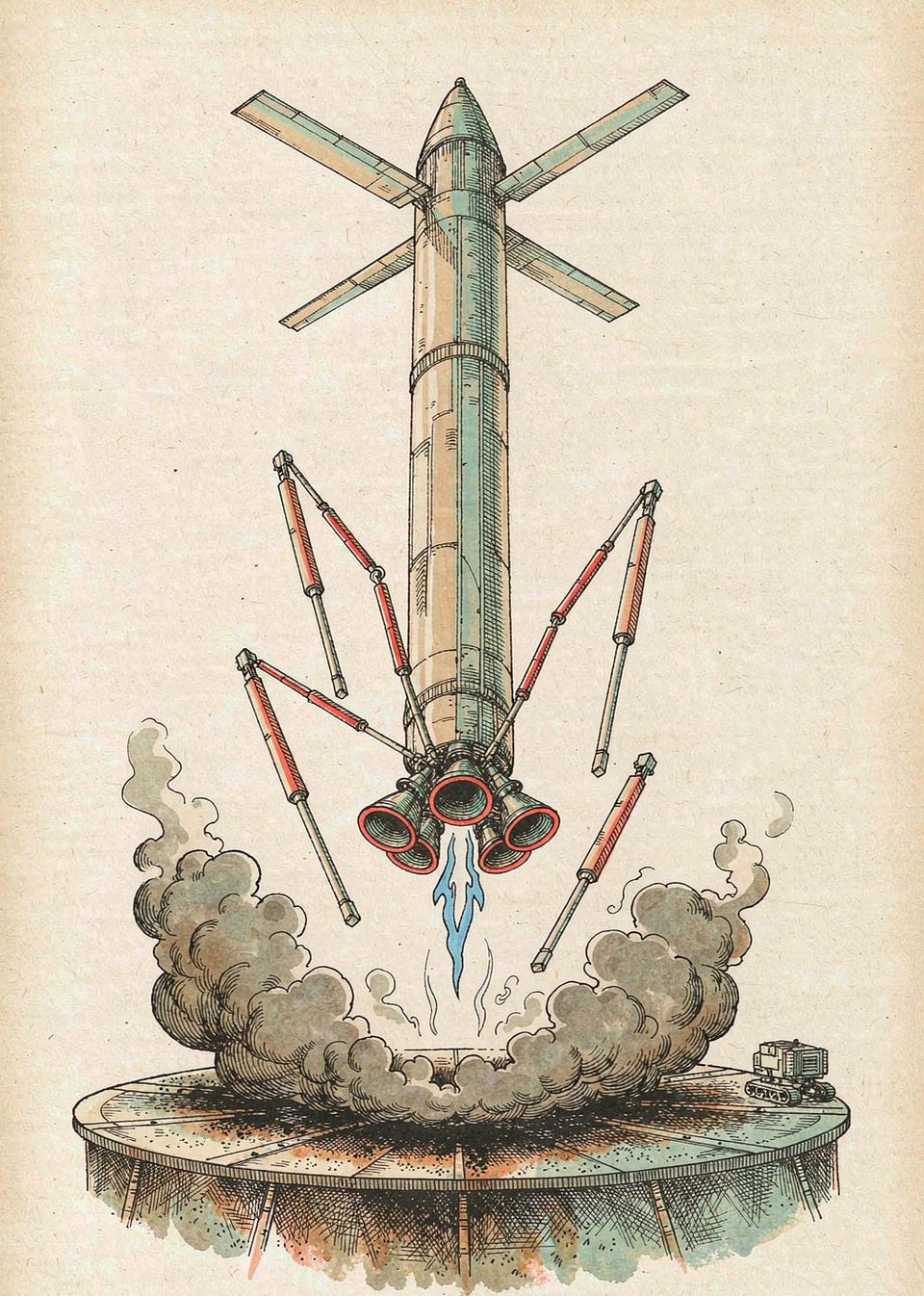
05Company history (1): from solid to liquid, 2015–2019
On 1 June 2015 LandSpace Space Technology Co., Ltd. was registered in Yizhuang, Beijing, and its headquarters long remained on Ronghua South Road, next to the China Academy of Launch Vehicle Technology—an area that later gathered about three-quarters of the country's commercial space companies and is known in the industry as Rocket Street. That year the company won a tens-of-millions angel round from Chuangxiang Angel Fund. In 2016 it completed a Series A of more than ¥100 million with Yongbai Capital, Shaanxi Financial Holdings Capital and others taking part, and in December signed a launch service contract with the Danish satellite company GomSpace; the signing ceremony was held in Hangzhou on 13 January 2017—the first commercial rocket launch service order in the international market signed by a private Chinese commercial space company. In 2017 the company also won a Series A+ of tens of millions of yuan from the Xi'an High-tech Zone investment fund, and more than ¥200 million of dedicated civil-military integration investment from Huzhou in Zhejiang.
Capital and facilities advanced almost in step. Between December 2017 and November 2018 LandSpace completed Series B and B+ rounds, the latter announced in November 2018 at ¥300 million, led by China Venture Capital, with China Jidian Investment, Xidian Tianlang Venture Capital and 36Kr Fund following, and existing shareholders Goldwind, Chuangxiang Angel and Zhongtian Century adding more. The Huzhou manufacturing base began conversion and expansion on 24 April 2018, and on 19 December that year the first phase passed completion inspection and was handed over—China's first private rocket and engine manufacturing base, and at the time Asia's largest private rocket factory. Two R&D centres in Beijing and Xi'an and a rocket manufacturing base in Huzhou, Zhejiang: the arrangement did not change for several years.
The technical tempo was just as dense. In January 2019 the gas generator of the ten-tonne-class TQ methalox engine completed a 1,000-second hot test; in February came a breakthrough in laser-welded sandwich nozzle technology, with the eighty-tonne TQ engine's nozzle jacket laser-welded successfully in a single pass—the first rocket engine nozzle in China to use the laser-welded sandwich process; in March the eighty-tonne engine passed a semi-system test firing; on 17 May the TQ-12 completed a twenty-second full-system test; in July it completed a 100-second full-thrust test and in October a 200-second throttling test; in November the ten-tonne-class TQ engine passed a full-system test firing. In August 2019, on the recommendation of the Beijing municipal government, LandSpace appeared at the fourteenth Moscow Air Show as the only private space company in the Chinese delegation.
The commercial side was laying its own markers. In December 2019 LandSpace signed Zhuque-2's first domestic rideshare launch service contract with the Changsha Tianyi Space Science Research Institute; the same month it announced a Series C of ¥500 million from Country Garden Venture Capital, bringing that year's total to ¥600 million. On 28 December 2019 construction began on the Jiaxing LandSpace centre, which would become the final assembly and testing base for the Zhuque series. In March 2020 a single test firing of the ten-tonne TQ engine reached 4,000 seconds and cumulative test time for one engine passed 10,000 seconds, fully validating the design, production, assembly quality and operating reliability of the engine. By around 2018, of nearly 200 employees two-thirds were technical staff working on rocket development; by December 2022 the company had more than 500 employees, with technical R&D staff making up more than 70%.
06Company history (2): engines, bases and capital, 2019–2023
2020 was the year of engines. On 13 May the Zhuque-2 control system was successfully matched with the TQ-12 engine, completing three gimbal test firings and marking the move into joint matching validation. On 14 July the second-stage vernier engine TQ-11 completed a single 3,000-second hot test, a domestic record for a single test firing of a pump-fed cryogenic liquid rocket engine. From 13 to 17 November the second-stage engines of Zhuque-2 passed a joint test firing, combining the eighty-tonne and ten-tonne TQ methalox engines. In December China's first methalox pintle injector to be validated by full hot-fire testing completed its test—one of the key technologies of a reusable rocket. In February 2021 the first-stage engines of Zhuque-2 finished final assembly; on 30 June the first phase of the Jiaxing LandSpace centre was completed and about to enter service.
The capital markets marked up the price accordingly. In September 2020 LandSpace announced a Series C+ of ¥1.2 billion led by Sequoia Capital China, Country Garden Venture Capital and Matrix Partners China, with a listed company under Cornerstone Capital co-leading, and China SME Development Fund, the Huzhou Saiyuan government fund, Lightspeed China, Gopher Asset, Yanfu Investment, Yunbai Capital, Hupan International, Sunac Investment, Luxin Venture Capital, Yisheng Investment and Juzhuo Capital following; the post-money valuation was ¥5.2 billion. With the ¥500 million Series C completed in the first half of the year, the company raised more than ¥1.8 billion over twelve months. The Series D closed in August 2021 and the Series D+ in February 2022. What these rounds had in common was the successful test firing of the eighty-tonne TQ engine in 2019—capital began to believe that this private company really could build a large-thrust methalox engine.
2022 was the year the product line closed up. On 20 October the vacuum version of the TQ methalox engine (TQ-15A) completed its first full-system test firing, with 836 kilonewtons of vacuum thrust, deep throttling from 60% to 110%, no vernier engine and a three-ignition capability. In November the first LandSpace auxiliary power unit, Yunque (YQ-10), passed a full-system test. On 14 December Zhuque-2 Y1 failed on its maiden flight from Jiuquan. Half a year later, on 12 July, Y2 reached orbit successfully, taking the world first for a methalox rocket. In August 2023 the company formally launched the Zhuque-3 reusable rocket programme; on 9 December Zhuque-2 Y3 completed a commercial launch with three satellites on one rocket. From the failure of the first solid rocket to consecutive successes with liquid rockets, LandSpace spent five years buying a technology route it could keep walking.
07Company history (3): Zhuque-3 and commercialisation, 2023–2025
Zhuque-3 is LandSpace's largest, most complex and most risky engineering project to date. In December 2023 the company unveiled the Zhuque-3 reusable methalox launch vehicle, planning first-flight capability by 2025; from programme launch to achieving orbit and recovery took only three years in practice, where a new model in traditional space usually takes five to eight years from programme to first flight. It is a single-core, two-stage, tandem-configuration rocket with stainless steel as the main structural material, and China's first stainless steel liquid launch vehicle: first and second stage bodies 4.5 metres in diameter, a 5.2-metre fairing, a total length of 66.1 metres, a take-off mass of about 560 tonnes and take-off thrust of 7,542 kilonewtons.
The first stage uses nine TQ-12A methalox engines in parallel, the second a single TQ-15A vacuum engine; the first stage carries a reaction control system, grid fins and landing legs, is designed for at least twenty reuses and, once mature, will lift no less than 18 tonnes to low Earth orbit in the downrange recovery configuration. The company discloses that the recoverable first-stage airframe accounts for about 70% of the cost of the whole rocket. In materials and processes Zhuque-3 uses high-strength stainless steel tanks and laser welding, and the company says large-diameter, ultra-thin-walled stainless steel tanks cut manufacturing cost by about 80% against aluminium alloy and shorten the production cycle by about 40%.
Validation came step by step. At 16:00 on 19 January 2024 the Zhuque-3 VTVL-1 reusable vertical take-off and landing recovery test rocket lifted off from Jiuquan, flying for about 60 seconds to an altitude of about 350 metres and landing with a position accuracy of 2.4 metres, a landing speed of 0.75 metres per second and a landing attitude angle of about 0.14 degrees: complete success. On 15 April that year the ten-kilometre-class VTVL test vehicle completed final assembly; on 11 September the VTVL-1 test vehicle successfully completed a ten-kilometre vertical take-off and landing return flight test, achieving China's first mid-air second ignition of a liquid engine. It was a landmark breakthrough for Chinese commercial space in reusable launch vehicle technology, and it smoothed the road to the orbital-class first flight a year later.
In the same year the improved Zhuque-2 took over commercial launches. At 10:00 on 27 November 2024 the improved Y1 made a successful maiden flight from the Dongfeng commercial space innovation test zone, placing the Guangchuan-01 and Guangchuan-02 test satellites into orbit. On 14 May 2025 the improved Y5 launched successfully with a customised 2.8-tonne test payload. On 17 May the improved Y2 placed six satellites, including Tianyi-29, into their planned orbits with six satellites on one rocket, generating launch service revenue of ¥35.69 million. But at 09:17 on 15 August the improved Y3 suffered an in-flight anomaly after ignition—a fault 258 seconds after lift-off, a short circuit in the power bus, and mission failure. LandSpace issued a statement that day saying it would carry out full fault attribution and technical improvement based on all the flight data. Zhang later defined the failure in interview as an opportunity: “We treat fault closure as an opportunity for systematic improvement.”
On 3 December 2025 Zhuque-3 Y1 lifted off from the Dongfeng commercial space innovation test zone; the second stage entered its planned orbit successfully and the first stage failed its vertical recovery test—an abnormal burn after the landing burn began left it unable to make a soft landing on the pad. It was China's first orbital-class launch and recovery verification of a reusable rocket. Afterwards Zhang said calmly at the press conference that the core objective had been met: “We have completed the engineering validation of a reusable rocket.” In August 2026 Zhuque-3's chief commander Dai Zheng disclosed the details of the failure: the first stage began its landing burn 3.3 kilometres above the ground, the burn sequence completed and the engine lit, then an abnormal burn developed and the stage finally crashed at the edge of the landing pad.
08Company history (4) 2026 — today's map
The first big event of 2026 was in the capital markets. On 29 July 2025 LandSpace completed IPO tutoring registration with the Beijing branch of the CSRC; on 23 December the status changed to tutoring completed; on 31 December the Shanghai Stock Exchange accepted its STAR Market IPO application, under the fifth set of STAR Market listing standards for commercial rocket companies, making it the first private liquid rocket company to file after the guidelines were issued. It entered enquiry on 22 January 2026; on 31 March the review was suspended because its financial data had passed its validity period; on 29 June it was restored to under enquiry after an updated prospectus. The offering seeks to raise ¥7.5 billion, all for reusable rocket projects, of which ¥2.77 billion is for capacity improvement and ¥4.73 billion for technology improvement, with China International Capital Corporation as sponsor.
The financials do not look pretty. The prospectus shows revenue of ¥3.9521 million, ¥4.2783 million and ¥52.0963 million in 2023, 2024 and 2025; net losses attributable to the parent of ¥1.188 billion, ¥876 million and ¥1.711 billion; and R&D expenses of ¥830 million, ¥613 million and ¥922 million. As of 31 December 2025 consolidated undistributed profits stood at minus ¥5.955 billion. The company explains that the Zhuque series is still at an early stage of commercial launch, that launch service revenue is small and unstable and hard-pressed to cover costs, and that aerospace equipment is a technology-intensive industry requiring sustained high R&D spending to keep technology advanced. The prospectus also warns that consolidated profitability is expected no earlier than 2029, while the performance targets under the option incentive plan require revenue of no less than ¥500 million in 2026 and no less than ¥1 billion in 2027.
Capacity and orders are being laid out in step. On the engine side, in April 2025 the Huzhou base saw its hundredth TQ-12A methalox engine roll off the line, marking the propulsion system's entry into volume production; local planning documents indicate capacity of more than 1,000 engines by 2030, with direct output value of ¥6 billion and knock-on industrial chain output of ¥20 billion. On the rocket side, in May 2026 LandSpace's Wuxi production base came into operation in Luoshe town, Huishan district—China's first rocket batch-production plant based on high-strength stainless steel and intelligent laser manufacturing, with capacity for twenty Zhuque-3 vehicles a year; the Jiaxing LandSpace centre continues to handle final assembly and testing. On the customer side, the company has signed formal launch service contracts with China Satellite Network Group and Shanghai Yuanxin Satellite, Zhuque-3 has been included in China SatNet's list of core launch vehicle suppliers, and it won a tender for an eighteen-satellite launch service in Yuanxin Satellite's 2025 launch services procurement.
Then came 19 August. At 07:35 Beijing time Zhuque-3 reusable Y2 lifted off from the Dongfeng commercial space innovation test zone; about 137 seconds after lift-off the first and second stages separated, the second stage flew on and placed the Hongqing Technology-built Honghu-03 satellite accurately into its planned orbit; at about 07:41 the first stage made a successful soft landing under programme on the Zhuque-3 landing pad in Minqin county, Gansu. This was China's first recovery of a launch vehicle first stage by landing legs, and its first land recovery of an orbital-class first stage; LandSpace thereby became the fourth company in the world to recover an orbital-class first stage. The mission also carried a company-developed non-pyrotechnic stack clamp-and-release device, preparing the ground for the batch rapid deployment of future large constellations. At 14:26 on 15 September the improved Zhuque-2 Y7 placed ten satellites of the Qianfan polar-orbit group 19 into orbit with ten satellites on one rocket, the first time a private Chinese commercial space company has undertaken a scaled constellation deployment mission for a large satellite internet constellation.
09Leadership style and temperament: a chairman who does not do engineering
The first element of Zhang's management style is clarity about his own position. From day one he had no intention of being a technologist—he has always felt more like a businessman—and his employee number is 001. That self-definition produces a rare restraint: he does not settle aerodynamic layouts at technical reviews but leaves technical decisions to people from the space system such as Wang Jianmeng, Wu Shufan, Zhang Long and Dai Zheng, while he watches capital, strategy, government relations and organisation himself. In 2018 he told Jiemian News plainly: “as a private company, there is no competition with the ‘national team’ in the market demand we serve or the technical direction we take”, adding that “with the ‘national team’ it is certainly a complementary relationship. For at least the next ten years we will probably remain a supplement.” Such a low posture is not common among founders.
The second element is looking upwards in hiring. When he started the company at 31 he brought in Wang Jianmeng, 60, and Wu Shufan, 50—both older than him and both more expert. That choice takes considerable confidence, and a willingness to let others carry more authority than oneself. The composition of the company's executives confirms the same logic: the director and deputy general manager Zhang Chen came from PwC, the board secretary Zhang Yujiao worked at King & Wood Mallesons for more than seven years, and the chief financial officer Tan Shuting came from Bank of China. Finance and professional services are strongly represented in LandSpace's senior ranks, forming two distinct groups alongside the technical core. Zhang's hiring standard can be summed up as: find people who can get things done, not people who will do as they are told.
The third element is his approach to external communication. When fundraising was hard in the early days his strategy was to talk less about the story, more about progress, and let facts speak: promise a core team in three months and deliver in three months. His private self-projection is entirely different: according to Huashang Taolue, he once posted a Star Wars poster on WeChat Moments captioned “after the baptism of battle, Luke Skywalker had become a superb freedom fighter”. That post sits at a clear distance from the management vocabulary of system, closed loop, alignment and fault closure he uses at press conferences—the public Zhang Changwu is almost never emotional, and after the failed recovery on the December 2025 maiden flight he said only, calmly, that the core objective had been met and that they had completed the engineering validation of a reusable rocket.
The fourth element is his attitude to money and time, and it is the most tested of all. In 2018 he said that developing a launch vehicle was not a particularly money-burning business, with funding needs topped out at a few billion renminbi. Seven years later the company's annual R&D expenses were ¥922 million, its annual net loss ¥1.711 billion and its accumulated undistributed profits minus ¥5.955 billion. He has not avoided the gap but redefined it as a question of time: “To make money in commercial space is not a sprint; it is a marathon that needs long-term strategic resolve and patient capital.” He also stresses repeatedly the coordination of technology route, patient capital and a clear commercial closed loop, and concedes that while starting the STAR Market process the company must build a long-term funding system, preparing for five to ten years of sustained investment. Compared with entrepreneurs of his generation, Zhang talks unusually little about speed and a great deal about tempo.
10The method behind the success: how an outsider built a rocket
First, he chose the right window. In 2014 global demand for low-orbit launches was building while supply was severely short; in November that year a State Council document for the first time explicitly encouraged private capital to take part in national civilian space infrastructure; in 2015 SpaceX's Falcon 9 achieved its first successful recovery—policy, demand and technological paradigm loosened at the same moment. Zhang is not a technological breakthrough-maker, but he was one of the first to look at those three things together, and he began betting seven or eight years before the market really exploded. His own words: “At that time we already felt the water in this market heating up.”
Second, he used equity to solve what he did not understand. He did not go and take a space degree; he made Wang Jianmeng and Wu Shufan partners. Third, he dared to go all in at the critical moment: after Zhuque-1 failed in 2018 he abandoned non-reusable solid rockets and turned all resources to the methalox route, which at the time had no precedent anywhere for reaching orbit. Fourth, he tied fundraising to technical milestones: the successful eighty-tonne TQ test firing in 2019 corresponded to the ¥500 million Series C and the ¥1.2 billion Series C+ of 2020 at a post-money valuation of ¥5.2 billion; the successful orbital launch in July 2023 corresponded to the ¥1.22 billion raised that December at a post-money valuation of ¥17.7 billion; in December 2024 the National Manufacturing Transformation and Upgrading Fund put in ¥900 million in a single round. More than ¥7 billion was raised over ten years.
Fifth, he built the supply chain himself. When engines could not be bought in 2015 he made them; thereafter Huzhou built engines, Jiaxing handled final assembly and testing, and Wuxi built a stainless steel smart factory, three bases with clear division of labour. Sixth, he borrowed the momentum of national strategy. Formal launch service contracts with China SatNet and Yuanxin Satellite, inclusion in China SatNet's list of core launch vehicle suppliers, the STAR Market's fifth set of listing standards for commercial rockets—none of these can be won on product performance alone. Seventh, he has a method for handling failure: fault closure, debriefing, and verification through repeated launches—a dedicated group after Zhuque-1 failed; frame-by-frame analysis and more than a hundred reproduction experiments after the 2022 loss, with fault closure review passed on 18 March 2023; tighter supply-chain quality and verification review after the improved Y3 was lost in August 2025.
Eighth, and most easily overlooked: his patience with time. From registration in 2015 to orbit in 2023 was eight years; from the launch of the Zhuque-3 programme in 2023 to successful recovery in 2026 was three years, where a new model in traditional space usually takes five to eight years from programme to first flight. Taken apart, the copyable part of his success is method—find the right people, tie fundraising to milestones, close faults after failure, keep the supply chain in your own hands—and any deep-tech founder can learn that. The part that cannot be copied is the era: the frequency-and-orbit deadlines for China's low-orbit constellations, the state's gradual opening of private space access, the fifth set of STAR Market standards for unprofitable deep-tech companies, and a primary market willing to keep transfusing money into a company that will not make a profit for ten years. He recognises those limits himself, which is why he talks about aligning the technology route and the business model at the right point in time rather than about being cleverer than others.
11The person, values and life: choose one thing, and stay with it for life
Zhang Changwu was born in 1983 and is 43 in 2026. His family life is almost entirely outside the public view, and the one family relationship repeatedly mentioned is his father-in-law Wang Jianmeng—both an elder and a partner and vice-chairman. That relationship is quite rare in a Chinese startup: what he gained from his father-in-law was not only technical resources but the connections and trust of a whole generation of space professionals. His decision to put the headquarters in Yizhuang continues that geographical closeness—there, next to the China Academy of Launch Vehicle Technology, about three-quarters of the country's commercial space companies have gathered, forming a Rocket Street.
His public roles have multiplied quickly in recent years. In January 2025 he was added to the fourteenth Beijing Municipal Committee of the Chinese People's Political Consultative Conference, in the science and technology sector. In a group interview under the “I am a committee member” banner on 23 January 2026, before the full session of the municipal CPPCC, he spoke of Beijing's commercial space companies growing from fewer than fifty to more than three hundred, of an industry scale past ¥100 billion, and of a pattern of rockets in the south, satellites in the north taking shape. He also takes part in events as an executive committee member of the APEC China Young Leaders Committee, and has returned to Tsinghua several times to give reports—in April 2024 he gave a keynote on Commercial space: opportunities and challenges at Tsinghua's New Ideas, New Technology, New Talent forum; on 8 May 2026 he gave a report on Cultivating new quality productive forces: emerging and future industries from the perspective of commercial space at the Zhejiang provincial Party school's Common Prosperity and Good Governance lecture series, attended by 186,100 people online and on site.
The honours list is long: in 2018 he was selected as an innovation and entrepreneurship talent by the Ministry of Science and Technology, and named a science newsmaker of the year by China Science Daily; in 2019 he won the China Economic Person of the Year rising star award and was named fifth in Fortune China's 40 business elites under 40; in April 2023 he won the commercial space person of the year award; in November 2024 the sixteenth Aerospace Laurel Award for a figure of the times; in April 2025 the title of Beijing municipal model worker. One phrase he uses repeatedly in public is “choose one thing, and stay with it for life”. For a man who came out of HSBC and did not begin building rockets until he was 35, the line reads less like an innate conviction than a self-confirmation repeatedly verified by ten years of time.
Details of his life are made public very rarely. He seldom discusses personal interests, wealth or family, and his public image is essentially the company's image—dark suits, a level speaking pace, a preference for engineering and management vocabulary. The one relatively unguarded moment was that Star Wars post on WeChat Moments. The two courses he took at Tsinghua—critical thinking and moral reasoning, and managerial economics—are probably closer to his actual work than any technical course: in an industry full of uncertainty his daily task is not solving equations but judging, on incomplete information, where the money should be placed next.
12National and epochal significance: from supplement to main launch capacity
LandSpace's ten years cover the whole cycle of Chinese commercial space from zero to scale. Before 2014, China's ability to reach space lay entirely in the hands of the state system; policy broke the ice in 2014, and 2015 was called the first year of Chinese commercial space. By 2025 the China National Space Administration had issued the Action Plan for Promoting the High-Quality and Safe Development of Commercial Space (2025–2027), bringing commercial space fully into the overall layout of national space development through five categories and twenty-two articles; that year the CNSA set up a commercial space department and announced a National Commercial Space Development Fund. On 26 December 2025 the Shanghai Stock Exchange issued guidelines applying the fifth set of STAR Market listing standards to commercial rocket companies, opening a capital channel for unprofitable deep-tech companies. Institutions, capital and technology aligned in the same year.
Zhang's position in that landscape has changed fundamentally once in ten years. In his 2018 Jiemian News interview he said: “With the ‘national team’ it is certainly a complementary relationship. For at least the next ten years we will probably remain a supplement.” By 2026 Zhuque-3 is a new-generation low-cost, high-capacity, high-cadence, reusable methalox launch vehicle whose programme was approved by the CNSA and for which LandSpace is the prime contractor, with the CNSA organising the entire engineering line and drawing commercial space companies into major national missions. On 19 August 2026 the CNSA announced that the mission was China's first successful controlled land recovery of a reusable launch vehicle first stage by landing legs, and stated clearly that it marks a major breakthrough in China's reusable rocket technology. From supplement to prime contractor: that shift of position is itself the most accurate gauge of ten years of Chinese commercial space.
Seen in global competition, the significance is clearer. By one account SpaceX completed 167 orbital launches in 2025, breaking its own record for a sixth consecutive year, with more than 9,300 Starlink satellites in orbit; China carried out 78 launches in the same period (including Zhuque-3's maiden flight), using more than a dozen different rocket models. The cost gap is generational: a Huayuan Securities research note shows China's commercial space average launch cost in 2024 at about ¥75,000 per kilogram, while SpaceX, with mature reusable technology, had it at about ¥20,000 per kilogram. Zhuque-3's target is to bring the cost per kilogram below ¥20,000. At the same time, International Telecommunication Union frequency and orbit resources follow first-come, first-served, and at the end of 2025 China submitted an application to the ITU for spectrum and orbit resources for a further 203,000 satellites, covering fourteen constellations. That means launch capacity is no longer merely a commercial matter but a nation's ticket of entry to low orbit.
LandSpace's breakthrough also makes China the second country after the United States to master both sea-based and land-based rocket recovery routes—the Long March 10B using sea-based net recovery, Zhuque-3 using landing legs and vertical take-off and landing. And the significance of Zhuque-3 goes further: it is the achievement of the fourth company in the world to recover an orbital-class first stage, and China's first launch vehicle to reach orbit and then achieve a land recovery. For the industry the spillovers are just as concrete—hundreds of suppliers in Huzhou, Jiaxing, Wuxi, Hangzhou and Nanjing have been pulled into one industrial chain, and capabilities that were previously scattered, such as laser welding of stainless steel tanks, grid fins, cryogenic control valves and sensors, have been driven to upgrade by real flight missions. If LandSpace's STAR Market IPO goes through, it will become the first commercial space stock on China's capital markets. In a 2026 remark at the Beijing municipal CPPCC, Zhang put the matter more simply than any set of accounts: “choose one thing, and stay with it for life.”
| Valuation / standing | LandSpace is one of the highest-valued private commercial space companies in China and among the furthest advanced towards an IPO. At its April 2025 capital increase its post-money valuation was about ¥20.8 billion; the 2025 Global Unicorn Index ranked it 418th on a valuation of ¥20 billion. After its STAR Market IPO application was accepted on 31 December 2025, the market extrapolated a valuation of about ¥75 billion from the ¥7.5 billion it seeks to raise—a market estimate rather than a valuation disclosed by the company. Technically, LandSpace is the only private company in China to have completed an orbital test of a medium-sized reusable liquid rocket, and on 19 August 2026 it became the fourth company in the world to recover an orbital-class first stage. |
|---|---|
| Basis and year | Post-money valuations: ¥5.2 billion after the Series C+ in September 2020; ¥17.7 billion after the funding round in December 2023; about ¥20.8 billion after the capital increase in April 2025. Unicorn index: ¥20 billion in the 2025 listing. IPO extrapolation: about ¥75 billion against the ¥7.5 billion sought, a media estimate; the company has not disclosed an offering valuation. Financials: revenue of ¥3.9521 million, ¥4.2783 million and ¥52.0963 million in 2023, 2024 and 2025; net losses attributable to the parent of ¥1.188 billion, ¥876 million and ¥1.711 billion. |
It comes down to policy, talent and money. If Musk can do it, there's no reason we can't.
According to a report in Huashang Taolue, this is what Zhang Changwu said to friends when he resigned from the bank and decided to build rockets. At the time his knowledge of rocket technology and manufacturing was close to zero, and most of those around him told him bluntly not to bother. He broke an apparently impossible task into three soluble variables: policy loosened at the end of 2014, talent could be coaxed out of the state system, and money could be found round by round. That decomposing optimism is both why he was able to hold on for the next ten years and why he dared to bet everything on liquid oxygen–methane after the failure of 2018—to his mind, the difficulty was simply a problem not yet taken apart.
In the early days we were often taken for crooks.
Zhang recalled the fundraising climate of around 2015 to Huashang Taolue. The questions investors asked—whether a private company could assemble specialised talent across the whole chain, whether the state would allow it to launch, whether it could use a launch site—could not be answered at the time even by people inside the industry. His response was not to argue: he promised to assemble a core team within three months, and delivered within three months. Once the team took shape, investors believed that people in the state system really were willing to give up the iron rice bowl. The line is often quoted by entrepreneurs, but its point is not grievance; it is that he chose delivery rather than narrative to buy trust.
Talk less about the story, more about progress, and let facts speak.
This is Zhang's own account of his fundraising method, from an interview with Huashang Taolue. In an industry like commercial space, where returns are measured in decades, the line has concrete operational meaning: in December 2017 the gas generator of the ten-tonne-class liquid oxygen–methane engine achieved its first successful ignition; in March 2018 the thrust chamber passed its test firing; in May 2019 the eighty-tonne TQ-12 completed a twenty-second full-system test firing—each technical milestone corresponded to the closing of a funding round. More than ¥7 billion was raised over ten years, and every sum priced a technical milestone rather than current-year revenue.
Until a launch is completed, the question of whether a private company can build a rocket will never have an answer.
Around 2018 Zhang explained to the media why he was in such a hurry to get Zhuque-1 off the ground. LandSpace had by then raised eight rounds, yet had not put a single rocket into the air. His judgment was that if even this question could not be answered, the whole industry would have no basis for survival. On 27 October 2018 Zhuque-1 lifted off from Jiuquan; the third stage malfunctioned and the satellite failed to reach orbit. It did not give a handsome answer, but it took LandSpace through the entire chain from development and testing to launch, and won China's first launch licence for a private carrier rocket. The form of the question changed, and only then did answers begin to accumulate.
For LandSpace, Zhuque-1 was a bitter lesson and an extremely valuable asset. As long as there are holes in quality control, the risk will surface sooner or later. If not this time, then the next.
Zhang's debrief after the failure of Zhuque-1's maiden flight in 2018. He did not pin responsibility on any single link but reduced it to an inevitable risk of the quality control system: holes do not disappear, they only choose which flight to surface on. The line became the undercurrent of how LandSpace handles failure—after the loss of Zhuque-2 Y1 in 2022 the company set up a dedicated working group to analyse telemetry frame by frame and ran more than a hundred fault-reproduction experiments, clearing the expert review for fault closure on 18 March 2023; after the improved Y3 was lost in 2025 it immediately tightened supply-chain quality and verification review.
After the baptism of battle, Luke Skywalker had become a superb freedom fighter.
According to Huashang Taolue, Zhang once posted a Star Wars poster on WeChat Moments with this film line as the caption. It is one of the few acts of self-projection by a founder who rarely shows emotion: the path of Luke Skywalker from farm boy to resistance fighter, and his own from an HSBC office into a rocket assembly plant, probably corresponded in his imagination in some way. Just as telling is the gap—in public his vocabulary is system, closed loop, alignment, fault closure, not the stars and the sea. That gap is an entry point to his character.
We have completed the engineering validation of a reusable rocket.
On 3 December 2025 Zhuque-3 Y1 reached orbit successfully and the first stage failed to land. Zhang set the tone with this sentence at the press conference. Attention outside was fixed on the words recovery failure, while he stressed the other half: the rocket had flown, and they had obtained the most valuable first-hand measured data from the return phase. Eight months later, on 19 August 2026, Zhuque-3 Y2 set its first stage down steadily on the landing pad in Minqin, Gansu. Read again, the sentence looks more like a progress assessment than consolation—redefining a partial success as a completed stage is his most-used method in long-cycle engineering.
To make money in commercial space is not a sprint; it is a marathon that needs long-term strategic resolve and patient capital.
From an Economic Information Daily interview with Zhang in December 2025. LandSpace's finances at the time: revenue of ¥3.9521 million, ¥4.2783 million and ¥52.0963 million in 2023, 2024 and 2025 respectively, with net losses attributable to the parent totalling more than ¥3.7 billion over the three years, and the prospectus forecasting that consolidated profitability would come no earlier than 2029. To speak of a marathon against numbers like these is both expectation management for investors and self-discipline about the company's tempo—what he stresses repeatedly is patient capital, not faster.
What LandSpace does is align the technology route and the business model at the right point in time.
From the same Economic Information Daily interview. Zhang reduces the conditions for success in commercial space to three variables: technology route, business model and timing. His judgment is that being right on each of the three separately means nothing; they have to align at the same moment. The line explains several key decisions—abandoning solid rockets for liquid in 2018, just as policy and the supply chain opened up; starting the Zhuque-3 programme in August 2023, just as Zhuque-2 had reached orbit and reusability was beginning to be proven; and launching the STAR Market process in 2025, just as the fifth set of listing standards took effect.
We are committed to developing a new generation of liquid oxygen–methane rocket propulsion technology, boldly adopting low-cost airframe materials, steadily raising the flight rate and improving our test and launch capability.
Zhang described LandSpace's technical direction in a 2024 interview with Science and Technology Daily. The line maps almost item by item onto Zhuque-3's design choices: methalox propulsion—nine TQ-12A engines in parallel on the first stage; low-cost airframe—high-strength stainless steel in place of aluminium alloy, with the company saying that large-diameter, ultra-thin-walled stainless steel tanks cut manufacturing cost by about 80% against aluminium alloy and shorten the production cycle by about 40%; higher cadence—the improved Zhuque-2 compressed the interval between two missions in May and June 2026 to 26 days. In the same interview he added one bottom line: hold firm to the baseline of quality and safety.
Using liquid oxygen–methane can bring propellant costs down by about ten times.
Zhang's calculation in a 2018 interview with Jiemian News, drawn from his breakdown of the cost structure: propellant accounts for about 80% of a launch vehicle's own weight and about 30% of the launch cost chain, an absolutely dominant share, so the choice of propellant directly determines launch cost. He also noted that methane burns cleanly without carbon deposits, so the engine needs no cleaning afterwards, which is friendly to reuse. The remark was made in an era when no liquid oxygen–methane rocket anywhere in the world had reached orbit—both a technical judgment and a public bet on an unproven route.
With the “national team” it is certainly a complementary relationship. For at least the next ten years we will probably remain a supplement.
His words in the 2018 Jiemian News interview. LandSpace was three years old, the domestic commercial rocket market was just starting, and Zhang deliberately placed himself in the position of a supplement—“in terms of positioning, as a private company, there is no competition with the ‘national team’ in the market demand we serve or the technical direction we take”. Eight years later, Zhuque-3 is a model whose programme was approved by the China National Space Administration and for which LandSpace is prime contractor, and the CNSA called it a major breakthrough in China's reusable rocket technology. From supplement to prime contractor is the most visible shift in position in ten years of Chinese commercial space.
First-stage recovery verification can be compared with the lithography machine in the semiconductor industry.
According to several Chinese financial sources, Zhang used this analogy to explain the place of first-stage recovery in commercial space. The logic: lithography sets the ceiling on the cost and output of chips, and first-stage recovery sets the ceiling on the cost and frequency of access to space. On 19 August 2026 the first stage of Zhuque-3 Y2 landed successfully at Minqin in Gansu, making LandSpace the fourth company in the world to recover an orbital-class first stage. His next judgment: once recovery and reuse mature and launch costs fall sharply, larger vertical-recovery applications will genuinely open up.
The rocket launch market is big enough to accommodate several companies at once.
In the 2018 Jiemian News interview, Zhang responded to the question of whether private rockets would end in a price war. He added a more important judgment: how far a company can really go depends on its independent R&D capability and core technology, and on whether it has a sound management system. Eight years later the market tested the judgment: all five leading companies—LandSpace, Space Pioneer, Galactic Energy, iSpace and CAS Space—have started STAR Market IPO tutoring, while the earlier Starter Space has had no public news since the second half of 2022, and OneSpace turned to engines and launch vehicles after a failed launch in 2019.
As things stand, developing a launch vehicle is not a particularly money-burning business. The funding required for development tops out at a few billion renminbi.
The most quoted and most tested line from the 2018 Jiemian News interview. His reference points then were the internet and car industries, and he thought the sums involved in rocket development were a drop in the bucket. Seven years later the accounts tell a different story: R&D expenses of ¥922 million and a net loss attributable to the parent of ¥1.711 billion in 2025, with consolidated undistributed profits of minus ¥5.955 billion as of 31 December 2025. This is not a lie but an underestimate of how fast the ceiling keeps being pushed up—and a reminder to readers that a founder's early understanding of an industry is often revised by time.
While starting the STAR Market process we are also building a long-term funding system, preparing for five to ten years of sustained investment.
From the December 2025 Economic Information Daily interview. Zhang sums up the conditions for success in commercial space as the coordination of technology route, patient capital and a clear commercial closed loop, in which patience on the part of capital is a key link. The immediate context: LandSpace's STAR Market IPO seeks to raise ¥7.5 billion, all of it for capacity and technology upgrades for reusable rockets; the company has also signed formal launch service contracts with China Satellite Network Group and Shanghai Yuanxin Satellite. He made no promise about when profitability would come, stretching the time frame directly to five or ten years.
In the next ten years Chinese commercial space will show six features: systematisation, high cadence, low cost, reuse, internationalisation, and healthy order.
In December 2025, asked in the Economic Information Daily interview how he would describe Chinese commercial space ten years from now, Zhang gave these six keywords. He expanded on each: systematisation means deep integration of the industrial and innovation chains; high cadence means launches as steady and orderly as airline flights; low cost means access to space is no longer out of reach; reuse means recovery becomes routine; internationalisation means competing and cooperating globally; healthy order means the industry's tempo becomes more rational. The six words can also serve as an index to LandSpace's own road map, in which reuse corresponds precisely to Zhuque-3.
Choose one thing, and stay with it for life.
On 23 January 2026, on the eve of the opening of the fourth session of the fourteenth Beijing Municipal Committee of the Chinese People's Political Consultative Conference, Zhang described his mission as a space professional in this way during a group interview under the “I am a committee member” banner; he used the phrase again on 8 May that year when giving a report at the Zhejiang provincial Party school. Against his CV the line is not a light one: he resigned from his banking job at 35 to enter the space industry, he is 43 in 2026, and over ten years the company has accumulated losses of several billion renminbi and lived through two failed maiden launches and one failed recovery. What he answers with the line is not achievement but the industry's long cycle—as he says elsewhere, commercial space is not a sprint.
- LandSpace website, “Zhuque-3 reusable Y2 launch vehicle achieves complete success in reaching orbit and recovering,” 2026
- China National Space Administration, “China successfully carries out its first land recovery of a reusable launch vehicle,” 2026
- CCTV.com, “Focus Interview: Zhuque-3 recovered successfully, another breakthrough for China's hardcore space technology,” 2026
- Economic Information Daily, “LandSpace chairman Zhang Changwu: making money in commercial space is not a sprint but a marathon,” 2025
- Huashang Taolue, “He is the boss of Zhuque-3, the man who brought the rocket home,” 2026
- Jiemian News, “LandSpace founder Zhang Changwu: developing a launch vehicle is not a particularly money-burning business,” 2018
- Guangming Daily, “Private commercial space: how to take the first step well” (interview with Beijing LandSpace CEO Zhang Changwu), 2017
- Science and Technology Daily, “Deep Focus: how commercial space can go far and steady” (quoting LandSpace founder and CEO Zhang Changwu), 2024
- Xinhua, “China's first privately developed liquid launch vehicle to succeed on consecutive launches: highlights of Zhuque-2,” 2023
- Xinhua Daily Finance, “LandSpace's STAR Market IPO review status restored to ‘under enquiry’,” 2026
- STAR Market Daily, “LandSpace updates its STAR Market IPO prospectus materials: plans to raise ¥7.5 billion, all for reusable rocket projects,” 2026
- Changjiang Times, “Zhang Changwu sharpens his sword for ten years and soars: LandSpace, valued at ¥75 billion, races to be the first commercial space stock,” 2025
- Securities Times, “Commercial space: a major breakthrough!” (improved Zhuque-2 Y7 with ten satellites on one rocket), 2026
- Beijing Business Today, “Beijing's 2026 two sessions: municipal CPPCC member Zhang Changwu says space achievements are deeply embedded in urban development and people's livelihoods,” 2026
- Party School of the CPC Zhejiang Provincial Committee, “The fifth lecture in the Common Prosperity and Good Governance series on cultivating and strengthening emerging and future industries,” 2026
- Sina Finance, “¥3.5 billion burned in three and a half years: a group of finance people take a ‘rocket’ to the STAR Market,” 2026
- Phoenix Finance, “¥7 billion raised in 10 years and the world's first methalox rocket to orbit—why does LandSpace still face a profitability problem?,” 2026
- CNR, “The rocket the Yangtze River Delta pieced together flew back by itself!,” 2026
- Huzhou Municipal Development and Reform Commission, “Reply on the handling of proposal No. 109 of the fifth session of the ninth Huzhou municipal CPPCC,” 2026
Yang Zhao
A PhD in theoretical physics from Stanford, where he studied black holes and gravity. In 2021 he founded Energy Singularity, pursuing the high-temperature superconducting tokamak route. In 2024 the company completed Honghuang 70, the world's first all-high-temperature-superconducting tokamak; in 2026 it raised a further round to push ahead with the next-generation device.
01Family and early years: A Xi'an boy, a clarinet and the call of physics
Yang Zhao was born in April 1991 in Xi'an, Shaanxi, of Han ethnicity. Public material about his family is extremely thin: he almost never discusses his parents' occupations or circumstances, and leaves only one detail in a self-account—in the second year of primary school his parents enrolled him in a class near home, and he, “sickly and frail”, picked out the clarinet at a glance from among several instruments. In Xi'an in those years there were plenty of children's arts classes; a thin boy carrying a long black instrument case through the school gate became the most vivid image of his childhood. No conservatory training, no family to lean on—this is a rare soft underlayer in his life story, one he himself returns to again and again, and it explains why he always speaks of “environment” rather than “talent”: the right people and the right atmosphere can hold up a boy who starts out unremarkably.
He practised the clarinet for five years. Classes were small: the teacher demonstrated first, then five or six children each played on their own; the textbook took primary pupils only through the first twenty pieces, but he read on by himself, and around the seventieth piece he came to Butterfly Lovers: “With the fragmentary knowledge I had, I felt my way along the keys and played it, half-understanding.” His primary school needed a wind band for the Monday flag-raising ceremony, so every Monday he carried his instrument case to school and became known throughout the school for that one small thing. In the fourth year a girl who also played the clarinet transferred in; she was better than him and her case was finer than his plastic one, and after school the two stayed in the classroom matching scores, arguing and testing notes, and many dusks passed that way. Years later he wrote it up as a moment of “a knowing smile, a meeting of minds”, and as the earliest happiness he had felt at making a difficult thing go smoothly.
After middle school he stopped taking clarinet lessons, practised only occasionally in junior high, and gave it up altogether when he began boarding at senior high. In those years he travelled with Shaanxi's physics competition team; at night his roommates played a music rhythm game, and he and another boy who had learned the violin won easily, while teammates with no musical training sweated and could not catch up. In 2009 he entered the Department of Physics at Peking University—he was eighteen that year. By his own account it was only after arriving at Peking University that he first systematically learned what branches physics has and which problems would decide the direction of the next decade of human life; it was also then that controllable nuclear fusion first entered his field of view and was taken up as a “lifelong goal”. A music-loving boy from Shaanxi handed the main line of his life to plasma.
It is worth noting that he grew up in exactly the years when China's private technological forces began pushing deep into hard technology. Many of his contemporaries watched the mobile internet take off in their fourth year of university and ran into the first wave of artificial intelligence on graduating; he fixed his eyes on a direction with a longer cycle, a more distant return and a higher failure rate. This habit of “choosing a problem ten years early” was already visible when he was an undergraduate, and it later became one of his most distinctive traits—he says repeatedly that he prefers the kind of thing that “whether or not I do it, sooner or later someone will”, because that is the inevitable trend of history.
02The founding impulse: From black holes and string theory to entrepreneur-in-residence at GSR Ventures
In the Department of Physics at Peking University he ranked in the top five per cent of his year. As an undergraduate he followed controllable fusion technology, but at that time in China fusion was still the domain of big-science facilities and the national team, and there was little a student could do. In 2013 he went to the Department of Physics at Stanford University in the United States to study for a doctorate, finishing the degree in four years; his research was in quantum gravity and string theory—in his words, “some basic physics that is rather far from this world”. His doctoral work sat at the intersection of quantum information and quantum gravity: using random tensor networks to characterise holographic duality, and deep learning to predict the quantum structure of spacetime. On the surface these topics have nothing to do with fusion, yet they gave him two things that later mattered enormously: the ability to write an extremely complex system as a concise equation, and an intuition for “trading algorithms for compute, and for cost”.
His best-known paper is “Holographic duality from random tensor networks”, published in 2016 with Stanford colleagues and cited more than four hundred times on Google Scholar; in 2017 he published “Learning the spacetime geometry from entanglement features” with Yizhuang You and Xiao-Liang Qi, formalising “finding the optimal random tensor network” as a deep-learning problem, one of the early works at the intersection of artificial intelligence and string theory. Baidu Baike summarises the research direction as “using quantum information methods to study quantum gravity and the geometric structure of black holes”, and says he “was the first to complete cross-disciplinary research between artificial intelligence and string theory”. Beyond the papers, the period also gave him a habit his colleagues still praise—write the “zero-dimensional code” first, define the goal clearly, and then make every subsystem align with it.
After completing his doctorate in 2017 he did not take the academic path but stayed in the United States for a year. “I just felt that sooner or later I would have to do something like fusion, and you still have to realise it through starting a company. But having just graduated I had no idea what to do,” he later explained that blank year. At the end of 2018 he returned to China and first became an entrepreneur-in-residence (EIR) at GSR Ventures; in May of that year he registered Yuanyue Technology in Beijing, using artificial intelligence to accompany children practising the piano—starting from accompaniment, it tried to make AI imitate the teaching behaviour of a professional music teacher. The company had nothing to do with fusion, yet it was a “catching up” he arranged deliberately: from product development and marketing to the rhythm of fundraising, he walked the whole zero-to-one commercialisation process. According to reports, Yuanyue Technology accumulated several million users, received a ¥10 million angel round from GSR Ventures on 17 April 2019, and was deregistered in January 2022.
His summary of those three years is quite clear: filling in the commercialisation gap between a researcher and an entrepreneur. The period also left a hidden thread—his first company chose music not by accident but as a return to that primary-school clarinet; in his self-account he writes that education has so many flaws only because it is so universal that everyone takes them for granted, and that artificial intelligence and the internet can help most people over that threshold. This idea of “using technology to flatten thresholds” was later transplanted almost unchanged onto fusion: turning an extremely expensive big-science facility into a product whose cost can be calculated and which can be delivered in quantity.
03The hardest gate: Four people's “zero-dimensional code” and a magnet that never went into the device
In March 2021, through an introduction, he met the veteran investor Ye Yuming—a graduate in automotive engineering from Tsinghua University with a master's in technology economics and management from Tsinghua's School of Economics and Management, who had long worked in private equity at Guangxin Capital. Ye Yuming was then looking to enter the new-energy sector, and someone recommended to him “a little Stanford genius who wants to do controllable fusion”; through a mutual friend the thirty-three-year-old Ye Yuming met Yang Zhao, who had just turned thirty, and the two took to each other at once. On 2 June that year Energy Singularity Energy Technology (Shanghai) Co., Ltd. was registered in Shanghai with registered capital of ¥1.9681 million and Yang Zhao as legal representative. The four founding members were Yang Zhao, Ye Yuming, Dong Ge and Li Zhuyong: Yang Zhao and Dong Ge were Peking University alumni who had both studied physics abroad, Dong Ge with a postdoc at Princeton, and Li Zhuyong an associate researcher in the Department of Electrical Engineering at Shanghai Jiao Tong University and a specialist in high-temperature superconducting magnets. This was China's first startup aiming at the commercialisation of fusion energy.
The hardest gate was not on the drawing but in the fact that nobody believed. The global mainstream at the time was the low-temperature superconducting tokamak—China's EAST, South Korea's KSTAR, Japan's JT-60SA and the ITER under construction in France all took that road, with more than twenty years of engineering behind them—whereas “all high-temperature superconducting” was a route never verified by any complete device, and the industry's objections focused on two points: the technical path was not mainstream, and the team was not from the field. Yang Zhao later recalled that the question was never “can we do it” but “there are a great many problems to solve, and every one of them requires you to find the answer yourself”. His judgment was simple: what high-temperature superconductivity faces are engineering problems, not scientific ones.
The first thing he did in 2021 was write a version of “zero-dimensional code”—breaking a tokamak that did not yet exist into ten first-level subsystems and more than thirty second-level subsystems, and working back from the plasma parameters ultimately wanted: how strong the magnetic field must be, what shape it takes, how the vacuum vessel is structured, at what temperature each subsystem operates, when to add fuel and gas, when to start diagnostics and control. The code had to be “as concise as a mathematical formula” and at the same time define the project's goal precisely. People who know him say that the reason Energy Singularity could complete the design, development and construction of Honghuang 70 within two years is that he had the whole device thought through from the very beginning.
What really tormented people was the physical stage. He remembers a full-scale process piece for the toroidal field magnet: every earlier step had passed inspection and gone smoothly, but at the final step the performance dropped by no small margin against expectations; after analysis upon analysis the cause could still not be pinned down with certainty, and vibration during manufacturing causing mechanical damage was only a suspicion. In the end the magnet never went into the device and was kept as a test article for later experiments, so the project had effectively built one extra. The team then added anti-vibration provisions along the whole chain—manufacturing, transport, machining—and no later magnet showed the same phenomenon. “The hardest thing, really, is not knowing what has gone wrong,” he said. “You cannot measure many things directly, so you guess at the cause, and that is fairly laborious and fairly tormenting.”

04The turnaround: Honghuang 70 lights up, from eighteen milliseconds to 1,337 seconds
In March 2022 the design of Honghuang 70 formally began. The name comes from the energetic yet chaotic early state in Chinese myth—much like the look of plasma inside the device; “70” comes from its key parameter, a plasma major radius of seventy centimetres (the device's actual plasma major radius is 0.75 metres). On 17 August 2023 the largest magnet, the PF4 poloidal field coil about three metres in diameter, was completed—the largest high-temperature superconducting tokamak magnet in China at the time; on 7 October that year the main machine system was shipped to Shanghai Electric Nuclear Power Group; the final assembly was carried out by China Nuclear Industry Fifth Construction Co., Ltd. In January 2024 twelve toroidal field magnets, the vacuum vessel and the inner cold shield were successfully assembled into a ring, and the device's skeleton took shape.
The budget was ¥150 million and about ¥120 million was spent. On 18 June 2024 the device achieved a successful plasma discharge—the time code in the corner of the image stopped at 18.668 milliseconds. The experiment used two pre-ionisation methods, local helical flux injection (an electron gun) and ion cyclotron heating, and obtained the first plasma. From that moment Energy Singularity became the first team in the world to build and operate an all-high-temperature-superconducting tokamak, and the first commercial company in the world to build and operate an all-superconducting tokamak; Honghuang 70 became one of four all-superconducting tokamaks in operation worldwide, with a domestic content rate above 96 per cent. The path it chose was to build a complete prototype first and verify engineering feasibility, rather than attacking the hardest magnet immediately.
Yang Zhao used an analogy for this: Honghuang 70 is the equivalent of the world's first complete ship made of steel. The ship still floats on buoyancy, but once you change the primary material, the design, welding, rust removal and sealing all change—when you build a ship of wood you do not think about welding processes, nor worry that it will sink; and before it actually goes into the water nobody can be entirely sure it will not leak. Honghuang 70 is not a high-performance device, but it is the first complete ship built of the new material, proving that this material can build a complete device, and that it can be launched, move forward and come back again.
What really turned things around were the twenty-odd days at the start of 2026. Until then the device's performance had climbed in units of seconds; after the second-phase upgrade was completed the team improved the wall-conditioning process and added AI-based plasma feedback control, and on 6 January the 5,319th experiment reached 120 seconds, on 19 January the 5,609th reached 335 seconds, and on 2 February the 5,755th reached 1,337 seconds—twenty-two minutes and seventeen seconds of steady-state long-pulse plasma operation, far beyond the original target of 600 seconds. This was the first time a nuclear fusion device researched, developed and built by a commercial company achieved long-pulse plasma current operation on the thousand-second scale. Yang Zhao said the result validated the operational stability of the high-temperature superconducting magnets and their power supply systems under long-period, complex working conditions, and also validated the performance of the in-house radio-frequency current drive system.
05Company history (1): 2021–2022, four people and a hundred and twenty
When Energy Singularity was founded, controllable fusion worldwide had already passed more than half a century and built over a hundred devices, the great majority of them tokamaks with copper magnets—copper heats itself when carrying a large current, so it can only support short-pulse experiments of seconds or tens of seconds. After 2006 China's EAST became the world's first all-low-temperature-superconducting tokamak, followed by South Korea's KSTAR and Japan's JT-60SA; there were only these three all-low-temperature-superconducting devices in the world. Around 2018 the second generation of high-temperature superconducting materials began industrial-scale production, giving “use a stronger field to make the device smaller” an industrial footing for the first time. The company's focus was written very concretely: high-temperature superconducting tokamak devices with commercial power-generation potential, high magnetic field, high parameters and standardisation, together with their operating control software systems.
On 25 February 2022, less than eight months after its founding, Energy Singularity announced a first round of nearly ¥400 million, led jointly by miHoYo and NIO Capital with Sequoia China's seed fund and BlueRun Ventures participating, and Shanjing Capital as exclusive financial adviser. The use of funds was stated concretely: to research and build the world's first small tokamak experimental device based on all-high-temperature superconducting materials, and to develop advanced magnet systems usable in next-generation high-performance fusion devices. At the same time the company announced a “three-step” strategy: first, a small all-high-temperature-superconducting tokamak experimental device meeting the scientific and engineering goals of long-duration steady-state operation, built and operating with plasma lit by 2024; second, a high-field device with an energy gain Q greater than ten; third, a commercial demonstration power plant.
As the money arrived, so did the people. The company settled in the Lingang New Area of Shanghai in 2022, and within a year the team grew from four to more than a hundred and twenty, drawn from Stanford, Princeton, Peking University, Tsinghua University, Shanghai Jiao Tong University and other universities and research institutes, covering high-temperature superconductivity, plasma physics, artificial intelligence and other fields. They built China's first high-temperature superconducting tokamak magnet workshop and developed in-house the high-temperature superconducting toroidal field magnet, the central solenoid magnet and the poloidal field magnets—each a breakthrough taking a new technology from zero. In March 2023, when Shanghai's Future Industries Advanced Nuclear Energy Expert Committee was established, Energy Singularity was the only startup among the five deputy-chair units.
At this stage Energy Singularity was essentially building credibility for something “nobody had done”. It needed to prove three things to the outside world: that the material could be bought, that people could be recruited, and that the device could be built. In the first half of 2021 Yang Zhao and the team visited a great many research institutes and suppliers to establish one thing—if controllable fusion were pushed forward in China, would it be strangled by talent, technology and raw materials? The conclusion of the survey was that there was no “reason not to go”: there were essentially no bottlenecks in raw materials and suppliers, most traditional knowledge was academically public, and the high-temperature superconducting route was new to the whole world; as for talent, not only was there no shortage, China's engineer dividend was an advantage. “There was not a single no-go,” he said.
06Company history (2): 2023–2024, two years to build a device
On 28 April 2023 Energy Singularity completed a Pre-A round, again close to ¥400 million, with investors including miHoYo, Heimen Investment, Shuhai Investment, Yunhe Fangyuan and ENLIGHTENMENT, bringing the two rounds to nearly ¥800 million. That year Honghuang 70 moved from drawing to workshop: in August the PF4 poloidal field coil, the largest high-temperature superconducting tokamak magnet in China, was completed at about three metres in diameter—the largest of all twenty-six magnets; final assembly of the device began in the same period. On 7 October the shipping ceremony for the main machine system of Honghuang 70, the world's first all-high-temperature-superconducting tokamak, was held at Shanghai Electric Nuclear Power Group.
In January 2024 twelve toroidal field magnets were successfully assembled with the vacuum vessel and inner cold shield into a ring; in March the device was completed in the Lingang New Area of Shanghai and obtained an operating licence; on 18 June it achieved a successful plasma discharge. From the start of design in March 2022 to completion and the lighting of plasma was two years—the fastest ever research and construction of a superconducting tokamak device anywhere in the world at the time. Honghuang 70 has a central field strength of 0.6 tesla, a plasma major radius of 0.75 metres, a magnet system of twenty-six high-temperature superconducting magnets and a domestic content rate above 96 per cent. That year it was selected as one of the Ministry of Industry and Information Technology's “2024 outstanding typical cases of innovative development in future industries”, the only case in the controllable fusion field; together with the Jingtian magnet it was repeatedly selected for the IAEA's World Fusion Outlook report, making Energy Singularity the only Chinese private fusion company to feature.
The comparison is telling. In the same period, Commonwealth Fusion Systems (CFS), spun out of MIT, began building SPARC with MIT in early 2022, announced it would be complete in 2026 and targeted Q greater than ten; ITER in France, built by six parties, had its design finalised in the 1990s, broke ground in 2006 and has absorbed about €25 billion, with its construction schedule still slipping—the second most expensive international scientific project in the world. Energy Singularity spent ¥120 million and two years, doing something nobody had ever done. Yang Zhao said afterwards that the point of this device is not high parameters but that it proved the new technical route stands up at the engineering level.
For this company the two years also accomplished something more important: keeping the capability in its own hands. From the overall design to the winding, insulation, impregnation and assembly of the magnets, from the cryogenic system's distribution valve boxes, liquid helium tanks and refrigerators to the final integrated commissioning and operation, almost every core link is developed in-house. Yang Zhao's explanation always circles back to cost: change the design a little and the cost difference is enormous; only when the device is not a black box to the team at all, when everything is transparent, do you know which system to move when optimising cost. This approach later became the hardest evidence when the company raised money—it proved that the team could not only write papers but also deliver a device worth hundreds of millions.
07Company history (3): 2025, a magnet breakthrough, a second-phase upgrade and self-sustaining revenue
The Jingtian magnet project, launched in 2023, delivered its answer in 2025. It is a large high-temperature superconducting toroidal field magnet, used to validate the most critical core component for the next-generation device. On 10 March 2025 it completed a first current-carrying experiment, successfully energising to 21.7 tesla and safely de-energising, setting a record for the highest magnetic field in a large-bore high-temperature superconducting D-shaped magnet—a record previously held by the TFMC magnet built by CFS and MIT at the end of 2021, at about 20.1 tesla. Energy Singularity's website later wrote it as “22 tesla”. What Yang Zhao emphasises is not only field strength: Jingtian also achieves an extremely high engineering current density, because at the same field a higher current density means a smaller cross-section and therefore a smaller device.
Making a high field is hard not only in winding the coil. Approaching 22 tesla the current per strand is about twenty-odd kiloamps, so one nano-ohm of joint resistance produces nearly a watt of heating, while the total heating of the whole magnet must be held to the order of a hundred watts—meaning the resistance introduced by every joint and every machining step must be controlled to the hundred-nano-ohm level. At the same time, because the Lorentz force is proportional to field times current, the conductor itself bears enormous stress, while adding too much structural material lowers the engineering current density. The design has to push the force, thermal and electrical constraints to their limits simultaneously, and cooling channels must be carved inside the magnet to deliver liquid helium to the places predicted to heat up. Jingtian will not go directly into Honghuang 170; it is a one-to-one process-validation article—the eighteen toroidal field magnets of the next device reach about 23 tesla at their highest field in combination, and Jingtian approaches that figure with a single magnet. Yang Zhao says that only two teams in the world are capable of making a large-bore magnet above twenty tesla: Energy Singularity and America's CFS.
Meanwhile Honghuang 70 entered its second-phase upgrade. The modifications focused on three places: the first-wall components resistant to heat radiation, the current drive and heating system, and the diagnostic and control algorithms. In October 2025 the second phase was completed and experiments formally began, and operating parameters started to climb. At the same time the company did two less conspicuous things on the commercial side: turning the design, machining and testing capabilities for high-temperature superconducting magnets into products and technical services it can offer externally, beginning to try to “feed itself”; and continually iterating the AI-based plasma operation control system, the “Qimen system”. On 22 September 2025, at the controllable fusion session of the Pujiang Innovation Forum in Shanghai, Yang Zhao gave a keynote address positioning the company as a provider of integrated all-high-temperature-superconducting tokamak solutions.
That year also transformed the shape of China's fusion industry. In 2025 China Fusion Energy Co., Ltd. was incorporated in Shanghai, with CNNC as controlling shareholder and PetroChina Kunlun Capital, Zhejiang Energy, the National Green Development Fund and others investing; its aim is to accelerate the movement of fusion technology from laboratory to industrial and engineering application, coordinating between Shanghai and Chengdu. The national team, local state capital and private startups appeared on the same industrial map at the same time for the first time. For Energy Singularity this is both an endorsement and a pressure—it must keep proving, on an increasingly crowded track, that it is still the fastest.
08Company history (4) 2026 — today's map
As 2026 opened, Energy Singularity released three numbers in succession: 120 seconds, 335 seconds, 1,337 seconds. On 2 February the 5,755th experiment achieved 1,337 seconds of steady-state long-pulse plasma operation, three jumps within twenty-odd days and far beyond the original target of 600 seconds. The company says this owed to two things: improving the device's wall-conditioning process, which effectively reduced plasma impurities, and continually optimising AI-based plasma diagnostic and feedback control. During the experiment the plasma current remained highly stable, with no disruption or loss of control. The result was reported by Xinhua, Xinhua Daily Telegraph and other outlets, and “the thousand-second scale” has since become a new benchmark for commercial fusion devices.
The capital markets added to their stake at the same time. On 4 February 2026 the company completed a Series A round, with investors the Beijing Green Energy and Low-Carbon Industry Investment Fund and Jing Guorui Investment—the first entry by a fund with Beijing state-capital backing, but the amount was not disclosed. With the previous two rounds at nearly ¥800 million, the company's cumulative fundraising now exceeds ¥1 billion. The team numbers about 156 to more than 160, with an average age under thirty-five, and many of them are not from a fusion background. The company has been called by the media “Shanghai's fusion industry unicorn” and appears on the Hurun 2025 Future Unicorns: China Cheetah Enterprises list; Yang Zhao himself was named to the Hurun 2025 U35 China Entrepreneurship Pioneers list and in April 2026 was awarded the title “2026 New Era Youth Pioneer”.
Today's map consists of three devices. Honghuang 70 continues long-pulse and diagnostic upgrades, with the next goal of further extending steady-state long-pulse operation and obtaining clear temperature data; Honghuang 170 has completed physics and conceptual design and entered engineering design, is planned for completion around 2027–2028 in order to achieve net energy gain from fusion, and is quoted at between ¥1.5 billion and ¥3 billion; the further-off Honghuang 380 is a demonstration power plant, planned for completion between 2030 and 2035, with an electrical output of about 500,000 kilowatts and a magnetic field raised from 23 tesla to around 29 tesla, targeting a price of roughly ¥40,000 to ¥50,000 per kilowatt, or ¥20 billion to ¥25 billion for the whole plant.
Policy and industry were moving at the same time. In 2026 nuclear fusion, as a core field of “future energy”, was written into the government work report for the first time; controllable fusion has been listed among the major engineering projects of China's 15th Five-Year Plan. Across the country, besides Energy Singularity, the BEST device under construction in Anhui and China Fusion's HL-4 are also mounting assaults on net energy gain, forming an industrial ecosystem of parallel routes. Startorus Fusion, in the same city as Energy Singularity, has taken a separate spherical tokamak route and completed three funding rounds in succession in 2026; Nova Fusion in Lingang focuses on the field-reversed configuration. A field that once belonged only to the laboratory now has competition between startups for the first time.
09Leadership style and temperament: Zero-dimensional code, extreme efficiency and a team with no team-building
The remark people who know Yang Zhao make most often is that he is extremely good at writing “zero-dimensional code”—the first line of code for building a complex system, which must define the project's goal precisely and be as concise as a mathematical formula. Honghuang 70 has ten first-level subsystems and more than thirty second-level ones, and from the beginning he had thought through how the whole device should be built; that line of code later became the company's foundation, letting a team of four accomplish in two years what others take ten. His own assessment of his strength is that he is “relatively rational, with very stable emotions”; his weakness is also emotion-related—“things related to emotions, I really do very few of them.”
His management is centralised and pragmatic: every core subsystem is developed in-house, and design, machining, testing and operation are never outsourced—not out of technological nationalism but out of cost. Change the design a little and the cost difference is enormous; only when the device is not a black box to the company at all, when everything is transparent, will it know where each system's optimum lies. His way of motivating the team is almost stingy with formality: “We have basically never had a team-building event; when one project is done we rush straight to the next.” At the same time his demands are extremely high: working through the night during experiments is normal, and in colleagues' eyes he has a great pile of problems to solve every day. The style looks cold, yet it is consistent with his standard for choosing people—he cares more about whether a person can find their own answers in an environment where no ready answers exist.
Compared with founders of his generation he barely manages his personal image. Before winning national-level awards he gave very few interviews; what he delivers is papers and devices, not launch events. The company's values are a single phrase—“extreme efficiency, seeking truth from facts”—and he repeats “the cost of electricity is the gold standard” to the team again and again. He also consciously pushes credit outward: speaking of Honghuang 70 he first says the team was “quite bold”, not that he was capable; asked about the greatest pressure, he says it is not some technical difficulty but the tuning period before each experiment, before the plasma is lit—“when it will not tune you think about why it will not tune, which step is wrong”—until it lights up: “Lit is lit. This thing is lit, good.”
He is not without warmth. Facing the possibility of failure he lists only three things—not enough people, not enough money, the thing not getting done; asked what he would do if he fell, his answer is “it depends where you fall—then you climb up again; if you are bad at it, you practise more”. This ability to translate a grand undertaking into extremely plain language may be exactly why he can persuade a team whose average age is under thirty-five and many of whom are not from fusion. He does not lecture on values, only hands over a clear checklist: is there enough money, are there enough people, has the thing been built.
10The method behind the success: Breaking a historically inevitable thing into three thousand solvable problems
The first thread is choosing the problem. As a Peking University undergraduate he was already asking what in physics would most affect humanity's future, and the answer was fusion; he prefers the kind of thing that “whether or not I do it, sooner or later someone will”, because it is the inevitable trend of history, and “for me this kind of thing is the most attractive there is”. The second is reading the material's inflection point: around 2018 the second generation of high-temperature superconducting materials entered mass production, making strong fields and small volumes possible for the first time, and he judged this to be an order-of-magnitude change rather than a ten or twenty per cent incremental improvement—so he moved in 2021. The third is sequence: instead of attacking the technically hardest and most expensive component, the magnet, he first spent ¥120 million on a complete prototype to prove the team could do systems engineering, and only then went for ¥3 billion.
The fourth is organisational form. He explains repeatedly why this should be done by a company rather than a university: to “achieve an order-of-magnitude change in the overall cost-performance of fusion with the shortest time and the lowest cost” is what startups are best at, not what research institutes are best at—the shortest decision chain and the most efficient way of working are the key to moving something from the laboratory to low-cost, large-scale use. The fifth is in-house development of the whole chain and a refusal of black boxes, because cost hides in interfaces and processes. The sixth is the logic of first-mover advantage: talent in this industry is scarce, knowledge must be accumulated by oneself, each generation requires enormous investment, and a second place on the same technical route can hardly exist—“once you have a lead, the second place basically has no chance”. The seventh is benchmarking and restraint: he publicly judges America's Helion route to carry “very high scientific risk”—extrapolating from 3×10^17 to 10^21 is like designing an aircraft for ten thousand metres using flight data from zero to ten metres—while his own team takes only the scientifically validated tokamak and keeps the risk inside engineering.
The eighth is admitting luck. The era accounts for a great deal of his success: China has a complete industrial system and an engineer dividend, Shanghai's Lingang New Area gives support from site to approvals, capital has been willing to place heavy bets on future energy since 2021, and a games company like miHoYo was willing to write cheques twice in a row in the angel and Pre-A rounds. What can be replicated is the method—choose the right problem, read the material, get the sequence right, break the system open, and align the fundraising rhythm with the milestones; what is hard to replicate is his almost perverse steadiness: four years for a theoretical physics doctorate, three years running a company unrelated to his field to catch up, then five years turning the phrase “build an artificial sun” into a real, operating device.
He himself compares the venture to climbing a mountain: “It is a continuous climb. The height of this mountain grows exponentially,” and “whether there is a ceiling to it, I at least have not yet seen one”. The line reveals his true attitude to risk—not that he does not know he might fall, but that he sees no reason why the climb cannot be made; if he falls, “it would be a pity, a great pity”, and then it depends where you fall, and you climb up again. This way of cutting enormous uncertainty into a sequence of executable gradients runs through his entire path from papers to devices.
11The person, values and life: A two-point commute, and the clarinet never finished
Yang Zhao describes his life as very monotonous: at work by nine in the morning, off work around eight in the evening most days, all-nighters normal during experiments—“life is relatively simple, just work and rest, roughly like that—much the same as when I was doing my doctorate”. In Lingang his range of activity is roughly a line between the office and his accommodation. He does not discuss personal wealth and does not care about outside speculation on his net worth; in his mouth there is only one ruler for measuring everything: the cost of electricity. It is his standard for the company and for himself—spend money on the links that can lower cost, keep everything else simple. He even hands over “when the company counts as successful” to this ruler: the day the cost of electricity falls to the same level as coal-fired power is commercialisation; an order of magnitude lower is energy freedom.
The rare soft part of him is reserved for music. He began learning the clarinet in the second year of primary school and practised for five years, reading ahead in the textbook to find Butterfly Lovers and play it; the experience later became the subject of his first company—Yuanyue Technology's AI piano accompaniment was meant to let more people cross that threshold and reach the deepest pleasure of music. In his self-account he writes that in the moment when music connects two people he feels happy; and he admits that in front of a schoolmate who was better than him he was “limited by my level and constrained by pride, and mostly quarrelled with her”. A man who studies quantum gravity and the spacetime structure of black holes recording his childhood this way is not common among his generation.
In values he wrote the company's watchwords: “extreme efficiency, seeking truth from facts”. Efficiency means that the core of a commercial company is to turn things into products, so his shortest-term commercial goal is to sell the Honghuang 380 device, not merely to build an experimental device; seeking truth from facts means that what cannot be done is said to be impossible and what has not been verified is said to be unverified. He openly admits that Honghuang 70 “frankly has not” verified smaller volume and lower cost—that waits for Honghuang 170; and that generating the first kilowatt-hour between 2030 and 2035 is a “fairly aggressive” timetable. About family and private life he almost never speaks publicly, which in an age when everyone competes for exposure is itself a statement.
12National and epochal significance: The first kilowatt-hour, and a bet on a civilisational leap
Energy Singularity is China's first startup aiming at the commercialisation of controllable fusion. Before it, fusion in China had always been the domain of the national team—EAST in Hefei, HL-3 in Chengdu, and China Fusion Energy Co., Ltd., incorporated in Shanghai in 2025 with CNNC as controlling shareholder. A private company pushing onto this track is itself a signal: the way big-science devices are built is being rewritten. The process Honghuang 70 completed in two years used to mean ten; compressing “research—build—operate” into a single company's tempo makes “one device every two years” possible, and for the first time gives capital an asset it can price by milestone.
From the standpoint of national strategy, controllable fusion has been listed among the major engineering projects of the 15th Five-Year Plan, and in 2026 it was written into the government work report for the first time as a core field of “future energy”. China and the United States form the two poles of this track: both have complete funding, talent and supply chains, but the technologies are independent of each other and the markets naturally divided. Yang Zhao's judgment is that China's fusion technology will not be realised with America's help, nor will America import this technology from China, so both sides will grow their own teams. According to industry figures he cites, global fusion funding has reached nearly $6 billion and the United States has about forty startups; China has fewer than ten private fusion companies, with total funding in the tens of billions of renminbi—a gap remains, but the window has opened.
He has his own formulation of what this means: once the structure of energy changes, civilisation crosses an order of magnitude; when energy is cheap enough, food can be synthesised industrially and interstellar colonisation is no longer an impossibility on the energy ledger—“this is very probably a civilisational leap”. This is also why he keeps stressing the deuterium–deuterium route—deuterium in seawater is inexhaustible, and using deuterium–deuterium bypasses the regulation and cost of tritium, which is the only way to push the cost of electricity genuinely below coal-fired power. As for the timetable, his version is: Honghuang 170 completed around 2027 to verify net energy gain, a demonstration plant generating the first kilowatt-hour between 2030 and 2035, and then ten years to verify generation, grid connection and cost reduction. He has said: “By 2035 China may well see the first kilowatt-hour of electricity generated by controllable fusion. And this seems to be something only Shanghai could do.”
Placed back in the long span of time, the weight of that sentence does not belong to one company alone. Controllable fusion is called humanity's ultimate energy because it answers two questions at once: whether there is enough energy, and whether energy is clean. In his view the age of artificial intelligence has pushed the question to the fore—anything that grows exponentially will hit a bottleneck, and the next great bottleneck for artificial intelligence is electricity. So a doctor who studied black holes going off to build a tokamak is less a crossing of boundaries than his way of joining two epochal questions together: giving compute the power it needs, and giving civilisation the energy it cannot do without. The cycle of this bet is measured in decades, and he puts himself in the front stretch of it—build that device first.
| Valuation / standing | Yang Zhao has no public net worth or shareholding valuation. His industrial standing shows in the following: founder, chairman and CEO of Energy Singularity, directly leading the three major projects Honghuang 70, the Jingtian magnet and Honghuang 170; the company is the only team in the world to have built and operated an all-high-temperature-superconducting tokamak (Honghuang 70), and in February 2026 achieved 1,337 seconds of steady-state long-pulse plasma operation, with cumulative funding of more than ¥1 billion. The media call it “Shanghai's fusion industry unicorn”, and it appears on the Hurun 2025 Future Unicorns: China Cheetah Enterprises list, but the company has never disclosed any post-money valuation figure. |
|---|---|
| Basis and year | Funding figures follow Energy Singularity's official announcements and venture-capital databases (Zero2IPO, PEdaily, PEdata): an angel round of nearly ¥400 million in February 2022, a Pre-A round of nearly ¥400 million in April 2023, and an undisclosed Series A on 4 February 2026; the figure of “more than ¥1 billion cumulatively” follows a Shanghai Securities News report of 2026, while another database has it as “¥800 million cumulatively over three rounds”—the two do not agree. “Unicorn” is a media description, not an official valuation disclosure. Industry comparison: on the same track Startorus Fusion passed a $1 billion valuation in 2026 and Nova Fusion has a post-money valuation above ¥10 billion, both on their own disclosed basis and neither of them Energy Singularity's figures. |
Whether or not I do this kind of thing, sooner or later someone will. It is a trend that history is bound to develop in, and for me this kind of thing is the most attractive there is.
In April 2025, in an interview with Zhang Xiaojun for Tencent News's Qianwang (Periscope), Yang Zhao explained why he had chosen controllable nuclear fusion. His test for a problem is not “who gets there first” but “whether it is bound to happen”: fusion would change the structure of energy supply, it belongs to a historical trend, and it is therefore worth staking an entire life on. This “necessity first” logic runs through every decision he made afterwards: for the route, the scientifically validated tokamak; for the material, high-temperature superconductors only just entering mass production—both things “someone was bound to do sooner or later, but the window has only just opened”. He says he treated it as a goal for “my lifetime” even as an undergraduate, and what really drove him to start a company after his doctorate was this reading of the trend rather than any fondness for a particular technology.
At the time it belonged to the “within my lifetime” category—as an undergraduate I already felt that if there were any chance at all in this life, I would want to be part of it.
From the same interview. He calls controllable fusion a “within my lifetime” project—meaning its cycle is long enough to be measured against a whole life. The phrase marks his most fundamental difference from most technology founders: most want an answer within three to five years, whereas from his undergraduate days he accepted that he might spend this life completing only part of one thing. It is also why in 2018 he first ran a company with no connection to fusion at all—an AI music-education business—to fill in the gaps, and only formally launched the project three years later, keeping the tempo very slow. That long-cycle mentality later became the steadiest ballast when he faced funding rhythms and technical setbacks, and it kept him from being pulled off course by short-term parameter races.
If our ultimate purpose is not scientific research, not weapons research, but to generate electricity, then the main method is magnetic confinement.
In the same interview, explaining the divide between inertial and magnetic confinement, he gave this verdict. America's NIF used lasers on a target to reach Q equal to 1.5, which looks impressive, but the laser's wall-plug efficiency is under 3 per cent and the reaction lasts only nanoseconds—it is in essence a tool for high-energy weapons research, and he therefore rules it out for civilian use. The passage is his methodology in miniature: first ask what the end use is, then work back to the technical route. And precisely because the purpose is fixed as generating electricity, the cost of electricity becomes his only gold standard, which leaves the tokamak—the scientifically validated path—as the only option in his eyes.
In other words, what does commercialising fusion mean? This is very clear inside the team too: the day you bring the cost of electricity down to the same level as coal-fired power, you are commercialised; the day you bring it an order of magnitude below coal, you can basically supply one or even two orders of magnitude more energy—that is the state we call energy freedom.
From the same interview. He converts the grand notion of “energy freedom” into a calculable number: the cost of electricity. Match coal and you have commercialisation; go an order of magnitude lower and you have energy freedom. This standard was later repeated to the team again and again, and it explains why the company develops every core subsystem in-house—change the design a little and the cost difference is enormous, and cost is the whole of the product. For a company whose near-term commercial goal is “to sell Honghuang 380”, this ruler is at once a technical metric, a business model and an organisational consensus, and it is the clearest dividing line between him and other fusion teams.
Risk appetite is a choice.
In a Shanghai Securities News interview the reporter asked why he dared choose a high-temperature superconducting route that had never been proven in engineering, and this was his answer. The industry's objection was concrete: high-temperature superconducting material was in mass production, but whether it could be used in a fusion device had never been verified, whereas low-temperature superconducting tokamaks had more than twenty years of engineering behind them. His response was to sort risk into categories—high-temperature superconductivity raises engineering problems, not scientific ones, and engineering problems always have a solution. The line shows that his understanding of risk is not about daring but about classification: scientific risk means the answer may not exist at all, whereas engineering risk means only that you must spend money and time.
As long as it is an engineering problem, there is certainly a solution.
Another line from the same interview, and the logical starting point of Energy Singularity's technical route. He divides the difficulties of fusion into two kinds: scientific problems where it is not even certain that an answer exists—for example extrapolating from 3×10^17 experimental data points to a field-reversed configuration at 10^21—and engineering problems that can be solved simply by committing time and resources. He chooses the latter, and he states the classification publicly, including saying flatly that the technical route of the competitor Helion carries “very high scientific risk”. That conscious sense of boundaries is what allowed a team of four who had never built a tokamak to deliver a complete device within two years.
Honghuang 70 is the equivalent of the world's first complete ship made of steel.
In the interview he used the shipbuilding analogy to explain Honghuang 70's value. Every tokamak before it was built of wood—copper or low-temperature superconductors; switch to steel—high-temperature superconductors—and the design, the processes, the sealing and the load paths all have to be redone; and until it is actually launched nobody can be sure it will not sink. Honghuang 70's parameters are not high—its central field strength is only 0.6 tesla—but it is the first complete steel ship: launched, it moved forward and came back again, proving that the new material can build an entire device. This is exactly why he insisted on “building a prototype first rather than attacking the magnet directly”, and it is the confidence behind the ¥3 billion he later raised.
The hardest thing, really, is not knowing what has gone wrong.
Asked what the hardest problem to solve in engineering was, he did not name a specific technical difficulty but “locating the problem” itself. Many parameters inside a tokamak cannot be measured directly and can only be inferred and eliminated, which is both slow and tormenting. His example was a full-scale process piece for the toroidal field magnet: every earlier step had passed inspection and gone smoothly, yet after the final step the performance dropped by no small margin against expectations, and the cause has never been pinned down with certainty—only a suspicion that vibration during manufacturing caused mechanical damage. In the end the piece never went into the device and was kept as a test article for later experiments, so the project had effectively built one magnet too many. The team then added anti-vibration provisions along the whole chain—manufacturing, transport, machining—and no later magnet showed the same phenomenon. “The hardest thing, really, is not knowing what has gone wrong,” he said. “You cannot measure a lot of it directly, so you guess at the cause, and that is fairly laborious and fairly tormenting.”
Because only when this device is no longer a black box to you at all, when everything is transparent, do you know that when I have a new goal—say reaching a higher parameter—and I go to optimise its cost, which system do I adjust, and where the optimum of each system lies.
He was explaining why almost everything, from the overall design to the magnets, cryogenics and vacuum systems, is developed in-house. The reason is not technical safety but cost: if any link is a black box, the team cannot tell which variable to move when raising parameters. The line pulls “in-house development” back from sentiment to commercial logic—it is not a posture but a precondition of productisation. A report by Science Popularization China sums up the same idea: “Only when this device is no longer a black box and everything is transparent will you know where the optimum of each system lies when a new goal requires optimising cost”, which shows how often he uses this as his core formulation.
In terms of improving value for money, change the design a little and the cost difference is enormous.
A remark from the same interview about why he insists on in-house design. For any non-standard equipment, a tiny change on the drawing is amplified layer by layer through subsystem interfaces and ends up in the build cost. Energy Singularity's approach is to reduce cost as far as possible to raw-material cost—the knowledge and information are worked out by the team itself, and the further up the chain you push, the more controllable the cost structure. It also explains why Honghuang 70 was budgeted at ¥150 million and ended up costing about ¥120 million. For a company that may not sell its first demonstration plant for another dozen years, controlling the build cost of every generation of device is how the business model is locked into the design in advance.
I do not need tritium at all. Deuterium is abundant in the sea—enough for humanity to use for tens of billions of years.
On why he wants deuterium–deuterium rather than the mainstream deuterium–tritium plant, he was blunt. Tritium is a controlled material with a half-life of only a dozen years and almost no natural presence; using it means building a tritium factory alongside the power plant, and both the regulation and the cost feed into the cost of electricity—whereas deuterium in seawater is inexhaustible, and bypassing tritium bypasses an entire extra industrial chain and safety chain. He admits that the deuterium–deuterium reaction is “another order of magnitude harder” than deuterium–tritium, but precisely because he wants a genuinely large-scale commercial power plant, this gate has to be passed sooner or later. The line ties his technical choices and his cost goals into a single thread.
As soon as the structure of energy changes, human civilisation crosses an order of magnitude. This is very probably a civilisational leap.
At the end of the interview the reporter asked what the world would look like if deuterium–deuterium fusion worked and energy became nearly infinite. He spoke of food perhaps no longer needing to be grown but synthesised industrially—because the main cost would be the cost of energy; of interstellar colonisation no longer failing on the energy ledger. It is a rare grand statement from him, and it complements his everyday pragmatism: precisely because the endgame is large enough do the present thousand seconds, ten thousand seconds and Q values deserve to be climbed rung by rung. It also explains why he keeps repeating one point—there is never a shortage of demand for energy; what matters is whether the cost can be brought down, and lowering cost is itself supply.
It is a continuous climb. The height of this mountain grows exponentially… and whether there is a ceiling to this mountain, I at least have not yet seen one.
He describes the venture as climbing a mountain rather than walking a tightrope. The difference: on a tightrope one false step ends everything, whereas climbing leaves an accumulation at every step, only the slope grows steeper. He describes the technical difficulty as an “exponentially growing height”—the higher you go, the more resources and capability each step demands, though better equipment may also let you cover more ground at once. Most important is the second half: he has not yet seen a ceiling on this mountain. For a company whose targets are Q greater than ten, then a demonstration plant, then commercialisation, that is both pressure and his reason for wanting to keep climbing.
Not enough people, not enough money, and the thing not getting done—three things.
Asked “what could make Energy Singularity fail?”, he paused for a few seconds and then listed only three things. He explained further: not enough money means the next thing you want to do cannot start and you can only wait for an opportunity; people not being up to it ultimately shows up in the thing not getting done; and if the thing does not get done, Honghuang 170 and 380 cannot be sold and the whole commercial logic breaks. The passage is the most complete expression of his view of risk—not the technical route, not competitors, not policy, but the plainest questions of resources and delivery. He also stresses that the problem is solvable: the demand is real, the product is clear, and if you can push the cost of electricity below coal-fired power, it can be done.
Everyone was quite bold, really. At the start the four of us knew nothing—honestly, because we had never done it, we had never built one at all.
Looking back at the four-person team at the founding in 2021, he used the words “quite bold”. None of the four founding members had ever built a tokamak: he did theoretical physics, Ye Yuming did private equity, Dong Ge was a physics PhD returned from abroad, and Li Zhuyong was a high-temperature superconducting magnet specialist in the Department of Electrical Engineering at Shanghai Jiao Tong University. He admits they were “learning while doing”, and that many difficulties became apparent only after the work was finished: “Looking back, I feel we were very brave then.” But the fearlessness was not recklessness; it rested on a judgment—that fusion is not blocked at some single critical point, but is an Edison-style engineering problem made of a great many small pieces, each of which has to be solved one by one.
At present there are many engineering difficulties we cannot solve. But though we cannot, the whole world cannot either—and since everyone cannot, there is no reason Chinese people should not be able to work it out!
This was said in an interview with Knews. The logic is unusual: it is not “we are better than others” but “nobody has a ready answer on this road”—and if there is no forerunner, there is no reason to conclude that Chinese people cannot do it. His reading of the China–US landscape rests on the same logic: both places will grow their own teams, the technologies will be independent of each other and the markets naturally divided, and “China's fusion technology will not be realised with America's help”. Turning “the same starting line” into confidence suits his consistently rational style better than a slogan—he rarely shouts slogans and would rather speak through engineering progress and parameters, and the line reads more like a reminder of common sense to his team.
By 2035 China may well see the first kilowatt-hour of electricity generated by controllable fusion. And this seems to be something only Shanghai could do.
Quoted in a front-page report by Jiefang Daily, the line contains both a judgment about time and one about place. The timetable: Honghuang 170 completed around 2027 to verify net energy gain, then a demonstration plant generating the first kilowatt-hour between 2030 and 2035. He is very concrete about the reason for the place: the company settled in the Lingang New Area of Shanghai in 2022, and behind almost every key step, from site to approvals to financing, there was support from the relevant departments; when Shanghai's Future Industries Advanced Nuclear Energy Expert Committee was set up in 2023, Energy Singularity was the only startup among the five deputy-chair units. He therefore says that “looking back now, settling in Shanghai was a very correct decision”.
My strength is probably being a relatively rational person with very stable emotions. My weakness—things related to emotions, I really do very few of them.
Asked about his strengths and weaknesses as a CEO, his answer bypassed technology and strategy and landed directly on temperament. This self-description of “very stable emotions” matches what colleagues say of him: facing a great pile of problems every day yet always calm, and speaking of the hardest moments only as “when it will not tune, you think about why it will not tune”. In the same interview he says the team has “basically never had a team-building event; when one project is done we rush straight to the next”, and that if he falls, “it depends where you fall—then you climb up again; if you are bad at it, you practise more”. Rational, restrained, not good at emotional reassurance: together these form his most truthful portrait as a leader.
- Tencent News, Qianwang (Zhang Xiaojun), “Energy Singularity founder Yang Zhao: how much further must humanity go to tame controllable fusion?,” 2025
- Shanghai Securities News, “Controllable fusion industry insight: an interview with Yang Zhao, founder and chairman of Energy Singularity,” 2026
- Jiefang Daily, “China may see the first kilowatt-hour of controllable fusion in 2035” (front-page report), 2024
- Shanghai Municipal Commission of Economy and Informatisation, “Shanghai industry elite: Energy Singularity's Yang Zhao chasing the first kilowatt-hour of controllable fusion,” 2025
- Xinhua Daily Telegraph, “What it means that the ‘artificial sun’ has achieved thousand-second steady-state operation,” 2026
- Xinhua Finance, “A new breakthrough in commercial fusion! Energy Singularity's Honghuang 70 completes 1,337 seconds of steady-state plasma operation,” 2026
- Energy Singularity official WeChat account, “Honghuang 70 tokamak discharges successfully! The world's first all-high-temperature-superconducting magnetic confinement fusion device lights up plasma,” 2024
- Energy Singularity official website, “Energy Singularity closes a first round of nearly ¥400 million to explore commercially viable fusion energy technology,” 2022
- STAR Market Daily (Cailian Press), “Energy Singularity closes a Pre-A round, nearly ¥800 million raised in total,” 2023
- Science Popularization China (I Am a Scientist), “He thought the traditional research system was too slow, so he decided to build a ‘sun’ himself,” 2026
- Knews, “A post-90s PhD starts a company to ‘build a sun’: there is no reason Chinese people cannot do it,” 2026
- The Paper, “miHoYo and NIO lead an ‘artificial sun’ project with a ¥400 million first round: a startup founded by Peking University physics alumni,” 2022
- China Financial Information Network, “Industry insight: from ‘past a thousand’ to ‘ten thousand seconds’, decoding Energy Singularity's engineering breakthrough on the ‘artificial sun’,” 2026
- PEdaily (Zero2IPO), PEdata, “Energy Singularity's funding history and business registration information,” 2026
- Yang Zhao (signed), “I am Yang Zhao, and this is the story of me and music” (self-account on the Yuanyue Technology WeChat account), 2019
Demi Guo
A bachelor's degree in mathematics from Harvard and an AI doctorate at Stanford. In 2023 she co-founded Pika, which rose quickly in Silicon Valley on “a few sentences into a video”, drawing a large user base from a very small team, and was at one point in acquisition talks with Meta.
01Family and early years: A competition girl “born in America, raised in Hangzhou”
Guo Wenjing (Demi Guo) is a US citizen of Chinese descent, born in the mid-1990s. On her birthplace the media give two accounts: most Chinese reports say she was “born in the United States”, while she herself was more precise in a 2024 Forbes video interview—“I was born actually in Silicon Valley, and then I spent some years in Asia and then went back for college.” Born in Silicon Valley, some childhood years spent in Asia, then back to America for university. What is certain is that in the first year of primary school she returned to Hangzhou with her parents, grew up there, attended Hangzhou Foreign Languages School for junior high and graduated from Hangzhou No. 2 High School. No authoritative public record of her birth year exists; Chinese media generally call her a “post-95s” and this site follows that usage. Her US citizenship is recorded in several places, and in 2015 it prompted a round of public discussion about “Americans finding it easier to get into American universities”.
Her family background is the most discussed and most rumoured part of her story. Her father, Guo Huaqiang, was born in 1956, studied finance at China Central Radio and Television University and later took an MBA at Zhejiang University; he was head of the software section of the technology department at the Industrial and Commercial Bank of China's Zhejiang branch and vice-chairman and president of Hangzhou Xinli Electronics, founded Sunyard in 1996, served as executive director and chairman, and was the company's actual controller; in December 2017 he was asked by the authorities to submit to investigation for personal reasons and resigned as chairman and other posts, though he remained a director. Her mother's record, according to a Hangzhou.com report of December 2023, is a computer science degree from Zhejiang University and a computer science doctorate from MIT. As for the online claim that “both parents hold MIT doctorates”, or even that “her mother is an MIT professor”, neither matches the verifiable material—Guo Huaqiang's qualifications are China Central Radio and Television University and a Zhejiang University MBA, and no authoritative source supports the “MIT professor” claim, so this biography does not adopt it.
The artistic atmosphere at home mattered just as much. She has an elder sister and a younger sister; the three went into film, fashion design and artificial intelligence respectively, and the family also kept a small gallery; China Times, citing a person familiar with the matter, says her younger sister graduated from Peking University. This household structure—half engineering, half art—was later projected directly onto Pika's product philosophy: she stresses repeatedly that she wrote poetry as a child and wanted to be a writer, and that she began programming in the third or fourth year of primary school. Her own explanation: “I grew up in a very creative family… I always grew up, you know, wanting to be a writer and really interested in poetry. But I also started programming since elementary school.”
Her secondary-school years read almost like a competition scorecard. In her first year of senior high she won first prize in the Zhejiang division of the National Olympiad in Informatics in Provinces; invited by MIT she took second place at the North American programming invitational, beating most university teams made up of Harvard, Stanford and Carnegie Mellon students; in 2014 and 2015 she won the United States of America Computing Olympiad two years running, with a perfect score in 2014 that was the only one that year; she also took the top score at the Mathematical Olympiad Program summer camp and represented the United States at the European Girls' Mathematical Olympiad. Her class was a competition class, and of forty-nine pupils entering in her first year only six were girls—a sex ratio that later became a subject she returned to repeatedly.
In 2015 she was selected for the US national team at the International Olympiad in Informatics (IOI) and won a silver medal in Almaty, Kazakhstan; by media conversion she ranked forty-ninth among 322 competitors worldwide. At the end of that year Harvard admitted her early—she was the first pupil from Hangzhou No. 2 High School to be admitted to Harvard as an undergraduate, and the first in Zhejiang province to be admitted early to Harvard as an undergraduate. Tang Meijie, a Harvard undergraduate alumni interviewer and secretary-general of Harvard China, told Qianjiang Evening News: “In six years of interviewing in China, she is one of the best students. Her level of computer science is the most outstanding even among American women programmers of her age.” She was not only about textbooks: at fifteen she flew to the United States alone to teach local children olympiad classes and came back with $2,000; through three years of senior high she also learned sailing and skiing, qualified as a lifeguard, took part in all-English debating competitions and attended the SPARC humanities summer camp at Berkeley.
02The founding impulse: An AI film festival that won no prize
After enrolling in 2015, Guo Wenjing took a bachelor's in mathematics at Harvard and completed a master's in computer science at the same university. Her internships covered nearly half the map of Silicon Valley: in 2016 and 2017 she did software engineering internships at Quora and then Microsoft (Bing); in 2018 and 2019 she took a gap year and joined the Facebook AI Research lab, where according to her own résumé she was the youngest member of the team at the time; after that came Google Brain, Epic Games and others. She was head of technology and innovation at the Harvard China Forum and director of the Harvard–MIT Mathematics Tournament, co-founded Hacklodge at Harvard, served as co-chair of WECode (the Women Engineers Code conference), was a founding member of the Four94 women's entrepreneurship conference, and became one of the first Neo Fellowship scholars.
In 2021, only months after graduating from Harvard, she entered the Stanford Artificial Intelligence Laboratory to study for a computer science doctorate, in the intersection of natural language processing and graphics, jointly supervised by Ron Fedkiw and Chris Manning—the former a graphics researcher with two Academy Awards who worked on the effects for Pirates of the Caribbean and Star Wars, the latter long the head of the Stanford AI Lab. The pairing landed exactly at the technical centre of generative video. She later recalled that during her doctorate she also interned specifically at Epic Games and seriously examined the possibility of making games: games are easier to commercialise, but the field is too crowded, whereas AI video generation was then blue ocean, and she judged that the direction could sustain at least ten years.
The real trigger was a failure. In the winter of 2022 she formed a team with several Stanford classmates for the first AI Film Festival run by Runway; before the competition she was confident of winning something, and in the end she did not even make the shortlist. What rankled more than the ranking was the process: she spent hours fiddling with Runway and Photoshop, and the AI tools were hard to use, high-threshold and yielded very little. According to Analytics India Magazine, she said afterwards: “It just didn't look that good. I was so frustrated.” If a doctoral student with a full AI training was in this position, ordinary people were worse off still. She saw the opportunity in that—why not build an AI video generator that is genuinely easy to use, with a threshold low enough for anyone? In January 2023 the idea of starting a company took shape.
In April 2023 she and her Stanford AI Lab classmate Chenlin Meng both dropped out and founded Pika in Palo Alto; the company was first called Mellis Labs. Chenlin Meng works on computer vision and diffusion models and published more than thirty papers in three years of doctoral study, among them DDIM (denoising diffusion implicit models), the technical route later used by DALL·E 2, Imagen and Stable Diffusion. The division of labour was clear: Chenlin Meng was the technical anchor, Guo Wenjing took product, fundraising and ecosystem. The third founding member and founding engineer, Siyu Chen, was her classmate at Hangzhou No. 2 High School, a member of the national training squad in both informatics and physics, recommended to Peking University, and in the first cohort of Peking University's Turing Class; the fourth to join, Matan Cohen-Grumi, is a television advertising director and became creative director.
03The hardest gate: Sora at the gates, scarce resources and the “daughter concept stock”
Pika's first users did not come through a website but were raised in a single server on Discord. The product launched first as a free beta, users queued in a channel to generate from prompts, and the team watched a screen full of failures and fixed the model. It was a money-saving route: without finishing a complete front end, they obtained a real-world distribution of prompts. Within four months the server passed 500,000 members, and by November 2023 there were about 500,000 registered users generating several million new videos a week, with the #pikalabs tag on TikTok approaching thirty million views. But this wild growth carried hidden risks—waitlists, stability and copyright disputes followed one after another, and when Pika 1.0 opened for trials the team had to develop in parallel a model to filter copyright-protected material.
Harder still were resources. In mid-2023 the team had only three or four people, and Silicon Valley venture capital had yet to reach a consensus on generative video. In a conversation with Zhang Peng, founder of GeekPark, Guo Wenjing admitted: “When we were planning the last round in June, a lot of people had no idea what the situation in this area was like.” What she relied on was the network built up since her school competition years—according to Inc., it was the mentors and friends she had met at the International Olympiad in Informatics who helped arrange Pika's earliest investor meetings. The first two rounds were led by Nat Friedman, former chief executive of GitHub, and the $35 million Series A was led by Lightspeed.
In February 2024 OpenAI released Sora, and sixty seconds of coherent high-definition video raised the whole track's technical yardstick overnight. For a company of a dozen-odd people this was a life-or-death stress test: compute, data, talent, brand—Pika led in none of them. Worse was the narrative: every video-generation company was forced into a game of “catching up with OpenAI”, and the outside world began to examine every Pika output by Sora's standard. In that period the team put the whole of its funding into training its own large video model and began expanding the algorithms and engineering team—its first real arms race.
The third pressure came from public opinion at home. On 30 November 2023 Sunyard hit the daily limit shortly after opening on the news that “Pika's founder is the daughter of the actual controller”, then closed limit-up for six consecutive trading days, a cumulative gain of 77.09 per cent, with market value reaching ¥8.3 billion. Sunyard issued six announcements from 1 December onwards, repeatedly clarifying: Guo Wenjing holds no position at the company, the company has not invested in Pika and has no plans to, and the company has no AI video-generation product or business. Her only response on social media was one line: “Words cannot express how grateful I am for all the support we have received from our investors, advisers, friends and community members on this journey!” On one side the share-price revelry at her father's company, on the other a statement of disassociation from something that had nothing to do with her—the most awkward lesson of her early fame.

04The turnaround: Pika 1.0 and “Sora is not hard to beat”
The first move in the turnaround came on 28 November 2023: Pika 1.0 was released, the web version opened at the same time and a waitlist went live. This version introduced a new model able to generate and edit in 3D animation, anime, cartoon and film styles, supporting text-to-video, image-to-video, video-to-style, canvas extension, content replacement and duration extension. The few seconds of “Musk in a spacesuit” in the promotional film became the core viral material, turning Pika within a month from a niche name in technical circles into a mass topic. At the same time the company announced three rounds totalling $55 million, of which the $35 million Series A was led by Lightspeed, at a valuation between $200 million and $300 million.
The real turnaround came on 5 June 2024. Pika announced an $80 million Series B led by Spark Capital, bringing cumulative funding to $135 million and doubling its post-money valuation from December 2023 to $470 million. The significance of the round was not only the money: four months after Sora had already “blown up the room”, some of Silicon Valley's most exacting investors still chose to bet on a small company of fewer than twenty people, which was as good as acknowledging with real money that a small team can build foundation models too. The secondary market subsequently priced Pika at close to $700 million at one point. The use of funds was stated plainly: to train its own large video model and to hire more people into the research and engineering team.
After the round closed, Guo Wenjing gave an exclusive interview to Machine Heart and set out a judgment contrary to the mainstream narrative. She said Sora was not in fact anything very novel—the model, algorithms and structure were all off-the-shelf—and the lesson it really told the industry was that “using more machines and more data, scaling up brute-force, can achieve better results”: “Sora is not hard to beat. It is just that scaling really does matter.” She also stressed that Pika is not doing artificial general intelligence: “Our company's goal is not to do AGI, but to build a product that serves creators. That is the essential difference.” In her view the whole video-generation industry was only sixty to seventy out of a hundred in maturity, everyone was at the same stage, and sideways comparisons were “not especially meaningful”.
The more crucial differentiation came from the technical route. In the same interview she proposed that video is in essence a low-dimensional manifold embedded in a high-dimensional space: for 1080p images at twenty-four frames per second the per-second dimensionality is as high as 155 million, but if you find a suitable algorithm to project it into low dimensions you escape the curse of dimensionality; she says this efficient architecture and data-compression method “can remove ninety per cent of the redundant information”, winning simultaneously on data efficiency, training efficiency and inference efficiency. She also pointed out early that users do not actually care whether it is “text generating video”—“a text-based approach will constrain our model more”—so Pika should use motion priors, image priors and other forms to help users express intent. This route of “controllability first, efficiency first” later became the technical chassis for Pika's series of effects tools.

05Company history (1): Four people, one Discord server and a list of angels
At its founding in April 2023 Pika's entire estate was four full-time members. Its earliest product form was neither a website nor an app but a Discord bot: users typed prompts into a channel and queued for a few seconds of video. The approach was seen at the time as a money-saving expedient, but in hindsight it was the cleverest step—it let the team, with no front end and no designer, receive a constant stream of real prompts with which to iterate the model. Within four months the server passed 500,000 members and by early 2024 more than 700,000. The most active users in the community spent ten hours a day making videos in the channel, and that heat was itself the best product test.
28 November 2023 was the first watershed. Pika 1.0 went live with the web version, and the company disclosed three rounds totalling $55 million at a valuation of $200–300 million. The angel list reads almost like a who's who of post-ChatGPT Silicon Valley: Nat Friedman, former chief executive of GitHub; Adam D'Angelo, founder of Quora and an OpenAI board member; Andrej Karpathy, a founding member of OpenAI; Clem Delangue, chief executive of Hugging Face; Aravind Srinivas, chief executive of Perplexity; Mateusz Staniszewski, chief executive of ElevenLabs; and Craig Kallman, chief executive of Atlantic Records. Michael Mignano, a Lightspeed partner and Pika director, put it this way: “We believe this team has what it takes to completely democratise video creation.”
Once the money was in place the first task was hiring. The company grew from four to eight, then to thirteen in the first half of 2024, pushing the density of research and engineering to the limit. According to the Machine Heart interview of June 2024, Pika's engineering team then had six International Olympiad in Informatics gold medallists, the company nine international olympiad gold medals in total, three of them IOI world number ones, plus two Putnam Fellows (the highest honour in American undergraduate mathematics); Guo Wenjing herself holds an IOI silver medal and was the only woman on the US national team in more than a decade. Omer Bar-Tal, first author of the Google video model Lumiere paper, chose to join Pika in the second week after Sora's release. The advisory team included Chris Manning, director of the Stanford AI Lab, Stefano Ermon, a leading figure in diffusion models, and Ron Fedkiw, twice an Academy Award winner.
At this stage Pika's self-definition also became clear: not artificial general intelligence, but a tool that serves creators. In several interviews Guo Wenjing repeated the same judgment—the professionals who can really make films with AI will always be a minority. “Most nonprofessionals will never try to create a film using generative AI, but lots of people like to make short videos. It's really about self-expression.” Redefining generative video from a “Hollywood tool” to a “tool for self-expression” determined all of Pika's product choices and pricing strategy over the following two years: not the most expensive, but the one most people are willing to open.
06Company history (2): From one model to nine effects tools
2024 was Pika's product year. In April it launched one-tap style generation; in October came Pika 1.5 with Pikaffects, a library of motion effects—shattering, melting, inflating, exploding and other surreal effects—that let ordinary users turn everyday clips into viral social-media material with a single tap for the first time; in December came Pika 2.0, introducing Scene Ingredients, which allows users to upload and customise characters, objects and backgrounds and solved generative video's most stubborn problem of character consistency. That year the company recorded revenue of about $7.6 million by third-party estimates, with a team of about forty-eight.
In March 2025 Pika 2.2 arrived, pushing resolution to 1080p and native duration to ten seconds, and launching Pikaframes, a keyframe transition system—users upload a first and a last still and the model generates entirely new footage in between, extending a finished film to twenty-five seconds; in the same month a lip-sync feature arrived in partnership with ElevenLabs. Pikadditions can place a person or object seamlessly into existing video, Pikaswaps can replace elements in the frame precisely, and Pikatwists changes a character's motion without breaking the original scene. Together this toolbox of nine effects tools became Pika's core asset distinguishing it from “cinematic engines” such as Sora and Veo.
Distribution was filled in during the same period. In September 2025 Pika became a third-party video model available in Adobe Firefly Boards, appearing alongside Runway and Luma in front of Adobe's professional creative customers; in December the API moved from invitation-only to self-service access through fal.ai, so developers no longer had to apply one by one. Brand cases also began to appear: by industry media counts, Balenciaga, Fenty and Vogue used Pika for social-media material, and the rock band Thirty Seconds to Mars used Pika-generated imagery as tour backdrops. In October 2025 Pika launched a standalone iOS social app, stitching the generator together with a feed—closer to TikTok than to a creation suite. In its launch month it reached the top of the App Store and Google Play charts.
The logic behind this run of moves was set out by Guo Wenjing as early as 2024. She told Zhang Peng that in the internet era building a product meant defining demand precisely and calculating costs, whereas in the AI era “three features cost the same as one”—“even if we build ten features, it costs us nothing extra, and we do not need to plan it in advance”. Pika's strategy is therefore to leave things blank and hand the definition of demand to users: “AI's defining quality is generality… the more precise demand inside can be defined by users.” She even predicted that the video product of the future would be neither a conversational interface nor a traditional editor but a new interface not yet invented—“I do not believe that new interaction interface will be ours or Runway's.”
07Company history (3): A valuation becalmed, revenue catching up and the price of being small
After the Series B in June 2024 Pika's valuation entered a relatively stagnant range. For nearly two years afterwards the company announced no new public funding round, and the valuation drifted between estimates: the $470 million reported by Bloomberg at the Series B, and about $700 million quoted on the secondary market at one point in the summer of 2024; by early 2026 industry analyses generally cited about $900 million, while one secondary-market platform gave a lower quote of about $622 million. As of September 2026 no new round had appeared in public channels, and the company continues to operate independently. This state—a valuation held up by reputation and secondary trading rather than refreshed by a new round—is not unusual among small and mid-sized AI companies.
The other side of the growth curve is lagging revenue. Full-year 2024 revenue was about $7.6 million, which against a $470 million valuation is not a cheap multiple. The turn came after the mobile app launched in October 2025: by industry estimates Pika's annualised recurring revenue has reached about $85 million, with full-year 2026 revenue forecast above $130 million and enterprise customers contributing about forty per cent; registered users rose from 500,000 at the end of 2023 to more than 11 million at the end of 2025 and about 16.4 million cumulatively by early 2026. Third-party statistics also indicate a free-to-paid conversion rate of about eighteen per cent and monthly retention of about seventy-two per cent—acceptable for a consumer product, but it also means nearly thirty per cent of users are lost every month, so the company must keep buying traffic.
In July 2025 market reports said Meta had discussed acquiring Pika for about $500 million, and no deal was reached, with neither side confirming publicly in the months that followed. The subtlety of that number is that it is lower than Pika's private valuation at the time and also lower than the secondary-market quote—in other words, a first-tier platform company priced this star company far more conservatively than the venture investors did. For Guo Wenjing this was both a temptation and a touchstone: selling would mean immediate liquidity, but Pika's brand and route would disappear with it; she chose to keep operating independently and to trade product iteration for pricing power in the next round.
Team size is the most easily misread element of the Pika narrative. Chinese media repeatedly cited “four people holding up a billion-dollar valuation” in 2023, but that was the figure six months after founding; by the end of 2024 it was about forty-eight, and by early 2026 it had grown to about 102 (other sources give 108 or 110), with headquarters at 849 High Street, Palo Alto. It is still small—OpenAI's and Google's video teams are far larger—but it is no longer the legend of “four people”. Guo Wenjing said at the time that the team might expand to twenty the following year; reality exceeded that by five times. And she has never abandoned the standard of “small and excellent” in hiring: research interns are paid $10,000 a month according to job postings, and openings are posted one at a time.
08Company history (4) 2026 — today's map
Pika in 2026 has a much wider product line than two years ago. In January, Pika 2.5 launched quietly, appearing first in app-store release notes rather than a press release—itself a signal of where the company's attention has moved. It strengthens texture detail, turns camera movement into a first-class prompt input and extends native scene duration, but still stops at 1080p and ten to fifteen seconds, and the core model has no native audio generation. Against Kling's native 4K or Veo's joint audio-video diffusion, the specification sheet does not read as aggressive; where Pika genuinely has no rival is still the nine-piece effects toolbox of Pikaffects, Pikascenes and Pikaframes, together with PikaStream for real-time video aimed at agents.
In February Pika launched AI Selves: users can set a digital avatar's personality, preferences, voice and appearance, down to details such as a peanut allergy, and let it share daily life in group chats on their behalf, make fun videos for pets, or call family when they are busy. Pika calls the logic “raising rather than prompting”—the avatar becomes more like its owner the longer they spend together. This is the first time a generative video company has pushed its product from “generate a stretch of footage” to “a continuously existing digital personality”, and it immediately raised questions of consent, deepfakes and regulation. The Director's Suite launched in the same period manages an entire video project with an AI agent, and Language Swap, released in June, supports video translation in forty languages.
In August Pika launched API Club: $10 a month for access to between seventy and more than a hundred generative media models through a single interface, covering video, images, audio and large language models. The price list is directly benchmarked against fal.ai and Runway Dev, with some models more than eighty per cent cheaper, at the cost of pushing its own gross margin close to zero. Guo Wenjing's account is that developers are “shocked” to learn they have been paying three times the mark-up for generative models. The strategic meaning of the step is clear: Pika moves from “a company that makes a single video model” to “an aggregation gateway for generative media”, taking business directly from the middlemen. It is also a defensive move—as foundation models themselves become harder to differentiate, controlling the developer gateway becomes another kind of moat.
Today's map can be summed up as three lines: on the consumer side a mobile app of “generation plus social”; on the professional side nine effects tools distributed through Adobe Firefly; on the developer side API Club and an MCP server. All three share the same model and research team. The risks are equally clear: Google's Veo and ByteDance's Kling can fight a price war with much larger balance sheets; Sora and Runway still hold the professional mind on image quality; and digital-avatar products such as AI Selves may at any moment run into national red lines on deepfake regulation. Pika's size means it cannot win on every front, only choose one or two roads it is best at and follow them to the end.
09Leadership style and temperament: A leave-it-blank product philosophy and the elite-density school
Guo Wenjing's decision-making can be summed up as “set the direction, then iterate fast”. On product features she hardly ever does long-term road-map planning, working back from model capability to the interface instead—she says her own product's interaction interface “took only a month, is based on AI functionality, each button represents something AI can do, and there is not much design in it at all”. To a traditional product manager that looks close to slapdash, but her logic is that AI's cost structure has changed: the marginal cost of adding three more features is close to zero, so there is no need to define demand too precisely in advance—let users complete the definition in use. This blank-leaving philosophy stands in sharp contrast to the previous generation of internet product managers, who held all design authority in their own hands.
In hiring she belongs squarely to the elite-density school. Pika's recruitment has long had one criterion—smart, and from a top laboratory; she told Machine Heart: “We are open to smart people from different backgrounds, with no restriction on location.” The asset she is proud of has never been compute or data but people: “Talent is our important advantage.” The claim has concrete quantitative support at Pika: six IOI gold medallists, nine international olympiad gold medals, three IOI world number ones, two Putnam Fellows, interns at $10,000 a month. At the same time she keeps team size restrained, and even as revenue grew she did not expand to hundreds as peers did—financial discipline, and a belief that fewer people means faster movement.
Externally she is a rare Silicon Valley founder able to explain technology in the finest detail. In the long Machine Heart interview she moved from the dimensionality calculation for 1080p at twenty-four frames per second to the curse of dimensionality, low-dimensional manifolds and motion priors, without a single line of public-relations talk; she also dared to say “Sora is not hard to beat” at Sora's most glorious moment. The bluntness is both confidence and protective colouring—she is used to answering competitive pressure in the language of technology rather than emotion. Privately, however, the interviews reveal another side: writing poetry, wanting to be a writer, a gallery at home, and, on video aesthetics, the remark that “everyone imagines the same piece of text differently, so the most accurate expression may not be text at all”.
Her attitude to labels is also worth noting. Chinese opinion has cast her as a “gifted girl”, a “beautiful top student”, a “daughter concept stock”, and she rarely responds to these directly, always pulling the conversation back to product and personal growth. She told the South China Morning Post something very frank: “When I was young, I was good at writing and won many awards, but I wasn't very good at maths. I thought being good at writing wasn't cool enough, and since programming and maths were male-dominated fields, excelling in maths felt more challenging.” Writing prizes were not cool; mathematics and programming were male-dominated, so excelling at mathematics was more of a challenge. That account explains her choices better than any inspirational story: every decision she makes carries a deliberate rebellion against what the mainstream assumes a girl should do.
10The method behind the success: Seven verifiable threads, and the part that cannot be copied
At least seven threads in Guo Wenjing's path can be verified. First, the compounding of a decade of competition and networks: from first prize in the informatics league in her first senior-high year to the IOI silver medal in 2015 and two consecutive USACO titles in 2014 and 2015, she built a technical network spanning China and the United States while still at school; Inc. states plainly that it was these competition mentors who arranged Pika's earliest investor meetings. Second, an extraordinarily early internship record: at Harvard she interned at Quora, Microsoft, Google Brain and Epic Games, and in her gap year joined Meta AI Research—learning how to do frontier research inside other people's frontier laboratories gave her, still in her twenties, an eye for judging technical routes.
Third, treating a setback as demand research. Losing at the Runway AI Film Festival in 2022 was Pika's true starting point—she did not stop at complaining that the tools were hard to use but converted it into a testable product hypothesis: let people who do not understand technology generate video within minutes. Fourth, choosing the right flank. When every peer was comparing image quality and benchmarking Sora, she chose another road: controllability, efficiency and effects tools, and stated explicitly “not AGI, but a product that serves creators”. That kept a company of a dozen-odd people out of a head-on collision with OpenAI. Fifth, turning “small” into a weapon: a four-person team, a start on Discord, model and product iterating together—this light equipment let Pika go through in six months the funding and product rhythm that takes others two years.
Sixth, academic judgment. She and Chenlin Meng were both doctoral students at the Stanford AI Lab, and Chenlin Meng is one of the authors of DDIM, which means Pika stood at the technical source of diffusion models from the beginning; and her architectural judgment that “projecting high-dimensional data into low dimensions can remove ninety per cent of the redundancy” is a typical doctoral-level insight applied directly to engineering. Seventh, narrative and positioning. She defined the product as a “tool for self-expression” rather than a “Hollywood tool”, and the company as “serving ordinary creators” rather than “the next OpenAI”—these two definitions directly determined the direction of fundraising, product and user growth.
And yet her success is far from wholly replicable. Its starting point is a stack of rare conditions: born in the United States with American citizenship, yet trained in China's most elite competition system; parents with the resources to support an international education; and a generative AI wave in 2022 and 2023 that broke exactly when her doctorate was half done and her technical judgment was most mature. What can be learned is the method—intern early, bet on technology, choose a flank, turn setbacks into demand; what cannot be learned is the era and the origins. She acknowledges the contingency herself. She told the South China Morning Post: “Whether it's Harvard, MIT, or Stanford, it's not that important. What matters is your personal growth.”
11The person, values and life: A poet who built a tool for creators
On wealth, Guo Wenjing almost never talks about money. She was named to the Forbes 30 Under 30 list (AI category) in 2025, one of her few personal honours; compared with the valuations, equity and net worth that founders are usually pressed about, what she discusses publicly is always the product and the team. The attitude comes both from Silicon Valley's startup culture and from her upbringing—her father was the actual controller of a listed company, and what she watched from childhood was not wealth but how a software company operates. Her view of money also shows in how the company is run: Pika has long kept its headcount very low, hires research interns one at a time, and spends money on compute and research rather than expansion.
Family is the part she rarely discusses yet is always present. Her elder sister studied film and her younger sister fashion, and the family kept a small gallery; that structure explains why she always stresses a dual background in art and technology in interviews—she is not an engineer who came to creativity late but someone who grew up speaking both languages. When she became famous in 2023, according to a person familiar with the matter interviewed by China Times, her father Guo Huaqiang handed out red envelopes of tens of thousands of yuan in a WeChat group. As for her own romantic life and marital status, there is no reliable information in public channels and this biography does not speculate.
Among her interests, writing and poetry are the self-identification she mentions most. “I wanted to be a writer since I was little and I am very interested in poetry,” a sentence she repeats across several interviews. She also told the South China Morning Post that she won many writing prizes as a child but felt that being good at writing was not cool enough, because mathematics and programming were male-dominated fields and doing well in mathematics was more challenging—a line that could almost serve as a footnote to her life choices. In her Harvard days she thought about becoming an internet celebrity; a few years later she built the tool that supports tens of millions of creators. Outside class she learned sailing and skiing, qualified as a lifeguard and took part in all-English debates—less a decorated résumé than her consistent character of “trying everything”.
In the rhythm of her life she keeps a faint connection between Silicon Valley and Hangzhou. Her company is in Palo Alto, but Chinese media still write about her as “a Hangzhou girl”, and media in Zhejiang and Hangzhou have turned her story into local pride again and again. She does not deliberately cultivate that identity, nor use it for commercial appeal—Sunyard's six clarification announcements said everything. This deliberate distance may be her clearest response to narratives such as the “daughter concept stock”.
12National and epochal significance: An amphibious identity and the reordering of the global AI order
In the global map of generative AI, Guo Wenjing occupies a rather particular position. She is not an engineer who left a big Chinese company to start up, nor a typical Silicon Valley founder raised in America; her path is “born in America, raised in Hangzhou, educated in America, founding in Silicon Valley”, and the two educations and two cultures did not fracture in her but stacked into an advantage. The competition training at Hangzhou No. 2 High School gave her an algorithmic foundation and a network, Harvard and Stanford gave her research taste and access to capital, and Pika's products serve users worldwide. This amphibious identity makes her a rare specimen among ethnically Chinese technologists in the global AI order: neither purely going abroad nor purely staying in America.
For Chinese industry her significance is mostly symbolic, but not small. At the end of 2023 a four-person Silicon Valley company could send the share price of a Chinese financial-technology firm to the daily limit for six consecutive trading days, a cumulative gain of 77 per cent; that fact is itself an extreme reflection of how hungry China's capital markets were for an AI narrative. Brokerage analysts, local media and investors projected onto her expectations far beyond the company's actual size. And the six coolly worded clarification announcements between her and her father's company constitute another kind of example: at the most turbulent moment of concept speculation, drawing a clear line of association takes more composure than riding the hype.
Geopolitically and industrially, Pika's position is becoming sensitive. On one hand its toolchain depends heavily on global compute and the frontier model ecosystem; on the other, since 2026 Chinese companies' open-source models have become the foundation of the global application layer, and the API Club Pika launched in August even includes Chinese models such as Kimi K3 and DeepSeek V4 Pro in its catalogue. A Silicon Valley company selling Chinese models to global developers as standard configuration was unimaginable a few years ago, and it is the most direct footnote to this reordering of the technological order—the direction in which technology flows is no longer decided unilaterally by any single country.
For the younger generation, and especially for women in technology, her significance may be the most direct. She once said in an interview that winning writing prizes was not cool, because mathematics and programming were male-dominated fields; today she is the only woman on the US national team in more than a decade, the chief executive of a hundred-person AI company and a member of the Forbes 30 Under 30 list. She rarely cultivates gender issues as a personal label, but her existence itself is changing the default assumption about what someone who does generative AI looks like. That will last longer than any slogan.
| Valuation / standing | Pika Labs (Pika) is one of the independent leaders in generative video, headquartered in Palo Alto, California. In November 2023 three rounds totalled $55 million at a valuation of $200–300 million; in June 2024 it closed an $80 million Series B led by Spark Capital, bringing cumulative funding to $135 million and a post-money valuation of about $470 million; the secondary market later quoted it at about $700 million, and in early 2026 industry analyses generally cited about $900 million, with some institutions projecting up to $1.5 billion by the end of 2026. Users grew from about 500,000 at the end of 2023 to about 16.4 million in early 2026; annualised recurring revenue is estimated at about $85 million, with 2026 revenue forecast above $130 million. |
|---|---|
| Basis and year | Funding and valuation figures are compiled from: Pika's official announcements and related Reuters and Bloomberg reports (2023, 2024); the Machine Heart exclusive interview (2024: the $80 million Series B, the $470 million valuation); AI Funding Tracker and ChatForest industry round-ups (2026: a valuation of about $900 million, revenue forecast $130 million); and LifeStonks statistics (2026: total funding of $125 million). The sources differ on cumulative funding ($135 million / $125 million / $115 million), team size (102 / 108 / 110) and valuation; most are media and third-party estimates rather than regulatory disclosures and are best treated as ranges. |
We all want to build, like, a very powerful AI video model that can really help creators realize their creative ideas in a more efficient way and to make video creation more accessible.
The source is a 2024 Forbes video interview, and the English above is the original. This is the self-introduction Guo Wenjing repeats most often, and the starting point of every Pika product decision: the keywords are not “most advanced” but “more efficient” and “more accessible”. From it she revised the company's goal from “build the strongest model” to “build the most useful video model”—in her view there is a distance between being technically the strongest and being the tool users are willing to open, and Pika means to occupy the latter. It is worth noting that the remark came after Sora had already detonated industry attention, and she still did not write “surpass Sora” into the vision.
We're not trying to build a product for film production. What we're trying to do is something more for everyday consumers — people like me and Meng who are creators at heart, but not that professional.
This comes from her Forbes interview in November 2023; the English above is the original. At the time the line sounded almost like self-demotion—Pika 1.0's promotional film was stunning, and the outside world naturally expected it to become a tool of the film and television industry. She instead voluntarily ceded the professional market to workflow products such as Runway and aimed at the majority who are “creators at heart but not that professional”. In hindsight the trade-off determined Pika's revenue structure: subscriptions, the mobile app and social features all grew out of it. It is also a sober market judgment—the number of paying users in professional film workflows is limited, whereas people willing to pay for a fun short video are everywhere.
Most nonprofessionals will never try to create a film using generative AI, but lots of people like to make short videos. It's really about self-expression.
Meaning: most non-professionals will never try to make a film with generative AI, but many people like making short videos—it is essentially about self-expression. The source is a compilation of interviews with her in various outlets between 2024 and 2025 (relayed by Ceowire and others). This line is the North Star of Pika's positioning: if the target user is an ordinary person, the metrics for measuring the product are not the ultimate quality of the image but the open rate, completion rate and share rate. It also explains why in 2025 Pika preferred to build a TikTok-like social app rather than a more professional editing suite—because she wants the scenario in which “everyone is doing it”, not the one in which “a few do it extremely well”.
We really believe AI will be the next way for people to express themselves and will define the next social platform.
Meaning: we really believe AI will be the next way for people to express themselves and will define the next generation of social platforms. This is a formulation she has used repeatedly since Pika's mobile app launched, quoted in the media between 2025 and 2026. If the second quote is about product positioning, this one is about strategic positioning: Pika's competitors are no longer Runway or Sora but TikTok and Instagram. The judgment is extremely risky—very few video-generation companies have succeeded in turning themselves into social platforms—but it also explains everything Pika has done since October 2025: stitching the generator together with a feed, leading on one-tap effects, and releasing only on iOS for young users. Whether it succeeds is not yet settled.
It just didn't look that good. I was so frustrated.
Meaning: the film just did not look good, and I was so frustrated. These are her own words recalling her failure to make the cut at Runway's first AI Film Festival in the winter of 2022, as reported by Analytics India Magazine (relayed by CloudNewsBox). This is Pika's founding moment: what rankled was not missing a prize but that, as a doctoral student with a full AI training, she spent hours fiddling with Runway and Photoshop and still could not produce the image she wanted. From that concrete frustration she read a product hypothesis—the tools were too hard to use, and ordinary people simply could not get in. Every Pika product decision can be traced back to that complaint. It is worth adding that the same competition was also how she and Chenlin Meng properly connected—both were then at the Stanford AI Lab, and their assessment of the existing tools was identical.
AI is not going to replace artists. AI enables possibilities, but human artistry is essential to guide AI in the right direction.
The English above is the original, from her Forbes video interview, with a Chinese rendering circulated by the Weibo account Gao Fei. The passage is a direct answer to AI anxiety in the creative industries and the ethical boundary she draws for Pika: the tool generates, the human sets the direction. She also gave a concrete case—someone remade an advertisement that originally needed a team of twenty, two months of work and a budget above $100,000 using AI, and in the end it took two people, one or two days and under $1,000. What she is talking about is not replacement but the rewriting of the cost structure. For a company whose main revenue comes from effects tools and subscriptions, the position is also self-protection: if AI really could replace artists, Pika would be selling only a cheap substitute; only while humans remain the subject of creation do tools have long-term value.
Sora is not hard to beat. It is just that scaling really does matter.
The source is an exclusive interview with the Pika team by Machine Heart in June 2024. OpenAI's Sora had stunned the industry with sixty seconds of coherent high-definition video four months earlier, and almost every video-generation company had been forced into a catch-up narrative. At this point she offered the opposite judgment: Sora's model, algorithms and structure are all off-the-shelf, and its real contribution is to remind everyone what can be achieved by “using more machines and more data, scaling up brute-force”. At the time the line was taken as wild talk, but it also accurately sums up her consistent technological optimism—she does not believe the leader has a structural advantage, only a resource advantage.
Use more machines and more data, scale up brute-force, and you can achieve better results.
From the June 2024 Machine Heart interview, immediately after the previous line. She explained further: before this most people believed in continuously improving algorithms and tuning models, and in fact everyone underestimated the importance of scaling up; the discovery is a positive signal for the whole industry—“with the same number of cards and equally good data, in theory you can reach Sora's results”. In her mouth the judgment is both a dismantling of a competitor and an encouragement to herself: if the gap lies only in resources and not in principles, then a small company still has room to win big with less. She then proposed an efficient architecture that strips out ninety per cent of the redundant information as her methodology.
Our company's goal is not to do AGI, but to build a product that serves creators. That is the essential difference.
From the June 2024 Machine Heart interview. Asked “what is your advantage compared with OpenAI”, she did not talk about parameters or compute but first drew a boundary. The commercial meaning of the line is practical: by not chasing artificial general intelligence, the company need not burn unlimited money against the giants on foundation models, and can concentrate resources on product experience, effects tools and distribution channels. It also explains why in 2025 and 2026 Pika put its weight behind the mobile app, Adobe Firefly integration and developer interfaces rather than simply refreshing model leaderboards. This kind of self-limitation was rare in the startup atmosphere of the time.
I would say around seventy out of a hundred.
From the June 2024 Machine Heart interview. The reporter asked her to rate the technical stage of the video-generation industry on a scale of zero to a hundred; she answered sixty to seventy, adding that Sora is more a proof-of-concept product and has not really solved the problems. Her evidence was concrete—some users have to try hundreds of times for a video they are satisfied with, high-definition resolution is still unsatisfactory, often requiring low-resolution generation followed by manual super-resolution, and a single finished piece takes twelve minutes. In her view the industry's first problems to solve are accuracy, controllability and efficiency, not a place on a model leaderboard. The judgment and her confidence that “small teams still have a chance” are two sides of the same coin.
First, it is very scalable; second, you can win big with less—use slightly fewer resources and get better results.
From the June 2024 Machine Heart interview, this is her summary of Pika's technical route. She then gave a mathematical argument: for 1080p video at twenty-four frames per second the per-second dimensionality is as high as 155 million, and the data required grows exponentially with duration, while long high-definition video is extremely rare in reality—a dilemma; but video is in essence a low-dimensional manifold embedded in a high-dimensional space, and finding the algorithm that projects it into low dimensions escapes the curse of dimensionality. She says the method “can remove ninety per cent of the redundant information”. In the most intense year of the compute arms race, this was a rare declaration of algorithm first.
Over the past year the Pika team has grown from three people to thirteen. Talent is our important advantage.
From the June 2024 Machine Heart interview. She went on to list a roster any big company would envy: the engineering team had six International Olympiad in Informatics gold medallists, the company nine international olympiad gold medals in total, three of them IOI world number ones, plus two Putnam Fellows (the highest honour in American undergraduate mathematics). This is not showing off—she uses it to explain Pika's competitive strategy: since it cannot afford the giants' compute, it stakes its chips on talent density. It also explains her view of hiring, “few people but a very high bar”: interns at $10,000 a month, one opening posted at a time, and a willingness to go short-staffed rather than lower the standard.
The precision of product demand in the AI era is different from before… the more precise demand inside a company can be defined by users.
From a GeekPark conversation compiled by Founder Park in February 2024 (her interlocutor was Zhang Peng). She said many people ask her who the product's users are, what the user profile is, what the use cases are—all of which are still the playbook of the internet era; AI is above all general-purpose, so one need only predict the outline of demand and leave the more precise part to users to define in use. This blank-leaving product philosophy was quite counter-intuitive at the time, yet it accurately foreshadowed what came next—Pika iterated hits such as Pikaffects precisely out of the real prompts users kept generating in its Discord community.
As long as you hold the engine, you can always fall back to the product—having the engine is a back-up option.
From the GeekPark conversation compiled by Founder Park in February 2024. Zhang Peng asked why she was not, like many application companies, anxious to find product-market fit as soon as possible; her answer was that as long as you hold the self-developed model, the “engine”, you can always fall back to product even if the application layer does not work out for a while—and you would then be better placed than a pure application company. It is a judgment about risk and fallback, and her most concrete statement of the belief that model and product matter equally. It distinguishes her from two kinds of company: those that do only applications, and those that consider themselves research laboratories.
I do not believe the video large model of the future will be a conversational interface, but I also do not believe the product it brings will be a traditional video editor.
From the GeekPark conversation compiled by Founder Park in February 2024. She divides products into two kinds: those that follow user demand and are built to PMF, and invented products—“like the iPhone, I am not solving a particular demand or a particular point, but thinking about what future products should look like”. She admits her own product's interface took only a month and is based on AI functionality, each button representing something AI can do, with not much design in it at all. The passage is both a rejection of the existing product paradigm and her ultimate hope for Pika—to build that not-yet-invented new interface.
There is always room to improve cost, but today's bottleneck is not cost but quality; if quality is poor, low cost is of little use.
From the GeekPark conversation compiled by Founder Park in February 2024. At a time when the industry generally treated generation speed and inference cost as the core competitive points, she put quality first: “I think cost only becomes important once model quality reaches a certain level. If today's video models were as good as image models, I probably would not care so much about cost.” That ranking shifted two years later—the API Club Pika launched in August 2026 was priced at close to zero gross margin, fighting precisely on the cost battlefield. The same company pushing in two directions in succession shows that her judgment of “where the bottleneck is now” adjusts with the stage.
Whether it's Harvard, MIT, or Stanford, it's not that important. What matters is your personal growth.
Meaning: whether it is Harvard, MIT or Stanford, it is not that important; what matters is your personal growth. The source is a South China Morning Post interview with her, relayed by SUCCESS magazine and VnExpress. From someone who studied at both Harvard and Stanford, won an IOI silver medal and has parents with top-tier qualifications, the line has to be read against another of her own accounts—she won writing prizes as a child but felt “being good at writing was not cool enough”, because mathematics and programming were male-dominated fields. She treats qualifications as a process rather than a medal, which also explains how she could simply drop out halfway through a doctorate.
When I was young, I was good at writing and won many awards, but I wasn't very good at maths. I thought being good at writing wasn't cool enough, and since programming and maths were male-dominated fields, excelling in maths felt more challenging.
The English above is the original, from a South China Morning Post interview relayed by VnExpress and SUCCESS. This is her frankest explanation of her own life choices: not driven by talent but a rebellion against the default assumption about what girls should be good at. She rarely speaks out on gender issues, but her existence itself—the only woman on the US national team in more than a decade, and the chief executive of a hundred-person AI company—is already the most complete footnote to that sentence. She says very little about being the only female member of the US national team in more than a decade, and has never written it into any product narrative, but the fact itself is harder to refute than any slogan that women can do AI too.
- Forbes, “Pika founder Demi Guo video interview,” 2024
- Machine Heart, “Exclusive interview with Pika: Sora is not very hard to beat, our algorithm can win big with less,” 2024
- Founder Park / GeekPark, “A conversation with Pika's founder: in the AI era the demand for a product must be defined by users,” 2024
- South China Morning Post, “Demi Guo interview: on education, mathematics and women programmers,” 2025
- Inc., “How This 26-Year-Old First-Time Founder Raised 55 Million for Her AI Startup,” 2023
- Analytics India Magazine, “Now Everyone's a Filmmaker, Thanks to Pika,” 2023
- Ceowire, “Demi Guo: From Olympiad Prodigy to AI Video Pioneer at Pika,” 2025
- VnExpress International, “Meet Demi Guo, Harvard graduate behind $470M AI video startup Pika,” 2025
- SUCCESS Magazine, “Demi Guo Is Shaping a New Era of Female Leadership in Artificial Intelligence,” 2025
- China Securities Network, “After the ‘daughter concept stock’ hit the limit, a late-night clarification!,” 2023
- Qianjiang Evening News, “A girl from Hangzhou No. 2 High School admitted early to Harvard,” 2015
- Tide News, “A post-95s founder from Hangzhou pushes PIKA further, launching the ‘growable’ digital avatar AI Selves,” 2026
- AlphaSignal, “Pika API Club Slashes AI Video Generation Costs by 88% Against Rivals,” 2026
- Pika official blog, “Pika 1.0 launch announcement and vision statement,” 2023
- People's Daily Online, “A Hangzhou high-school girl admitted early to Harvard,” 2015 (reprinted from Qianjiang Evening News; records earning $2,000 teaching in the United States at fifteen and a competition class of forty-nine with only six girls)
- Hangzhou.com education channel, “Pika founder Guo Wenjing courted by Silicon Valley's elite,” 2023 (records that her mother took a computer science degree at Zhejiang University and a computer science doctorate at MIT)
- Securities Times, “The ‘daughter concept stock’ fever continues, the listed company reiterates that it has put in no money,” 2023 (six consecutive trading days of limit-up, a cumulative gain of 77.09 per cent, a market value of ¥8.3 billion)
- China Times, “The ‘daughter concept stock’ Sunyard hits the limit up twice! A person familiar with the matter: the third daughter graduated from Peking University,” 2023 (family background and the detail of her father handing out red envelopes)
- Forbes video interview (excerpted and relayed by the Weibo account Gao Fei), “Pika founder Demi Guo: human artists are the key to guiding AI in the right direction and ultimately producing masterpieces,” 2024 (an artistic family background, AI not replacing artists, the advertising production cost case)
- South China Morning Post and SUCCESS magazine reports (relayed by VnExpress and SUCCESS), “Meet Demi Guo, Harvard graduate behind $470M AI video startup Pika,” 2025 (her account of writing and mathematics as a child, her view of Harvard, MIT and Stanford, her family and team size)
- Analytics India Magazine (relayed by CloudNewsBox), “Now Everyone's a Filmmaker, Thanks to Pika,” 2023 (“It just didn't look that good. I was so frustrated.” and the product feature list)
- AI Funding Tracker / ChatForest / AI Wiki industry round-up, “Top AI Video Generation Startups Funded in 2026,” 2026 (Pika's valuation of about $900 million, a team of about 102, and Meta's abortive approach at about $500 million in July 2025)
- Tide News (relayed by Toutiao), “A post-95s founder from Hangzhou pushes PIKA further, launching the ‘growable’ digital avatar AI Selves,” 2026 (AI Selves feature details and product positioning)
- cnyes, “Guo Wenjing: the Hangzhou girl who won an IOI silver medal, dropped out of Stanford to found the AI video company Pika, valued at $470 million,” 2025 (forty-ninth out of 322 competitors at the IOI; she attended Hangzhou Foreign Languages School for junior high)
Frank Wang
The king of the global consumer-drone market, DJI commands more than 70% of the world and posts annual sales approaching ¥100 billion. It started in 2006 from a rented flat in Lianhua North Village, Shenzhen, and for the next decade Wang refused every interview, leaving behind only a single much-quoted line. He returned in 2026 with a nineteen-hour in-depth conversation with LatePost, earning the label 'the Chinese entrepreneur hardest to pin down for an interview.'
01Family and early years: comic books in Hangzhou, a remote-control helicopter, and a dream of hovering
In 1980, Frank Wang was born in Hangzhou, Zhejiang, into a family of intellectuals: his father was an engineer and his mother taught at a school. Like many boys his age, the young Wang was drawn to the sky with something close to instinct, and what lit that spark was a comic book about the adventures of a red helicopter, Grandpa Brainstorms (Dong Naojin Yeye). The helicopter in its pages, rising and falling at will, first showed the grade-school Wang that flight could be understood and controlled. From then on he spent most of his free time on model-aircraft reading. His grades were only middling, but the pleasure of taking machines apart and studying how they worked consoled him far more than exam papers ever could.
At sixteen, after doing well on his exams, Wang received a remote-control helicopter as a reward from his father. He flew it up in rapture, only to find it almost impossible to control; it lost control and crashed the moment it left the ground, its rotor leaving a scar on his elbow. The failure did not put him off—it planted an obsession: to build an aircraft that could hover steadily and automatically, without a human frantically steadying it every second. The teenage Wang would return to this episode again and again, saying his dream then was 'to build a fully automatic plane myself.' The words all but foretold the next two decades of his career.
Wang attended Hangzhou Foreign Languages School, but his academic path was far from straight. After high school he first gained admission to the electronics department of East China Normal University in Shanghai, yet in his junior year he made a decision that stunned those around him: he dropped out. The reason was simple—what he truly wanted to study was aircraft and robotics, and his then-current major could not carry that dream. He clung to a longing for an environment that bred first-rate scientists, and applied to Stanford and MIT, only to be rejected in turn because his grades were merely above average. In the end, the Hong Kong University of Science and Technology (HKUST) opened its doors to this stubborn young man, and that turn became the pivotal hinge of his life.
02The founding: from an HKUST graduation project to a flat in Lianhua North Village
In 2003, Wang enrolled in the electronic and computer engineering department at HKUST. At this young, research-minded university he thrived, burying himself in the lab and entering robotics competitions twice, taking the Hong Kong championship and tying for third in the Asia-Pacific. By his junior year he had finally turned his childhood fixation into a formal graduation project: studying the flight-control system of a remote-control helicopter, with a single core goal—automatic hovering, making the aircraft 'stay still in the air, stopping wherever you want it to.' HKUST granted the project nearly HK$20,000; Wang recruited two classmates as assistants and laboured at it for over half a year.
On demo day, Wang's helicopter crashed unexpectedly owing to uncontrollable factors like wind and temperature, leaving a big 'C' on his report card. Yet the failure unexpectedly brought the mentor who would change his life—Li Zexiang, a professor of robotics. What Li valued was not the grade but the technical understanding and leadership potential Wang had shown in practice; he brought Wang straight into his own graduate lab so this stubborn student could keep researching. Wang would later stress again and again that without Li Zexiang there would be no DJI; the mentor went on to put up funds and introduce students, becoming one of DJI's earliest pillars.
In January 2006, Wang built his first prototype. That same year, with Li's backing, he rounded up the two classmates from the graduation project and raised about HK$2 million to found DJI Innovations in Shenzhen, registering the parent company in Hong Kong to tap its technical talent and tax regime. The first office was a Shenzhen warehouse in Chegongmiao of under 20 square metres, later moved to a three-bedroom flat in Lianhua North Village, Futian. Of the four founders—Wang, Lu Zhihui, Chen Chuqiang, and Chen Jinying—only Wang had any drone background, so he doubled as engineer, salesman, and teacher, often instructing others hands-on.
03The hardest stretch: no working prototype, partners gone, only ¥20,000 left in the account
In its earliest days, DJI was less a company than a workshop fighting to survive. Of the four-person team, only Wang understood flight control, and progress was desperately slow—so slow that a test nearly struck a person. Many early executives lost all confidence in the small firm. Worse still were frictions over equity and direction: Wang was a thoroughgoing perfectionist who tolerated no mediocrity, a temperament that made collaboration friction-filled; he once admitted, 'I'm a perfectionist, so working with others is painful for me.' Before the first product launched, two of the founders left in turn. At the lowest point the company had only ¥20,000 left in the bank, teetering on the edge of collapse.
For those years DJI scraped by mainly selling helicopter flight-control systems, mostly to state-owned enterprises that bought them only to put on flight demonstrations for their bosses. The money was easy, yet Wang keenly sensed that this 'easy money' was destroying the company's hope of doing something big—'this isn't my direction; I'm a product person, I just want to make good products and put them in more people's hands.' He would rather give up steady orders than steer DJI away from the real consumer market. This refusal to compromise at the point of life and death later became what he called DJI's 'narrow gate' philosophy: technologies not yet proven, designs not yet conceived, markets still to be nurtured—those are the true shortcuts.
The turning point came from the sustained backing of his mentor Li Zexiang. Li not only brought funds but also introduced a batch of his own students, giving the dying DJI fresh blood. In 2008, Wang and Li completed DJI's first drone flight test in the Everest region of Tibet; that same year DJI released its first fairly mature helicopter flight-control system, the XP3.1—fit it to a traditional helicopter model and it would hover automatically with no one at the controls. The product pulled DJI out of trouble for the first time and proved one thing: that hovering dream could really be made into something people would willingly buy.
04The turnaround: from selling flight-control parts to building a 'camera that flies'
What truly turned DJI around was a signal from the front line of the market. In 2010, a DJI agent in New Zealand reported an odd pattern: she sold only a few dozen helicopter flight-control units a month, yet could move over two hundred gimbals (the mounts that hold a camera), and ninety percent of buyers attached them to multirotor aircraft. Wang instantly grasped that the market for complete multirotor craft was far larger than for helicopter flight control. Germany's MikroKopter did make multirotors then, but took a DIY route—users had to source parts and download code themselves, with poor experience and reliability. Wang reckoned DJI should become the first to offer a commercial, ready-made flight-control product.
The direction set, the team still split: keep selling components, or build complete craft? And if complete craft, fixed-wing, helicopter, or multirotor? Wang finally decided—build the complete multirotor. Drawing on years of accumulated flight-control know-how, DJI had a finished product within months of the decision. In 2012, Wang led the team to develop the world's first integrated quadcopter, the DJI Phantom 1; by the end of 2012 DJI held everything needed to build a complete drone—software, propellers, frames, gimbals, and remote controls. This step flipped DJI from parts supplier to the definer of the complete-craft brand.
On January 7, 2013, DJI formally launched the Phantom 1, then in October released the Phantom 2 Vision, integrating flight control, photography, and video transmission—hailed as the world's first all-in-one aerial camera. From then on the drone entered ordinary homes as a consumer good, and DJI came to be called 'a camera that flies.' That same year DJI entered the U.S. market. By end-2013 it already held about 70% of the global consumer-drone market—while the whole industry was still worrying about 'whether drones can even fly steadily.' From Silicon Valley engineers to Hollywood cinematographers, from research teams to extreme-sports enthusiasts, everyone had a DJI in hand. DJI was not merely making drones; it was defining what a drone is.
05Company history (I), 2006–2012: surviving between warehouse and flat
Wind the clock back to the first six years, and DJI's story was anything but glamorous. In 2006–2008, DJI was a handful of people in a Shenzhen flat fussing over hundreds of screws. Wang's obsession with detail already showed then: the fit of the hundreds of screws on a flight-control unit could not be precisely measured, so he tightened each one to different requirements and worked out strict rules—how many fingers to use, and what degree of feel to tighten to. This seemingly obsessive exactitude became the bedrock of DJI quality. At the same time he was learning to lead: a notice by the office door, 'Rules for entering to discuss business,' included the line 'don't emphasise the difficulty, emphasise the solution.' He rejected the narrative of suffering, believing that overcoming hard problems was something pure and happy.
In this period DJI's sales numbers were pitifully small. Disclosed data later showed revenue of just ¥3 million in 2010, rising to ¥200 million by 2012. What carried the company forward was conviction in the multirotor direction and a few key external links. In 2011, at a remote-control helicopter convention in Indiana, Wang met aerial filmmaker Colin Guinn, invited him into the North American subsidiary with a 48% stake; this gave DJI a foothold overseas. But the partnership later broke down over differing visions, and at end-2013 Wang locked the North American staff's email accounts, dissolved most of the team, and routed all orders back to China headquarters—blunt, yet it set the pattern of his refusal to loosen his grip on control.
In 2012, an intern not yet graduated, Chen Yiqi, proposed his own solution to the Phantom line's hard problems—aerial hovering, steady imagery, and unobstructed 360-degree shooting. Wang broke protocol and gave him real responsibility: a technical team of over a hundred and tens of millions of yuan in R&D funding. Two years later that team built the first transformable drone with 360-degree full-angle HD photography. The episode reveals a trait in how Wang deploys people: he can be extremely picky, but once he recognises someone's product instinct, he will stake astonishing resources on them. It is precisely this boldness of 'clearing the road for genius' that kept DJI half a step ahead technically.
06Company history (II), 2013–2015: the Phantom takes flight and defines the consumer drone
From 2013 to 2015, DJI exploded from a niche geek toy into a mass consumer product. As the Phantom series caught on, the revenue curve rose almost vertically: revenue hit ¥800 million in 2013, more than triple the prior year; ¥3 billion in 2014; and over ¥6 billion in 2015. Between 2011 and 2015, DJI's sales grew nearly a hundredfold. In Fast Company's 2015 ranking of innovative consumer-electronics companies, DJI placed third—the only Chinese firm on the list. Facing the media, Wang merely said understatedly, 'I am an excellent member among drone-company R&D people.'
In these years DJI's product pace was too fast for rivals to catch their breath. In April 2014 it launched Lightbridge, a full-HD digital video-link system; in November, the Inspire 1 (Wu 1), the world's first drone with a built-in 4K camera; in 2015 the third-generation Phantom 3 series debuted, directly driving the transformation of the global consumer-drone market. More importantly, Wang always refused to win market share with low prices, insisting, 'We won't make second- or third-rate products and win on cheapness—cheapness means you lack the ability to put out good goods.' This standard was set on day one of the venture: if you do it, do it the world's best, and everyone had to get used to that bar.
Confirmation of market standing came with capital and prestige. In August 2015, Forbes published its global tech rich list, and Wang, worth about ¥3.6 billion, became the drone industry's first billionaire; that March, Dutch Prime Minister Mark Rutte visited DJI's Shenzhen headquarters, where Wang walked him through the innovations and the founding story, and the two explored the possibility of co-hosting an international innovation contest. By then DJI products already held about 70% of the global consumer-drone market, making 'Made in China' turn heads in high tech for the first time. Wang and his DJI had, within a decade, locked in the lead in consumer drones.
07Company history (III), 2016–2020: a throne atop the boom, and the first crisis
2016 was a year of both peak and turning point for Wang and DJI. That year he took the launch stage three times to present products himself: in March in New York he fully explained the Phantom 4's philosophy and technical core; in September, also in New York, he unveiled the foldable Mavic Pro (Yu Pro) that fits in a backpack with 27 minutes of flight time; in November in Los Angeles he released the Inspire 2 (Wu 2), the flagship for professional cinematic aerials. Mavic Pro orders topped six figures and the device was near impossible to get; while rivals were still chasing the Phantom's level, DJI had jumped to the next generation. That year DJI's revenue soared from ¥5.98 billion in 2015 to ¥9.78 billion, approaching the ¥10 billion mark, and in the mid-to-high price tier (above ¥1,500) it held over 90% of both sales and profit.
It was also in 2016 that Wang left that much-quoted line. In interviews with China Daily and China Entrepreneur, he said 'the world is unbelievably stupid' (some reports used 'foolish'). DJI was then sweeping the globe, and the remark got him tagged 'the arrogant genius'; for the decade that followed he all but stopped granting any formal media interview, hiding completely the self behind the products. That same year, judging the drone market near saturation and estimating revenue would cap at about ¥20 billion, Wang quietly set up the 'DJI Automotive' project and began exploring car business—a seed he would later call off himself, planting the seed of his reflection on 'boundaries.'
From 2018 to 2020, DJI met both the throne and trouble. In 2018, DJI held over 90% of the consumer-drone segment and about 80% of the U.S. non-professional drone market, so dominant it was repeatedly placed on U.S. 'blacklists.' That year DJI closed a US$1 billion equity round using a distinctive 'auction-style funding' method, attracting nearly a hundred investment institutions with subscriptions thirty times oversubscribed, valuing the company at about US$15 billion—the largest round in DJI's history, which led some to suspect an IPO was near, yet DJI held firm on staying private. In December 2020, the U.S. Commerce Department added DJI to the Entity List citing 'national security,' and DJI responded that it would keep selling in the U.S.
08Company history (IV), 2023–2026: today's map and the ¥100 billion threshold
After 2023, DJI's map had long outgrown the word 'drone.' Its agricultural drones (the Agras series) spray pesticides over Chinese farmland, covering over a third of cultivated land; its industrial drones have become near-infrastructure in power-grid inspection, oil and gas pipelines, emergency rescue, and geographic surveying; the handheld gimbal Osmo and Pocket-series pocket cameras opened a new imaging front. In 2025, the Pocket 3 sold over ten million units in under two years, and by Wang's own account its portable-camera market share already exceeds the combined total of traditional giants like Sony, Canon, and Ricoh. DJI has also moved into filmmaking: Netflix's hit Adolescence was shot on DJI's Ronin 4D camera.
On revenue, multiple media reports say DJI's 2025 sales surpassed ¥80 billion, with profit understood to reach over ¥20 billion; in an internal letter Wang expected 2026 to comfortably top ¥100 billion in revenue. Measured against a global consumer-drone market of about ¥40 billion, DJI has long held around 70% of it alone—meaning of every ten consumer drones sold, seven are DJI's. On April 16, 2026, on the eve of DJI's twentieth anniversary, the Osmo Pocket 4 went on sale and sold out across platforms instantly, with a spot premium near ¥600—the market, with real money, cast its vote of confidence in the company that grew out of a flat.
Yet beyond the ¥100 billion threshold, the anxiety is just as real. Per Statista, the global consumer-drone market's compound annual growth rate over the next five years is projected at only 3.4%, a sharp contrast with the double-digit growth of the past. Wang admits the existing business (drones plus imaging) can still carry DJI perhaps another 50%, but 'sooner or later growth will stall; it can't grow infinitely to a trillion.' He has tried new tracks like robot vacuums and e-bikes: the robot vacuum was in preparation for four or five years and only launched its first ROMO in August 2024, yet it has not broken out immediately in a red-ocean market crowded with Ecovacs, Roborock, and Dreame. The deeper challenge is that for twenty years DJI was built on 'hardware defining experience,' but in the AI era the 'camera that flies' is becoming a 'flying agent,' and the hardware moat is diluted by software and ecosystem—that is the real exam hanging over its head.
09Leadership style and character: the Monkey King, the Tang Monk, and the office that said 'don't speak of difficulty'
Wang's character is both the easiest and the hardest to understand. He is an extreme product perfectionist whose exactitude about detail approaches instinct—there are strict rules for how tightly each screw is turned, and he personally vets every frame of a product launch. This obsession made his early collaborations friction-filled and kept him 'caring only about the product' for a long stretch. A subordinate recalls Wang calling out of the blue at midnight to talk ideas, no matter the hour; some simply put their phones in an iron box after work so callers would see 'unavailable.' Wang himself called that period 'the darkness before dawn,' and posted by the office door the rule 'don't emphasise the difficulty, emphasise the solution.'
In how he deals with people, Wang underwent a transformation from 'the Monkey King' to 'the Tang Monk.' He says that in his early years he was like the Monkey King, wanting to smash any monster with one blow, pursuing an ideal clean state through forceful confrontation; only after the anti-corruption crisis did he realise 'the Monkey King himself is a bigger monster.' Later he shifted to a Tang-Monk approach—chanting scriptures at the monsters, reforming them through rules and culture rather than sweeping them away with a blow. He also dislikes power itself, once saying 'I don't like power. If I say I need power, it's because I want to do this thing well, and that's why I need it.' When cleaning up a mess he establishes rules and order first, like Shang Yang's reforms, yet he confesses that entrepreneurs are to some degree destined to be lonely.
There is a clear gap between his public image and private character. Outwardly he is 'the Chinese entrepreneur hardest to pin down for an interview'—silent for a decade, absent from launch stages, mysterious and aloof; inwardly he would dance with excitement over a technical instinct, and would painfully admit, when the organisation broke down, that he didn't understand people. In hiring he prizes 'product instinct' and an environment of seeking truth, holding that 'the best incentive for excellent talent is, of course, money well paid—any talk of incentives divorced from money is PUA; then create an environment where they can seek truth: less politics, no amateurs managing experts, no managers indulging themselves.' This bluntness made DJI attract a band of geeks while filtering out those who could not endure the pressure.
10The secret of success: the narrow gate, product instinct, and treating management as entropy reduction
Looking back at Wang's success, a few verifiable lessons emerge. First, dare to enter the narrow gate. Citing a Western proverb to rebut the 'windfall' theory, he says technologies not yet broken through, designs not yet appeared, markets still to be nurtured—those are the true shortcuts to entrepreneurship. From flight control to complete craft, from parts to 'a camera that flies,' DJI walked a path no one had trodden at the time, every step. Second, lock the product standard at 'the world's best.' From selling flight control he rejected easy money and second-rate products, and this standard let DJI capture over 90% of profit in the high-end market for the long term. Third, believe delta beats average. He argues 'average intelligence is worthless; only the delta above the industry average is worth anything'—refusing to settle for industry consensus and scorning 'emperor's-new-clothes' innovation.
Fourth, product judgement relies on instinct, but instinct doesn't come from nowhere. Wang describes his brain as image- and instinct-oriented: whether a design is good, he knows at first glance, with words only added afterwards; yet instinct comes from massive viewing and input, and he believes in the 'great artist steal' borrowing doctrine—many great innovations are essentially borrowing and recombination. Fifth, treat management as entropy reduction. He coined a 'first cosmic velocity of management': only when organisational capability reaches 70 does it enter a self-driving virtuous cycle; the gap between 50 and 70 is one 99.9% of companies never cross. He himself climbed from 30 to 65 over a full eight years. Sixth, restraint at the boundary. He gave up building cars and refused boundless expansion, believing 'there are rules in this world that punish things that grow too large'—the middle way is not compromise but the precise ability to hit the bullseye.
Yet we must be honest: how reproducible is Wang's success, and how much is the product of era and luck? DJI caught the window of digital photography's spread, mature lithium-battery and MEMS technology, and global supply chains gathering in Shenzhen; it also met a mentor, Li Zexiang, willing to catch and lift it; and it completed its definition when the drone track had almost no worthy rival. His product talent and obsession are unquestionably real, but strip away those era conditions and 'peak from day one' is hard to replicate on purpose. Wang himself admits that the early 'I must win, I must be number one' ego was a driving force yet also a poison; real growth is learning to reflect, not copying the arrogance of those years.
11Person, values, and life: the soft-shell crab, not building cars, and 'seek truth and integrity'
Wang's values are distilled in DJI's motto 'strive to the utmost, seek truth and integrity' (Jiji Jinzhi, Qiuzhen Pincheng). He admits that in his early years he thought only of the first half—to win, to be number one in the world; but seen today, the second half, 'seek truth and integrity,' matters more. Winning alone drives an organisation toward endless utilitarianism and involution, reducing relations between people to tools and transactions; 'seek truth and integrity' is the ballast: less political struggle, no amateurs managing experts, no managers indulging themselves. This shift is inseparable from his decade of silence and repeated self-examination. He reproaches his former self as 'quite proud, but in truth I understood nothing,' wary of the inflated pride that calls innovation something conjured from nothing, and holding that the most precious human quality is 'not deceiving oneself, not packaging or romanticising oneself.'
In 2026, at forty-six, Wang described his silent decade-self as 'a soft-shell crab mid-moult,' saying the transformation is not complete but has already begun to grow. He accepts human weakness, the grey zones of management, people leaving and people erring, and from the dialogue where Zigong questions Confucius he realised: not judging others by a rich-or-poor frame is the higher realm. On freedom he gives a crisp definition—'not being bound by wrong expectations; wrong expectations are the greatest unfreedom.' This loosening of external labels explains why he vanished at his peak yet was willing to speak again before the ¥100 billion threshold.
In concrete trade-offs Wang shows rare restraint. In 2016 he seriously considered building cars, but ultimately judged his own capacity unable to handle it and dropped it; in his own words: 'Even Lei Jun went all-in on cars, handing the phone division straight to his executives; back then I had no one I could hand things off to, and if I'd built cars in 2016 I'd have died ugly.' He stresses that DJI's capability boundary is its management boundary, so for the past three years there have been no new projects—go deep on existing business, prune appropriately, prefer steadiness, and leave growth for later. He even says that in twenty years of entrepreneurship his greatest satisfaction is not building a world-class company but learning to reflect—which may be, from this hardcore engineering man, the least self-help-like self-help he leaves to his generation.
12National and epochal meaning: Chinese smart manufacturing that flew from a Shenzhen flat to the top of the world
Before DJI, the consumer drone was almost a blank space, and the Western stereotype of 'Made in China' was that it couldn't make good things, only copy. Wang and DJI overturned that impression with one integrated product after another—'it is so advanced it doesn't seem like a Chinese company; this is a Chinese company the whole world is chasing.' From the summit of Everest to volcanic lava, from Hollywood blockbusters to farms and infrastructure, DJI's silver-grey-and-white logo became a calling card for Chinese hard tech. DJI not only defined the consumer drone but lifted the entire supply chain of Shenzhen, that hardware city, making 'Chinese smart manufacturing' turn heads in high tech for the first time.
Yet DJI's rise has always come with geopolitical tug-of-war. In 2018 the U.S. firm Autel Robotics launched a Section 337 investigation; in December 2020 DJI was added to the U.S. Entity List; in March 2022 the design software Figma cut off DJI's accounts without warning; that April, as both sides of the Russia–Ukraine conflict had refitted civilian drones for combat, DJI announced it would suspend all business in Russia and Ukraine and repeatedly stressed in public that its products are never intended for military purposes. In May 2023, the U.S. firm Textron sued DJI for patent infringement; a Texas jury awarded US$278.9 million in damages, which DJI said it disagreed with and appealed. In October 2024, DJI went further and sued the Department of Defense in the U.S. District Court for the District of Columbia, challenging its placement on the 'Chinese military company' (CMC) list.
This trans-Pacific lawsuit reached a first-instance verdict on September 26, 2025: Judge Paul Friedman rejected the Defense Department's core allegation that 'DJI is owned or controlled by the Chinese government,' yet upheld the listing on the CMC list on the grounds that 'the technology has dual uses'; DJI promptly appealed. Tellingly, despite repeated bans, U.S. fire, police, construction, and agriculture users still buy DJI in large numbers because they can find no substitute—which precisely proves the substance of its technical moat. For China, Wang's significance is not merely having built a ¥100 billion company, but in proving that, rooted in Shenzhen and facing the world, Chinese engineers too can set standards and define categories in high-end hard tech, and make the whole world unable to bypass their technology. That, perhaps, is the heaviest weight carried by the two characters 'Da-Jiang' (DJI).
| Valuation / standing | DJI is a privately held, unlisted company with no public market capitalisation. Its market position is measured by share and revenue: for years it has held about 70% of the global consumer-drone market (in 2018 its consumer-segment share exceeded 90%, and it held about 80% of the U.S. non-professional market). On revenue, media reports say sales surpassed ¥80 billion in 2025 and are expected to comfortably top ¥100 billion in 2026; a US$1 billion 'auction-style funding' round in 2018 valued the company at about US$15 billion. Founder Frank Wang's personal wealth: per the Hurun Research Institute, in 2024 he ranked 128th on the Hurun Rich List with ¥35 billion, and in 2025 he placed 745th on the Hurun Global Rich List with ¥35 billion. |
|---|---|
| Basis and years | Market share and revenue are estimates from media reports and company disclosures, with years as noted in the paragraphs above; the funding valuation is from 2018; personal wealth is from the Hurun 2024 and 2025 lists. As DJI is unlisted, no exchange market cap can be cited. |

The world is unbelievably stupid—and so am I.
In 2016 he said only the first half, and after being labelled arrogant he vanished for a decade. In 2026 he added the second half: 'there was no second half back then; now I feel adding it is what makes it perfect.' From ignorance to reflection, he treats it as a path he can demo for others to walk.
The gate that leads to success is narrow, and few find it. DJI's secret is precisely that it entered the 'narrow gate.'
A Western proverb says: the gate that leads to failure is wide, and many enter it. He uses this to rebut the 'windfall theory'—technologies not yet broken through, designs not yet appeared, markets still to be nurtured are the true shortcuts to entrepreneurship.
We won't make second- or third-rate products and win on cheapness—cheapness means you lack the ability to put out good goods.
From day one of the venture, DJI's standard has been 'the world's best.' 'We are no longer used to making a product that falls short of the world's highest requirements; nobody is anymore.'
For the first half of my life I was driven by the ego of 'I must win, I must be number one.' But later you find that the word 'I' is poison.
The 'self' that powered his success became precisely the shackle on further growth. The 2019 anti-corruption turmoil and eight years of organisational restructuring were the price of that poison—and the reason he says 'what satisfies me most in twenty years of entrepreneurship is having learned to reflect.'
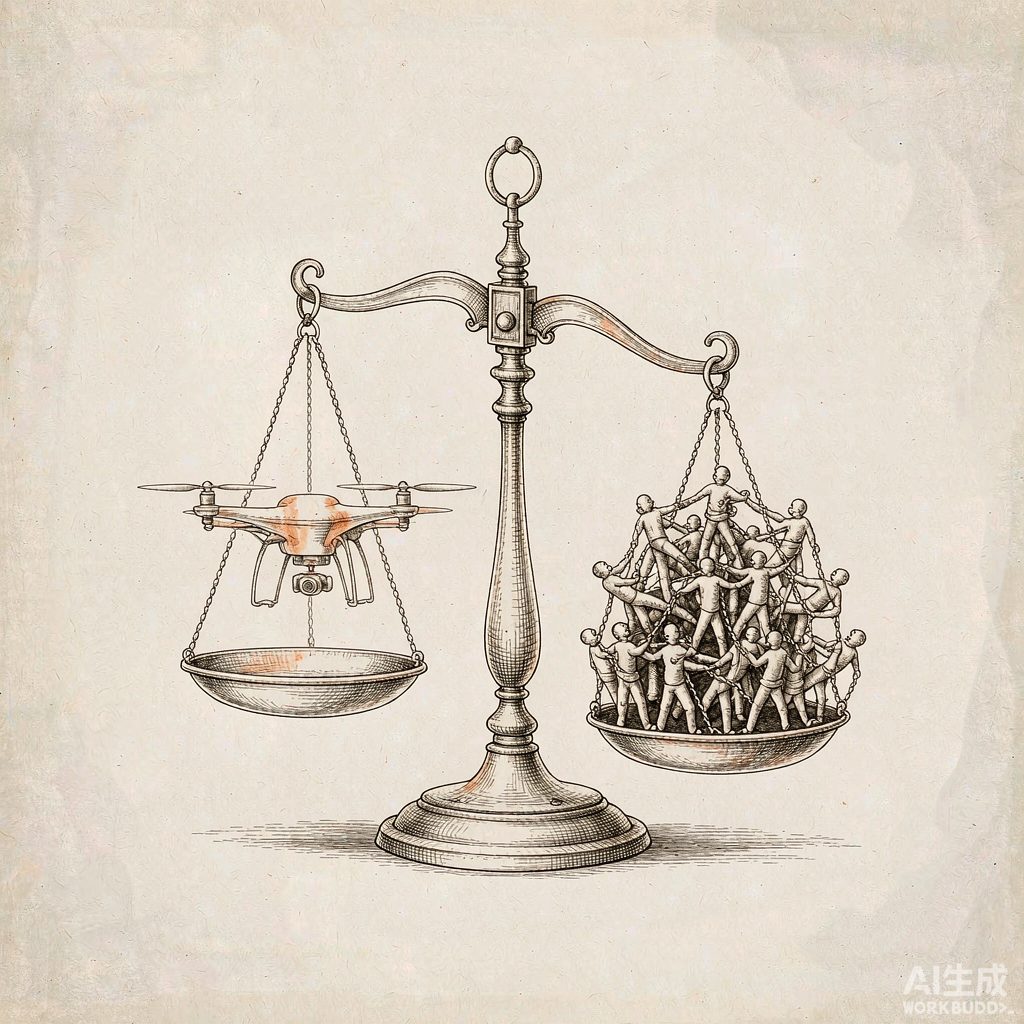
For me, making a product is a difficulty of 1; management is about 10.
Product ability was something he naturally acquired in his twenties, peaking from the start; management took half a lifetime to catch up on. From this he concludes: any banner held up by product power and innovation alone can sink into mediocrity in perhaps just five years.

Good things are all in the middle way—it is not a choice of compromise but a precise ability; hitting the bullseye with bow and arrow is the highest level.
This is his gloss on 'restraint at the boundary': DJI gave up building cars and chose 'not to be so large.' 'There are rules in this world that punish things that grow too large.' The middle way is not pleasing both sides but hitting the bullseye.
DJI's values are 'strive to the utmost, seek truth and integrity.' At first I thought only of 'strive to the utmost'—to win, to be number one in the world. But seen today, the four characters 'seek truth and integrity' matter more.
He reflects: the will to win of 'strive to the utmost' alone drives an organisation toward endless utilitarianism and involution, turning relations between people into tools and transactions. 'Seek truth and integrity' is the ballast—less political struggle, no amateurs managing experts, no managers indulging themselves.
I see the company as a system of continuous entropy increase, and management as a process of constant entropy reduction.
He coined a 'first cosmic velocity of management': only when management reaches 70 does the organisation enter a self-driving virtuous track; the gap between 50 and 70 is one 99.9% of companies never cross. He himself climbed from 30 to 65 over eight years.
Only when I got into it did I understand that management is simply not a simple problem. What hurt more was that some companies I'd once thought mediocre were more mature than us in management—at that moment I felt a sense of awe.
The arrogance of the product genius was knocked out of him lesson by lesson by management reality. This 'sense of awe' became the starting point of his transformation: from sweeping monsters away with one Monkey-King blow to the Tang-Monk way of chanting scriptures at them.
I don't like power. If I 'need power,' it is because I want to do this thing well, and that is why I need it.
He treats power as a means, not an end: when cleaning up a mess one must first establish rules and order, like 'Shang Yang's reforms.' Yet he also confesses that entrepreneurs are to some degree destined to be lonely—an equal relationship is what makes one happiest.
Everyone should just run their own race and not stick out a foot to trip others; but if an opponent comes at us, we will certainly strike back.
His view of competition: it is not life-or-death but a pursuit where you chase and I chase. Each of DJI's dozen-odd business lines faces a mature company; it is a game of Tian Ji's horse race—matching strengths against the right opponents. Yet he insists those who interfere with opponents don't run fast.

I don't need others to be loyal or obedient to me. What I want is loyalty to the right values and to the team's shared goal.
DJI, nicknamed the 'Huangpu Military Academy,' has sent off batches of entrepreneurs; his response is that talent belongs to society. Once he worked out 'I can just hire faster than they're poached, can't I,' the problem of retention turned from a zero-sum game into healthy symbiosis.
Average intelligence is worthless; only the delta above the industry average is worth anything.
This is DJI's core consensus on making products: one cannot rest content with industry consensus. What is truly valuable is always the part where you exceed the average—which is also why he scorns 'emperor's-new-clothes' innovation.

Product judgement is a bit like a neural network; some feel it by instinct, as fluently as speaking their mother tongue. Good design is never agonised over.
He says his brain leans image- and instinct-type: whether a design is good and why, he knows at first glance, with words only added afterwards. But instinct does not come from nowhere—it needs massive viewing and input, great artist steal.

Anyway, life can still be restarted, so within the time of a life you can actually restart a great deal.
In his silent decade he described himself as 'a soft-shell crab mid-moult.' Jung's line 'real life begins at forty; before that it's just market research' resonated deeply with him—the transformation unfinished does not prevent restarting.

What is freedom? Not being bound by wrong expectations. Wrong expectations are the greatest unfreedom.
He accepts human weakness, the grey zones of management, people leaving and people erring. The dialogue where Zigong questions Confucius gave him an epiphany: not judging others by a rich-or-poor frame is the higher realm—that 'click' moment of sudden understanding.
What is the most precious human quality? Not deceiving oneself, not packaging or romanticising oneself.
He reproaches his former self as 'quite proud, but in truth I understood nothing,' and warns against theinflated pride that calls innovation something conjured from nothing—'many seemingly great innovations are essentially a kind of borrowing.' To seek truth, begin with being true to yourself.

My ultimate pursuit in life is to discover truth and to live by it.
The truth he understands is the meeting point of the physical world, the conceptual world, and the world of feeling—commercially sound, settling into a healthy organisational order, and letting people find real satisfaction within it. The outcome is uncertain; the road is what gives it meaning.
- LatePost conversation 'Seek Truth, Gain Freedom, Live into a Story' (2026-04-09)
- Tencent News compilation 'DJI's Frank Wang in a Rare Deep Interview: 80 Key Points' (2026-04-09)
- Economic Daily 'Flying from the "Narrow Gate" to Vast Territory' (2017-08-10)
- Shenzhen University opening ceremony speech (2014)
- China Daily online exclusive 'DJI's Frank Wang: The World Is Unbelievably Stupid' (2016-09-20)
- China Entrepreneur 'DJI's Frank Wang: The World Is Unbelievably Stupid' (2016-09)
- Tencent Finance / Huxiu 'Frank Wang Speaks Out After a Decade, on DJI's Eight Years of Adjustment, Competition, and Next Steps' (2026-04)
- Securities Times 'Cracking the Code of DJI Innovations' Drone Ascent' (2014-01-29)
- U.S. District Court for the District of Columbia, DJI v. Department of Defense, judgment (2025-09-26)
- DJI official statement 'Drone Export Controls' (2023-08-01)
- Hong Kong University of Science and Technology (HKUST) related reports and public materials on Professor Li Zexiang (2003–2006)
- Statista Global Consumer Drone Market Report (2024)